Tom Palmer, Inker & Illustrator Career Interview by Alex Grand & Jim Thompson
· January 2, 2021 · by Alex Grand · Interviews
Read Alex Grand’s Understanding Superhero Comic Books published by McFarland Books in 2023 with Foreword by Jim Steranko with editorial reviews by comic book professionals, Jim Shooter, Tom Palmer, Tom DeFalco, Danny Fingeroth, Alex Segura, Carl Potts, Guy Dorian Sr. and more.
In the meantime enjoy the show:
Tom Palmer Sr. is an American comic book artist best known as an inker for Marvel Comics.
Alex Grand and co-host Jim Thompson interview Tom Palmer about his extensive career as both inker and illustrator starting at the Frank Reilly school, learning from Jack Kamen, illustration for advertising, encountering Wally Wood, then inking various Marvel comic book pencilers in the Silver Age like Gene Colan, Neal Adams, John and Sal Buscema, and eventually others like Howard Chaykin, Walt Simsonson, and Ron Frenz on characters & properties like Dr. Strange, X-Men, Avengers, Dracula, Thor, Star Wars, Batman, Wonder Woman and more. Learn about his first 1968 penciling job with Stan Lee plotter, Roy Thomas writer, and inked by Dan Adkins and move forward in time to inking John Romita Jr’s Kick-Ass. Tom was also friends with Stan Drake and gives interesting details of the car accident that killed Alex Raymond.
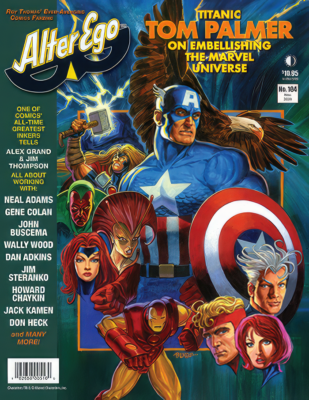
Tom Palmer interview conducted by Alex Grand and Jim Thompson was transcribed by Alex Grand and with Palmer’s approval, sent to Roy Thomas and published in Alter Ego 84, 2023. Tom was kind enough to send a high resolution scan of his Avengers art to Alex for use in Roy’s magazine which is the cover displayed.
📜 Video chapters
00:00:00 Welcoming Tom Palmer
00:00:28 Let’s start with your name
00:01:12 Family background
00:03:07 Reading comics | Green Lama
00:04:24 Early drawings – Jack Kamen, EC Comics
00:07:26 Jack Kamen
00:09:00 Jim Bama, Doc Savage
00:10:01 Bob Peak
00:13:04 Frank Reilly
00:14:53 Howard Pyle
00:15:41 School of Visual Arts, Art Students League,
00:16:58 Working at Lexington advertising agency
00:18:27 Frank Reilly School
00:23:10 Jack Kamen
00:25:55 Society of Illustrators, Joe Orlando, Tony Bennett
00:27:34 Wally Wood, Mike Esposito, Joe Orlando
00:29:04 Working with Wally Wood
00:32:42 Mike Esposito, Sol Brodsky | Got into Marvel
00:35:09 Were you following Marvel or DC?
00:38:15 Flo Steinberg
00:39:45 Doctor Strange #171, Dan Adkins
00:41:49 Doctor Strange #172, Gene Colan
00:47:34 Colan’s full-body figures
00:49:13 Clea’s hair | Stan Drake, Juliet Jones
00:51:58 Marvel before you join… you were the change
00:53:36 Stan Drake, Alex Raymond car accident
00:55:46 Doctor Strange #173
00:58:07 Captain America #113, Jim Steranko ~1969
00:59:44 Captain America #112, Joe Sinnott
01:01:58 Ink Neal Adams Uncanny X-Men #56-#65, 1969
01:02:53 Zipatone | Wally Wood, Marie Severin
01:04:53 Neal Adams’s approach to his pencils | Neal and I, or Gene Colan
01:06:45 Avengers-Kree-Skrull, John Buscema
01:10:07 X-Men #62, memory segments
01:12:53 How long would a Page of Ka-zar and the beast?
01:16:08 X-Men #64, Don Heck issue
01:18:24 Working on Avengers with John Buscema
01:19:17 Avengers #93 Ant-Man
01:21:10 Avengers #82-Daredevil, #83-Rutland Parade
01:23:18 Amazing Adventures #5 ~1971 | Pen Points
01:25:10 Inking Gene Colan on Daredevil and Captain America in Falcon
01:27:23 You or Neal color the X-Men issues?
01:30:09 You inking and someone coloring, do you feel frustrated?
01:31:29 Becoming Tom Palmer the inker
01:35:04 Tomb of Dracula #3-#70, Gene Colan
01:40:04 Tomb of Dracula B&W
01:41:10 Inking Gil Kane covers
01:43:23 Gil Kane Dracula covers
01:45:19 At the end of Dracula…| Marv Wolfman, Jim Shooter
01:46:55 Slap at Marvel? | Stuart the Rat
01:48:34 Man-Thing with John Buscema
01:49:10 Working with people, no one recognized it
01:50:46 Fun working with John Buscema
01:56:33 Dracula #8, #11-#18
01:56:26 Movies: Jaws, Lonely Hearts Club Band
02:00:22 Beatles’ double spread covers
02:00:56 Englehart: Clea, Ben Franklin
02:01:47 Nova 3-5, Ms Marvel #10, Hulk #213: Sal Buscema – Tom Palmer, co-artists
02:05:06 Thor #272-279 ~1978
02:06:11 King Size Spider-Man #14 ~1980 | Frank Miller
02:08:41 Star Wars, inking Howard Chaykin, Simonson, Ron Frenz
02:14:48 Star Wars #87, Noel Sickles
02:16:40 Star Wars painting covers
02:19:35 Avengers, Captain Marvel cover #225 ~1985 | Mark Gruenwald
02:21:38 You came in and closed out the series
02:22:28 Roger Stern
02:24:23 Deathlok-John Buscema
02:27:07 Ink Avengers for long time? | Archie Goodwin, Mark Gruenwald
02:31:38 Shift to DC
02:33:40 Back to Marvel
02:34:00 John Byrne | Silver Surfer #1 – 1982, Star Brand #11-1988
02:37:23 John Romita Jr. | Kick-Ass
02:40:40 Pat Olliffe, Scooby Apocalypse, Hanna-Barbera
02:42:19 Intense collaborations
02:50:47 You made a real contribution to Marvel
02:53:33 Back in the ‘40s – Jack Kamen
02:56:16 Alex’s bond with Tom’s characters & work
02:58:01 Jackson Guice
02:58:35 “they still make comics?”
03:01:24 What fascinated you early on, about comic books?
03:03:11 Current work
03:07:28 Wrapping Up
🎬 Edited & Produced by Alex Grand.
Thumbnail Artwork, CBH Podcast ©2021 Comic
Book Historians.
Alex: Welcome back to the Comic Book Historians Podcast, with Alex Grand and Jim Thompson. Today we have a very special guest, inker and illustrator, Tom Palmer. Tom, thank you so much for joining us today, and talking about your history and your history in comics.
Palmer: Well, thank you for the invitation. Looking forward to it.
Alex: We’re going to kind of hopscotch around different aspects of your life. Jim’s going to start at the beginning. Take it away, Jim.
Jim: Tom, let’s start… Actually, just even with your name, because when doing research, I would find where it would be, Tom Palmer but you… Did you change your name from your full given name? Are you Tom Palmer, legally now?
Palmer: Well, my given name is Thomas John Palmer.
Jim: Right.
Palmer: Thomas J, and in some financial or legal, I’ll sign John or J. But when I started… Well even when I was a kid, no one called me Thomas, even the nuns didn’t. But Tom, it’ll be Tom.
Jim: Let’s go back to New York in 1942 – you were born. Where did you live growing up? Which part of New York?
Palmer: Queens, New York, Southwestern, I was born in Richmond Hill, Queens.
Jim: And how long did you stay in Queens?
Palmer: Probably after high school. Probably in my early 20s, is when I left, yeah.
Jim: Now, I know that you lost your father at an early age. When was that?
Palmer: It was in the ‘50s. I was young… I can’t remember the exact year anymore, because I was young.
Jim: Was it before third grade and your hip problems or after?
Palmer: Oh, you know more about me than I realize.
[chuckles]
Well, he was still alive when I had my hip problems, yeah. Go ahead…
Jim: So, how many siblings did you have?
Palmer: I have one brother that was about eight years older than me. And but I had a bunch of half brothers and sisters that were old enough to be my parents, some of them. I have nieces and a nephew that was older than me. Can you imagine having a nephew or niece older than you? I have a niece right now, [chuckle] in North Carolina. She’s older than me. Because my father just had… His first two wives died, and then my mother was around, and was related to the second wife. And out of propriety and everything else, he just had a big family. I think there was eight or nine children in all, and I was the last one.
Jim: So, in the house, when you were growing up, though, how many kids were in the house? Because your brother was still there or not?
Palmer: Yeah, he was, but he was so much older. I remember I never played with him or… I got his comic books, though. I think that’s what…
Jim: I know… I was going to ask you about that, and that surprises me. So, you got his comics. Were they ones he had read when he was younger?
Palmer: Yeah, I guess so. And it was called the Green Lama I remember it’s one of the… I think I saved a few of them. He didn’t have any good first issue Batman from… I don’t think he bought Batman, but EC Comics. He had those.
Alex: What was it like the Mac Raboy Green Lama stuff?
Palmer: That’s right.
Alex: Oh, wow. That’s awesome. That’s good stuff.
Palmer: Yeah, yeah. So, but I really didn’t get caught up in it. I didn’t go out and start buying those comics. But then when I did go out, the EC Comics would grab my eye. I was kind of a young yet but Wally Wood, Al Williamson, (Frank) Frazetta, I think that was my first really… Oh, and I get the newspaper strips. I didn’t get Flash Gordon… Yes, I did, I’m sorry. But this is after Alex Raymond. And I didn’t care for it, if it wasn’t Mac Raboy, I didn’t care for it. But Hal Foster on Prince Valiant… Oh, I saved every Sunday… poof, I cut that out.
Jim: So, when you developed those problems, you were in crutches from like third grade up until almost high school, for like four years or so… We’re you staying inside a lot. I know you were drawing a lot. That’s when you really started to begin to draw and focus on that. And on comics because you were drawing your own comics, at that time, even as a kid, right?
Palmer: Yeah, yeah. I guess I sat around a lot because I got heavy. But I did go out. And it was good that my mother…
[00:05:02]
I don’t know if my dad was gone at that point. He passed away when I was on crutches, but it was on a few years after that. But I used to go out on crutches and walk around, get into… Not into trouble. But you know, I’d sometimes trip and fall, and people would go, “Awwh…”. But I get up. I was like a stunt man.
[chuckles]
But I was young, when you’re a kid… And I got off crutches in the eighth grade, luckily, just before high school.
Jim: And so, when you were drawing while you were in crutches around there, you had this archive, basically access to, of your older brother’s comics. And you were you were getting to know, at that point, artists like Wally Wood, and which other EC artists were you drawn to?
Palmer: Jack Davis, Al Williamson, and I should say, [chuckle] the one EC artist, maybe I’m jumping here… We can always go back… The one guy that I kind of… Is Jack Kamen, I was doing him more…
One of the studios, the last studio I was in… I was bouncing around in New York, in studios, advertising studios. And there was one on Madison Avenue, and I went for a job there. And I don’t know if they were going to take me or not. And I look over and I see… And the fellow that owned the studio said, “This is our illustrator Jack Kamen.” I said, “Jack Kamen? EC Comics?” He turns around, he says, “Yeah”, it’s like a voice out of his past. Well, bank back and forth with the guy and he says, it was just the fact that I knew Jack Kamen. And I was there a couple years with him. Jack sat not that far away from me at the drawing board.
So, the EC comics had a big connection in my life.
Alex: Could you recognize Jack Kamen with his pipe? Is that how you recognized him?
Palmer: No. I just… Well, in the comic books, they had a biography with a photograph. I knew the photograph. But when he said, “Jack Kamen”, I said, “Are you the Jack Kamen from EC Comics?” It could have been somebody else. Because he looked like… He always looked the same, I think. Even back when he was younger. But I don’t… He wasn’t smoking a pipe in the studio. I don’t think they allowed smoking…
Jim: I have pages of Jack Kamen questions to ask you. So, we will get to that in a few…
Palmer: Okay, yeah.
Jim: I think he’s very important obviously, to your work, both in terms of how you got in comics, in terms of your contacts, but also in terms of molding you. I got the impression, not just as an artist, but also as a person.
Palmer: Very much so. I think in that period of time, well even before, I was always looking for a father figure, because I’d lost my father when I was like… Trying to think… How old was I…? I was young. And I… When, you really need a dad, and I didn’t have one. And my brothers were older, and on their own. I have a half-brother; he had his own family.
So, Jack was somebody who I was really drawn to… And he was crippled… Not crippled, but he was laid up when he was a kid also. I think he fell off a bus or… It’s something, I don’t remember the whole story. So, there was a connection, between the both of us, and I don’t know what he was doing during that time… Maybe the same thing as I was, drawing. Who knows?
Jim: And he had had kind of a mentor relationship himself, hadn’t he? A person that he looked up to?
Palmer: Did he have one?
Jim: Yeah.
Palmer: Not that I know of…
Jim: Or maybe I’m thinking of Frank Reilly.
Palmer: Oh… Yes, that’s a real father, Frank Reilly… [overlap talk]
Jim: Let’s get through high school and then we’ll go to that.
All right, so you’re reading books, you’re also aware of illustrators at this point too, not just comic book artists. People like Jim Bama. I think most people know him as the Doc Savage artists. How was it that you had become aware of Bama?
Palmer: The paperbacks, Doc Savage and a few others. But before Bama was Norman Rockwell. I wanted to be Norman Rockwell. I even wrote him a letter when I was in high school. And I went up to meet him, up in Stockbridge, that was a big deal for me.
Jim: Oh, wow.
Palmer: Yeah, went up. I mean, for him to say, “Come up”. Imagine today, just having a stranger come in to your… I don’t mean during the pandemic, but I mean, just in general. There may be a lot of kooks out there… I don’t want to get too far ahead of myself, when we get to Reilly then I’ll explain further about Rockwell…
[00:10:01]
Jim: Okay… And then let’s talk about, you had listed in some interviews, you talked about Bob Peak too, which I don’t know if he’s a household name with everyone. But he’s most known for his movie posters, starting with West Side Story.
But for comic book type people, there’s the Superman posters, and Excalibur, and Star Trek, and maybe most famously, for a lot of people, the Apocalypse Now poster. Was it the film work that you noticed? Or was he was doing commercial stuff before that?
Palmer: Commercial stuff, advertising also. But his work had a comic book look to it. It was a line, the butt and the basis of his artwork was line. All the different ways he drew and then painted over it, did all sorts of things, pastels and all that.
Jim: I was looking at one of his art books yesterday, preparing for this. And I was struck by his faces in the drawings because they… I saw some of you… Is he an artistic influence as well, or just an interest? Because it seemed like he was an influence?
Palmer: I never really looked at his work to copy it or use it as reference. I really didn’t. I think what I liked was his color, when he used it. Maybe that was an impression on me. But Bob Peak, just looking at his work, it would inspire you to do something. So, I think a lot of artists in comics are attracted to Bob Peak.
Jim: Now, did you ever meet him?
Palmer: Yes. Well, I’m a member of Society of Illustrators, and I would see him up there. But I got really to know him, I was in a studio in New Jersey later on, and the owner there was having a New Jersey Art Directors’ Dinner, whatever. And Bob Peak was going to be there with his agent, and they’re going to show slides. He was trying to get work out in Jersey.
And I went, and it didn’t work out too well for him, because the people weren’t aware of who he was. I think he was at the other end of his career where… A lot of artists were getting hurt by the photography and the… You didn’t have artwork… It hurt me too… They didn’t use artwork for advertising, and that’s where you made money. And that was hurting him.
And he had a bad time… After he got off the stage, he went to the bar, and I went and followed him. And that’s where we got to talk a little bit. He was banging them down too. I think he was just frustrated.
[chuckles]
But he was… I think he had a very good time. But I can say, I met somebody that I… It’s like meeting Norman Rockwell.
Jim: So, you got to meet most of the real hero artists, when you were young, when you were growing up.
Palmer: I met Jim Bama too, because he was a student of Reilly. Frank Reilly.
Jim: In fact, didn’t you know that when you apply to the Reilly school, that that was a point of interest for you?
Palmer: Well, at Illustrated I met… Well, I don’t want to hurt, or I don’t want to say anything, bad words [chuckle]… I went to the School of Visual Arts, originally. This is right out of high school. And I want to learn how to paint, and they didn’t have a very structured painting course, and I got tired of it. And I left.
And I happen to meet this illustrator, in my bouncing around to the studios and he said, “I heard about this famous teacher, Frank Reilly, and he opened a new school. His own school up on 57th Street. And when I went up there, on the walls were… I never heard of Dean Cornwell. I never heard of JC Leyendecker… That’s when my head – poof, exploded.
But there was work by Jim Bama. And I said, “Jim Bama…” It was also in his catalog, Jim Bama, and he was a student there. He left around 1950, so it was a few years earlier. He’s been around. He’s still out in Wyoming, I believe. He’s still working out there. But I just loved his work. But it’s too tedious for me to emulate. It’s just, I like something more brushy.
Jim: Right.
Palmer: He, for me, works hard. But his coloring… And what Reilly taught is the important part, the hue, value and chroma. That’s what made the difference in helping you learn how to paint.
Alex: Wasn’t Howard Pyle also an influence on you in some way?
Palmer: Howard Pyle was the original American Illustrator.
[00:15:00]
I mean, he was the father of a more… I knew his name, and I really didn’t know who he was until I got to Reilly’s. And he would refer back to him, because there was a certain, things you’d write about illustration that I’d gone through that Pyle school, you had Harvey Dunn, you had Dean Cornwell. There’s another one, Wyeth, Andrew Wyeth, the father, N.C. Wyeth… So that’s what Reilly picked up on, and went with when he worked on a painting, that he brought something to it beyond just the thought… Go ahead.
Jim: But before we get to Reilly, you’re at the School of Visual Arts. Now, in some of the pieces I’ve read on you, there’s also the mention of the Art Students League. And I know Reilly taught there. A lot of people went in and out of there in some contexts. I’m not sure with that… Can you talk about that for a minute and what was your association with that?
Palmer: It really wasn’t. Reilly…
Jim: I didn’t think so either, and yet it pops up in places. So, I wanted to put that to bed. That was just a place where Reilly lectured sometimes or…?
Palmer: I think he had classes there. I never knew of Reilly before, this illustrator said, “There’s a teacher, Frank Reilly.” Never knew about him. Then I realized he took over for George Bridgman at the League, Art Students’ League. Back in the ‘40’s maybe, I’m not sure. But he was really good on those basics in drawing and painting. So that’s where he was, and maybe that’s the connection. If you look at…
Jim: Yeah. He’d been there. He taught at Pratt or lectured to Pratt. I mean, there were a lot of… He’d been in a lot of places, I guess, before he started his own. But I didn’t see any connection with you. So, I’m glad we got that worked out.
At the same time that you were going to night school at this School of Visual Arts, you were working at a Lexington advertising agency. Was that like an internship? Or did they just not give you any work to do? I know you weren’t happy there.
Palmer: Well, I didn’t stay long. I was going to Reilly at the time. I think I was done with Visual Arts, but it was on. It was in the Graybar Building, and it was right on Grand Central Station, this agency. And it was the entrance into the business – I was the gopher. I learned the ropes. But the best part about them, and being in the next studio, was that I would be sent out to pick up the work. And one of the art directors there said, “The best thing to do when you are with the art director or the agency, whatever the person, when they’re telling you what to do, if you have any questions in your mind. Ask them. Don’t hold back, because we’re going to ask you the same questions.”
And just going, and presenting myself, I had to wear a tie and a sport jacket, it was something that I was not taught in my growing up, in my teen years. It was a subtle way of bringing me up to speed in Madison Avenue, whatever. Advertising and business, was really professional in New York at the time.
Jim: Now. when you started studying under Reilly in the school, how many teachers were there? It wasn’t just Reilly. About how many teachers? How many students?
Palmer: Well, I don’t know. There was not a lot of… I was going there nights, so that’s a different time. I was never there during the day. It was only Reilly but he had monitors in his two classes drawing and painting. You had to draw, you had to be in a drawing class for a while before you could go to the painting class.
And the monitor in the painting class, in the time I was there, is a famous guy, Roger Kastel. I don’t know if you know the name. He painted the Jaws poster; the famous Jaws poster and that artwork is lost. And he painted The Empire Strikes Back for… He painted other posters also, but he was an illustrator doing work.
At the time he was at Reilly, I think he came to Reilly, and he used to go in the evenings. I don’t think he was there during the day. And because he knew Reilly very well, and he obviously didn’t have to pay for anything, but we would watch what he was doing, and that was a lesson in itself.
On Thursday night, Reilly would have a lecture, he’d talk about something specific. But each night, he would have us go through the phases of doing a painting, a figure painting. You started with a wash, and then doing everything else. Putting out your palette or whatever. But you watched what Roger was doing. And that was as good as having Reilly there, because it was of Reilly palette.
[00:20:03]
Jim: Now, I had read that Reilly didn’t touch a brush, for demonstrations, that he thought that it was more about being a teacher than learning how to… Than just painting in front of students.
Palmer: That’s true. Yeah, no, he didn’t want you to paint like him. He wanted you to get the teaching, the what he knew from him, about painting, about color, and everything else, compositions.
Jim: And he had a very, would you say it was a scientific approach?
Palmer: Well, some people used to call it… I remembered, the first time I was in the Society of Illustrators, when I became a member, and they’d said, “Oh, where’d you go to art school?” I said, “Frank Reilly.” They said, “Oh, the mathematician.” And I went, “What? The mathematician?”
[chuckles]
If you know anything about Reilly… It was all values, nine values and the chroma, you had all these numbers going out for the chroma, but it was hue, value, chroma. And that’s why people say, “All the numbers.” But I mean, when you first go into Reilly, you had a house next to a road and you had a tree. And you had to paint that in sunlight, cloud, and at night. Three different… And you did them in values, and he told you the values. He had Reilly grays in tubes, Grumbacher had them. And that’s what sold me. It’s so much like filling in the numbers… You painted it, and you look at it, and it works – day light/ sun light, cloudy day, and at night.
Advertisement
And that’s what sold me… I said, “Holy smoke… That thing you can… That’s a real lesson.” And there’s a lot of things you learn from that. And that was, I think the basis of Reilly’s… I think that’s how he caught you… Well not caught you, but how he got your interest. So, after that, when he was speaking to the class, he had a lecture, you understood what he meant. He was talking about certain things. And he has some terrific students that came out of his classes, fine arts students, not just illustration guys.
Jim: And in terms of people that the comics community would know, I know Basil Gogos from Famous Monsters of Filmland.
Palmer: He was early on. Yes, he was back like Bama’s time. Yeah. Well probably a little after that… The only reason, I probably would’ve gotten longer to Reilly, but he had a brain tumor; he died.
Jim: Yeah.
Palmer: Back in ’68, and that kind of… ’67, ‘68. And that’s when I… Anyway, I’m getting ahead of myself. But that’s when I kind of moved on out of going to school. I probably would have gone longer with Reilly.
Jim: The school shut down. Right?
Palmer: Yeah, they tried to keep it, but they couldn’t. Reilly was the core. He was the backbone, so to speak, of the school.
Jim: And that opened up your comics opportunities, and I’m going to get to why that was in just a minute.
Let’s go to the other major influence, besides Reilly, was with Kamen. And you had changed jobs at that time, and you took a freelance studio drawing board position at a Madison Avenue advertising studio, right?
Palmer: Yes.
Jim: Okay. And you noticed Kamen sitting there, and then how long did the two of you work together?
Palmer: Wow… Gee… more than a couple of years. I really don’t know the… It was maybe three, four years? I don’t know, three years maybe. I don’t remember that part. I don’t remember that part only because there’s a blur there. There’s so many things that were going on… I don’t know if you want me to jump to that now… What I learned from Jack, was watching…
He’s a comic book artist, but he was rounded. He had Harvey Dunn as his teacher. And Harvey Dunn is one of those Howard Pyle students in a row. And I would watch him he was doing truck ads for; I forgot the name of the truck company… Mack Truck. And how he would lay this thing out, and how he had a very odd way of painting. He would put down a base with acrylic, and then he would use Prismacolor pencils, and use that all over. And then he would use an ink eraser, the motorized, and he would then blend it with this abrasive. Here I am, going to school with Reilly and [chuckle], trying it with brushwork with all the different types of brushes.
[00:25:01]
But it was just… Someone asked me once in an interview, what I’d learned from Jack? Not how to paint but how to work, how to set it up, how he would get a layout from somebody, and he would have a photo stock made, and make it larger. He never worked the same size. But he made it sure that you fit that size in that area.
And sure enough, that’s what happened going out on my own. Is that art directors wouldn’t tolerate that if you… You had to know what you were doing, at least on that basic level. And that’s what I learned from Jack. The last thing, I learned how to be an artist in an odd way. I mean not in an odd artist… But in a roundabout way, I should say, how to be an artist.
Jim: Now, while you were there with him, he sponsored you into the Society of Illustrators too, right?
Palmer: Correct.
Jim: So, he really took you under his wing in all kinds of respects.
Palmer: Yep, they have to sponsor… And just, this is a quick jump forward, one night I was in art school and I saw somebody here, again from EC. It was Joe Orlando sitting in the front row, sketching. And I knew him again, from the comic books, you know, the bios they did. So, after the class was over, I went over and, “Are you Joe Orlando?” He said, “Yeah”… Same thing, we got to talk. “I’m working in a studio, with Jack Kamen…” “Oh.” So, we became buddies.
He was great. When he was the head guy up at DC, I was getting work from DC and everything else. But anyway, Joe… [chuckle] I was at the Society of Illustrators’ with him, and I think he came on my… You have to bring somebody; you can’t go there yourself. And he saw Tony Bennett. And he said, “Oh, I went to high school with Tony Bennett.” I couldn’t believe him, and I said, “You know, Tony Bennett is a member.” “He is. How do you become a member?”
So, I could sponsor Joe but I got the forms, filled them out, and I gave them to Jack Kamen. And Jack Kamen sponsored Joe. And Joe lived at the Society of Illustrators. Yeah, because he lived in the city at the time. He had a place upstate, but he loved the Society of Illustrators. I don’t know if he was waiting for Tony Bennett to come in again.
Jim: Oh, that’s great.
Palmer: Tony Bennett was a member. He was and is a painter. He’s still around. Anyway, that’s the sidetrack.
Jim: Now, let me skip and follow up with something on that. The way that I’ve read the story was, when you went to Wally Wood… And we’ll talk about that in a few minutes… But when you went to Wally Wood, that he’s the one that sent you to Joe Orlando. But you already knew Joe Orlando. Is that right?
Palmer: I’m not sure if that’s the course… I think… That may have been later. That I can’t put together… Wally… I shouldn’t say Wally. We call him Woody.
Jim: Yeah.
Palmer: He sent me to Joe or… Mike Esposito. And he knew Joe Orlando. But Mike Esposito, I did some backgrounds for Mike Esposito. Then I did some backgrounds with somebody else and I was doing backgrounds. But just, they’d give me a page. I wouldn’t do the whole comic. So, I did the backgrounds…
Jim: Right. I think that this story has been a little bit mixed in because they have, that you went to Wood, and he sent you to Joe Orlando. And then Orlando sent you to Esposito. It sounds like maybe that’s not exactly what happened.
Palmer: Now, I never did work with Joe Orlando.
Jim: Right.
Palmer: He was always… Once we became friends, which we did early on. We remained, to the end of his days.
Jim: Okay. That’s helpful. My understanding is that you asked Kamen, repeatedly, to connect you with some people; you wanted to do comic book work. And that he wasn’t helpful at first, because he wanted you to stay studying under Reilly. That he encouraged you to stay to keep your art studies going first.
Palmer: Right, and when Reilly died, that’s when Jack relented. Yeah.
Jim: Because you didn’t have the school anymore, so he said, “Okay”, and that’s when he called up Woody Wood, and said, “I’m sending somebody for you to look at his portfolio.” Is that how it played?
Palmer: Yeah. I guess. Yeah. And it was up on 86th Street or something.
Jim: Now, was that his studio that you went to or his apartment?
Palmer: His apartment, his studio, had one of those… I always think of The Odd Couple – when you see the movie, those big cavernous apartments that Walter Matthau and Jack Lemmon had.
[00:30:06]
Jim: Yeah.
Palmer: Wally… Woody, I should say, had the same thing. He had a big Artograph that you put up on the wall. You can only have one in a very large studio or a large apartment like that. He had me working on that a little bit too. So, I learned how to make an artograph. He would have automobiles, or people, or whatever… He would project it down in a kind of pencil form, in an odd way. But no, he wouldn’t be penciling, he would be drawing rough sketches of things. That’s all he needed. That’s how he worked.
Jim: That’s it… So, when you went in, how long did you work with him? Or how many times were you there?
Palmer: I penciled something for him. And I…
Jim: The Jungle Gym story.
Palmer: Yeah… The first I ever penciled; I should say. The first, yeah. I always say it’s Doctor Strange… But it was six pages, I think… Four or six pages.
Jim: And this is a Charlton comic.
Palmer: Yeah. Yeah, I have the comic… Look, if you see it now, you’d just say, “No, Wally Wood did that, when he [chuckle] inks something, it became him.
Alex: So, with Wally, this was in 1967, he had some involvement in Tower and T.H.U.N.D.E.R. Agents around this time. Did you notice, just behaviorally, any mental health issues with him during this time?
Palmer: No, I he was my… You know when you have somebody in your life that, when you were kid… Wally Wood was the king. He was the guy I wanted to be… I’ll just say, after I met him, I wanted to do what he did but didn’t want to be him. You know what I mean?
Jim: Sure.
Palmer: He was a very talented artist, unbelievably so… What did Bill Gaines call him? A tortured elf. I noticed that about Woody is that, in many ways, I think we all are, he was childlike. And he got caught up in things, his demons. But he was just… I think he’s the only science fiction artist that I know of in the comics, at least, that stood out the way he did.
He was just inspired, the work he did. And I just…
Jim: Yeah, and those EC stories that he was doing on those two series were just amazing.
Alex: And I do love his Galaxy Science Fiction digest illustrations. They’re beautiful.
Palmer: Yes, yes.
Jim: Now, could you have stayed and work, and assisted Wood, if you’d wanted to, but instead you went to Esposito in DC?
Palmer: Well, I only went a couple of times, on the dates he’d asked me back… I made the mistake of, I’d be working on a page, I’d be inking a page he had already worked on. And the pages were coming past me… There’d be a couple of the guys there. And I started to tickle up the faces, and he exploded. He just [chuckles] and sort of boding, “Do not do that.”
So, I think he found that I was more of a hinderance than a help with… And he didn’t say anything beyond that. I don’t know if he had me back anymore. But I stopped going up there. But I didn’t need him then. I don’t want to say I didn’t need him anymore, he kind of gave me… I think it was Mike Esposito… And then Mike Esposito… Oh, I forget the other guy’s name… He’s from that era.
But one of them played poker with the group from Marvel…
Jim: Yeah, it was Esposito played with Sol Brodsky.
Palmer: Yeah. Sol Brodsky was at Marvel. Yeah, they used to play poker. And Roy Thomas, I think, was in the part… But Sol Brodsky… And Mike said, “Hey, I got this guy.” and I was doing some work for Mike, the backgrounds. But that’s how I got up to Marvel. Sol Brodsky.
Jim: And so, who told you? Did Mike tell you, “Sol’s interested, you should go to Marvel?” Or who contacted you and said, “Come on up.”
Palmer: Who contacted me? I don’t know, that was so incidental. That was the connection, because, all of a sudden, I was up at Marvel, showing my portfolio. And I think the portfolio, having only penciled six pages in my whole life, and the rest of it was advertising work and whatever, I forget what I had in that portfolio. And they wound up giving me, especially, they figured I worked for Wally Wood, that Doctor Strange #171, I think.
[00:35:04]
Jim: #171, and I’m going to let… Alex is going to take over at that point. I just want to ask you, in terms of you going up to Marvel?… Had you read…? I mean, I only knew you in terms of the EC comics and stuff. And then you got into art school and things. But were you following comics at all, at this point?
Palmer: Yeah. I’m admitting it now. I’m not admitting it when I was asked before. I was not a follower of Marvel and DC, at that point, the comics. I was looking elsewhere, at illustrations, more of paintings, paperbacks, the men’s magazines, Male Stag… That’s where Bama and a bunch of other guys… Another guy that was a Reilly student was there doing work with them. And that’s were guys kind of went – into that field.
So, I didn’t know who Jack Kirby was.
Jim: I was going to ask you, Kirby and Ditko weren’t big names to you.
Palmer: [overlap talk] All the names that were… I guess, none of them. None of them. Back at that moment… Good people that came in after that, and then I knew of them. But I don’t want to get too far ahead. But I think that’s when the other part of my career opened up, it’s when I was working… Roy Thomas was writing the Doctor Strange and within a short period of time, he had me doing some other work.
But he had a party up on a… He lived on 86th Street, on the East side. And it was a big party, even Stan Lee was there, and Wally Wood, and blah blah blah. Gray Morrow… And he introduces me to Neal Adams, and… Oh, geez, I forgot the other guy. Just out of my head, one moment. [overlap talk]
Jim: Steranko?
Palmer: No, no, no, no. Anyway, it’ll come to me.
Alex: What, Gene Colan?
Palmer: No, no, no, no. Woody…
Alex: [chuckle] Name that artist. Yeah.
Palmer: Bernie Wrightson. Bernie Wrightson… And it was terrific. I think that’s how, what led to Neal and I working together. I don’t know, because Roy was writing the X-Men. But that was… I’m giving you really these little landmarks, that kind of took me in different directions. All of a sudden, I wasn’t worried about doing paintings for the men’s magazines or doing the Saturday Evening Post cover, like a Rockwell.
I always loved comics, but it was hidden. It was a latent thing. It wasn’t something that was on the surface. And that really drew me in. I think being able to color that issue… I was still getting started in coloring. I thought that would really disturb me – putting a lot of work into the inking, and then they would hand it to somebody, and had no clue, because they paid nothing. They paid like $2 a page. So, you did it out of the love for the comics and you want it to look good. And I wasn’t the only one. A lot of the guys after me were doing it as well.
Alex: So then, now Sol Brodsky was your entrance into Marvel and you’re talking about the parties and meeting people. Was he the one that then gave you the Doctor Strange #171 assignment?
Palmer: You know, I don’t remember, either Roy Thomas was there… I remember meeting Roy, John Romita Sr…
Alex: I see. It could have actually been Roy then. Okay.
Palmer: Yeah. It was a very small group.
Alex: Very small group.
Palmer: I was told, somebody, I mean, it was a riot. Stan acted it out – the plot, for me in his office. And his gal Friday was… She took notes for me. She took Cliff Notes.
Alex: Yes.
Palmer: I couldn’t remember. I just stood there. I couldn’t believe there’s Stan jumping on the couch and everything else. But that’s the way he gave plots out to the artist, was by phone or once in a while, I guess, they’d come in. But after a while, I guess he’d call up Kirby and just say, “Yeah, have Captain America doing this, or whatever.
Alex: Right. It was like more verbal. It was verbal, not written, really.
Palmer: And then the script was written after that.
Jim: So that was Flo Steinberg that gave you her notes?
Palmer: Flo Steinberg, yes, yes. Yes, she was the one I… She had stood behind me by the door. She was fantastic… She only passed away the last couple of years. I’d go into Marvel even years later, I saw Flo… And he kept her on. She proofread, and everything else.
Alex: And you were inked by Dan Adkins on that issue? Is that right?
Palmer: Yeah. And he saved me too, because I didn’t know who Doctor Strange was. [chuckle]
Alex: Yeah, so you hadn’t seen the previous issues.
Palmer: No, no, no. [overlap talk]
[00:40:00]
Alex: There’s this like double paged spread in that issue that I think has been in posters, or people have admired it a lot because it’s so wonky. There’s like this trans-universal cosmic dimensional stuff. Did you put those patterns in there?
Palmer: Oh yeah, but I ripped off an illustrator that did something, a pop art thing. And I don’t remember… I say ripped it off obviously, not with that Doctor Strange. But those, that was a period of time in the ‘60s that you know what was going on, and everything else. It was the pop art.
Alex: Pop art. Yeah. So, you looked at some pop art stuff for that spread.
Palmer: Oh, yeah, for that spread, because I needed that spread, and that was kind of laid out.
Alex: And then when you say Adkins saved you, you mean like, was it – were you doing more breakdowns? Or were you actually trying to illustrate those panels?
Palmer: Oh, I was doing tight pencils, but they weren’t comic book pencils. Plus, I didn’t really know the characters. They gave me work with comics that had been done by… But you don’t really know a book, unless you’ve been on it for a while.
Advertisement
Alex: So, you mean like for example like Stephen Strange’s face, maybe he changed it or altered it a little bit?
Palmer: Yeah, because when he got done… He spent a lot of time with Wally Wood – Dan Adkins.
Alex: Yes.
Palmer: And I think he picked that up, not that he worked like Wally Wood, but he made those pages I penciled, more like his work, preceding me. He was penciling and inking the comic book before me. I don’t know how many issues.
So, I … Pfft… have no regrets on it. I still got seven pages back on that. No, I’m sorry, I didn’t. I didn’t get anything back. I didn’t get anything back. I think Dan got all the pages back.
Alex: Oh, I see… So now, you said you weren’t that thrilled with that issue, looking back on it? Is that right?
Palmer: No, that one wasn’t bad. It was the one that I inked.
Alex: Okay.
Palmer: The following one, #172 was the one that I inked.
Alex: Uh-huh, yeah, because then you were inking Colan after that.
Palmer: Yes, that was the first issue of Colan and me. It was the first time I worked with Gene Colan. I didn’t know what comic book pencils was supposed to look like. So, Gene Colan had this… People had a problem doing it, but they said that I used to draw into the shadows. You know, you find something in the shadows, you can’t just make everything black. Because he looked like he made everything black and it wasn’t.
And Gene was terrific artist. He was a terrific artist. He could have been an illustrator… He was an illustrator, but you know what I mean. He wasn’t somebody who took a pencil and drew by the point of the pencil, he used the side of the pencil on everything else.
Alex: So, who then decided, “Okay we’re going to have you ink, instead of continuing to pencil.” Do you remember that?
Palmer: No… I think I just wasn’t ready to do.
I really never talked to him about… Maybe Roy will say something once…
Alex: Maybe, Roy. Okay. I got you.
Palmer: Yeah, but maybe my drawing was okay, but my storytelling was terrible. Because I knew they discarded a page… And I’m trying to figure if they’ve filled it in. I’d never kept track to that. But I’d gotten that page back. It was kind of… It wasn’t badly done, I don’t think. But I don’t think it fit the story. It didn’t tell the story. And that was the thing that you had to do, especially with Stan – is tell the story. [overlap talk]
Alex: Right. Like the layouts have to push the story along.
Palmer: And I didn’t have enough experience I think, to have them carry me along. And they asked me to ink, and I’d never inked a comic book before. And I said, “Sure.” I never turn down work. You’ll never know… [chuckle]
Alex: Right. You’re going to do it. Yeah. I got you.
Palmer: I said, “Yeah, sure.” And I just did… But what I did was, since I didn’t know comic books, I used the instruments and the tools that I, what I knew when I did the advertising art. I was doing advertising art in line. But some of it was very boring and everything else, and some figure work and everything else… But I think that was the difference.
With Wally Wood, I was using Zipatone too. And people weren’t using Zipatone at that time, because Woody, this was way past the EC thing. I don’t think they knew what it was. Or craft tint, that was the other thing that I was able to use. Chemicals. And that was paying… Yeah.
Alex: Yeah… And the textures of gray shadow, like you’re talking about with Colan, it said that you use Zipatone and cross hatching on your inking to kind of follow where he was getting at, to kind of flesh it out, in a sense. And that you added, you potentially even add… Did you add some illustration lines to his ephemeral forms, as well?
Palmer: I’m sure. I didn’t follow. You really couldn’t.
[00:45:02]
If you followed Gene Colan’s pencil, you’d have a big black area, and then some, maybe a head, or a hand because he did work in black… It wasn’t even black, it was gray… He used a very soft pencil, and when you get up to 6, 7, 8B, that’s very soft. No one uses it because the point wears down. But it’s beautiful, lush, and they’re very silky blacks.
And when you get above HB, the only way you can make it darker is by adding clay to it. And your hands were black when you get done working on the pages. And I used to take a kneaded eraser, this is after me getting to know Gene’s work. And I used to just roll it like you would with rolling dough on it. People were saying, “Oh, you were erasing it.” And I said, “No, I’m not erasing it, I’m just taking all that clay off.” And it would reveal Gene’s lay-out, his drawing, his pencil lines.
Then he’d fill it in with the side of the pencils or something. So, what you saw was just a massive penciling. So, I think that’s why people had a problem with him.
Alex: Right, right.
Palmer: So, by me trying to get rid of the clay… I knew about the problem with the clay… I revealed something that, all would say, “Wow.” It was to my benefit. So, I didn’t follow every line. He wasn’t like… Neal Adams, I’d say. You don’t change lines on Neal, because they are there… Bam! You can add to them and make them, whatever, different thicknesses and all that, different treatment, but you don’t change. With Gene you sometimes had to, because he works so quickly, I think. But, again, he was just an artist, beyond, beyond the comic conversion.
Alex: On that first issue you did, there’s a double-page spread that has almost kind of a similar layout in Doctor Strange #182. And Doctor Strange is like fighting this sorcerer magic creature with like planets being thrown. It’s like a similar layout but the synergy with you and Gene. It really explodes off the page. It’s like a whole other thing is going on there.
Palmer: See, I don’t remember it. But if I have the book here, I’d remembered it and looked it up.
Alex: Yes. It’s pretty amazing though.
Palmer: Yeah.
Alex: And then, now this is also, we should say it’s the Doctor Strange with the mask on. Right?
Palmer: Okay, that’s when they wanted to make him like a superhero. Yeah.
Alex: Right, right. They were trying to make him like a superhero, exactly. So now, I looked also, there was an issue with Juggernaut that was in it, a Doctor Strange issue. And I love what you guys did with Juggernaut, like there’s this whole page of him just materializing out of this dimension. I mean, it’s incredible. But I noticed like sometimes, maybe in Doctor Strange more so, than in Daredevil and Captain America. But sometimes, when there’s a full body figure, there’s almost like a distortion to them. Did you find yourself having to try to normalize some of Gene’s full body figures, in a sense, or to make it more anatomically correct? Did that ever occur?
Palmer: I wouldn’t do that to Gene. There were things that I would… Well, not change but help out.
Alex: Help out.
Palmer: Yeah. If he was quickly doing something. But I’d never changed the anatomy or anything like that. But sometimes, the shadows on a face would look good in pencil but if you ink them, they would look grotesque.
So, you would just kind of have a work, if you know the dimensions of the head [overlap talk]
Alex: I also noticed like it depended in the Doctor Strange, if it was a magician Doctor Strange or civilian Doctor Strange. And it almost kind of shifted in style, artistically. Was that kind of stuff that you kept in mind when you’re inking that?
Palmer: No, I just kind of maybe… I don’t… A lot of it was just instinctive or just my natural approach. I really don’t know.
Alex: Natural approach. Yeah. And then, the hair, like if you look at Clea’s hair in these issues that you inked, it’s like lustrous hair, you see like each follicle of hair.
Palmer: Okay, well this is what I was looking at, at that time, it was a couple of strip artists. One was Stan Drake. Stan Drake. The [overlap talk].
Alex: Stan Drake.
Palmer: I’d wind up meeting him too at one time. We would have lunch together. and Stan Drake, Ken Bald… The stuff by Stan Drake, anything with women, I mean, he was just fantastic.
I remember Jack Kamen mentioning his name. I think I started using the same pen point as Stan Drake. But Jack Kamen was doing a lot of that line work himself, on that comic strips.
[00:50:03]
But the advertising, and he said, “Stan Drake was the highest paid illustrator in New York”, back in the late part of the ‘50s, with all the line work he was doing, and that’s… He was the first man in Manhattan with a Polaroid camera, when they came out. That’s what made The Heart of Juliet Jones look so good, and everything else. I mean just, so the whole strips changed. I had to get a Polaroid camera, and I started doing the same thing. I’d have a friend pose at something or whatever, a woman. So, I was kind of doing advertising. So, Stan Drake was one of the people that I would refer to. I had clippings and everything else.
I was not a brush man, Jack Kamen was. That’s all he did was use brush. And I just, I did work with a brush, but depending on the artist… On the Kick-Ass series I did with John Romita Jr. But other than that, I like the pen. So, when I got into the business, I realize how many people were doing brush. It was the Milton Caniff school, I guess, was part of that.
And I may have been getting ahead of things here but I think that’s what changed the comic books as it, because a lot of people were using pen, coming in behind me, and before me, maybe. I don’t know how many people were doing it. But the older artists, whether it was Wally Wood; he’d use the pen for his faces, eyes, but he was brush. Joe Orlando was brush. Jack Kamen, like I said. So, that whole era… And I think maybe that’s why comic books changed in the ‘60s, the later ‘60s, because… I’m thinking of Klaus Janson, I’d say, so many people, they started using pen.
Jim: Versus like Joe Sinnott, and George Klein, and that older school that so define Marvel, before you came really, because you were the change, I think.
Palmer: I never thought of that… Well, now I know Neal for a long time, he was working in Johnstone & Cushing.
Alex: Yeah, that’s right.
Palmer: He was in there too, and I think he picked up a lot from Stan. But he also brought that quality in to comic books. It wasn’t that far along, I just told somebody else about this recently. We were doing the X-Men. When I got the first pages from Roy Thomas, on the X-Men, and I saw a couple of things. There was an operating room or whatever, and there was something else. I had that reference in my clip file, the operating room, and maybe it was, oh King Fahyed something. And I had that reference, which meant that Neal was using that reference as he would, Johnstone & Cushing because they did advertisements on that. So, he was bringing that into the pencils.
Alex: Right. That’s his reference, physical reference. Yeah.
Palmer: It’s the first time I saw it, so that’s the first, my exposure to it.
Alex: I see. And that may have affected you as well, influenced you as well.
Palmer: Yeah, sure.
Alex: Yeah, Neal Adams, I see.
Now, you mentioned Stan Drake, wasn’t he the one in the car with Alex Raymond in that accident in the crash?
Palmer: That’s right… He told me that whole story over lunch that day. It raised the hair on the back of my neck. It must have been torture. He relived that day, over and over, and over, for years. Probably, lasted to his last days. And he told it in such a colorful, well not colorful but tragic way about that. I think he felt the guilt of losing Alex Raymond, being part of it, so to speak. But Alex Raymond was the one driving.
Alex: Right. So, there’s like a PTSD, from this experience.
Palmer: Yeah. It was Stan Drake’s car.
Alex: Stan Drake’s car. And did he indicate that he thought Alex Raymond may have done that on purpose?
Palmer: No, I’ve heard stories, only through… And maybe that’s why he told me straight out. He didn’t give me variations. It was starting to rain, and they were going on this curve. He knew that Alex was going a little bit too fast but he didn’t say anything. And when he made the turn, they just went off the road. But there happened to be a tree there. And when they hit the tree. I believe he lost one of his ears, at least, I mean the lobe was ripped off Stan Drake’s head, when he went through the windshield or whatever.
[00:55:09]
Alex: Oh, wow.
Palmer: But Alex Raymond was impaled on the aluminum, around this coupé Corvette. You know the first Corvettes, there was a big, thick aluminum chrome around the window. He was impaled, so when they found him, he was dead.
Alex: In his mouth.
Palmer: Mouth and neck, or whatever. But he was dead.
Alex: Yeah, crazy. I never heard that part of it. That’s amazing.
Palmer: That’s it. That’s a ghastly part, maybe you can cut that out. I don’t know. [chuckle]… Or maybe leave it in… I don’t know.
Alex: I think leave it in. That’s a good detail. Well, thank you for sharing that. That’s very intense. So then, with issue #173 of Doctor Strange you asked to also color the book. Is that right? Who did you ask that to?
Palmer: I just went in to Roy Thomas or Sol Brodsky and said… I think it was Roy. Roy was – I connected with Roy, and he was a comic book guy, and he was Marvel. And I said, “Can I color?” And he said, “Sure.” And he says, “Let me take you into Marie Severin. Marie Severin will give you this chemical color chart and all the bottles of Dr. Martin’s dyes.”
And she was so good. She opened the chart, she said, “Now, this color is beige, but you add water to it and this is the flesh, and this and this.” Gray was red and blue, together, and I’d go home… And they were all numbered charts. So, I said, “How long does it take you to do this?” Or how long does it take? She said, “Well, look at these, whoever is doing it, we can do at least a book or two a day, because it was only $2 a page, so you could make $40 a day if you were good, and had two books.”
I went back to do it in the apartment, Queens at the time. Three days later, I was still working on it. I was doing little watercolor paintings. [chuckle]. And I still remember the one that Doctor Stranger is levitating the book of Shanti, or whatever it was called.
Alex: The Book of Vishanti, yeah, something like that.
Palmer: Yeah, I remember, I was doing a watercolor painting. And when I took it… Palmer, what are you doing?… I was not getting paid for it but it was so much fun doing it.
Alex: Yeah, gratifying.
Palmer: Yeah, yeah. And also having all those colors because you had muted colors in the bottom rows, where all the colors were getting together. And then you had the bright colors, going up in the top. Everything bright, is nothing bright, so if you use the muted colors, you could make things bright. But anyway, I’m getting ahead of us, but are we going to say that’s probably Reilly and the painting part… [overlap talk]
Alex: Yeah, yeah, this is interesting because a lot of the inkers and comic people, it’s almost like they start from a cartooning background. But you’re different, you start from like an illustration background which is like a whole other thing, and that’s great.
So then, now, you did Doctor Strange all the way through the final issue of #183. You inked Gene Colan; Roy Thomas was writing it. And then there was also, you did one Captain America Steranko issue in 1969, Captain America #113. I think that’s his final Captain America. Do you remember that?
Palmer: Oh yeah, very well.
Alex: Yeah. So, tell us about that, because that’s like this one Steranko issue that you inked. First, how did you get that assignment? And what was your take on those pencils?
Palmer: Again, somebody recently asked me about that, a friend of his, as a matter of fact. I could tell he put a lot of time in on it.
Alex: He put a lot of time on it. Yeah.
Palmer: He put a lot of time in on it, and it was, everything was packed. It was so well laid out. I can see he must have done things over again; put them in, then changed them. He wanted to do the best job he could, and he did. I thought it was very well… The compositions were terrific, the drawings were too. And it took me a while to do. It wasn’t something that you just bang out.
And I thought I was going to get another one, but he was working on the next issue but I guess he was wasn’t getting it done in time, and they had to get those books out… and they got, I understand, Jack Kirby to come in, and do the next issue. I believe it is… I never really… Follow on those things.
Jim: Yeah, it was.
Alex: Yeah, yeah. Yeah, because yours was #113, that Jack Kirby fill in issue was #112. And then, the previous issue was Steranko but it was inked by Joe Sinnott, it looks like.
Palmer: Oh, okay. Yeah, Joe Sinnott did a wonderful job with Steranko. Yeah. [overlap talk]
[01:00:02]
Alex: So now Steranko, when I chatted with him, I think he was just… We were talking more about the Sinnott stuff. At the time, I was not aware that you had inked him on that one issue, but he had mentioned that Sinnott had elevated his work. Do you feel like you did something similar? Did you add stuff to that Steranko issue?
Palmer: It was so tight. I don’t think… I think I was more careful, when I saw things that were tight. I don’t know if… It goes back too far… It was at the very beginning of the game, you know.
Alex: Yeah sure. Yeah, it’s been a while [chuckle].
Palmer: They would throw stuff at me and see how it worked out. I did John Buscema. That, I fell right in to that. I was certainly got used, constantly.
Alex: Did you and Steranko, chat at all before inking that? Was he like, “Hey, I need it like this or what?” Or was it just, you got the pages and you just inked it, and that was it?
Palmer: It was a couple years ago, maybe five, six, seven… But there was a comic show over in New York City, Manhattan. Steranko was going to be there. I had never met him. And I asked somebody, “I want to go. I want to meet Jim.” And I did. We didn’t sit near each, I found out where he was in the convention area, and I went up to him. And he looked, I think he knew what I looked like… I kind of knew what he looked like.
Advertisement
But we become best of friends since. We really have.
Alex: Oh, that’s great.
Palmer: Yeah, really have.
Alex: Yeah, he’s a character I like him a lot.
Palmer: Yeah, he is.
Alex: And then a lot of people show those images of Captain America on the motorcycle flying into these HYDRA guys and Rick Jones’s Bucky, you inked that, and that’s pretty cool.
Now you’re talking about inking Neal Adams on the Uncanny X-Men that began in the spring of, 1969, and those were issues #56 through #65. He was kind of new to Marvel at the time, but had you already seen some of his DC work before that?
Palmer: Yeah, well when I started to do work for Marvel, now I started to go with the stands, the comic book stands. And I was looking at what other people are doing, and I picked up Marvels, I picked up, whatever. But I remember picking up… I think it was Deadman or something, something from DC…. Deadman… I don’t remember what else it was but I was aware of Neal but I didn’t put two and two together. I didn’t know he was the guy… Well, boy, it turns out to be. We were both working in Manhattan at the same time.
Alex: You’re saying that Neal’s pencils were very tight, very illustrative. That you didn’t have to add as much form to it like you had to on Colan. But you had also alluded to, adding a little bit of…
Palmer: Zipatone.
Alex: Adding some shading, or enhancing the form, is that right?
Palmer: What I do remember is adding some Zipatone.
Alex: Zipatone.
Palmer: Yeah, yeah, where I think it needed it. And you’ll never see anything about… You know That’s the part how Zipatone came into my life, I think. I said, “I always wonder why Wally Wood’s pages, in the comic books, looked different; the coloring book different. And, what it was, was there’s this Zipatone underneath it. Marie Severin was coloring and all those issues, you know?
Alex: Yeah, yeah.
Palmer: She would end up at Marvel. But right over that, maybe a 10 or 20% Zipatone was different than the red without Zipatone. And you couldn’t get that subtle difference with the limited color you had. So, you used percentages. You had to keep it simple, yellow, red and blue maybe worked, while you couldn’t do with browns and everything. Well, I guess you could but it didn’t work out the same.
And that’s what fascinated me, so there was something… Somebody had their arms up, there’s a cape, whatever. I can make it look like it had a background to it, you put some Zipatone on it. Or you want to push something in the back, so when it’s colored, it does go in the back. We’re thinking that comic books are planes. Just like in painting, there’s a foreground, middle ground, background. And you got to be careful what’s in the background that it doesn’t come to the foreground.
Even when I’m inking, I’m very aware of those three planes. Maybe that’s what I’ll do, but I don’t, instinctively, do it to everybody or, it’s just that it’s in my head.
Alex: It’s in… Yeah, it’s in your action.
Palmer: And if I did it, I’m not doing it consciously.
Jim: Alex, I have a question for Tom. Tom, you had said in an interview, I think for Comic Book Artists, that Neal Adams approached his pencils differently than other people in that, in terms of inking, in that he did his pencils, as pencils.
[01:05:11]
And he expected the inker, that they were two very separate jobs, and very different skills and different things. And that what he would do is set up his pencils exactly how he wanted him, but then he wanted the inker to come in and be the inker, like not just a tracer or anything like that, but to actually do what he thought an inker would do. And that it was different from other artists. And that you really appreciated the collaboration because of that. Do you know what I’m talking about?
Palmer: Yes. I never heard it explained before, like that. I never heard it said like that.
[chuckles]
Jim: Did I did I mangle it or was it accurate?
Alex: You really botched that one, Jim. No…
Palmer: Fortunately, that didn’t came out of my mouth…[chuckle] I wouldn’t even think of that… It’s funny how partnerships, like Neal and I, or Gene Colan and I, take on a different, I won’t say importance but…
Alex: Meaning.
Palmer: Meaning. Meaning, today. And that’s a time, the comic books… I’m just saying that you know every 30 days is that there’s going to be another going out. You can’t finish it… Woops, they pulled it out of your hands. That book had to leave for the printer, otherwise they would lose… There was a period of time at Marvel, maybe not just Marvel, but they were only getting monthly books out. Artists from England and all that. I don’t mean, it would be to blame the artist or anything, but that was the way Marvel…. You got to get 12 issues out a year, one a month. And if you stumbled…
I don’t know what was going on with Neal, maybe it was something else at DC, but there was an issue with the Avengers we were working on with the Kree-Skrull, was it?
Alex: Yeah.
Palmer: Yeah. And it was that John Buscema had a middle slot. It was three chapters. I think they made it to three chapters. I think Roy, got John in, and said, “Do whatever you can do [chuckle] to make it look like it was you and Neal. Because Neal was doing the other part of it.
Alex: Right.
Palmer: He couldn’t do the whole book. That’s what the whole thing was. Besides, he was doing stuff at DC. And I think the quick reader would never even notice it. Except that John Buscema laid out a page differently than Neal. I mean, someone else would say right away, that’s not Neal Adams, or that’s not John Buscema. So, it was a business.
Alex: You did your best to try to bridge the look, the continuity of the look.
Palmer: Yeah, and I think that was my studio experience, there was working in a studio, you had to get it done. You had deadlines. And I remember you had to be clean with the work, you couldn’t deliver work that was dirty, and all that. I guess I brought that with me. But deadlines were very important to me. I can’t say I’ve made every one of them, but if was going to have a problem, I let them know.
Alex: Right. You’re also mentioning that foreground and background, but I was going over those issues last night; you don’t scratch off some detail. Like you’d see Colletta would scratch out some detail, or just kind of ink it real quick. But you did not. You spared… You did not gloss over any detail. The backgrounds had just as much detail as the foregrounds did. The little beads of sweat on Alex Summers for example, clothes, suits wrinkling. Every little wrinkle, you inked all that stuff. The energy lines from Havoc, exploding with… You inked; you kept all that stuff. Did you also add some texture to that stuff as well? Because it’s impressive, the detail in those pages.
Palmer: Well, if you showed me the page, maybe I would remember. I have a file; I use it today. A big folder of just wrinkles.
Alex: Wrinkles. Yeah.
Palmer: Wrinkles on blouse, pants, whatever. And especially with John Buscema, who was doing backgrounds, different category. John was doing loose breakdowns. Say, he would go, “scribbles.”
Alex: Scribbles.
Palmer: I’d be up, I have to do wrinkles. And you know I use the same wrinkles all the time. So, I pull out of my folder, some different unusual wrinkles, you have to go around the arm and all that. But just the way, they’re almost like little pieces of metal or paper, then put it together. I did variety.
Maybe that’s the illustrator in me, is that you look at little details like wrinkles.
Alex: Yeah, follicles and wrinkles. Yeah.
Palmer: [chuckle] Not the follicles, but the way it lays. and the lighting on it. The lighting is very important.
Alex: Yeah, yeah, yeah. I noticed that. I was like, this is crazy stuff, in a good way. And if you compare it to the Werner Roth, Sam Grainger backup stories, it’s like, you kind of stop reading when your section’s done.
[01:10:04]
I also noticed some little questions on the X-Men, and it might jog your memory. I know it’s been a long time, but I’m going to throw it out there as a question, but X-Men #62, there were like some memory segments where people weren’t inked with black. It was almost like inked with blue or red, to show that it was a memory segment. Did you not ink that or did you ink it? And then colorist later changed it?
Palmer: That’s it. Oh yeah, the printer would, it would be on an overlay. You didn’t ink it blue or red. That was a decision made in the production stage, and it was very crude back then. Later on, just going forward a little bit, but when Marvel got into color, they had no idea… There’re using a painting, that’s why, for a while there. And then they finally caught up because they was so used to the way comic books were colored and printed, really.
But when they became rotogravure… Rotogravure was when, it’s the overhead… Before, there was letterpress, which meant the metal plate came down and printed black, and then the color came from something else, it was printed over. But once they brought up rotogravures, like a newspaper or a magazine rather, it can be anything after that.
You opened up the world. You don’t have to use this thing. Today, you do comic books in whatever medium you want… He was washing, and watercoloring, and everything else. So, but at that time, it was almost like prehistoric…
Alex: You’re right. Yeah, and I know that Steranko and Barry Windsor-Smith have also commented on the prehistoric production part of things.
Palmer: Yeah, especially if you had any foot in the regular business and being in an advertising studio, you at that level of right thinkers, because this stuff is going into magazines, it was going here or there. So, it had to have an overlay or it had some way of separating color. So, by the time you got to the comics, it was almost like unheard of, to them. Because they never did it.
But it was coming in. I think guys that were coming in, were wanting to doing it. Like Jim Steranko, or Neal.
Alex: Sure.
Palmer: They’re the two that were… You know better than I, I guess. Was Jim Steranko there before Neal or… ?
Alex: Yeah.
Jim: Yeah.
Palmer: All right. Okay. I didn’t know that.
Alex: Yep.
Jim: Because he did the X-Men issues before Neal did.
Alex: Yep, that’s right.
Palmer: Oh really?
Alex: Yeah, there’s a couple issues. Yep.
Jim: Steranko, Barry Smith, and then Neal.
Palmer: Holy smoke.
Alex: Yep. Now, there’s this one page of Ka-zar and the beast, fighting some Savage Land goons. And there’s so much detail, there’s so many figures on this one page and then there’s like no background at all. And you see every little muscle every little body hair in this. That it is actually… Do you remember that page? It was almost like that Frank Frazetta Famous Funnies cover that there’s like all this action in that fight. Do you remember that?
Palmer: Not every detail but yeah, a lot of those pages were, time consuming.
Alex: Yeah, time consuming. That’s what I was going to say. So, how long would a page like that take? Or How much time?
Palmer: Oh, people would ask me, how long does it take you to do a painting? I don’t know. I never kept track of it. You don’t put the clock on. You learned that early on; you never look at the clock. Because it isn’t… It’s so much more than just a chore, a labor. It is what you love to do, first of all. And you don’t slough it off, and then more, you don’t – “Oh! I spent 20 minutes longer than I should have, or 10 minutes longer.” You do what you have to do.
I used to have some late nights trying to… [chuckle] Of course, from an advertising… I kept on doing advertising, by the way. I didn’t give it up for comics. I mean I didn’t give it up when I went to comics. I did comic books, and advertising. I kept it up, paintings and everything. So, I had some late nights, and sometimes a real crunch doing the comic books.
Mostly, with Gene, it must have the period with Dracula, Tomb of Dracula. I remember there was one issue that Gene did very loosely, and I could follow it up by doing a very… I’d inked the whole book over a weekend. Lot of late nights. [chuckle] But it got done. But it was so… I don’t even remember what number was.
So, there were times that you had to do what you had to do. But Neal’s stuff, to me… I don’t want to say anything bad about Vinny Colletta, but he used to erase things. Walt Simonson got a Thor cover, that Vinny inked over Jack Kirby.
[01:15:03]
And I was over the house one time, and I’m looking closely at it. I said, “Walt, come over here. Take a look. You could see Vinny had erased to bunch of figures here.” [chuckle] Imagine doing that. And Jack Kirby didn’t realize it, I guess, the guys at Marvel didn’t. But Neal made some comment… I think Vinny Colletta inked one of his DC Comics stories. [overlap talk]
Alex: Yeah, I think it was like a Flash issue.
Palmer: Okay, because… Yeah, there was something about the arm. He said, the way he inked it, the arm looked like a stunted, short arm.
[chuckle]
And the reason was that, you don’t draw the lines going to the short end, you draw them to the outside. It’s a long hand. So, even though it’s the shortened version of the form, and it were some other things. So, Neal was very aware of that. And this was after weeks that we worked together.
But I never rushed. I never scribbled. I really spent time in doing it.
Alex: Yeah. Now, X-Men #64, that one is the Don Heck issue. And this is interesting in that, if you look at Don Heck stuff before, and even after that, that issue seemed different, because a lot of people say, it almost feels like there is more muscle and texture in the anatomy and the classic Don Heck stuff. Was that you who added that, to make it almost more continuous with what you and Neal were doing?
Palmer: Oh yeah. I had to redraw, pretty much, most of it. Not every line, but I like you’re saying, the anatomy and the folds, and the X-Men look, so to speak. But I had to redraw that, pencil it quick. I didn’t make it a tight rendering to help me. But it was basically… I forget what the book was… It was from some book. It was on a shelf – they would do that. They would pull a book out, and convert it into something that was late, or needed it.
Alex: Yeah, I see. So, you actually kind of redrew a lot of that issue, which makes sense because people are like, “Oh, Don Heck was trying to mimic Neal Adams.” No, it was actually your inking that provided the continuous look there.
And that kind of, you look at Sunfire, who’s the Japanese character in that – there’s a lot of wrinkles like in his uncle’s face, in that issue, that Don Heck just… I’ve never seen him do that. And then Gene Grey’s face looked more sexy, for example. Iceman’s face, it wasn’t a block, it had all these textures, like a human face almost. And I feel like that was the Tom Palmer effect.
Palmer: I don’t have it in front of me now, but it looked much different. It looked like Don Heck. I think it’s still does, to the purest, they can see Don Heck’s layouts and…
Alex: Sure. The layouts. Yeah.
Palmer: Yeah, yeah, yeah.
Alex: And because before, it seemed like the inking before you. And that’s what kind of Jim was also talking about, but there’s almost like this Dan Barry, like slick New York line. And then, and then you come along, and make it more of like an illustration effect. But I think it almost like modernized comic art in some way.
Now, we already talked a little bit about the Avengers, how the John Buscema issues and how you also tried to make it a continuous look with the Neal Adams stuff. Do you remember that? Those early Avengers issues being mostly breakdowns also then or were they tighter pencils?
Palmer: Well, when I first worked with John, I was on the Avengers a little bit; did a couple of issues, and then there was a big gap. I think was… What year… Well, what issue? I think it was issue #50? Something around #50 when I came back on, and that’s when I stayed with it, until over a hundred.
Jim: You did issues #74 through #84, in 1970… Those were the real classic…
Palmer: Okay.
Alex: And then you also did do that Avengers, what? #93, that was the Ant Man going into the Vision’s body. Right?
Palmer: Yeah.
Jim: With Adams.
Alex: With Adams.
Palmer: Yeah, that was the…Yeah.
Alex: Yeah, that’s pretty amazing because it looks like a cinematic odyssey. And you see every detail on Ant Man’s helmet, and Vision’s face and you… It’s pretty amazing. How do you feel about that work? Do you feel proud of that work when you look at it? What’s your take on that?
Palmer: Yeah, I even colored that issue, by the way.
Advertisement
Alex: Yeah.
Palmer: Yeah, it was, Neal and I would swap the coloring…
[01:20:00]
Yeah, because I felt doing it… And Neal did a fantastic job. I mean, he just… It was like meant for him. And I couldn’t do less than what I could do best on it. That would be, you know… Not being a good friend, first of all, and to slough it off, maybe. So, what you see there is what…maybe I used some zip I don’t remember. I don’t know that end of it.
I wonder… you know the one illustration where there is a tube going up and down?
Alex: Yeah.
Palmer: (George) Lucas used it as reference when he was doing Star Wars.
Alex: Yeah, yeah, so that was what made it to Star Wars, actually.
Palmer: [overlap talk] They were doing the… Where you had the making of – there was that comic book page, from the Avengers. They had that…
Alex: Yeah, that’s pretty cool.
Palmer: Yeah, and if you know the tractor beam, wouldn’t know it wasn’t… It was when they were having the Luke and Leia… They kind of flew from that…
Alex: I’d have to look at it to isolate the scene.
Now, but you also inked Daredevil as a character in Avengers #82 over Buscema. And I think that was your first Daredevil inking before inking Colan on Daredevil. Is that right? Do you think that’s right?
Palmer: [chuckle] It could be. Yeah.
Alex: A long time ago. Yeah.
Palmer: Well, not only that. I didn’t keep track of that.
Alex: There’s a John Buscema Avengers #83, it was the Rutland Parade, and you also inked that issue as well. Was there any discussion of Rutland when you were working at Marvel? Did they talk about it at all?
Palmer: You know you’re really bringing back memories… I have Roy Thomas, I don’t think he gave me something to work from, but he gave me some background. It seemed to be very important to comic book, people.
Alex: Yeah.
Palmer: What was that all about? Was it a meeting?
Alex: Well, it was a… Yeah, it was in Vermont and it was a Halloween Parade. It was like really some of the early like people dressing up in superhero costumes. Fans, and having fun at this big house, Tom Fagan’s house, and then there are these parades and stuff. But you never went to that, it sounds like.
Palmer: No.
Alex: Yeah. And you lived in New York, at this time.
Palmer: What year was it?
Alex: Now, this would be 1970, ‘71.
Palmer: Yes, yes. I was in New York.
Alex: Yeah. Were you hanging around at the Marvel offices that much?
Palmer: No, no.
Alex: Not so much? You’re working from home, pretty much.
Palmer: During that, I was doing advertising.
Alex: And advertising… So, it wasn’t like your main… Yeah, I get you.
Palmer: I was the oddball. I would visit an advertising client and I had a sport jacket on, I’d take the tie off, but I go up to Marvel, and I looked like, “Who is this?”. Was I selling insurance or what?
[chuckle]
Alex: This very important insurance salesman just walked in.
Palmer: I remember there’s somebody who took a shot at me. They were doing, I don’t know what, candid stuff, and as I was getting into the elevator, I had a sport jacket on. I was the only guy in the building, probably, in a sport jacket. But that was my life at the time. I had two hats, so to speak.
Alex: Yeah. And then you winked over Adams again in Amazing Adventures #5, 1971, this was the Inhumans. Again, you spared no detail, like Black Bolt’s costume, and every little muscle in a black costume. Like you’re able to maintain texture, and shade in muscles on a black costume. Is that tricky? Like a full black costume and how you ink that?
Palmer: I think it’s the tools that you have, there’s Gillott pen points… No wonder they were around for a long time, for years. And luckily, I had some. And they’re flexible, but they’re not flexible like rubber. They’re like springy, and you can make thick and thin lines.
Plus, the characterization, I think that’s the character that Stan Drake has. If you look at Stan Drakes work, and it’s what drawing should be like. It’s that if you’re going to have a, let’s say, a wrinkle on a sleeve. When it comes around from the back of the arm, it would be thin. But to the front of the arm, it gets thicker. So, it’s not just one thickness. So, that’s what’s great about those pen points. And that’s when you have to think, as an artist, what you’re doing something, when you’re doing something… Where is it thick? Where is it thin? Or where it should be dark, or whatever.
So, there’s little things that make you stop and think, and do that. What I’m saying is, when you do that, the appearance then, is a realistic look. And that I think comes from the advertising, it’s that it’s got to be realistic looking. Otherwise, it looks flat.
Alex: Yeah. And it works because it creates like this almost cinematic… Like you’re reading a movie. I know that Alex Ross, does that sort of stuff now, but this is, what you guys did is like an early superhero version of this, and I think readers love that stuff.
[01:25:08]
Just a couple more questions and Jim’s going to talk about Dracula.
Now, you also inked Gene Colan on both Daredevil and Captain America in Falcon for some issues. And I noticed, my question, was the art and inking, pencil and ink style seems different than the Doctor Strange stuff, where there’s a lot of misty scenes. And these are more defined scenes, more illustrative figures, running around, a lot of acrobatics. So, did you approach the inking differently, or did gene actually draw those pencils differently than he did Doctor Strange?
Palmer: [chuckle] I’m trying to think back… Gene Colan… I could tell you; you know that party I was telling you about at Roy Thomas’s? Roy, at one points, called Neal and I… And who else?… I don’t’ know. There’s a few other people, there’s a few other artists, into his bedroom. And he said, “Take a look at this”, and he had a full issue. And that’s what people did… A full issue and voted in to be written. And Roy had a writer, and I believe it was a Daredevil issue of Gene Colan’s pencils, and all of us we’re just amazed at what Gene had done. He was the one doing beautiful work at that time on Daredevil. I was barely in there, so it wasn’t…
Doctor Strange was I guess, pretty good too but Gene was doing his thing. Like when you see the cape flowing and Doctor Strange, and all that, that was Gene. There was the acting part of Gene.
Alex: Interesting. It sounds like he would approach his pencils on Daredevil as a more tight figure than the Doctor Strange. And that’s what I was wondering about. Then also, I don’t know if you remember, but Daredevil #77, you inked Gene Colan drawing Spider-Man. Did you draw the webbing in his costume?
Palmer: [chuckle] I don’t know. I don’t remember…
Alex: Yeah… I don’t remember. Yeah, because the lines are so distinctly different than when I see those lines in other issues with Spider-Man.
Palmer: I don’t know. Howard the Duck, I was going to say Gene would draw it differently… Howard the Duck?
Alex: Yes.
Palmer: Yeah. That was a different Gene. It was the, almost the cartoonist Gene.
Alex: That’s right. His cartoonist side, yeah.
Palmer: It was that you were talking before, yeah. So, Gene had his styles.
Alex: Yeah. And it would vary. It would vary on genre and things. Yeah, because he could do the funny animal thing with Howard the Duck.
All right, and then while you’re inking, Gene Colan on Daredevil, you are also inking him on Dracula, and Jim, take it away.
Jim: It would seem to me, overall… First of all, a quick question. Do you remember, did you or Neal color the X-Men issues? Or did you take turns like you did with Avengers?
Palmer: I didn’t do all of them, but I did some of them. I’d have to see them. But Neal, I don’t know, if Neal did all of them, the ones that I didn’t do. Neal and I were on the same page. I remember Neal saying that what he liked about my coloring is that I went down to the lower… If you ever saw a chemical color chart, it started out with the single colors, the balls but then it was percentages and then as it went down the chart, you started to mix up the colors.
And if you want to mute a color, you use its compliment. To make it simple, like red you could mute it with green, or vice versa. You want to mute the green you can use some red, it becomes almost like an army green… And you could go all the way down the bottom, you can get some real, you can get so much like 75% of that mix coming together, and if you use those around something, then the index goes back to Reilly.
He used to say that, “If everything’s right, nothing’s bright.” And if you want to, you can make somebody look at a thing in your painting by using values of color. That’s what I was… This maybe answering what you were asking… That’s what I would do, is go down and use those muted colors. Then if you took those muted colors, especially if they had some green in it, and put it next to a red, it’d make the red pop. It’d make the red very strong. And I think Neal was doing the same thing too. He was aware of color.
[01:30:07]
Jim: So, when you would do an inking job, and someone else would do the coloring, that was probably frustrating to you when they weren’t doing that kind of technique in those things. Because it wasn’t looking the way you envisioned it when you were inking it and probably, thinking about the coloring aspect of it. Is that fair?
Palmer: Yeah, it is. Early on, and that was when they used anybody that was walking around the office. Later on, there was some terrific colorist. Greg Wright was one. He used to work at the… He was a terrific colorist. Christie Scheele, she used to do… and many others. I can’t think of all the names… And now it’s even a broader thing – you’re on the computer.
Jim: And coloring has become almost the new inking, and because of the technologies and things.
Palmer: Yeah. But you have to know color.…
Jim: What’s that?
Palmer: I said you have to know color. You can’t just do a coloring block. You can use… The same principles apply, but you could do a lot of things with that simple chart. It’s just like you only have so many crayons in the box but you can still do a nice job.
Jim: Sure, that Avengers issue with the Ant Man is amazingly colored, that whole sequence. It’s fascinating to study.
The other question I had, in relation to how you became Tom Palmer the inker was, it seems to me, that fortune smiled on you and that you had this incredible training in terms of giving you more tools than a lot of inkers had because of your training with Reilly in terms of the painting, and the understanding of color. But also, of gray’s because I know in the palette, he focused initially on a lot of gray, and that might have helped you with understanding how to do Gene Colan in a way that other people weren’t quite getting. And also, Kamen in and his approach and tutelage.
Then you walk into Marvel. I think you got lucky because you got two of the hardest people to ink, that there could be. And with Colan, because of his style and Adams in what he expected, and how he viewed it similar to what you did in terms of the advertising backgrounds, that you had to bring those tools out, initially, for those particular projects.
And so, it sort of set a stage for who Tom Palmer was going to be as an inker going forward, and how important that was that you just… It happened to work out perfectly for you. What do you think of that?
Palmer: I would like to have a copy of that, what you just said. That’s perfect. [chuckle]
Alex: You’ll get it. Don’t worry. There’s a transcript, I’ll send you the paragraph.
Palmer: I am flattered by that because, I thought about the same thing. I walked into Marvel at the right time; they were expanding at that time. If I had tried maybe a year before that, it wouldn’t have happened. And I got the right training – with a little bit here, and a little bit there, and it all worked.
And it worked, and I found a home at Marvel. I’m glad I went to Marvel because DC, DC today is different than DC back then. But they were kind of rough up there. Gene Colan used to work for them, and he told me some horror stories about an editor ripping up some of his pages. Well, I can’t see anybody at Marvel doing that. If somebody did that to me, I think I’d really lose it.
Alex: Remember who that editor was, by chance?
Palmer: Yeah, yeah, but I’m not saying his name.
[chuckles]
Well, he’s not around anymore, not that he’s going to be hurt. No, I don’t have to. It doesn’t matter, just a popular story. He’s just what he is. But I’m just saying that the team of Marvel was a very down to Earth… Flo Steinberg, Marie Severin, John Romita, the senior. He was such, as they say, a mensch. He was unbelievable. He was the heart, I think in that sense, but then they have Roy Thomas who was perfect; he was like, adjunct to Stan. And Stan was Stan, you want to hear a half a story, he’ll give you three, and if you like, lie on the couch, and then you’d leave. It was like it he was in his own world.
So, Marvel was the best place for me to walk into… Not Charlton. Not DC. I think that’s why, even to this day, I’d do work for them. I’ve been to other places… Looking back on it, it was a nostalgic period. It was a great time. I wish I could go back and do it over again. It was exciting. There was always something new.
[01:35:04]
Jim: Well, let’s talk about, maybe, I think your greatest time, at least in terms of product, which would be when you get assigned to Tomb of Dracula with issue #3 or so. And what you… Once Marv Wolfman comes aboard and you all figure out… Everything gels. And then you go all the way through, issue #70 just doing some of the best work, all three of you were doing, every day. And it was a perfect combination of artist, writer and inker. One of the great ones, of the ‘70s, for sure.
Palmer: Yeah. That’s nice.
Jim: You guys realized it, didn’t you? I mean at some point you said, “This is what I’m proud of.” I know Colan did.
Palmer: Yeah… Well, I don’t know if proud is as so much as the challenge. I couldn’t wait to see Gene’s pages, and what I could do with them… Not getting… Let’s say he took an HP pencil, and did just line work. Just drew with a pencil line, that would be as much as challenge… I guess it would be a challenge in a different way. What can I add to make it, flesh it out? But Gene would throw something at you that was loose. Loosely done in the sense that it was like, he used the side of the pencil. He would draw it in with the side the pencil.
But it was beautiful stuff. It should have been printed that way and I think Marvel did that, recently… No, not recently, but in the last decade. It was something that he did – Captain America, I believe. Just reproduce his pencils. Because you couldn’t do that back then. That’s how they were done.
Jim: Yeah, I know the thing you did with Don McGregor for Eclipse, Ragamuffins.
Palmer: Oh, yes.
Jim: Just incredibly lovely.
Palmer: That’s a piece of work. I must say, he did that for Dracula or the other ones, but it was that sort of thing that we were confronted with. And I hear people say, “Well, nobody can ink him.” And because, if you try to ink him, as you would another comic book artist, it doesn’t work. You have to approach in a different way. That’s the only answer I can give, and I don’t have some formula of doing it. I don’t know, I just saw it in a different way.
Jim: Were you enjoying the horror aspect of doing it. I mean, you had grown up on or been very in touch with the EC… Most of the artists that you mentioned in there were, at least did some of the horror, Jack Davis, certainly. Were you having fun not doing superheroes?
Palmer: I don’t know if I thought about that that way. I just liked doing comics, drawing. I always said that I was making a lot more money doing advertising then. And doing comic books were my vacation. I could wait to get on the comic books because it was fun… I wouldn’t say it was easy, but it was. There was an ease to it. I think maybe that’s what I brought, was an ease to it. And you kind of blended yourself with whoever you’re working over. You just found what they were looking to do, and reinforced it.
And Gene was perfect for that. Did you know that he used, as his model… Jack Palance did a TV movie… I’ll be, was it TV, it was not in the theaters, about Dracula.
Jim: Yeah.
Palmer: Oh, okay, Jim… I remember, like the first time I saw that. Now, this is after the fact. I was seeing [chuckle] Dracula’s head in some of those scenes that I was working on, maybe in another time… Gene was using them. I don’t know where he got the film from because it was before video recorders, or players. I don’t know where he got it from. He was really into film.
He told me about a bunch of books that he used, I still have in my book cabinet, and they were the silver covers and they would do a movie, and it would have frames from the movie. And it was different issues. One was with John Barrymore, maybe it was Jekyll and Hyde. And he was telling me…I bought the books, and every so often, I’d see that Gene would use some of those panels and those faces as inspiration. I was like good guessing the angles at EC, using the riffing on it. You need something to spark your creativity. And I think Gene… I guess I’ll say Gene was perfect for that, in the Dracula … They tried to revive it and I just don’t think people were ready for it. I did a little bit of work for him.
[01:40:03]
Jim: Right after Dracula, there was still some carryover over to the black and white Tomb of Dracula.
Palmer: Oh, yeah.
Jim: I wanted to ask you about that. Was it different? What was different about doing it in a black and white magazine versus doing it in color?
Palmer: Well then, I could use Halftone. I can use opaque grays, camo grays. I could use airbrush. I could do so many things, and make them into little illustrations in halftone, black and white.
Advertisement
And in the other one, is only line. Again, I said line printing, so you had to use Zipatone or pencil strokes I mean, ink strokes. But in that magazine, you could do whatever you wanted to make those gradations of gray. [overlap talk]
Jim: Those are almost more satisfying to do in terms of doing Dracula. In terms of the product, how it turns out.
Palmer: Well, it was more time consuming, and I don’t know if they paid that much more, with that… Then the comic books.
[chuckle]
Hey, it’s a comic book. But whatever it was, I enjoy doing it.
Jim: Now, I know, Colan eventually took on the task of doing the covers of Tomb of Dracula too. But Gil Kane did a substantial number in the beginning.
Palmer: Yes.
Jim: And you were inking those, weren’t you?
Palmer: Yes. A lot of them.
Jim: I’ve been looking at… Gil Kane, obviously, get a huge number of covers for Marvel during that period in the ‘70s, and in most of the series that I see, you do at least some percentage of those. Did you enjoy inking Gil Kane?
Palmer: Yeah, I did a lot of work with him, but on Spider-Man too.
Jim: You, Klaus Janson, there’s a couple of inkers that really do something different with Gil Kane, that I think works great. Joe Sinnott also does a really nice inking job on Kane. But you can tell, there’s a great variety depending upon who’s inking those covers. And I was just curious what you brought… How you viewed those and were they a challenge to do, or were they easy to do?
Palmer: Easy in a sense, they were always dynamically… I guess the compositions were playful. He would do things… A great design, I can say that. If you look at this, just like the cover of first Blade, I think, for Dracula. And it’s a foreground shot of Blade… I mean not fore- … But his back is to you, and Dracula is up… I’m trying to remember the cover now. But it’s a classic cover, I know they just sold, I think, on Heritage, and it went for a lot. It was the first appearance, but they all had a great structure to it.
Gil had this sense of composition that he took… That he’d worked in everything that he did. You could always know it was Gil.
,Jim: Yes. There’s no mistaking that. Now, those Gil Kane Dracula covers, Colan made Dracula feral, and there was, as you said, the Jack Palance look. There was a nobility, or a aristocracy to the Gil Kane ones. He would have a sash going across and everything… But you inking it seemed to make it all part of the same tapestry, in a way… Were you aware you were sort of the keeper of the of tone, and the look of the book?
Palmer: No, I never thought twice about it… Didn’t think twice about it. I didn’t change anything.
Jim: Did you ink the Bernie Wrightson cover?
Palmer: I don’t… I don’t know. I don’t think so.
Jim: There’s one Wrightson cover, and Neal Adams, obviously, does the first cover, and everything else is I think pretty much Kane or Colan. But you were a consistency through that.
Palmer: Yeah, I don’t think… I really… Yeah, I think when I came back is this, when I started to do the, inking the covers. Yeah, Neal did one and someone else did one, early on.
And I was in and out of the inside of the magazine. I think I… Maybe you know better than I, what issue I came on – #8, or #9, or #10, that it was a study… The whole time I did it.
Jim: You did like issue #3, but then you miss like #7 through 11. You had a little gap there, and then after that there was no gap at all.
Palmer: Yeah. And I think they were trying to find maybe a look, I don’t know. I don’t know what it was but…
[01:45:04]
Then when I got back on, and I stayed, this was a whole series, about 70, up to issue #70… And you can tell when Gene wasn’t crazy about the issue [chuckle].
Jim: You’ve been admirably discreet about anything negative about anyone. But when it comes to the end of Dracula, there were a lot of ill feelings about how it was handled. That Marv Wolfman said that he was not liked by Jim Shooter, and that Jim Shooter kind of pulled the rug out from under him in terms of there was going to be three issues. And then he only gave them a double issue and a lot of pages that were done, were not allowed to be used. Did you ink those pages?
Palmer: Wow. That isn’t what you just said, that I’m aware of.
Jim: Oh, that’s interesting.
Palmer: Well, if you know what the system… Jim Shooter, I assume, was the editor in chief at the time. Correct? And, and Marv was writing. I had no input we had an editor, who was the editor? You have to take a look at a book. I don’t remember who the editor was.
Jim: Yeah. I’m not sure who was editing it at that point.
Palmer: Well, that would be my connection. I wouldn’t hear from a Jim Shooter, and certainly not any conversation he had with Marv. Yeah, I don’t know, I’d have to look at the editor’s name, that would be very telling. But they didn’t gossip about things going on, which was smart, because you can have a lot of hard feelings. Honestly, just saying that, you got to be careful where you step.
Jim: Which is a good segue to, you also did, for Gerber and Colan, you inked on Stuart the Rat. Now, were you aware that that was a bit of a slap at Marvel, right? That that was Gerber was not happy over the Howard the Duck things.
Palmer: Yeah, yeah. But, you know, I didn’t have a contract with Marvel, that was one thing. And I chose the outside work – I did my advertising, and I did a lot of other work, and I didn’t want to start doing work with DC. I did some work with DC on and off, a little bit. But I didn’t want to do so much where Marvel would stop using me on regular books. I wanted to… Well, if I was working on a regular Marvel book and I’m just doing too much DC, and I wasn’t getting Marvel work done, or it looked like I was sloppy – I’m sure they would have pulled the book on me, and said, “Oh, he’s doing work at DC.” So, I didn’t do that.
And that was with… Who was the publisher on that? That’s two brothers, right? The rat… You’re talking about the rat?
Jim: Yeah, yeah. That was Eclipse, wasn’t it?
Palmer: [overlap talk]
Alex: Yeah, what? Dean Mullaney?
Palmer: Dean Mullaney, yes. Dean and Gene? Dean and … Yeah, there were two brothers. Yes, Mullaney… And I knew them. I think I had done some other work with them or they had a convention. So, it was fun working with Gene because it’s a different Gene. It’s a different Gene working on that.
Jim: Now, you had you worked with Gerber… You had inked some other… You had inked a Man-Thing issue that John Buscema did, with the Vikings. Do you remember that?
Palmer: I remember a cover. But I don’t remember the issue… I did a Man-Thing with John Buscema…
Jim: Yeah.
Palmer: Wow… [chuckle] …Was it one of those weekends?… Like if you went back to a rack and pulled a comic book, and said, “Do you remember on page 12 that you were…
[chuckles]
By the way, we’re talking about, working with people, and no one recognized it. I remember calling up Roy Thomas, and said, “I made a mistake on that issue”, the Neal Adams and I weren’t doing it, the one we were talking about, before the Avengers issue.
Jim: Right, like Ant-Man.
Palmer: The Fantastic Four issue… Yeah, yeah. And there’s the Vision, in the first couple of pages. And I was coloring right up against the wall, I had to get it out on Monday, it was over the weekend. And I was spending time on it. And one of the panels, I changed, where the green should be and the yellow should be on Vision’s head. And I didn’t realize it… I realized that the next day after I had sent it to chemical color. I went, “Oh… Goodness.”
[01:50:05]
So, I called up Roy, and told him, and Roy was like, “Oh! Goodness!” Because he liked his books to be… And I screwed up. And he called them up and had them change it. And they never changed it. I think it was already beyond…
But to this day, you tell somebody, “You go look at that comic book.” You don’t see it. I’m not going to say the cap or the cowl… I don’t remember, but it’s something with the head. You see, it was yellow and green, yellow and green, and got to a page, I did the green where the yellow should be, whatever.
But it was a sign of the times, when you’re pushing this stuff out the door. You made mistakes.
Jim: Sure.
Palmer: Yeah.
Jim: You did, not a lot of Conan, but at least a couple of issues. Was that fun to do?
Palmer: Anytime I’m working with John Buscema was fun. We even did a crossover with… Who the hell was the character…? You don’t have that in hand, it was even a cut out cover… Oh, wow… And it was a funny book. Because it was to be, some other artist came in and helped out to make this. It was a crossbreed with something else.
It was always fun working with John. He was such an accomplished artist – illustrator. He was in Chaite Studios. And other people in Chaite Studios at the time, maybe they didn’t work there all the time, most probably peak… Howard Terpning?
Jim: Right.
Palmer: He’s got a couple of brothers in Chinatown. John had a great background. Talk about a guy doing advertising. He was in a much higher level than I was in a little studio where I was in. And he then was doing work for the comics, and he just couldn’t take the pressure that he was in, where he was. He loved the comic books. So, he got to the point where he was doing pretty well with that doing breakdown on most books. That’s why he was around everything.
Alex: It was, I think, Dell (Comics) or something but his Hercules before Marvel, you could tell it’s like more illustration style. And then once he goes into Marvel then you can see the Stan -Jack Kirby influence where it’s all dynamic layouts and things. But yeah, you can see the advertising aspect in his pre-Marvel stuff.
Jim: Well, when we talked to Rick Marschall, a long time ago, and he was talking about that, Marvel special series they did, the Shadows of a Warrior Realm, that was done in color and Rudy Nebress did the inks on it. But John wanted to do it himself, and to ink it himself. And apparently, had done some sample pages. Marschall said they were just brilliant. If he wanted to ink himself, he was a great full artist, in terms of the inking as well.
Palmer: I got to speak to him a great deal when we were working together, especially near the end of his life. We’d be on the phone for a long time. but I knew from early on. He would talk about his early beginnings, and every Sunday, they used to get the Journal American, and he would get the pages, the pro pages. His favorite was Hal Foster, especially the old Tarzan. He at somehow had… I guess, was old enough to get those Tarzans from 1930 in it. But it was Hal Foster.
And a certain amount of Alex Raymond, and from a certain period also. His Captain America, especially the torso. If you look at a couple of his poses… Not that he swiped it but the legs, the way they were planted. His Captain America looked like he was growing out of the ground, there were roots.
And with the Powerman of Mongo in Flash Gordon, a couple of shots of those, because I got the volumes that Woody Gelman had printed up black and white. And you can see that. So, John had digested all that Flash Gordon, and all that Hal Foster. And his inking was the same thing. He has beautiful inks and by brush, just beautiful inker, especially his own work, which I left alone. I don’t think he would have made the money he did, because magazines were different; you get more money for them. But he couldn’t do both, and the comic book, he wouldn’t make enough money.
He would pencil it, but he didn’t ink it, and that’s why I was inking him. But he was a terrific artist, he really was.
Alex: Are you pretty good at spotting a penciler’s swipes?
Palmer: Only if I have them.
[chuckles]
No, no. It’s just that the time with Neal was just…
[01:55:01]
Well, Neal was somebody, I wouldn’t say blatant, but he used them, and the other people didn’t. They would make it up. It’s generic, you know. There was one thing someone said to me that the comic books that he used the same hats, he used the same this, whatever it was. And you didn’t have versatility. We didn’t have something that was different than… Police cars would all look the same. They didn’t have any make or model. They’re just the same.
Jack Kirby was perfectly for it. But Jack Kirby created his own world. I think Walt Simonson does that too. He creates his own world. And the cars fit that, and the buildings fit that, with Kirby. And it was certainly true of John Buscema also; his people and his cars. He’d have the cars, and they were all the same… And you had to… I didn’t try to change them, I left them way they were. But it was something I had to do when you had to get this stuff out. I don’t know what their deadlines were, how many pages he did a day. It’s a 20-page or 22-page book, you’re going to do more than a page a day, if they made a monthly issue, and he was doing more than one. So, that’s a lot of work, for anybody working it.
And Jim Steranko was trying to do such a beautiful job, which he did. He was probably taken two days into a page that’s why it was tough to do 22 pages or 20-page.
Jim: Now, at the same time that you were doing Dracula, they had revived Doctor Strange and Steve Englehart was doing it with Frank Brunner and then, Colan came back on. And you did issue #8, and #11 through #18. Was Colan the same artist then, as he was when you first worked with him, almost a decade earlier? In terms of Doctor Strange. Obviously, you were working with him on Dracula.
Palmer: I really don’t recall. It didn’t strike me that he wasn’t, so I don’t know what to say. Some drastically, I think we all change, over time.
Jim: Well sure, because you were learning as you went along during the first run of Dracula. I mean of Doctor Strange; it was your first inking that year.
Palmer: I penciled…
Jim: By this point, you’ve had a decade of experience.
Palmer: Yeah, and I’ve penciled in the beginning, when I first got at Marvel, I did some short horror stories. Roy Thomas had written them. And then later on, I did… Walt Simonson had done thumbnails writing some Star Wars issues. I penciled and then inked. Then I did the movie adaptation of the 2010, it was for a magazine though… But I penciled, inked and the pencils were, Joe Bonnie had done the layouts. Penciled, inked and colored, and even painted the covers.
So, I was having a lot of fun doing, flexing all the muscles whatever I had, about production of a comic book.
Jim: You did Jaws too, didn’t you? Or it was another movie.
Palmer: Yes. I didn’t pencil and inked that, I worked with Gene.
Jim: Yeah, that’s what it was.
Palmer: Yeah. There was one, Sean Connery was in it, where the asteroid hits…
Jim: Oh, that’s right. You all were doing that, and nobody had seen the movie, and then once you did, everybody realized it was going to be a horrible movie?
Palmer: [chuckle] Well, that… I have a painting, a color painting for… I’m trying to think of the name of the movie, but it was… Lonely Hearts Club Band, but it was the Beatles. But it was that rip-off thing… Not a rip-off but they made a movie about [overlap talk]
Jim: One of the worst movies that’s ever been made. [chuckle] It was… Who was it? The Beegees or something did it?
Palmer: Yes, yes. Well, I was approached to do the cover for it. There was this guy, David Craft I think, who’s doing it outside. He was the outside vendor, putting the book together. He came to me, and I remember meeting him on the street, in Manhattan, at the time, by Marvel, and getting paid for it, but the cover was never used. Or no, was it? No, was it used? I’m trying to think if it were used. No, the book was never published. It was used over in Europe.
Jim: Right.
Yes, it was never published, because the movie wasn’t good … [chuckle]
[02:00:02]
Palmer: So, it was great. I have this painting, I get paid for it, I got the painting back… Well, you will usually get your paintings back but it’s funny. Yeah, yeah. I had relatives, everybody posing up in the dining table, I had my Polaroid, taking pictures of everybody that… I still have the Polaroids. Because that was a wild cover.
Oh, I also did a Beatles’ double spread, front and back cover for a magazine that published. And I remember leaving the building that day to pick it up, and Stan quickly got on the elevator with me and he said, “You want to sell it?” And I said, “No. No.” He said, “You sure?” I said, “Yeah. No.” But it was still around on 57th Street, at that time, Marvel.
Jim: Wow.
Palmer: Yeah.
Jim: That’s really interesting.
Palmer: Yeah, so I still have that.
Jim: That’s a compliment, that Stan’s coming up and offering you money.
Palmer: Yeah, I think he’d liked the Beatles, or just the persona and everything else.
Jim: Alex, did you ever… Clea- Ben Franklin question for him?
Alex: Ha! Well, do you remember that page? It was I think, Englehart’s last issue or second to last. And Ben Franklin seduces Clea, Stephen Strange’s girlfriend, do you ever inking that?
Advertisement
Palmer: No.
Alex: [chuckle] It’s memorable, and I love it. And it’s a joke between me and Jim, because I love that Ben Franklin and Clea had an affair, while Stephen Strange was saving the universe somewhere, so that I thought that was interesting.
Palmer: [chuckle] See… I…
Alex: And you drew the hair beautifully, and everything else. I love the page, it’s beautiful.
Palmer: [overlap talk] [chuckle]
Alex: And the shading you added, it was a very romantic shot, I’m not kidding.
Before we do Thor, Nova #3 through #5, Miss Marvel #10, you’re co-credited as artists, with Sal Buscema. And it says co-artists, and it has your names. Does that mean he was doing breakdowns and you filled in the rest? Is that what that means as co-artists?
Palmer: What was the book?
Alex: It was Nova, the Nova issues #3 through #5, and some other ones. And then Miss Marvel, some issues of that. Also, there was Hulk #213. But, they all say, Sal Buscema – Tom Palmer, co-artists.
Palmer: I don’t remember those particular issues but if they put your name together… It could be like me and John Buscema. They maybe didn’t break it down, maybe it was breakdowns he did…
Alex: Yeah, but you weren’t actually doing the layouts, right? It was probably Sal doing that stuff.
Palmer: That was Sal.
Alex: That would be Sal, and you’d fill in the rest.
Palmer: Yeah, but people… I only have Xerox copies of them, or copies I made in my studio.
Alex: Oh cool.
Palmer: Al and I, no, Sal and I, notice some different things. When Stan Lee was going to leave Marvel, they wouldn’t give him a contract that he wants… I forget what the problems he had with Marvel. He was going to start his own comic book company. It was called Excelsior.
Alex: Excelsior, yeah.
Palmer: He was going to do a book a week. So, in a month, an issue would come out first week would be this issue… And I had an issue with Sal Buscema. And he was doing the pencils, almost like a breakdown kind of thing, and I was doing finish inks on it. And I thought it was pretty good.
It was a take-off on, it was a movie with…
Jim: Jeff Bridges? You’re talking about…
Palmer: Bridges. Yes. Jeff Bridges was in the movie where he… Starman.
Alex: Starman.
Jim: John Carpenter film, yeah.
Palmer: John Carpenter film. It was a take-off on that. But no so much that it was an adaptation. It was to take off on that, and I did one issue. I was, “Oh, this is going to be great.” But we had to really pump this stuff out. It had to be done one a month… Or it could be one a week. But I got to halfway through the second issue, and I get a call from the editor. I’d say Bob Tokar was his editor as he took him from Marvel. And I had to send everything back, because Marvel has settled with them.
Alex: Oh, what year was this?
Palmer: Oh, wow, I don’t know.
Alex: But not in the 80s, right? Like more like 2000 or so?
Palmer: Yeah, it happened so quickly. It was when things were slowing down with Marvel. It could have been the end of the ‘80s, going towards the ’90. yeah [overlap talk]
Alex: Okay, almost like 1990 actually. Okay.
Palmer: But those pages are floating around somewhere and I… Beautiful, like I said, out of all of it, but I took Xerox copies of the… That’s just an old term, Xerox copy.
[02:05:05]
Alex: Right, Xerox copies… Now, Roy Thomas takes over for Thor in 1978 issue #272 with John Buscema. And in this Thor run goes through #277 in 1979. But there was also an equal billing in the art credit. So, this is kind of the same concept as with Sal, where John would do breakdowns and you would fill in the rest, right?
Palmer: Yes. Yeah.
Alex: And were you filling in the rest with pencil or with ink?
Palmer: I did very little pen… If I was going to do penciling, what I did do, on all the books, all the books, even the Avengers, I would plot where I was going to put shading. I wouldn’t pencil it all in though. I would take the side of pencil and just guide, this is the area, whatever it is that [overlap talk]
Alex: Oh, I got you… So, mostly inking actually.
Palmer: Yeah.
Alex: Which is what Wally Wood kind of did, right? When he would ink someone, he basically just went straight to inking, and just would actually fill in a bunch of stuff just with ink.
Palmer: When he got done, it became a Wally Wood drawing.
Alex: Yeah. So now, you also inked over Frank Miller actually, in King Size Spider-Man #14 1980, and both Doctor Strange and Spider Man are in that issue. Do you remember doing that?
Palmer: Yep. Yeah.
Alex: Do you remember your take on Frank Miller’s layouts and pencils?
Palmer: I remember they were different. They were good, yeah. Frank Miller was… Walt Simonson, Howard Chaykin, and these other couple of guys, they had a studio over in Manhattan. That I’d stop in on a Friday, if you’re in the city, and you would show your work, what you were doing. And I’d bring some advertising, and somebody would bring something else.
Frank Miller had come in, and I believed, it was a pretty good book he had penciled some pages. It was beautiful.
Alex: Daredevil or…
Palmer: No, see I don’t know. I don’t remember.
Alex: Yeah. Okay.
Palmer: It was just something, it was just… He was somebody that was very talented coming in. And I don’t know how really that book that you’re talking about that I worked on was… Was it the first thing he did? Or it was the 20th thing he did. But it was well done.
Alex: Yeah, it was pretty early. I mean, 1980 for him. But what’s interesting about that is, when I see other Doctor Strange – Spider-Man issues before him, or after him, there’s usually a lot of details in the face and background. In this one, it’s interesting because you have an illustration background when you’re inking, but there isn’t very much detail in those Frank Miller pages. It’s like a lot of shadow, the outline with like a white background which he does a lot in Sin City later. Did you kind of think like, “Man, this is a different… This guy’s doing a different thing.”?
Palmer: If I did, at the time, it was a quick thought. But I can’t… This is going back too far for me to say, “Yes, I could have.” But [overlap talk].
Alex: Is there ever any thought like, “Man, okay, there isn’t that much detail… Whooh. This one’s going to be fast because I got to get this done.” Has that ever…?
Palmer: Yeah. [chuckle] Well maybe, on certain things we need to… Yeah, you had to get something done quickly. But I just remembered, there was one where there’s a bunch of heads or something, on the bottom on some decorative thing. The bottom of the page.
Alex: Yeah.
Palmer: I remember that, that taking a while. But other than that, that’s what stands out in my mind.
Alex: Now, on Star Wars, you inked over a Chaykin, a Simonson, Ron Frenz, quite a few people. I don’t know if you remember, but when you look at the ones that you’ve inked over Chaykin and Simonson, and Frenz, the look is really feels like Tom Palmer did those. So, did they give you breakdowns? Did Chaykin give you breakdowns? Or did he give you like full pencils, and then you turn it into like more of a Tom Palmer thing?
Palmer: With Howard the first cover, was with the Howard Chaykin pencil. And I followed pretty much of it. I remember we had so little reference on that. I remember calling… It was not Brodsky, it was the guy up in Marvel, big guy. Anyway, “What is that person in the background, looks like a fireman, looks like a masked fireman?”
Alex: Like Darth Vader?
Palmer: Yeah, I said, “Is that a fireman’s mask?” “Yeah, yeah. Go ahead.” No one knew what Star Wars was about.
[chuckles]
I think Chaykin drew some reference early on, and he had done a couple. He knew more than all of us.
[02:10:00]
So, if you look at the first cover, is that it looks like the bottom of a strainer. He was straining spaghetti in a whatever.
[chuckles]
In Marvel, the original cover, I have a copy of it, that is absolutely different. So, different how Marvel changed everything. They moved things around, and they added all these spaceships, and they put this color on there. And they redid an area, that isn’t like the original cover. They took out, I think, the part of Darth Vader and all that.
But Howard had, I think he had people helping him when he was doing a few pages that I worked on in that first series. But then he dropped out, somewhere he dropped out, and there were very loose breakdowns.
And at that point, my interest… I loved Star Wars, the movie when I first saw it. And my advertising, I guess, were better… Probably, when I got into the whole series, I went and bought the models. They were selling models, large scale models of the ships, the Millennium Falcon, and all of them. The X-Wing.
I had them built. I built them. And again, I would draw a line where the structures were, and my son was very little. He’d be in his pajamas. I have Polaroids of him. I’d have him hold the spaceship up and I take a Polaroid, and then use that as my reference.
Alex: Oh, cool.
Palmer: To get it correct because nobody did it right. And I worked over Carmine Infantino’s version, and it was terrible. He was so… [chuckle] I don’t mean he was always terrible but it was tough getting the Millennium Falcon correctly, and the X-Wing too. So, I was a real stickler on that.
Alex: Yeah. On the mechanical objects, because when you look at those, they look like the real Millennium Falcon in those pages.
Palmer: Well then, as I got near the end of the run, on the individual page or on the inside for a long stretch, I was getting pictures out of the fan magazines at the time. It was… Oh, I forget the name of the science fiction books with it… Star Wars was everywhere. I remember I saw a picture. And I was using pictures of Han Solo and the other characters Chewbacca, and I was drawing from the photographs.
Again, for those pages that were before that, they just would not, you know… They didn’t have reference on it. You couldn’t get it from the movie, you had to get it from the outside. And initially, there was none, until the movie came out. But then as we got into the book, I think that the book looked better and better because we had reference.
And I worked on, I did some of the Return of the Jedi, the last movie. Helping Al Williamson out. I remember I was working with Al, back and forth. And I did some pages on my own. And Archie Goodwin was the writer and editor of that. I remember he’s the one who got me on that.
And at that point, seeing the stills that they gave you were unbelievable. I mean they’re just perfect for what you needed. I did the scenes where they’re doing that bunker, where they were going to fight fire from.
One of the shots I got was of Han Solo holding the pistol up. And it was, he was hiding outside the bunker. And I use that as my cover painting, I did for Star Wars. Because you couldn’t use Han Solo for a whole period of time because he was frozen. I remember Walt saying, and the writer, David Michelinie was the writer for a while, and other writers came in. But you knew what was going to be in the last movie, by what they told you, you can’t do in [chuckle] the comic book while they were making it, because the writer would touch base on it.
So, it was like a give and take… “We can’t do that.” I go, “We can’t?” There were some things we wanted to do, and they wanted to go through the writer. So, it was fun. It was fun. I’m sorry it ended. But I think it kind of just… I think the public walked away. I think the comic was selling very well and it kind of died away when it got near the end.
Alex: Right, right. Because the movies already done by a couple years ago by that point, when it ended. And you also penciled and inked issue #87. So, you generated your own layouts for that. Do you like doing that?
Palmer: Oh, yeah.
[02:15:01]
But again, I hadn’t done any of that for a while. I did some of it, I did the inking, but that I was doing all the time. And I could not do it on a monthly basis. So that was something I had more time to do on that Star Wars issue. But if I had to do it every month, I don’t think I could do it.
Alex: Yeah, looking at some of the aircraft that you detailed in those, even when other artists would kind of give you a jumbled pencil version of the aircraft, and then you actually made it into the real aircraft, kind of reminds me of some of those images I’ve seen of Noel Sickles, where he went into advertising, and he would draw like real aircraft. Was Noel Sickles ever an influence on you at all?
Palmer: I love Noel Sickles’ work, but his approach was different. He worked from almost on patterns of black. He would draw something, and use black to hold the edge, and that’s how he lined. It was not a line work, so much. And he kind of gave Milton Caniff his style. He had a very cartoony style. They were in a studio together.
Noel Sickles is known by everybody in the comic books. I think. Maybe not today but anybody, especially that period of all the brush artists. That’s what he used, the brush, on most of it. I mean he did a few things with a pen…
Alex: Yeah, he’s like this silent influence that a lot of people just know about just know about but doesn’t get mentioned that often.
All right, and then, Jim, go… Actually, just to finalize on Star Wars you actually ended up giving it… Your inks ended up giving it its overall look for a good chunk of it, and a lot of fans love it.
Jim: You did several, lots actually, of cover paintings for that series, didn’t you?
Palmer: One, two… I think… Three…
Jim: Three or four?
Palmer: Yeah, three or four. Yeah, yeah.
Jim: But they’re standouts. I mean they are very memorable, and I think Star Wars culture remembers those. I mean those are fairly… I mean, I’m aware of those covers.
Palmer: Well, the one that I did, I was just mentioning about Han Solo. That was a montage of Han Solo, Princess Leia, and I forget who else was on the cover. But he dominates, and that was when the cover of the issue where he was back now in the comics. And when that was printed, it looked terrible. It’s Marvel’s first attempt at trying to print.
So, the next time I did a cover was the cover of the issue that I worked on the whole book, pencils, inks, and coloring and everything else. I painted the cover but I painted the cover with what they call blue line. In that you draw it, ink it, and then Marvel would send it to someplace that they would take a blue line and put the blue line on a board, and on an overlay, they print the black where it would be an exact register. So, when you painted the board, the black overlay would lay over it.
So, when Marvel had it printed, the color was printed, and then the black overlay. It’s an old process but that cover came out well. And like I said, with the one with just Han Solo, it was terrible. I never saw a good copy of it. A real good copy. And they used it on the second or third Omnibus that Marvel did. You know that?
Jim: Right.
Palmer: Yeah… Yeah. They really did a nice job.
A matter of fact, they had me take out the Indicia box… I had to do a change on that. But by the time I did the last cover, which was issue #100, I think was the last one, I believe. And it was just a conglomeration of heads, and floating around, and everything else, whatever was going in the book. There’s nothing specific. But that was just a plain painting, and they had gotten much better, the paintings.
Jim: That’s right, #100 was the last. You’d stopped working on the book with #91, or so, but then you did the cover for #100.
Palmer: Yeah. I think they kind of had me back because it was the last issue. Yeah.
Jim: Now, speaking of painting covers, that’s a good segue to… I’m going to talk about your work on the Avengers, after that. When you returned along with John Buscema, you did that painted Captain Marvel cover, and that was in 1985 at issue #255.
Palmer: When Mark Gruenwald, who was the editor, asked me on board I was busy doing everything else and I said, “I’ll do one issue.”
Advertisement
[chuckle]
[02:20:09]
So, he says, “No, no. [chuckle] We want you to be on continued issues.” I said, “All right. Let me paint the cover.” I was into my painting mode.
So, he says, “Sure, go ahead.” We got a kind of an idea and, asking them what can we work on, Captain Marvel maybe was in it, I don’t remember… Then I came up with that design, and did it. And I don’t think I painted a lot of covers for that. But I’ll tell you what, I think I didn’t paint the cover to the last cover…When I left and went out to Image, remember when …
Jim: Oh, yeah.
Palmer: Marvel… What’s that book? Captain America…
Alex: Right. Before the Heroes Reborn, a celebrated hallmark of comic history.
Palmer: Yeah. Well, when I did that last cover, I put everything into that, that I could think of. It was sad that that issue was printed, and Mark died of a heart attack like a month later. They said he had a party up where his house was upstate. So, I think it was the only two paintings I did for the Avengers.
Jim: And that would have been the last issue of that entire Avengers run.
Palmer: Yeah.
Jim: Because that numbering didn’t continue. It was started back up, as a new series, after that.
Palmer: Yeah, yeah.
Jim: Which I had noticed, it’s sort of funny that you’re sort of a harbinger of doom, in terms of some of the series. In that you came in and closed out Doctor Strange as your first job. Then you went to X-Men and closed that out. And then years later, you come to the Avengers, and you don’t leave it until it’s done too. It’s just a funny coincidence.
Alex: And Dracula also.
Jim: Yes.
Palmer: Yeah. Well, I didn’t paint anything on Dracula.
Jim: No, we’re just talking…
Alex: No, you inked it till the book was done.
Palmer: Oh yeah. Yeah. Yeah, you get paranoid if you start to think about that. “Gee, did you bring it to its untimely end?”
[chuckles]
Jim: Well, we won’t hold you responsible for the Avengers, that’s for sure.
So, it starts off, you’re back and you’re working with Roger Stern, who has a great run on the Avengers, with John. And you’ve got new character… Well, Dane Whitman is a new character but he’s a mainstay of this run of the Avengers, as is Hercules, and Monica Rambeau. Were John’s pencils different? I’d asked you this about Gene Colan, but he seems like it’s the storytelling even, is different from what it was when you were doing Avengers in the early ‘70s.
Palmer: Yeah, he was still doing his normal thing in the early ‘70s. But when we got back together again, the first couple of issues… I don’t know how many issues. I say a couple or one, a couple. It was pretty much the same he was putting a certain amount of work in. And then I think he got too busy, or he was doing too many, because he was doing only breakdowns, and he was doing a couple of books a month, and he started to get looser… And he didn’t like Captain Marvel, because it looks like, he’d said, “Well it looks like sour milk when she was in it …”
[chuckles]
I remember getting a page with her on it. He must have taken at least 10 minutes to do the page, because she was in all the scenes and it was just… [chuckle] He just threw it away, and I had to… I thought it was funny because I had to find ways of using Zipatone or something, because you couldn’t put any light or shade on her. She’s going to be painted – curdled yellow milk.
And I could tell he was getting looser because of… You know what he did do?…Was, yeah, Deathlok. It was the last book John did for Marvel, and he did it. He came in, Bobbie Chase was the editor, and she needed something very quickly and … I’m trying to think of… he did the coloring. But John did the breakdowns, and I inked it. And it was like, it had to be done in less than two weeks, and it had to be colored.
[02:25:01]
And he really banged that thing out, and when he got done, I asked him, I said, “Do you mind if I buy your pages back?” And he said, “No, I’m not taking any money.” So, I said, “No, John, let me do something.” I think I wound up mailing him some Italian fruit basket with wine and everything else.
What I did – I really changed everything. I had to redraw everything. He really banged this thing out. But he did it. It was the last job he did for Marvel. And that’s not the reason he left. He was on his way out.
So, that to me was important, to have that part of going that far with John. But even when he was loose and rough, everything was there. He was uncanny in that he could take his pencil and draw a perspective line, and it was absolutely correct. If you took it back, it was a vanishing point; even though the vanishing point wasn’t there. It was in his head. He’s been doing this so long; he could fit everything in in its right place.
And I just love to take a pencil and kind of fleshing out his breakdowns. It would be with such… So well done… Which is like a finisher, that’s what he was, a finisher.
Jim: Well, that run is much loved by Avengers fans. And one of my… As much as I like the early work you all did, in the ‘70s before the Kree-Skrull War, together which is just fantastic. This run with the nobility of Captain America and the tragedy when Avengers Mansion is destroyed, there’s moments that are some of Avengers fans’ favorite moments, and all of those issues that you guys did together. And then it ended in #287, in terms of, Stern stayed until then, but then Walt Simonson came on as a writer, and then John Byrne came on as a writer.
And when John left, Paul Ryan came in as the artist. You could have left, but you didn’t. You stayed and continued to work throughout Ryan’s run. Even when other writers like Larry Hama came on. And then, even when Bob Harris came on… And there was Andy Kubert for an issue or so, and then Steve Epting, and then Mike Deodato. And next thing you know, a whole decade has gone by, and as you’ve said, you closed out the series. What made you stay with the Avengers for that long a period of time?… In through, what I would say is differences in quality.
Palmer: It was a constant gig. You knew you had it every month, was one thing. And sometimes that’s all I did in comics, was that. I was doing advertising, and sometimes I had some big jobs I had to do, and I enjoyed it. And I enjoyed all the people I worked with.
In a recent… Paul Ryan… Paul’s gone so… Not that I’m going to say anything bad about him, but Mark Grunewald said, “What a change from John Buscema to Paul Ryan…” Because Paul was… He was that way, physically. Kind of very taut, very wiry type. And it was a contrast. His Captain America was a big contrast to John Buscema’s.
Jim: Yeah.
Palmer: And Mark Gruenwald asked me to flesh out, Captain America, like not as much as John Buscema but bigger than… And he didn’t tell Paul that. And Paul was quietly, very annoyed at my changing his pencils. And I don’t know if I… How it came out, I think… I finally said, “You know, Mark Gruenwald asked me to do that. I didn’t do that on my own. I didn’t do that off the top of my head.”
But Mark Gruenwald was Mr. Marvel. It was, Marvel was Mark. His initials were Marvel Comics Group, MCG… I forget his middle name… Charles. But when he died something left Marvel. It was a shame. He used to have such antics going on up there at Marvel. And he was an inspiration to so many people, he was just…
Archie Goodwin, just to mention Archie Goodwin. I remember when he was up to there. I remember saying to somebody about Archie Goodwin… You could go into Archie, especially when I was doing something on the Star Wars, the movie, and he had a change to be made…
[02:30:01]
Is that a cat trying to get up on you?
Jim: Oh yeah, that is a cat.
Palmer: I saw the tail. I was wondering what that was.
[chuckles]
Alex: It wasn’t Jim. He’s seen a doctor about that. Yeah.
Palmer: What was I was just saying about?… Oh Archie Goodwin, if he had you do a change on something, instead of dragging your butt behind you, you couldn’t wait to get back to your studio to do the change. That’s how inspirational he was. Great editor to work with. He was a great, great guy. Big loss to the industry. He was at DC at the time, but even… Anyway…
Jim: We’ve interviewed an awful lot of people, and I would say, that’s the one consistency that we hear from virtually everyone – is Grunewald as the life of Marvel, and the soul of it. And that Archie Goodwin was one of the best and nicest people in the industry of all time.
Alex: Nicest… Kindest.
Jim: Those come across every single time.
Palmer: Speaking of how versatile he was, the comic books, he was doing a comic strip with Al Williamson, and he was doing the Star Wars comic strip. And I think he was even writing… Whatever he touched, it was done in a very professional way. I guess then he was a great guy too, just, you could have gotten away with a lot more [chuckle]. Not that you got away with anything but, you know, just a great, great guy.
Alex: Did the Marvel bankruptcy kind of then just shift you over to DC, were you like, “Okay, I…” Do remember that shift?
Palmer: I don’t want to start opening up… Because the names are still around… Well, there were some people at Marvel that… Oh, you know what? It was right after John Buscema had left; after I did that issue with John – the Deathlok issue. And I wasn’t being given as much work, and the Avengers was gone and everything else.
And I think I said, “Maybe it’s time for me to move on.” And Archie Goodwin was up at DC at the time. And that’s when I went up there, and I was working at DC for quite a while. I did stuff with John Byrne. I did stuff with Graham Nolan. A lot of other people. I was up there for a while.
But it was good to see that DC was not the DC it was in the beginning… From what I understand. It was a different… In a way, you know what, someone said, DC then, maybe now too – is the insurance company of the industry. Everything was double, or triple form, but everything was… Marvel was kind of a loose, wild west type of thing… Not near the end, I think. It became very corporate. But it was nice going up to DC. And I knew my card would’ve been at Marvel too, very well, and Archie Goodwin was up there.
Jim: And you got to play on a lot… You didn’t have like a super regular book at DC. But you got to do some Wonder Woman, you got to do some Batman with Two-Face, you got to do some Superman. You had a few issues of Steel. But you got to play with a lot of different characters. That had to be fun, during that couple years that you were you were working up there, primarily.
Then you went back to Marvel to do the work with Byrne on (X-Men: The) Hidden Years, right?
Palmer: Oh, you’re right. That’s right. John asked for me, and that’s what brought me back to Marvel. Marvel asked me to come back… Yeah, that’s right. Forgot all about that.
Alex: So then, as far as John Byrne, you had done some work with him before. You inked his Silver Surfer #1 – 1982. You also, on Star Brand #11-1988.
Palmer: Oh yeah.
Alex: You also, it’s interesting the credits look funny. They don’t say pencil and ink, they say, “Sound and form: John Byrne, Substance: Tom Palmer”.
[chuckle]
It’s what it says in the credit. And then I think on the X-Men: The Hidden Years, there’s almost like a co-artist credit given on those.
So, on all these, and then even going back to the 1982 Silver Surfer #1, it looks more like your art than it does John Byrne. On these issues, is there an overall theme where it was like breakdowns, and you fleshing it out for a lot of this?
Palmer: Well, I think John’s world opened up… He was living up in Canada, I believe at the time as a young guy, when those X-Men issues came out. So, he always wanted to…
[02:35:01]
That was the dream, is to come back and do that fill in. Yeah, that’s reason, was the Hidden Years, for that year or two that they went to reprint.
But that one I did with Neal, John was like… poof. That was it. So, when I came back and that’s why he wanted me, he wanted me to make it look as much as I could, like that run. And what I did was using the black to show form – muscle form on the characters. So, John left a lot of it open for me to do.
Alex: Right, right, because you had done the originals. You had inked the original Neal Adams, Savage Land issues so you’re able to bring some of that vibe back, right?
Palmer: Yeah, kind of… Yeah, yeah. Plus, I’m using the same tools, and I guess we’re using Zipatone too. John Byrne’s a different artist though, you can’t make him look like Neal when it’s… It’s Neal… Because it’s just… It’s almost like a dance, the way he approached the page. I think it’s the page layout, more than anything else, and the views that you do with the characters. But I enjoyed it. I enjoyed that too. It was a nice change of pace. I think, I was doing other work for Marvel at the time.
Alex: Did he give you, provide you much pencil faces to go with? Because when I look at The Hidden Years. It looks like the faces are generally yours. I think the only face I saw that looked like Byrne was like Mephisto’s face or something. Is that pretty much right, you think?
Palmer: … I don’t remember… Well, if you think so. Because I did a lot of work to it… No, he wanted me to make it look like the first X-Men ones.
Alex: Yeah, like Adams. Yeah.
Palmer: I had looked back at what I’ve done there, the inks… I’m just assuming that.
Alex: Yeah. It’s interesting, that you’re asked, because you did that with Don Heck, back in the middle of the Neal run, or towards the end of it. And then you’re doing that with John Byrne to try to make it look like Neal, in a way. That’s a fascinating task that seems to be given to you sometimes.
Palmer: But the one with Don Heck, I had to do a lot of redrawing because his drawing was not, from the bottom up, it wasn’t like they was X-Men characters.
Alex: Right. You actually, actually physically changed a lot of that one story.
Now, John Romita Jr., also, you’ve done a few things with him. There was The Hulk new volume issues in 1999. You also inked him on Kick-Ass, at this point. So, tell us about that… And now, I also noticed that it looks less like Tom Palmer, at this point. Now, it looks like, it’s like you’re inking, the pencil lines more. Like are you, essentially, consciously trying to dominate it less at this point? Tell us about that.
Palmer: Well, we started, I remember John, when he asked me to work on this series, that’s the original Kick-Ass run. I thought it was just going to be one run for the movie. He said he wants to add black borders… No, I’m sorry, he didn’t say he want black borders… He wanted to have this without any blacks, I think, in it. And I said, “So, you’re going to have to use some grays or whatever, and didn’t have a black border.”
I wound up using some grays, and the colorist, Dean White… Because it was complicated, encouraged me to do more. It got to be so much, where I was doing a lot, that the renderings became lined with Halftone. But never darker than the fifth value… I’d scan them and send Dean the scans. And then he would, if he needed them darker, he can lower it on his end, the threshold.
So, it became a real collaborative book between John doing the pencils, and my doing the inks, and the grays, and then Dean White, literally painting, because at that point, there’s some beautiful coloring in that series, in the original…
But by the time we got to Hit-Girl, in that run, it was… Looking at those pages, they’re just… They’re nice. And I think that the… What John wanted I held… I think everything that John drew is there, what is changed or what’s added, may not be apparent in the inking, was the Halftone, is the gray where we could use it… It’s a different book, it’s a different way it’s used.
I have copies of it, and I get them from all over the world. [chuckle] The Orient, Asia, Spain, whatever. They reprinted them. And some of them, I think the ones from Italy have the best printing. They’ve beautiful printing. Like guy, you look at it, it wasn’t printing that… I shouldn’t say they printed badly in the United States but it’s been around the world, and it’s got a different look because of that gray tone.
[02:40:05]
Underneath again, again the gray tone, because it softens the… Without adding the… More, like I said, Dean White as a painter. He knows how to paint, so he added to it. He did a lot of beautiful renderings.
That to me is a series that is hard to put on the back… It’s one of the last things I really did… I won’t say the last things I did, but a campaign like that, a run. Most times, you come in, you ink something or like someone will come in and pencil it and then I ink it.
I did some work with DC, recently, with Pat Olliffe – Scooby Apocalypse. Yeah, yeah, we had fun with that. They got me on because they wanted some textures and I said, “Oh good, I’m the guy with textures. So, I put Zipatone and Halftone, and whatever else I had. And it worked. It really did.
The Barbera Harris… Barbera… Or was…
Alex: Hanna-Barbera?
Palmer: Hanna-Barbera, they wanted to make a movie, which they did, which bombed like, you know… And we had to stop. They stopped the book. They didn’t want the zombies running around, I guess, when the movie came out… Scooby Doo.
[chuckles]
So, I really loved that. I loved working with Pat Olliffe. I think we did a Dracula, back at Marvel. Neither one of you see, you didn’t pick up on…? Did you know that?
Jim: Yes.
Palmer: Oh, well, okay. Okay… See when you get to that level, talking about a penciler now, you have to be good. And my hats off to all of them. It’s a tough, tough place to be to have the white blank page, and page a script really. It really is. Because I’ve been there, and I know the angst, you can go through. On my end, it’s pretty much that, it’s just my angst is not an angst. It’s just a matter of putting my time in my work. So, it’s doing the studies and everything else.
Jim: That brings me to a question, in terms of, you were always going to make more money as a commercial artist, and I want to talk a little bit about your career just for a few minutes about that. But you always stayed in comics, even though your time was going to be more profitable elsewhere. And I know you’d love the medium but was it also…
In commercial work, is it as collaborative, as it is in comics? Because the thing I think about you, in terms of this, and not always with all inkers, but you formed really intense collaborations and you’re known for those with Colan, and with Buscema, and with Neal Adams, and it works. It’s some of the most loved comics of that ‘70s era, especially, then later on in the other times as well. Was it that working together with somebody to produce something that was an attractive aspect of it?
Palmer: Well, I’m just thinking as you’re speaking about that. In advertising, it was paying a lot more. It probably still would, but they’re not using that much art. You had a good art director. I had some good art directors I worked for. I love working with them, because they challenge you, and they always had some great layout or great concept. But the rest of it was boring. Absolutely boring.
Sometimes, it was a doing a band aid… Where you spread it apart up for Johnson & Johnson showing the band aid at different layers. Airbrush. It paid well, but the most boring, boring, boring job. Because I was doing the airbrush renderings. Some renderings for airbrush, I did work for Medical Economics that was more fun, there was a good art director.
There’s a lot of the things I did that was more fun, but the comics topped them all. They were the most fun. I thought it brought me be back to my childhood, probably. And we are all still children, anybody in comics is still a child. [chuckle]
Jim: That’s why we’re all talking about it right now. Well, that answers the question, I think. I mean, you did some notable ad campaign, working on things like Hertz and American… Was it Cyanamid?
Palmer: Cyanamid. Yeah, paintings.
Advertisement
Jim: Winsor & Newton, and Panasonic, so you had lots of work. But you never gave up comics and we all benefited from it.
Palmer: Well, I did too, I had my sanity. [chuckle]
[02:45:00]
[chuckle]
No, the comics were… When they started to have royalties… I don’t know if I’ve ever mentioned this… Doesn’t matter right now. When I was working on the Avengers… I’m trying to think what issue it was. That one with John Buscema, the second one, or the last one. And I forget where we were but… Where I am now, the house I live in. We had just moved in, and I was working in the basement because I had the studio added on, where I’m in right now. It’s got skylights and all that.
We had another house in town, and we sold that, and kind of use that to buy this one. I was having work done, like I said, adding the studio on. And my royalty checks every month was paying the mortgage. The other stuff was being paid for, but I didn’t have to worry about the mortgage. It was paid for by the check of the royalties for the Avengers, and then plus, I got paid for the Avengers. And I was getting breakdown rate. Great.
The book was selling over a quarter mil, 300,000. X-Men was doing maybe 600,000. It wasn’t like Marvel was the… I mean, the Avengers was at the top of the heap. Books were selling like crazy. Like people used to have fights, over getting on the X-Men books… I’m kidding. I’m sure may be verbally. But it was a lot of competition to get on those other books because they sold unbelievably well.
And I thought, that sold well, and it still pops up now, every once in a while, then you get royalties. Even to this day, I get royalties on stuff like that. When they put the compendium, they’ll put up a trade paperback of Avengers issues, or something like that.
Jim: Right.
Palmer: And they’re selling them. They’re still selling them, the books in a way. They design them in a different way. But it’s… That alone, I would always marvel, even to this day, I’m still getting royalty checks. They’re not as like they were, wished they were, but it’s the books still sell. It’s almost like they’re doing work all over again, so they’ve paid back many times.
And the advertising, sadly, when you do a painting for an advertiser, they own it. Once I got it back, I did work for Volvo. And it was for poster, and the artwork was too big for the art director’s office, and he gave it back to me. So, I still have it, I got it back… I mean it’s not like comics, or anything like that. It’s nothing, it’s a Volvo and there’s a guy with the skis on the roof, and whatever. He was saying, he can use it in winter weather and summer weather.
When I did that interview… Did I send you the Dare2Draw, the interview?
Alex: Yeah, we’ve seen it.
Jim: Yeah.
Palmer: Okay, so you’re probably repeating things in but I said at some point, it’s wonderful. It’s been a wonderful life. To be able to do something that as a child… How many kids draw or whatever? Comics, maybe even comic books … I’ve some grandchildren that are drawing. They’ll come over and they’ll sit in my studio and draw. They’re very young though. I don’t know if they’d I ever want to be… My son, I’d never pushed him to be.
Nobody pushed me. No one even noticed what I was doing. When I was a teenager, and I got out of high school, I had bought a car and I had to sell it. I said, “I’m selling the car. I’m going to art school.” That’s when I went to Visual Arts. My family looked at me like, “Pfttt….” You know, it’s like going to the actors’ studio, and become an actor or something. But I was driven. You got to have that drive, and somebody can’t say, “You’re not drawing today”, or “Send you to art school… Art school?”
Frank Reilly had some great little notes. One is, “Creativity is 99% perspiration and 1% inspiration.” And you think about that, it’s true. You do a lot of scraps, paper sketches. Another thing he said was, “You know when times in your career, you’re going to come to a plateau, like with a bunch of doors, and you just have to pick a door, and go through it, and you’ll find the next stage of your life.
[02:50:00]
And I’ve done that without ever seeing a door. But I notice I’ve been doing that through my life. And somehow, it’s worked out, like a painting more now, doing little stuff, and illustrations. It’s like full circle, but I’m still doing comic books, and probably better than I did before, I think. Because my skills have gone further.
But it’s a great life, and it’s going to be tougher to do advertising. There’s no advertising art today. Doesn’t exist that I know of, I mean maybe one shot… But I used to be doing it all the time. All the time, especially out here in New Jersey. So, anyway, I’m kind of [overlap talk] …
Jim: I just wanted to say that when you started, and I don’t think a lot of people can say this, when you started at Marvel, the inking look a certain way. And it certainly, wasn’t as static as the DC style, but there were approaches, and there was a way of doing it. And you came, and you inked it differently. And after you, other inkers didn’t look the old way anymore. And whether it was Klaus Janson, or (Josef) Rubinstein, or (Bob) McLeod, just all of the ones that were inking a certain…
After you came in the late ‘60s and into the early ‘70s when you were doing your stuff; when they followed, it looked different. And you made a real contribution to Marvel that ushered in between the Silver Age into the Bronze Age, you were a key ingredient to that. I think it needs to be noted more often than it is. And that’s all I’m going to say.
Palmer: Okay. Well, it’s funny, I’m smiling as you’re just saying all this because, recently, there were people that I just did a phone interview with somebody who’s writing a book about somebody else in the business. And I won’t mention any names here, but that’s what he drilled on, and the advertising background changing my entry and other people, like Neal, into the business. And the guy knows, Neal.
And looking back I could see it now, and just what you’re saying about how the change… Change happens, subtly. It isn’t like a thunderclap or lightning. Something has to catch the eye of the other participants. I guess like in acting too. You have a Marlon Brando or a James Dean…
Jim: And it changes everything. Yeah.
Palmer: Yeah, because not everyone was doing James Dean and Marlon Brando, but their version. Then all of a sudden, they’re doing something different. They’re acting different. I think it’s the same thing with the comics. Same thing with illustration. I was always looking at different techniques. I used to go up to the Society of Illustrators for the shows, and if something caught my eye, I’d go over and I’d looked behind to see what kind of illustration board they were using. The texture, the different Crescent textures.
So, I was being nosy guy even with the illustration part, because I love the paint… I’m still doing it. And I still use different pieces, different types of illustration board. It’s the curiosity. You’re seeing what else you can do with what could be a very dull medium. I think back in the ‘40s, and Jack Kamen came on out, he used to talk about that… Sitting in (Everett) “Busy” Arnold… Was it? Somebody [overlap talk] …
Alex: Yeah, for Quality Comics.
Palmer: Okay, you got to help me because I don’t know all the names he was throwing out… And I forget what Jack was drawing… And I guess there was so many people sitting around, they were passing this stuff, and somebody was inking, and somebody was penciling. I don’t think you did a whole page on your own. I really don’t know. But he found it to be almost like a factory, I guess, assembly line factory. And he wasn’t crazy about it.
Then he went into the army. And he… I don’t know if it was in the Pacific or in Europe, I’m not sure now. But he came back, and right after that is when he got married and he wound up having, I don’t know how many kids, two sets of twins. But that’s when he and Al Feldstein… He knew Al Feldstein. It was back in the ‘40s when he started DC, right? I guess… Like late ‘40s…
Alex: Or later, like maybe ‘48 or ‘49. I mean, it’d be later ‘40s, yeah.
Palmer: Yeah. And he was doing other work, I guess, in the comic books. And that’s all he knew when he went into the service. And Jack transitioned somewhere, when I met him, he was a full Illustrator. And he was doing his paintings, and I’m just amazed at watching that.
[02:55:01]
That kind of told me that I can do both also. I can do line drawings, and I can do… And he was doing line drawings, but he used a brush. He used to buy a cart of six or eight Winsor & Newton Series 7 #2s. And they were in a cardboard with a rubber band holding them in. Every week, Monday morning, he’d start out with a brand-new brush, and he would, not ruin it intentionally, but he would swish it out when he got done at the end of the day, and stand it upside down in a burger tray. All that ink went in there, that’s what happens. It’s not the tip, what’s inside that ruins the hairs.
So, he was always passing me the brushes. And I just didn’t like them. I didn’t like the feel of it and he was fantastic with it. Used to be able to do line work and everything else with the ruler, just bend the ruler. And he enjoyed it, enjoyed the whole business. So, when he taught me something it was… Make it enjoyable, whatever you’re doing. And the comics worked, for him too.
Alex: I feel like I sense that, because when I was… I was born in 1978, so I started reading comics in like ’86, ‘87, I mean, officially. I started a little bit before that. But it was a Ron Frenz Thor and your Avengers, and John Byrne X-Men like reprints, that caught my eye. And you were part of that. And I would go back and read like the Roger Stern stuff, and I was there all the way through Paul Ryan and all the later stuff.
And really, I probably phased out of it, when you left Avengers. And those faces, that Jim mentioned, Monica Rambeau, Dane Whitman, Hercules, Star Fox, those faces that you really crafted, I bonded with those characters in the form that you filled in and fleshed out.
So, when I look at like some … I followed your career. I love the older Avengers stuff which I read later. But when I look at like, you did some inks on Lee Weeks for Wolverine – Captain America in the early 2000s. And it didn’t look as much like you. You did 2011 X-Men: Legacy, again, it looked more like the artist’s than your stuff.
You start to show in like Underworld in 2006, but when I was reading the Immortal Hulk #34 (2020) which you have behind you, I can see some of that old Tom Palmer vibe, again. And I love it. It feels like I’m drinking coffee with an old friend, when I look at this stuff that your stuff dominates. So, I love the stuff that you’ve done and thanks so much for talking with us today.
Palmer: Yeah… Most of this is the same with… I didn’t realize you could see behind me. Yeah, I’d like to work with (Jackson) “Butch Guice again. He and I, he likes me working over him and I like working over him. It’s like me stepping back. He loves the Dracula stuff It’s funny, he brought some pages, not from me but from out there. But he’s somebody else that just loves the medium. He loves the look of things.
But it’s nice of you to say… When you have people… This is what conventions have done, now we would have them… We’ll close the year out without any conventions… Don’t know when they’re going to start next year. But when I started to go to conventions, just a number of years ago, the fans coming over and talking to you; it was so heartwarming because you sit alone. It’s very lonely business. You sit in your studio, for a while it was in the basement but now it was above ground. And you do it, because you love doing it. But you never get feedback.
They used to send letters into Marvel, I think they used to… The short notes and put them in, just a few lines, and only if somebody knew you. Who knew a comic book artist?
When I was first married, I was living in an apartment and I’d get up every day and go out and get the newspaper or something like that. And the guy across the street, that I rented the garage from. He stopped me one day, and he said, “Tom, what do you do…?” He thought I was a gambler, maybe or …
[chuckles]
Alex: A shady gambler, [overlap talk] the night.
Palmer: Yeah. “I see you have a car, you know… “ [chuckle] And where was I making the money? So, I said, “Oh, why the money is good?… Oh, I’m doing comic books. I’m an artist. It’s that, I’m doing comic books.” I’m doing something else. We go up to the corner, and buy comic books.
[03:00:02]
At that time, this was the Marvel… Yeah, little comic book thing, Daredevil… It’s not Daredevil. I’m skimming the DCs. And he said, “They still make those?”
[chuckles]
I said, “Yeah, yeah.” Comic books were unknown, until, and this is where Stan really was the backbone of the industry. He used to go out on college campuses. He used to go… This was right around that time, later ‘60s. And he was the one that really let people know there were… Wait, I’ just thinking of Walt Simonson… That’s where he saw comic books, really. That’s where he got to fall in love with comic books, I think a lot of people did, in those years.
So, it’s opened life for Walt… Stan said there will always be comic books. Because they were used not the same way, maybe to educate young people or to document… I don’t know. You can make up your list. But there’s something about the medium. And it’s not a cookie cutter, that everybody would draw the same way, all the different comic books. But all these things that you’re talking about, each element in it, bring something to it. And it’s different than the other comic book; no two comic books are the same. Really, when you come down to it. So, what fascinated you early on, about comic books? Is it the superhero part, or the Star Wars… ?
Alex: Yeah, me, I think probably more the superheroes, as a kid. Yeah. Jim?
Palmer: Yeah.
Jim: I don’t know. I started… I mean my first comics weren’t superheroes. I was reading, Sugar and Spike and other things, Sheldon Mayer. Those were really interesting to me. But superheroes kicked in pretty early, and once I was hooked, it was… But I read it. I’ve continued to read everything for my whole life.
Palmer: See, that is funny. I go into a comic shop, My Comic Shop, not here, I’d go over a town, and on a Wednesday. Not recently, I got to be careful… But it’d be mostly adults, you don’t see little kids in there buying the comic books. Some, but it’s the older crowd. And I think this is why Marvel went through a rougher time there, is that they were kind of just doing older artists and their styles.
But now, I don’t know, I think they want to get that back. I’m not sure. I’m not sure. But you pick up a comic book if you recognize somebody on the cover, or you open it up. You open up a comic and if it looks like the old Avengers that you remember, you go, “Wow!” Right?
Alex: It’s a good feeling, yeah. Your inks and Sinnott’s inks, it makes it feel like Marvel for me. That’s why when it doesn’t have those, I enjoy it still, but there’s something very unique to me about you and Sinnott as the inkers on a Marvel book. It feels like a real genuine Marvel feeling, probably because of so many issues you guys did.
Palmer: Well, here’s a little promo, but we’ve run out of time… I did this Immortal Hulk with Butch Guice, beginning of the year, or maybe the end of December-January. But then at the same time they had a 30-page issue of Avengers Snaps… I don’t know what the hell it was… Snapshots the first issue, and they’re doing more.
So, I’ve worked with Staz Johnson. I haven’t worked with him in a long time. Like on, talking about some of those issues. And there’s, he doesn’t send the artwork, he sends a scan and I have to print it out as a blue line. But Kurt Busiek is the writer, and at the end of the run, it was 30 pages and… it was… Pfft… Right on the edge we get… I get one extra day because of… April, sometime in April. But the delays of having it come out. Because it’s beginning, it’s #1, Al works with the covers. But this how and how many, different characters will be different book, each one. Avengers’ just the first one.
So, I guess they held them back. It’s coming out this month, that first issue.
Alex: Nice.
Jim: Right. I read some of the Snapshots ones, the Johnny Storm one, and some others. It’s a return to the Marvel that we know. It’s nice. I’ve really enjoyed the things that have come out so far. I look forward to that.
Palmer: Yeah, they are coming out already then.
Jim: Yeah. Some of them have, there’s been some Snapshots out.
Palmer: Well, my guy in the comic shop, I said, “Let me know when it comes out, because they kept changing. It’s supposed to be in May or June, July then next. Now, it’s November…
Alex: Yeah, publishing is full of all sorts of delays right now.
Palmer: Oh, I can imagine…
Alex: They made something but they’re waiting till next year to release it.
[03:05:01]
It’s like all over the place, whoever you talk to.
Palmer: Yeah… We have to go through this you know. If this ship on the ocean is on calm waters all the time, it’s a dull ride. But you go through a little bit of a storm, it’s memorable in many ways.
Alex: Sure.
Jim: Yeah. Although beware of exciting times.
Palmer: [chuckle] Yeah. Somehow, I made it through this and, I’m still alive.
[chuckle]
I think that I’m always going to be… Even though I have to be, say, paint turtles down at the boardwalk at the Jersey Shore. But it’s the, why I astute doing anything on a computer beyond basic stuff. I don’t… I find it boring, and tiring. I fall asleep at a computer. I didn’t fall asleep here, because I’m not typing. But if I had a work, and look at a Photoshop…
So, I have done things on it but never from scratch. That’s for the new generation, they ink with the stylus on a syntax ware, but I couldn’t do that. I could do so many things with my pen points. There’s two different pen points, one is a brush Gillott and the other one is a more flexible one. But it’s a joy using the tools, and if you can keep doing that, I think it’s staying in that world that you find enjoyment in. Maybe there’s that… Maybe it’s the secret to this whole thing.
You know, artists don’t retire. Really. They usually… There’s an artist, he’s up in Connecticut. Fred something… He’s 100 years old, and he was ghosting in Flash Gordon and he was doing a bunch of different artists over the years. He’s still working. Somebody had an article up in a Connecticut magazine. So, if you can stand somebody up long enough to go… Or sit down and draw… Look at Joe Sinnott…
Jim: All right, so we look forward to decades more from you then.
Palmer: That’s right. And I will visit you in a nursing home and I’ll bring them to you.
[laughter]
Jim: Well, maybe we’ll end up at the same place.
Alex: And we’re going to be there with cameras and a microphone doing an interview, part two. Well, this has been a great episode of the Comic Book Historians Podcast with Alex Grand and Jim Thompson. The illustrious Tom Palmer, thank you so much for joining us today. This has been so illuminating for us. We enjoyed every minute. Thank you so much.
Jim: Thank you, Tom. It was a pleasure.
Palmer: Thank you. Same here.
Images used in artwork ©Their Respective Copyright holders.
#TomPalmer #ComicBookHistorians #MarvelComics #JackKamen #NealAdams
#CaptainAmerica #DoctorStrange #XMen #Avengers #StarWars #ComicHistorian
#CBHInterviews #CBHPodcast #CBH
Join us for more discussion at our Facebook group
check out our CBH documentary videos on our CBH Youtube Channel
get some historic comic book shirts, pillows, etc at CBH Merchandise
check out our CBH Podcast available on Apple Podcasts, Google PlayerFM and Stitcher.
Use of images are not intended to infringe on copyright, but merely used for academic purpose.
Images used ©Their Respective Copyright Holders
Interview © 2021 Comic Book Historians