‘The Ditko Version’ – Exploring Steve Ditko’s Recollections of Marvel in the 1960s by Rosco M
· October 28, 2023 · by Rosco M · Articles
Introduction
Steve Ditko (1927 – 2018) was one of the most distinctive illustrators to work for Marvel Comics during the early 1960s and is probably best remembered for his defining runs on Amazing Spider-Man and Dr Strange. Many of Ditko’s creative and visual contributions to these characters remain integral to their portrayals today, influencing both the comic book medium and the hugely successful Marvel Cinematic Universe.
Having concluded a groundbreaking tenure with Marvel in late 1965, Ditko remained active in the comic book industry for decades. He shunned formal interviews and convention appearances but engaged with readers through essays, articles, and letters, where he shared his perspectives on a broad range of topics. Amongst these writings were numerous detailed reflections and opinions concerning his personal experiences at Marvel and his collaborations with writer/editor (and well-known Marvel ambassador) Stan Lee.
Since his passing in 2018, public recognition of Steve Ditko’s influence on popular culture has only continued to grow, as evidenced by his posthumous induction as a ‘Disney Legend’ in 2024. However, Ditko’s reflections on his work at Marvel during the 1960s have garnered less attention. Many of his insights were originally published in niche publications with limited circulation, and there has been little effort to consolidate and present them in a way that truly captures their significance as an alternative history of comics.
This document draws on key quotes from all of Ditko’s available commentaries, presenting them within a single chronological framework for the first time. Its goal is to offer readers an in-depth examination of his experiences and contributions at Marvel Comics from 1961 to 1965, as recalled by Ditko himself. The central chapters are organized around significant events and issues mentioned in his writings, while also incorporating his related views on topics such as credit and remuneration. (Note: Separate ‘Personal Reflections’ and ‘Endnotes’ sections have been included for those who may be interested. These contain some of my own thoughts/speculation as well as additional recollections/background relating to the initial chapters).
Cover dates of relevant publications have generally been employed when determining which work falls into which era, even though these do not reflect the actual date of sale. This approach is taken for the sake of simplicity and in recognition of the challenges in determining precisely when some of the events mentioned by Ditko took place.
This is not intended as a critique of Steve Ditko’s recollections or opinions, nor is it a comprehensive overview of all his writings. Those interested in exploring his complete works are strongly encouraged to consult the original sources. Additionally, this remains a work in progress. Anyone who comes across a new Ditko quote (or a trustworthy secondary source) that could contribute to this project is welcome to share it via comicbookhistorians@gmail.com. Constructive feedback regarding factual inaccuracies, typos, or other improvements is also appreciated.
Rosco M
Last Update: March 2025
Part One (1961/1962)
1.1. ‘In regards to our working method…’
Steve Ditko’s earliest accounts of his work at Marvel Comics relate to 1961. This was the same year that saw the publication of the Fantastic Four #1, the comic book series by editor/writer Stan Lee and creator/artist Jack Kirby that initiated the so-called ‘Marvel Age of Comics’.
The 34-year-old Ditko was already an established freelance artist at this time, and he had been illustrating short stories for ‘Atlas Comics’ (a precursor of Marvel) since 1956. Often engaged as both a penciller and an inker, Ditko was producing material for the company in collaboration with Stan Lee:
“In 1961 I was working with Stan Lee (writer/editor) at Marvel Comics in producing material (stories and art) for ‘Amazing Adventures’ (which became ‘Amazing Adult Fantasy’). Briefly, in regards to our working method, Stan provided the plot ideas. There would be a discussion to clear up anything, consider options and so forth. I would then do the panel/page breakdowns, pencil the visual story continuity and, on a separate piece of paper, provide a very rough panel dialogue, merely as a guide for Stan.
Stan would provide the finished dialogue for the character, ideas and consistency.”
— Steve Ditko ‘An Insider’s Part of Comics History: Jack Kirby’s Spider-Man’ essay from Avenging World (2002)
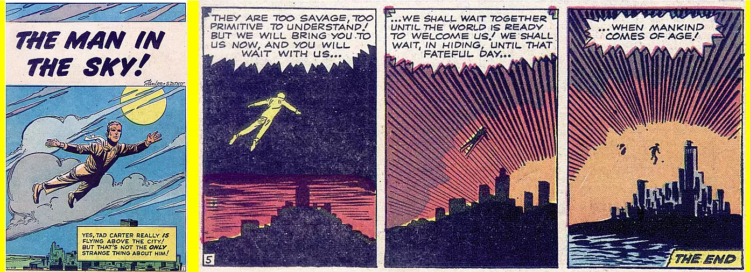
(Note: Ditko’s description aligns with what is now often referred to as the ‘Marvel Method’ of producing comic books. Various iterations exist, but all involve artists working from a premise/outline as opposed to a ‘full script’, with the dialogue being added by the writer after the story has been laid out by the artist. Depending on the situation and those involved, the premise/story ideas may come from either party.)
The Amazing Fantasy series was rebranded as Amazing Adult Fantasy beginning with issue #7 (December 1961) when it became a showcase for material produced exclusively by the Lee/Ditko team. Consisting of short stories with twist endings in the ‘O. Henry/Twilight Zone’ tradition, the publication was intended to attract a more sophisticated audience (as emphasised by both the title and a cover blurb proclaiming that it was ‘the magazine that respects your intelligence’). Despite these changes, the series would reportedly face both creative and commercial challenges (see ‘Endnotes’ for more information).
It was while working on this series that Ditko was given an inking assignment on another project, one that was intended to introduce a new superhero character.
1.2. ‘Spiderman’
“For me, the Spider-Man saga began when Stan called me into his office and told me I would be inking Jack Kirby’s Pencils on a new Marvel hero, Spiderman.”
— Steve Ditko ‘An Insider’s Part of Comics History: Jack Kirby’s Spider-Man’ essay from Avenging World (2002)
Ditko was provided with the initial five pages of a ‘Spiderman’ origin story, as pencilled by Jack Kirby. The lack of a hyphenated name was one of many differences between the character that appeared in those pages and the ‘Spider-Man’ that is familiar to global audiences today:
“The Spider-Man pages Stan showed me were nothing like the published character. In fact, the only drawings of Spider-Man were on the splash and at the end. At the end, Kirby had the guy leaping at you with a web gun. Aunt May was there, and Uncle Ben was a retired policeman. He looked a lot like General Thunderbolt Ross. Anyway, the first five pages took place in the home, and the kid finds a ring and turns into Spider-Man.”
— Steve Ditko ‘An Insider’s Part of Comics History: Jack Kirby’s Spider-Man’ essay from Avenging World (2002)
Another account provided additional story/character details:
“The other four pages showed a teenager living with his kindly old aunt and hard, gruff, retired police captain uncle, a General Thunderbolt Ross-type (from The Hulk) who was hostile toward the boy.
Next door or somewhere in the neighbourhood was a whiskered scientist-type involved in some type of experiment or project. The end of the 5 pages depicted the kid going toward the scientist’s darkened house.”
— Steve Ditko ‘An Insider’s Part of Comics History: Jack Kirby’s Spider-Man’ The Comics Vol 1 No. 5 May 1990: the newsletter of Robin Snyder.
Ditko recalled (and attempted to reproduce from memory) the original Kirby-designed costume worn by the ‘Spiderman’ character. Amongst other features was a cowl that covered half the hero’s face, in a manner reminiscent of ‘Batman’ or ‘Captain America’:
“I’m uncertain about the abstract chest design. The closest thing to it is the one on Ant-Man. Kirby’s Spider-man had a web gun, never seen in use. The only connection to the spider theme was the name”
— Steve Ditko ‘An Insider’s Part of Comics History: Jack Kirby’s Spider-Man’ essay from Avenging World (2002)
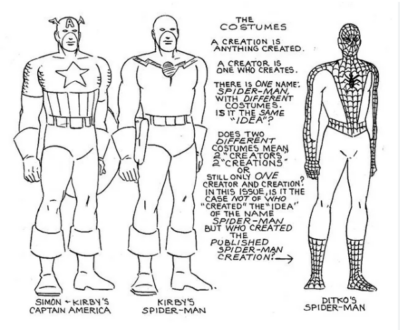
Lee made no mention of who had come up with the initial idea or storyline. He explained that the character was a “…teenager with a magic ring that transformed him into an adult hero – Spider-Man.” However, the premise sounded familiar to Ditko, who informed Lee that the new hero “…sounded like Joe Simon’s character, The Fly (1959), that Kirby had some hand in, for Archie Comics.”
“Stan called Jack about The Fly. I don’t know what was said in that call.
Day(s) later, Stan told me we would be doing SM (Spider-Man). I would be pencilling the story panel breakdowns from Stan’s synopsis and doing the inking.”
— Steve Ditko, A Mini-History 13 ‘Speculation’ The Comics! Vol 14 No. 8 August 2003, the newsletter of Robin Snyder.
Lee’s newly written synopsis was described by Ditko in his commentaries as a ‘brief story line’, being a ‘page and a half’ in length. This would form the basis of a new origin tale with a twist ending in the style of other Lee/Ditko short stories. Ditko viewed the revised venture as a fresh start for the strip:
“Kirby’s five penciled Spiderman story/art pages were rejected. Out went the magic ring, adult Spiderman and whatever legend ideas that Spiderman story would have contained.”
— Steve Ditko ‘An Insider’s Part of Comics History: Jack Kirby’s Spider-Man’ essay from Avenging World (2002)
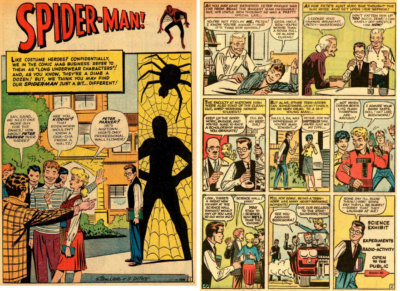
Reflecting on his role in this turn of events, Ditko would pose the following question decades later:
“Does anyone wonder or care what S-M would look like, be like today, if I had never mentioned the Fly and just inked Jack/Stan’s S-M idea?”
— Steve Ditko, ‘The Silent Self Deceivers’ 2012 (as reprinted in The Complete Four-Page Series and other Essays, 2020)
1.3. A ‘New Creation’
For reasons unmentioned in his records, Ditko was assigned as both the penciller and inker for the project. He likely welcomed the decision given his strong views on splitting the roles:
“Pencil art needs an inker to bring out the strength of the penciller’s style in how a penciller emphasizes or diminishes panel elements: people, faces, action, mood, settings, etc. in panels.
So matching an inker with a penciller is almost impossible because they are two different talents, skills, even in outlook: more imaginative, more realistic, etc.”
— Steve Ditko, ‘Creator or co-creator’ The Avenging Mind 2007 (reprinted The 32 Series by Ditko, Vol 1 Overture, 2019 p 27)
The pages that Kirby had originally pencilled for the new strip, which Ditko had retained, no longer appeared to hold any value:
“The Lee/Kirby S-M idea, five art pages, was not a story, no kind of blueprint but a flawed, failed S-M idea. The potential (acorn, seed) could not be brought to life.”
— Steve Ditko ‘Roislecxse’ The Avenging Mind 2007 (reprinted The 32 Series by Ditko Vol 1, Overture, 2019)
And, in an era where the value of original comic art/history was very different to today, they were simply disposed of:
“…I always regret I threw away Kirby’s pages on his ‘creation’ of Spider-Man. I could have, should have, had the pages photostatted.”
— Steve Ditko, ‘Could/Should’, The Hero Comics #29 (Autumn 2019)
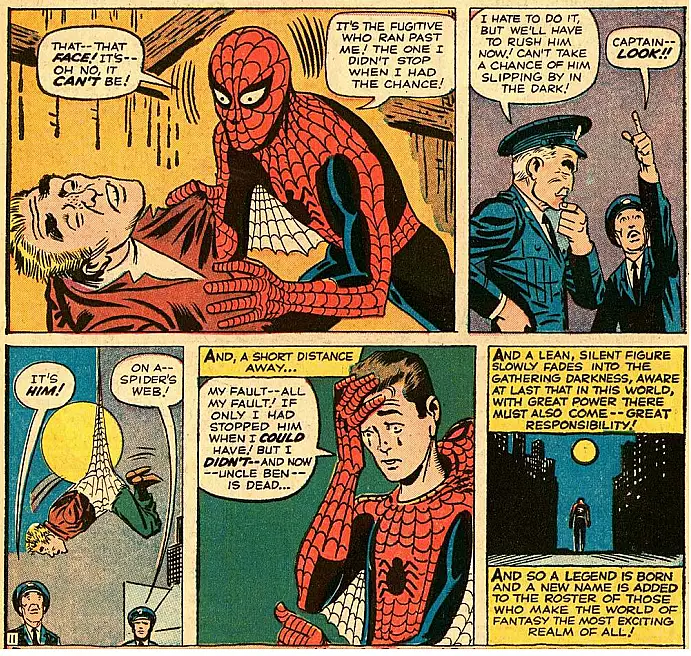
Working with lee’s written outline, Ditko commenced conceptualising/illustrating the fifteen pages of pencilled artwork for what would become the iconic ‘Spider-Man’ origin tale. His artistic and creative talents would be critical in bringing the story (and Spider-Man himself) into existence:
“Everything beyond Lee’s synopsis-creation idea needed another hand/mind to make abstractions, some mind/word ideas, into a different, new creation by adding, creating, ideas, executing, to make the necessary physical whole for publication.”
—Steve Ditko, ‘Roislecxe’, The Avenging Mind 2007 (reprinted The 32 Series by Ditko, Vol 1 Overture, 2019
1.4. Working from a Synopsis – Ditko as the ‘Artist Plus’
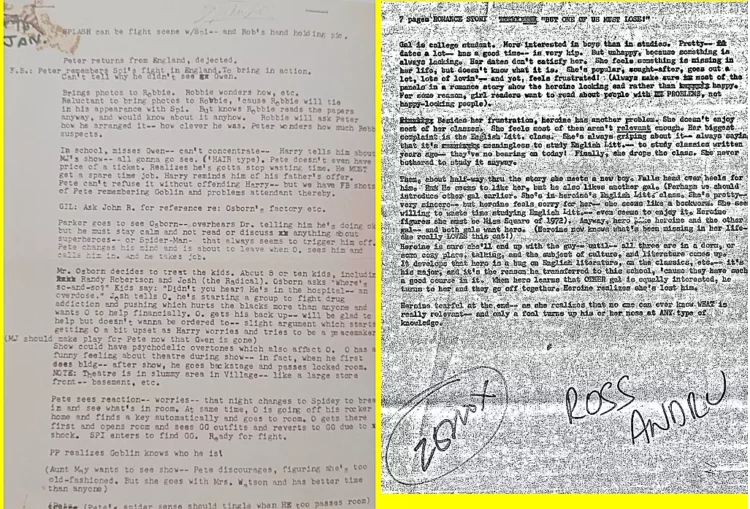
Ditko’s accounts of his early work with Lee contain numerous references to written story ‘synopses’, i.e. documents containing story/plot ideas that Lee provided to him as directions in lieu of a ‘full script’.
Ditko never referred to the written synopses as being prepared during (or as a summary of) any specific story conferences between the two. In some of his accounts, he even expressed dissatisfaction with the ideas and scenarios contained in them. However, in at least one instance, Lee’s synopsis did incorporate a suggestion for a Spider-Man villain that Ditko had made in one of their earlier discussions (this is explored further in ‘2.4. Many Wonderful Ideas’).
Lee’s use of synopses differed substantially from the ‘full script’ method more commonly employed in the comics industry at the time. Comic book artists always made some creative decisions beyond simply drawing pictures, but this particular approach explicitly conferred upon them a portion of the writer’s traditional storytelling responsibility.
As Ditko explained, Lee’s decision to employ synopses meant he “…surrendered his part of the writer’s division of labor as a writer of full script, to the artist.” This was because a synopsis did not contain sufficient detail/directions necessary to directly transfer story ideas to the page without significant creative input from the illustrator:
“A synopsis is a brief story line, words, abstractions, and so is a part, incomplete, not detailed not the whole story.
A comic book synopsis does not tell/show the what, how and why for every panel and exactly how each character should, must be seen, act, react, in every situation.
The synopsis does not tell/show how to create the visually important, especially in dramatics scenes, in fight scenes, and how they are to be staged, shown, in what way, how many panels etc. and from what visual viewpoint (close up, long shot, mid-shot, over-head, etc.).”
— Steve Ditko ‘Roislecxse’ Avenging Mind 2007, (as reprinted in The 32 Series by Ditko Vol 1, Overture P 23)
The additional responsibilities (and creative freedom) inherent in the process necessitated a certain type of illustrator:
“…a created synopsis needs an artist – a creative artist. The artist has to collaborate – co-create – by supplying additional ideas and storyline for a publishable story/art creation. The artist has to collaborate with the synopsis writer in providing, in co-creating, the rough equivalent of a full-script, a complete page/panel story idea breakdown. Then, alone, the artist creates the visual story/art continuity. He provides rough panel dialogue, a rough full script for the writer to use, edit and, for the final panel, dialogue.”
—Steve Ditko, A Mini-History 1,’The Green Goblin’, The Comics! Vol 12. No. 7, July 2001, the newsletter of Robin Snyder.
Ditko even created a term to describe the artist working under this scenario – the ‘artist-plus’:
“With a synopsis, the incomplete storyline material, there is an actual need for more than an illustrator, and even more than an artist.
A synopsis must have an artist-plus. An artist-plus has to take what is incomplete, what is partly provided, and add new story ideas, fill in, expand, provide everything else needed to make a complete, whole, work/picture story.
The artist-plus has to supply rough dialogue for every panel for the writer, dialoguer, to polish, provided better storytelling, continuity etc.”
—Steve Ditko, ‘Roislecxe’, The Avenging Mind 2007 (reprinted in The 32 Series by Ditko, Vol 1 Overture, 2019, P 23
In his writings, Ditko did not express an opinion on whether the use of synopses was better or worse than a ‘full script,’ although (as will be explored later) he did record his dissatisfaction with the way his contributions were recognised in the official credits of the era.
None of the written synopses provided to Ditko by Lee has ever surfaced in the public domain, and they are assumed lost to time. (Note: the following images show surviving Lee synopses for Amazing Spider-Man #96, May 1971, and Our Love Story #17, June 1972).
1.5. ‘My Ideas and Creation’
The ‘ideas’ that Ditko contributed to the origin of Spider-Man included elements that became synonymous with the new character:
“Stan’s synopsis to me did not mention any (two) wrist shooters, or hidden belt, or any specific costume or specific spider-like actions. Those are my ideas and creation.”
— Steve Ditko ‘Tsk Tsk Examining a Creator/Creation Claim’ Avenging World 2002, p 137
There is a strong implication in Ditko’s commentaries that Spider-Man’s web-spinning and wall-crawling abilities were amongst those ‘spider-like actions’ left unspecified by Lee. While these are attributes naturally associated with spiders, it was left to Ditko to work out the technical details:
“Real spiders naturally spin webs, move on web lines and stick to walls. No one can ‘create’ spider abilities. But how a person does it (two wrist web-shooters versus a web gun, etc.) is, again, mine.”
— Steve Ditko ‘Tsk Tsk Examining a Creator/Creation Claim’ Avenging World 2002, p 137
There was also no direction from Lee as to how the new Spider-Man might appear. It was therefore Ditko who opted not to incorporate any of the design elements Kirby had utilised in the rejected ‘Spiderman’ pencils:
“One of the first things I did was to work up a costume, a vital, visual part of the character. I had to know how he looked, to fit in with the powers he had, or could have, the possible gimmicks and how they might be used and shown, before I did any breakdowns. For example: he had a clinging power so he wouldn’t have hard shoes or boots, a hidden wrist-shooter versus a web-gun and holster, etc”
— Steve Ditko, ‘An Insider’s Part of Comics History: Jack Kirby’s Spider-Man’ essay from Avenging World (2002)
The decision to employ a full-face mask was unusual for the time:
“I wasn’t sure Stan would like the idea of covering the character’s face but I did it because it hid an obviously boyish face. It would also add mystery to the character and allow the reader/viewer the opportunity to visualise, to ‘draw’, his own preferred expression on Parker’s face and perhaps, become the personality behind the mask.”
— Steve Ditko, ‘An Insider’s Part of Comics History: Jack Kirby’s Spider-Man’ essay from Avenging World (2002)
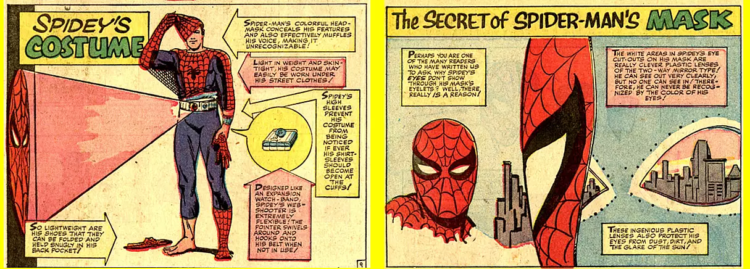
In a single panel during the story’s conclusion Ditko depicted pupils in Spider-Man’s normally blank eyelets. This one-off device was employed to convey the character’s shock at discovering the identity of his uncle’s murderer:
“The eyes through the usually blanked-out eye is just legitimate dramatic effect. We’re not dealing with reality but with fiction and fantasy. The more that can be legitimately shown, explained, the more viewers will accept the exaggerated.”
— Steve Ditko, Ditko Shrugged 2020 as quoted by author David Currie, 2020 p 63
Ditko’s costume design included his selection of an initial colour scheme that was used in the early appearances:
“My original color combination was a warm, red-orange on the webbing section and a cool blue on the body parts. These colors made a nice contrast, they emphasized the webbing and added to the mystery mood.”
— Steve Ditko, A Mini History 3 ‘The Amazing Spider-Man #1’ The Comics! v.12 #11, Nov. 2001) the newsletter of Robin Snyder.
1.6. Comics Code Concerns
Having completed at least some of the pencilled pages, Ditko met with Lee to present and discuss his work:
“The crucial point came after Stan and I went over my pencilled pages. Stan wanted me to take Peter Parker/Spider-Man off the wire, ceiling, etc. to change the spider-like poses, action.
Why? Stan was afraid the Comics Code ‘judges’ might or would reject Spider-Man because Peter Parker, the teenager, would be seen by young buyers as something non-human, a freak, a spider-like creature. Seeing the spider-like poses would be bad, causing all kinds of mental health and behavioural problems – nightmares and acting out the panel scenes.”
“I said something to the effect that we should wait until The Code complains or demands the spider-like poses be changed or reviewed.”
Lee agreed. The tale, simply entitled ‘Spider-Man’, appeared as the lead story in Amazing Fantasy #15 which was published with a cover date of August 1962 (the word ‘adult’ had been removed from the publication’s title, ostensibly due to readership feedback). Any angst concerning the spider-like poses was unfounded, with Ditko noting that “The code didn’t complain.”
— Steve Ditko, ‘A Mini-History: 2 Amazing Fantasy #15’ The Comics! v. 12 No. 10, October 2001, p1) the newsletter of Robin Snyder.
1.7. The First Spider-Man Cover
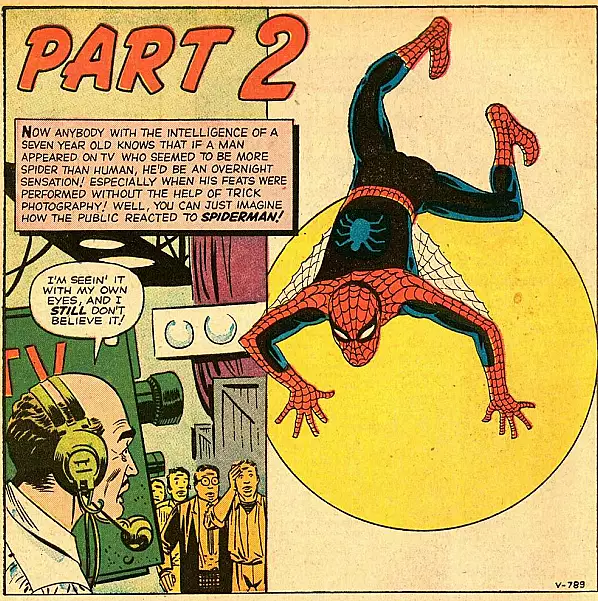
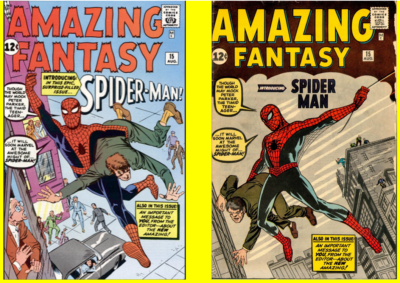
The cover of Amazing Fantasy #15 was pencilled by Jack Kirby, with inks by Ditko. It utilised a similar layout to an earlier, rejected submission by Ditko:
“I drew the cover from a subjective viewpoint. I wanted to put the reader/viewer up front with the swinging Spider-Man, to be a part of the activity, to see and realize the danger in falling, in having a sense of swinging along with Spider-Man.”
“Stan rejected it for a more heroic S-M action an objective viewpoint, the viewer not up there with S-M.”
— Stevie Ditko (2013 letter to David Currie), Ditko Shrugged, David Currie p 67
1.8. Ditko’s Opinions: Who Created Spider-Man?
Determining who should receive official credit for creating ‘Spider-Man’ is complex, given the circumstances surrounding the character’s creation and the differing accounts from those involved.
Stan Lee consistently claimed that the initial idea for a spider-based character was his, and that he rejected Jack Kirby’s initial pages because the ‘heroic’ depiction did not align with his vision.
Jack Kirby asserted that he had brought the ‘Spider-Man’ name and concept to Lee, drawing on work he had done years earlier with Joe Simon, his former creative partner. Simon essentially corroborated Kirby’s account, while also claiming credit for coining the name ‘Spiderman’ (originally without a hyphen).
Over the years, both Lee and Kirby occasionally claimed sole credit for the character’s creation. However, there were also instances where Lee referred to Spider-Man as a ‘co-creation’ with Steve Ditko, and interviews where Kirby credited Ditko entirely with the character’s development. (Further detail is provided in the ‘Endnotes’ section).
Ditko’s perspective is explained in his essay entitled An Insider’s Part of Comics History: Jack Kirby’s Spider-Man. In that article, revised several times over the years, he placed the focus squarely on the final, published version of Spider-Man. This, he declared, was a creation by both Lee and Ditko. A co-creation.
In making his case Ditko was aware of Kirby’s claims of having brought the ‘Spiderman’ name to Lee but declined to take a side in any argument between the two, stating that “Who first came up with the specific name, Spider-Man is for Stan and Jack to resolve.” Ditko also acknowledged that Kirby had been involved in the creation of the pencilled pages for a rejected version of ‘Spiderman’…though he apparently had no interest in finding out what vision Kirby may have held:
“I never talked to Jack about Spider-man, so I don’t know what his ideas concerning the character actually were.”
— Steve Ditko ‘An Insider’s Part of Comics History: Jack Kirby’s Spider-Man’, Avenging World, 2002, p 59
Ditko reasoned that, regardless of the real-life backstory, the ‘Spider-Man’ brought to life by Lee and Ditko in Amazing Fantasy #15 was sufficiently new/different to be judged an independent and original creation. In making his point, Ditko noted that the idea of a spider-themed character/hero was hardly a new one:
“There have been earlier uses of the spider “idea” in comics: Paul Gustavson’s Alias the Spider, DC’s Tarantula with his web gun, and certainly many other heroes, heroines, villains and villainesses (such as, in this last category, the earlier Black Widow, before Simon or Kirby or Lee). There was a Spider pulp novel series and a Spider movie serial, all before any Kirby or Lee Spider-Man.”
— Steve Ditko ‘An Insider’s Part of Comics History: Jack Kirby’s Spider-Man’ Avenging World, 2002, p 59
The fact that the Lee/Ditko Spider-Man had elements/aspects in common with other creations (including the Kirby-drawn ‘Spiderman’) did not preclude it from being something new. As Ditko viewed it, any creation was “…actually a recreation, a rearrangement of existing materials in a new, different, original novel way.” When compared to what had preceded it, the Lee/Ditko Spider-Man could still be said to “…have its own unique identity consisting of specific parts (characters, costume), place (setting), qualities (powers and gimmicks), arrangements and relationships (plot ideas), and meaning (the view of man, life, existence, right and wrong, justice).”
— Steve Ditko ‘An Insider’s Part of Comics History: Jack Kirby’s Spider-Man’ Avenging World 2002 p 59
Ditko was aware that Jack Kirby had claimed sole credit for the creation of virtually all the characters he had worked on at Marvel, including Spider-Man, and made a point of invoking Kirby’s own logic as part of his argument. Ditko noted that Jack Kirby had claimed the Marvel Comics character ‘Thor’ as one of his creations even though it obviously followed on from a character of the same name that had appeared in Norse myths:
“If Marvel’s Thor is a valid created work by Jack, his creation, then why isn’t Spider-Man by Stan and me valid created work, our creation?”
— Steve Ditko ‘An Insider’s Part of Comics History: Jack Kirby’s Spider-Man’, Avenging World, 2002, p 59
Part Two (1963/1964)
2.1. An Evolving Partnership
Ditko’s comic-book assignments underwent a notable shift in 1963, with most of his work aligning with Marvel’s emphasis on super-heroes. The success of Spider-Man’s debut in Amazing Fantasy #15 (August 1962) led to the character gaining his own series with the same creative team. The new series, Amazing Spider-Man, would initially be published bimonthly before switching to a monthly schedule with issue 5 (October 1963). Ditko and Lee would also work together on other superhero projects, including the ‘Hulk’ and ‘Dr Strange’ comic strips.
For a time at least, Lee continued to outline his intended tale and plot concepts in written synopses. In the course of their collaboration, he and Ditko met frequently to review work, design covers and discuss story elements. Ditko followed directions laid out by Lee, while contributing the necessary additional ideas and storytelling:
“For Marvel’s Spider-Man, Dr Strange and Hulk stories Stan wrote a synopsis, a one or two page brief story outline. His synopsis contained no panel/page breakdown, no specific panel ideas, no captions or panel dialogue, so there was no full story. A synopsis is an incomplete story line. As such it cannot be translated into an equivalent, usable picture story.”
— Steve Ditko, A Mini-History ‘The Green Goblin’, The Comics! Vol 12 No 7 July 2001, the newsletter of Robin Snyder.
The change in structure from the old ‘five pagers’ did necessitate some refinements to the way they had worked together earlier:
“…our working method was obviously more involved than with the five pages because the ideas were greater. There were more characters, action, drama and complexities. There were continuing characters (main and supporting), all with different personality types, ongoing relationships, personal problems and conflicts. The heroes and villains had various motives and powers to be exploited. All needed consistency, yet development and growth had to be considered.”
— Steve Ditko ‘An Insider’s Part of Comics History: Jack Kirby’s Spider-Man’ essay from Avenging World (2002)
The Lee/Ditko team would face some fresh challenges as they moved away from their short stories to focus instead on recurring characters and mythos development. Working together on ongoing continuities would enable them to explore fresh ideas and directions that weren’t feasible in their earlier collaborations, but it would also highlight differences in their respective artistic views.
2.2. Launching the ‘Amazing Spider-Man’
The ongoing Amazing Spider-Man title debuted with a cover date of March 1963. The origin tale had established the basics of the title character, but significant world-building was still required to transform Spider-Man into a viable, long-term property. As Ditko recalled, this was implemented in a somewhat free-wheeling manner:
“Stan never worked out a S-m (Spider-Man) ‘blueprint’ upon which S-m could be built. Changes or additions were arbitrary and did not follow some thought out, planned story world.”
—Steve Ditko, ‘A Mini-History 6: Spider-woman/Spider-girl’ The Comics! Vol.13 No. 5, May 2002, the newsletter of Robin Snyder.
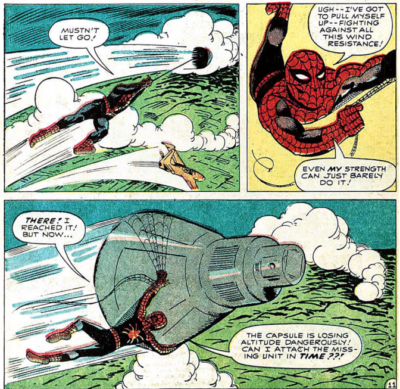
The first issue of Amazing Spider-Man presented readers with two short stories featuring the hero. Ditko viewed it as “…the best time, opportunity, to establish the groundwork, the nature of the teenage hero’s story adventure world.” However, each tale would contain elements attracting Ditko’s disapproval. The first introduced publisher J. Jonah Jameson and established his personal vendetta against Spider-Man. In the tale’s conclusion, Spider-Man rescued an astronaut—the publisher’s son—from a malfunctioning space capsule, only for the ungrateful Jameson to use the event to further publicise his anti-Spider-Man campaign. Ditko regarded this scenario as a misstep, believing that the real-world ramifications of immediately thrusting the teenage hero into such a high-profile event worked against his more grounded vision of the strip:
“The space capsule incident involving JJJ’s son may have been a legitimate way to introduce JJJ and his foolish yet interesting relationship with PP. But the story idea undercut the teenage context. It’s like having a high school football player playing in the Super Bowl.”
— Steve Ditko ‘A Mini-History 3 ‘The Amazing Spider-Man #1’ (The Comics! V. 12 No. 11, November 2001) the newsletter of Robin Snyder.
The second story brought Spider-Man into contact with both the Fantastic Four and the villainous Chameleon. The appearance of Marvel’s first super-hero team as guest stars resulted in subtle colour changes to Spider-Man’s costume, with Ditko recalling that “Spider-Man’s cool blue was removed because the color blue was ‘owned’ by the guest stars costume color.”
Ditko felt that the decision compromised the visual qualities of the original costume:
“Spider-Man’s blue was changed to a warm purple (it gets warmer, redder, in later issues, ruining the better contrast and mood).”
The instigator of this change wasn’t identified, but Ditko would cite the event as an example of unwanted interference by “OOs”—a term he used to describe those outside the immediate creative process:
“The integrity of S-m was undercut, subordinated, because the likes and wants of OOs were held to be more important.”
Interference by outsiders would be a topic to which Ditko returned on various occasions in his commentaries.
Steve Ditko, A Mini History 3 ‘The Amazing Spider-Man #1’ The Comics! v.12 #11, Nov. 2001, the newsletter of Robin Snyder.
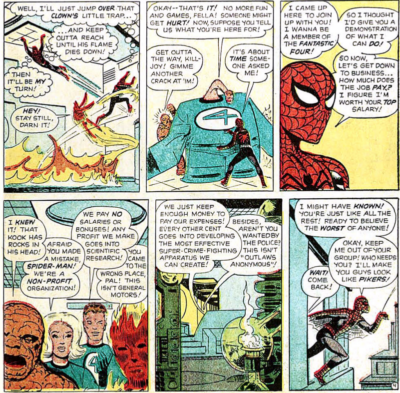
Later in the tale Spider-Man tackled a soviet submarine, an element that Ditko felt was as incongruous to Peter Parker’s teenage world as the space capsule rescue in the previous story. Ditko likened it to “…elevating a local issue onto the international level…” and something that was “…more fitting for Captain America.”
As events unfolded, readers were introduced to Spider-Man’s famous ‘spider-sense’, a concept developed during a review of the initial artwork:
“That idea came after Stan and I were going over the pencilled Chameleon story/art pages. Stan asked me a very good question: ‘How, in the darkened room, does (Spider-Man) know where the Chameleon is?’
At some point I took a pencil and drew squiggly lines radiating from S-M’s head and said ‘S-M has ‘spider-senses.’ The way bats can detect, sense insects, objects at night. Stan accepted the idea as valid. The ‘senses’ worked for our character. We went over the earlier pages, panels and where we thought appropriate, I added squiggly lines denoting the spider senses around (Peter Parker or Spider-Man’s) heads.”
— Steve Ditko A Mini-History 3 ‘The Amazing Spider-Man #1’ (The Comics! V. 12 No. 11, November 2001) the newsletter of Robin Snyder.
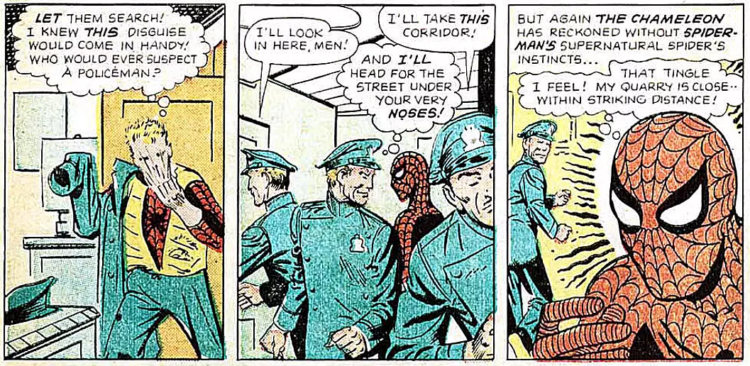
The Chameleon tale concluded with Spider-Man running down a street, sobbing after an awkward interaction with the authorities in a scene reminiscent of the origin’s ending. Whether this was his idea or not, the notion of a young character who was still learning to deal with the world clearly resonated with Ditko:
“Peter Parker, a teenager becoming a hero, had to learn how to be a hero. He wasn’t even like a rookie policeman or soldier with some experienced Sgt to train him, set him straight. Parker (Spider-Man) could make mistakes a hero like Captain America or Superman could never make. From grade school to college etc. Parker has to learn and grow up to be a hero.”
— Steve Ditko (quoted from letter to David Currie) Ditko shrugged p 79
Another noteworthy aspect of Amazing Spider-Man #1 was Lee’s addition of regular creator ‘credit boxes’ on the splash pages, something that was rare for comic books of the era. Within these brief descriptions Lee credited himself for the ‘script’, presumably reflecting his responsibility for providing finished dialogue/narration. This wording subsequently become a point of conjecture with Ditko, whose later accounts asserted that it misled readers into believing that he was an artist working from Lee’s ‘full script’. His commentaries therefore emphasised that no ‘script’ was provided to him beforehand:
“The book contains two independent stories. They were both credited as Script: Stan Lee/Art: Steve Ditko. There was no Stan Lee script. I worked from two synopsis. And I provided rough panel script — dialogue — for the penciled story panels, plus whatever clarification needed when we went over the penciled panels.”
— Steve Ditko A Mini-History 3 ‘The Amazing Spider-Man #1’ (The Comics! V. 12 No. 11, November 2001) the newsletter of Robin Snyder.
2.3. Incredible Hulk
At approximately the same time Ditko and Lee were developing the Amazing Spider-Man, another Marvel title was concluding its short run. The Incredible Hulk, a feature produced by Stan Lee and Jack Kirby as a follow-up to the highly successful Fantastic Four, had failed to resonate with readers and was being concluded with the sixth issue (published with a cover date of March, 1963).
Lee, rather than keeping Kirby on for the final instalment, brought in Ditko to illustrate a full-length tale that matched the Hulk up against a newly introduced ‘Metal Master’:
“It was said Kirby would be wasted on doing the final issue when he could be put to better use working on something else.”
—Steve Ditko ‘And Lo, There Was a Hulk’ p69 The Complete Four-Page Series and Other Essays by Steve Ditko 2020
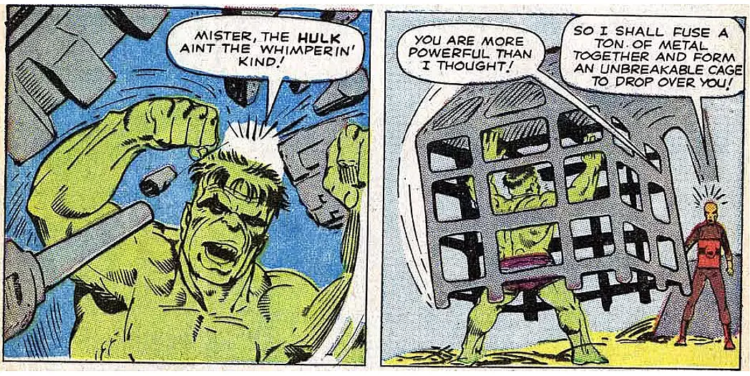
As Ditko described it, this collaboration was a textbook example of the ‘Marvel Method’ in action:
“Stan provided a brief treatment of the story and he and I discussed the story idea. I worked out the visual story, supplied all the necessary details and fill-in material for the 24 page story.
I pencilled the pages and provided rough script for the panels, captions, dialogue on 24 separate sheets of paper.
I delivered the art and rough script pages and Lee and I went over ever page and panel for clarification, how I followed the synopsis, added to it or changed it and why. Any necessary corrections were made in the page margin to be done after Stan added dialogue and the pages were lettered.”
—Steve Ditko ‘And Lo, There Was a Hulk’ p69 The Complete Four-Page Series and Other Essays by Steve Ditko 2020
2.4. ‘Many Wonderful Ideas’
Just as the initial saga of the Hulk was concluding, the Spider-Man strip was entering a period of remarkable creativity. With the fundamentals now largely established, the Lee/Ditko team would proceed to introduce new concepts/villains at an impressive pace. The second issue of Amazing Spider-Man appeared with a cover date of May 1963 month, displaying a new, Ditko-designed corner box to promote the company’s brand:
“I suggested the corner box with a Marvel hero face and drew a face to show Lee and Sol Brodsky how it would look, and more important how and why the Marvel title with a hero face would be quickly seen, recognized no matter how comic books sold in stores were placed in racks.”
— Steve Ditko, ‘Martin Goodman/Stan Lee’, The Avenging Mind 2007, (reprinted The 32 Series by Ditko, Vol 1 Overture 2019 p. 44)
The corner box was employed across the growing Marvel line, becoming further evidence of Ditko as a proactive, creative force within the company.
Amazing Spider-Man #2, like its predecessor, contained two stories. The first of these introduced the ‘Vulture’ – a villain with the power of flight. Ditko’s rendition was that of a lean and middle-aged man, which went against Lee’s usual preference:
“Stan believed the most effective villain was the heavy-set one. He once mentioned the movie villain, Sydney Greenstreet, as a villain model.
So Stan didn’t like my thin, gaunt Vulture.”
“An elephant’s bulk can be frightening and destructive, but it is easier to escape from than the lean, fast cheetah.”
“The bulkier anything is, the more panel space it has to take up, thereby shrinking panel space for other characters and story panel elements.”
—Steve Ditko A Mini-History: ‘The Amazing Spider-Man #2’, The Comics! Vol. 13 #1 January 2002, the newsletter of Robin Snyder.
The following tale issue pitted Spider-Man against the ‘Uncanny Threat of the Terrible Tinkerer’. The plot, involving common radios being utilised as a tool of espionage by alien spies in their conquest of Earth, could easily have been employed in the Amazing Adult Fantasy series. Aliens had also been a mainstay of Atlas/Marvel and would regularly appear in Lee/Kirby titles such as Fantastic Four, but their appearance here did not sit well with Ditko. Spider-Man’s rescue of the space capsule in the prior issue had already clashed with his own, more grounded take on the character. An off-world menace was similarly seen as problematic. Ditko’s view would be succinctly summarised in his later memoirs:
“Space aliens do not fit into a teenager’s world.”
—Steve Ditko A Mini-History: ‘The Amazing Spider-Man #2’, The Comics! Vol. 13 #1 January 2002, the newsletter of Robin Snyder.
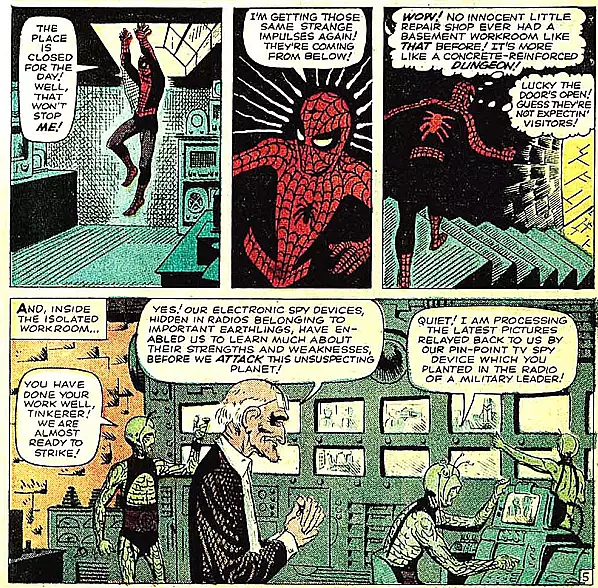
While there is no record of Ditko raising this concern with Lee, this would none-the-less mark the last time Spider-Man interacted with the Tinkerer (or any other alien) during his run on the title. And, coincidentally or not, it was during the production of the second issue that Ditko pitched his own suggestion for a more grounded Spider-Man villain:
“…I told Stan about a villain with four mechanical arms. Stan named him Dr Octopus and worked up a legend.”
— Steve Ditko, ‘A Mini-History: ‘The Amazing Spider-Man #2’, The Comics! Vol 13 No. 1, January 2002, the newsletter of Robin Snyder.
Although Lee “…worked up the story synopsis…” containing the ‘legend’ (i.e. origin) for Ditko’s conception, his outline did not include the introduction of Spider-Man’s belt-mounted ‘spider-light’ (or ‘spider-signal’) that Ditko depicted during an early scene. For Ditko, this innovation exemplified the ongoing development of their hero:
“The Lee/Ditko S-m involved different ideas, interpretation and continuing free will choices, options and developing possibilities. It was like the manufacture of some alloyed product, needing, using different skills, needing to search, find, discover raw material to develop a method to detach, refine and combine material in new and novel ways to produce a saleable product.
In this case it was the process of making the actual S-m issues published by Marvel.”
—Steve Ditko ‘A Mini-History 5 The Amazing Spider-Man #3’ The Comics! Vol 13 No 4 April 2002, the newsletter of Robin Snyder.
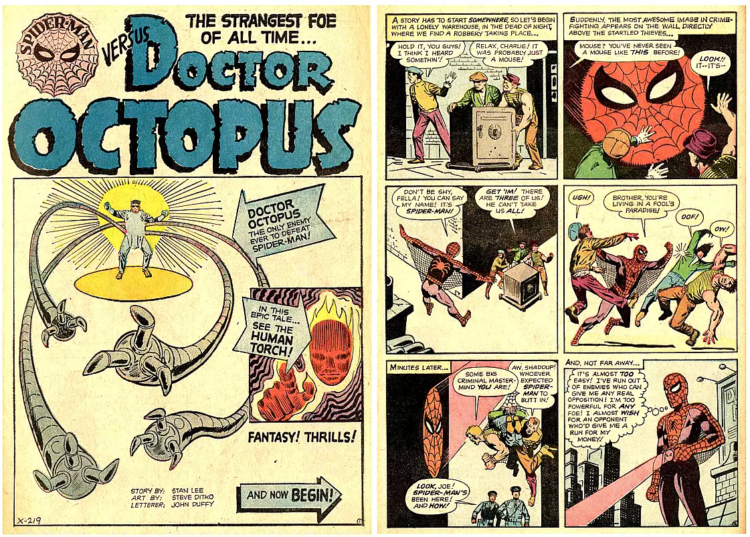
Ditko’s Dr Octopus design would accord with Lee’s preference for bulky super-villains, as he recognised the logic in designing a character who was required to move about with four metallic appendages.
— Steve Ditko, ‘A Mini-History: ‘The Amazing Spider-Man #2’, The Comics! Vol 13 No. 1, January 2002, the newsletter of Robin Snyder.
Ditko’s creative input, which from the very start had been so crucial to the creation/development of Spider-Man, was soon openly acknowledged in the letters page of the fourth issue (cover dated September 1963): “Stan and Steve have so many unusual and wonderful ideas for future Spider-Man tales that we don’t want anything to interfere with them.”
2.5. Ditko’s Opinions: Ownership of Ideas and Remuneration
Steve Ditko’s commentaries provide many examples of the creativity he brought to projects at Marvel and other comic-book companies. Regardless of any misgivings about how such work was acknowledged, Ditko recognised that the industry was one in which roles and responsibilities of writers and artists were not always clearly defined. As he succinctly stated to a fan during one correspondence, “There was no strict division of labour” in comics.
— Steve Ditko (in letter to David Currie) David Currie Ditko Shrugged 2020 p 80
Ditko retained no ownership with respect to his creative contributions at Marvel. This was the norm in the industry at the time, but it would become a point of contention for numerous creators in later years, particularly as the amount of money generated by intellectual properties became more apparent. Ditko later referenced the arrangement in a pragmatic manner, noting the benefits he’d also received as an ‘artist plus’:
“The ideas could be mine but I had no real right to them when published. And it didn’t matter. I was getting the experience free lancers don’t usually get.”
— Steve Ditko (in 2013 letter to David Currie) Ditko Shrugged, David Currie 2020, p 67
Nor did Ditko seemingly harbour negative views with respect to the financial remuneration he received, at least as it applied to his most famous comic book work. It is a subject that goes largely unmentioned in his essays, and is explicitly dismissed as an issue in at least one fan letter:
“What I did with Spider-Man I was paid for.”
— Steve Ditko (in March 2015 letter to David Currie) Ditko Shrugged, David Currie 2020, p 80
2.6. ‘A Credible Peter Parker/Spider-Man World’
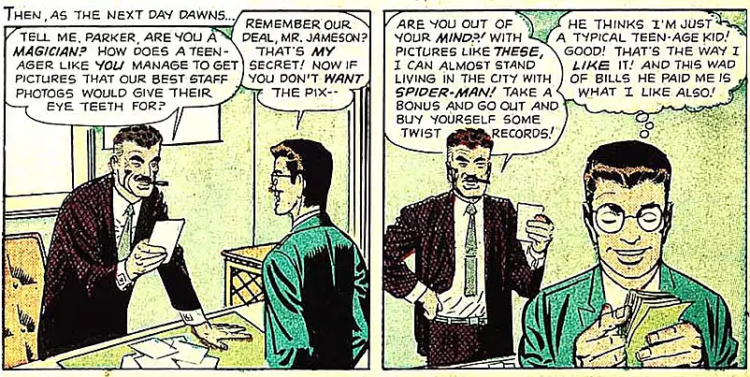
While working on the third issue of Amazing Spider-Man, Lee opted to engage his partner as a ‘sounding board’ for a potential cast addition. This involved the potential introduction of a female equivalent of Spider-Man. Ditko recalled that Lee “…did not have any synopsis about Spider-Woman joining Spider-Man…” and there was no indication as how she would fit into Spider-Man’s world, either as an ally or an enemy. Ditko would successfully argue against it, effectively ceasing any further development of the concept. Ditko’s rationale was that the team had only produced three issues of the title, and “…had not really done much in establishing a credible Peter Parker/ Spider-man world.”
— Steve Ditko, A Mini-History: ‘Spider-Woman/Spider-girl’ The Comics! Vol 13 No 5 May 2002 the newsletter of Robin Snyder.
Ditko was already beginning to steer the strip in a particular direction, with the focus firmly on building a relatable, teenage hero who could stand on his own. This was not compatible with some of Lee’s more freewheeling/outlandish ideas, nor was it suited to Lee’s tendency to bring in other Marvel characters as guest-stars:
“The gimmick of guest stars and far-out space aliens is not an appropriate way to establish a credible PP/S-m story world. The out of place ideas, inclusions, distract from rather than help build up the supporting characters and the showing, understanding the heroic teenager’s world.”
— Steve Ditko, A Mini-History: ‘Spider-Woman/Spider-girl’ The Comics! Vol 13 No 5 May 2002 the newsletter of Robin Snyder.
Ditko would later cite the Tinkerer tale in Amazing Spider-Man #2 as one which exemplified early differences between his vision and Lee’s:
“The Tinkerer story could be taken as Stan’s ideal way to do a S-m book since the story mostly involves the hero and the alien villains.”
—Steve Ditko ‘A Mini-History Amazing Spider-Man #2’ The Comics! Vol. 13 #1 January 2002, the newsletter of Robin Snyder.
Ditko’s own preference for drawing extended scenes of Peter and his supporting cast in early Spider-Man tales drew criticism from Lee, who “…believed the point of a superhero (story) was to show the costumed hero in action” and felt that Ditko’s storytelling was restricting the amount of action that readers expected. Ditko appreciated this perspective “…up to a point”, but felt his emphasis on personal, everyday elements made the strip a stronger one:
“What is the point of doing a teenage hero if his regular teenage personality, his home life, school environment, etc, is to be just a brief (few panels) interruption between the hero and villain battles?”
“It is important to show how a costumed hero acts in a non-costumed (non-villain) situation. It reveals the consistency or the contradiction in his values in striving to do what is right. Is it the costume that makes the hero or the personality inside?”
— Steve Ditko ‘A Mini-History 4 The Amazing Spider-Man #2′ The Comics by Robin Snyder Vol 13 No. 1 January 2002, the newsletter of Robin Snyder.
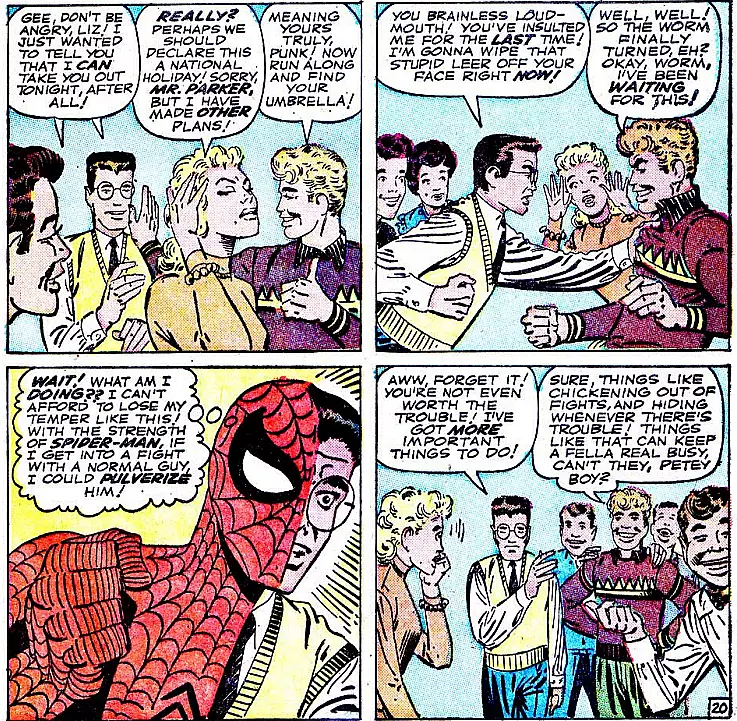
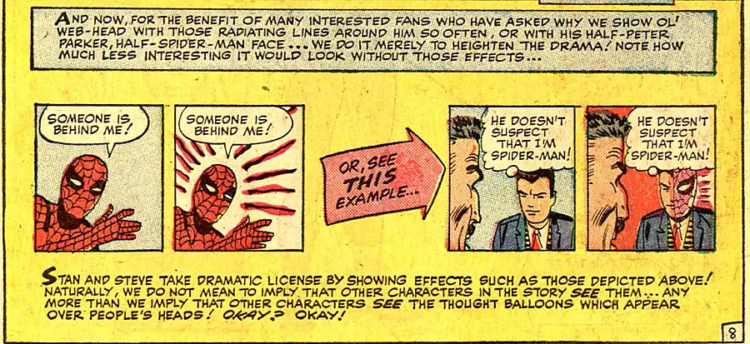
For a time, at least, such creative disagreements were seemingly resolved by the willingness of both parties to engage in constructive discussion. Their differing perspectives would be reflected in the unique nature of the strip, including some early innovations/compromises. A specific example of the latter was Ditko’s creation of a visual device in which half of Peter Parker’s face would be depicted with the Spider-Man mask – something that could be utilised when an aspect of his superhero identity was referenced during civilian scenes. As Ditko explained, it was a direct response to Lee’s concerns that he “…was using too many panels with supporting characters, especially PP’s classmates so any mention of S-m brought on some visual S-m presence.”
—Steve Ditko ‘A Mini-History Amazing Spider-Man #2’ The Comics! Vol. 13 #1 January 2002, the newsletter of Robin Snyder.
2.7. The Influence of ‘Others’
The emergence of divergent views within the Lee/Ditko team would be exacerbated by the attention Lee gave to readers’ opinions. There is no question that part of Marvel’s rapid rise was attributable to Lee’s active engagement with the target audience. He regularly encouraged feedback via the popular letter pages that appeared in the magazines, and even utilised some specific reader story suggestions. It was an approach that had obvious benefits, ones that were recognised by fellow creators like Jack Kirby.
Ditko himself took at least some interest in what fandom was saying about Marvel:
“Comic book fans who put out fanzines sent them to Marvel and Flo (referring to Flo Steinberg – Lee’s secretary at the time) would let me have them to read.”
— Steve Ditko, fan letter (addressed to Bryan Stroud) dated 7 May 2019, as reproduced in Alter Ego #160, September 2019, TwoMorrows Publishing
However, he became concerned that Lee was paying too much attention to feedback from ‘others’ or ‘outsiders’ – a disparaging term he used to describe those external to the Lee/Ditko creative team. This was particularly so when ‘OOs’ wrote in to express dissatisfaction with certain elements of their work:
“Stan had a tendency to believe complainers, OOs, know best. He granted them some kind of superior insights, knowledge. So they should be given arbitrary authority over the ideas of the editor, writer and artist”
— Steve Ditko, ‘A Mini-History Further Complaints and Influences of the OOs’ The Comics! Vol 14 No 6 June 2003, the newsletter of Robin Snyder.
Ironically, one of the first targets of the ‘OOs’ was the visual device Ditko had created to allay Lee’s earlier concerns. Readers provided feedback to say that both the ‘split-face’ and ‘spider-sense’ imagery were ‘bad’ or confusing, prompting Lee to request that Ditko discontinue their use. Ditko noted that Lee never followed up on this direction (for reasons that were not recorded) and in a possible compromise the features section of Amazing Spider-Man Annual #1 included an explanation of the visuals for readers.
Readership reaction would shape an important narrative involving Peter Parker’s social life in the pages of Amazing Spider-Man. Betty Brant, the secretary to J Jonah Jameson, had been introduced in the fourth issue (with “story/art panel ideas…originated from Stan’s 1 or 2 page synopsis.”) and her early appearances resulted in “…some early negative mail” with respect to the romantic implications present in her interactions with Peter Parker.
— Steve Ditko, ‘A Mini-History 7: The Amazing Spider-Man #4’ The Comics! Vol 13 No 8 August 2002, the newsletter of Robin Snyder.
Some months later Ditko would push this scenario further with his inclusion of a scene depicting Peter and Betty in the aftermath of a battle with the Vulture in issue 7 (December 1963). This sequence, while still presumably dialogued by Lee, had not been part of his synopsis:
“Then I added the ending… indicating an actual budding romance. The explicitness proved to be a situation some (or many) S-m followers did not like or want to see continue.”
—Steve Ditko, ‘A Mini-History 8 Others, Outsiders (OOs): Complainers and Complaints Against Betty Brant’ The Comics Vol 14 No 2 February 2003, the newsletter of Robin Snyder.
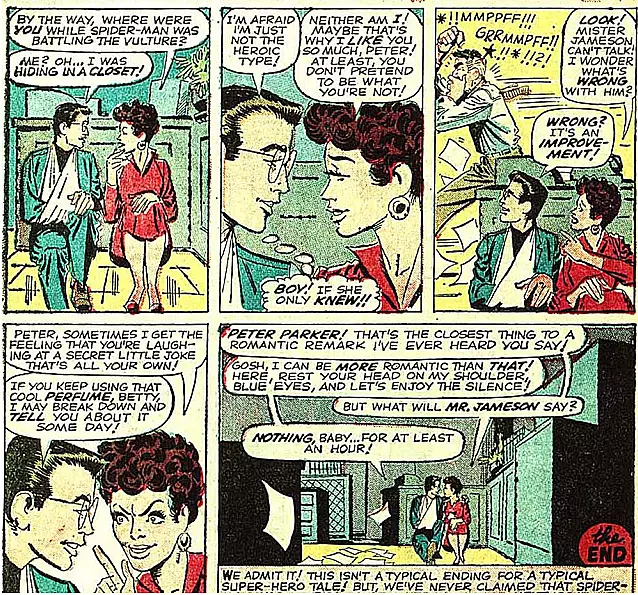
Ditko recalled “The OOs rationale was that since PP was a high school student and teenager and BB was a working girl she must be an adult and therefore obviously too old for PP.” This supposed age gap was something that Lee would later address in the letter pages of the Amazing Spider-Man, but in the meantime he “…wanted something worked out…” to address the complaints. Whether or not Ditko argued the point is unclear, but he did have his own thoughts as to how the storyline might progress:
“I had the idea we establish a real romance between Betty Brant and Peter Parker and then have her die in some kind of accident – nothing criminal, just the kind of unfortunate tragedy that happens in real life.”
—Steve Ditko, ‘A Mini-History 8 Others, Outsiders (OOs): Complainers and Complaints Against Betty Brant’ The Comics Vol 14 No 2 February 2003 the newsletter of Robin Snyder.
This time it was Lee’s vision of the strip that prevailed. He rejected the suggestion, convincing Ditko that such a development would be detrimental to the strip’s integrity in the longer run:
“Stan rightly believed that (Betty’s) death would cast a negative pall over (Peter and Spider-Man). They would lose their light-hearted approach to (J.Jonah Jameson), to action, to life. The nature of (Spider-Man) was a light-hearted form of entertainment, (Peter’s) problems were of no real crises. (He) held his own with his classmates, won more times than he lost with the feuding JJJ, and Aunt May was a source of courage and inspiration, living with health problems and the lone responsibility of bringing up her nephew. Whatever the problems with (Peter and Spider-Man), the feature wasn’t a downer.”
—Steve Ditko, ‘A Mini-History 8 Others, Outsiders (OOs): Complainers and Complaints Against Betty Brant’ The Comics Vol 14 No 2 February 2003, the newsletter of Robin Snyder.
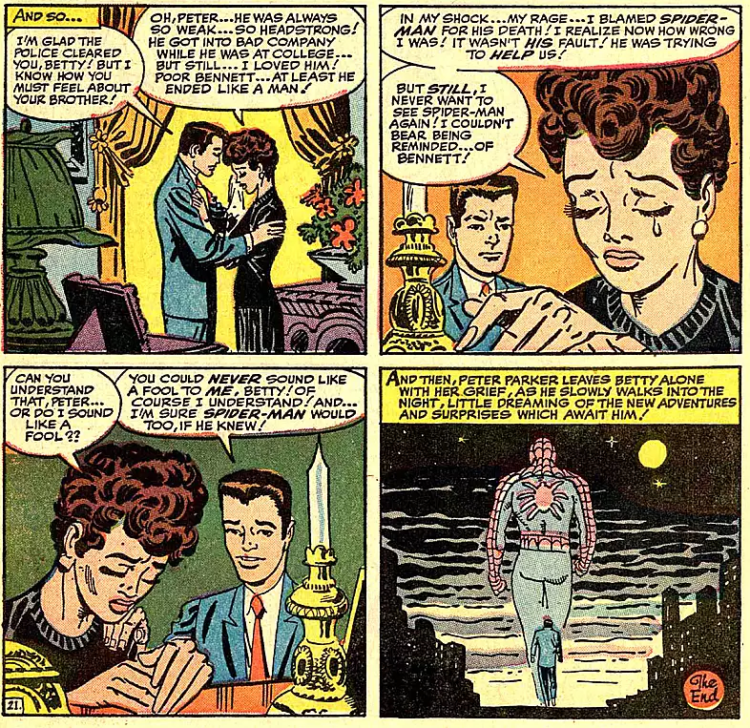
The agreed solution involved introducing (and killing off) Betty Brant’s brother in issue 11 (April 1964) in a manner that left Betty with strongly negative feelings towards Spider-Man. This effectively neutralised Peter’s plans to reveal his identity and pursue a romantic relationship.
If Ditko had no objection to appeasing criticisms of the Peter/Betty relationship, the same could not be said about the negative commentary Marvel was also receiving in relation to Aunt May:
“Their complaints were that AM (Aunt May) was too old, too frail and, especially, too ugly.”
—Steve Ditko ‘A Mini-History 8 The OOs and Aunt May’, The Comics! Vol. 14 No. 4 April 2003, the newsletter of Robin Snyder
Lee’s initial reaction was to suggest altering Aunt May’s appearance to make her “more attractive, more visually appealing” to readers. Ditko, however, believed that her changing appearance was a natural consequence of the events in Peter Parker’s life and that her characterisation served the story well:
“AM [Aunt May] developed from her first appearance as a plump, jovial woman (Amazing Fantasy #15, 1962) in a way I believe she worked best for the PP/S-m story world. The tragic death of her husband, Ben, meant AM would have the sole responsibility for raising her nephew, Peter Parker (PP). That alone would have placed a worrisome burden on her. It could explain the change in her appearance and correctness of her looks if her visual appearance needed justifying.”
“The visual contrast, visual age difference, between AM and PP in itself establishes the human drama of the real life process. The elderly have concerns with their health, responsibilities and diminishing potentials, limitations, in many ways, areas that need attention, concern and action.”
Lee thought of another idea: she could exit the strip by dying a natural death, leaving Peter Parker to move on with his life and secure permanent employment with the Daily Bugle. Ditko responded by asserting that Peter would then be in a scenario reminiscent of the competition’s Clark Kent (who also worked for a major newspaper) making Spider-Man: “a rank imitation, a copycat version, a Brand Echh idea.” The discussion apparently went no further.
—Steve Ditko ‘A Mini-History #8 The OOs and Aunt May’ The Comics! Vol 14 No. 4 April 2003, the newsletter of Robin Snyder.
Another major character, J. Jonah Jameson, also proved susceptible to reader criticism. This prompted Lee to ask Ditko to tone down some of Jameson’s “facial features (laugh etc.), the visual stimuli that caused the OOs emotional pain…”:
“Why? Two reasons
1) They didn’t like the way JJJ was always picking on S-m (Spider-Man) and poor PP (Peter Parker).
2). They certainly didn’t like the way I showed JJJ acting – his laughing facial features – at poor S-m/PP’s expense.”
—Steve Ditko ‘A Mini-History 10 The OOs and JJJ’ The Comics! Vol 14 No 5 May 2003, the newsletter of Robin Snyder.
Ditko again held a differing perspective, viewing the request in a broader context:
“Stan was willing to appease the complainers without any real understanding of the what, why and how of the JJJ/PP/S-m relationship and the negative response of the OOs. And more importantly, the consequences for S-m with the appeasing because the real issue wouldn’t be dealt with, just evaded.
There was definitely something wrong with the idea of toning down JJJ but we went on to discuss other things.
Later, when I had had the chance to think about JJJ and the OOs, my understanding of the complaint and the complainers became clear.
Someone’s dislike, displeasure, is not a cognitive argument for or against anything, it is a desire for some personal, subjective, emotional gratification and, too often, a whim.”
—Steve Ditko ‘A Mini-History 10 The OOs and JJJ’ The Comics! Vol 14 No 5 May 2003, the newsletter of Robin Snyder.
2.8. Crossovers
One of the distinguishing aspects of the early Spider-Man stories was their integration into the wider Marvel Universe via character crossovers, a strategy that Lee employed across a range of Marvel titles. Many readers enjoyed seeing different characters interact, while the blending of various aspects from different titles helped to generate a variety of dramatic story scenarios. This would become a defining standard of the Marvel Cinematic Universe decades later. It would also form the basis of another difference of opinion between Lee and Ditko.
In later reflections Ditko would pose a rhetorical question: “What does using guest heroes (GH) and guest villains (GV)…actually achieve in specific story world?” From his perspective the unique appeal of a strip could be potentially compromised by the use of crossovers, and in later writings he made a point of listing those which had occurred in the pages of the early Amazing Spider-Man issues:
“The Fantastic Four (FF) were guest stars in The Amazing Spider-Man# 1, 5 and 8. The Human Torch (HT) was a guest star in #s 3, 8, 17-19 and 21. The Hulk in #14, Daredevil in #16. Dr Doom in #5, The Ringmaster and his circus crew in 16 and 22 and The Beetle in #21.
“In AS-m #18 there were guest spots of the FF, Daredevil, The Avengers, Iron Man, Thor, Giant-Man and the Wasp, and Captain America – 11 different Marvel heroes.
So the first 22 issues of As-M had guest heroes and guest villains in issues 1, 3, 5, 8, 14, 19, 21, 22. Over fourteen others, outsiders, guested in S-m.”
— Steve Ditko ‘A Mini-History 12: Guest Stars: Heroes and Villains’ The Comics! Vol 14 No 7 July 2003 the newsletter of Robin Snyder.
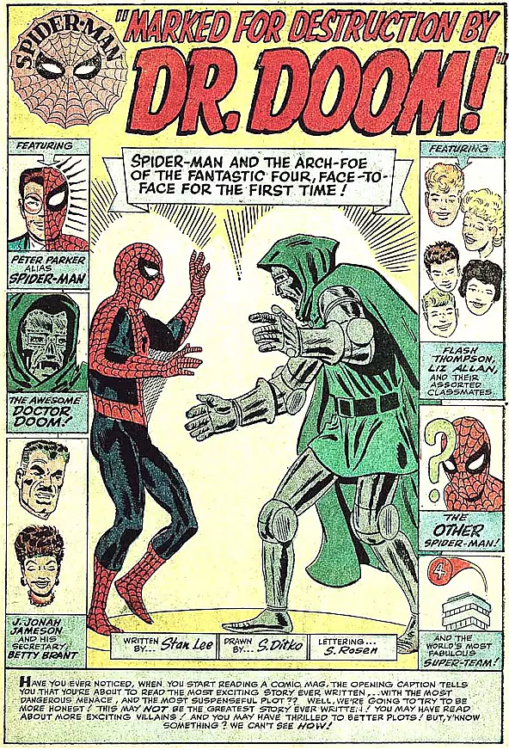
While Ditko acknowledged the “…economic advantage in using guest heroes/villains to attract buyers…” he didn’t believe their inclusion necessarily helped build a growing readership. More importantly, he felt they could be detrimental to any focus on building an inspirational, individual hero. Ditko further asserted that guest stars brought contextual elements along with them that could be at odds with the credibility of the main character’s world (citing, as an example, one of Lee’s suggestions that Spider-Man be pitted against Attuma, an underwater foe created for the ‘Sub-Mariner’ strip):
“Those kinds of inclusions make an undesirable package deal of incompatible, even contradictory, story ideas, elements. It is like mixing two different recipes or two drug prescriptions in the belief that there must now be an increase or doubling of taste enjoyment or health benefits.”
— Steve Ditko, ‘A Mini-History: Guest-Stars: Heroes and Villains’, The Comics! Vol 14, No. 7 July 2003 the newsletter of Robin Snyder.
For Ditko it was important for strips such as Spider-Man to establish and maintain their own integrity/identity, something he felt could be compromised by Lee’s penchant for crossovers:
“Everyone used from another hero’s story-world prevented us from focusing on, creating and developing our own unique story-world of characters and villains like Dr. Octopus, Electro, Kraven, etc. And it affected S-m’s own cast—JJJ, Betty, Flash, Aunt May—such as Johnny Storm’s (HT) relationship with Peter and his classmates, etc. All outside, other inclusions robbed us of our unique potentials.”
— Steve Ditko, ‘A Mini-History: Guest-Stars: Heroes and Villains’, The Comics! Vol 14, No. 7 July 2003 the newsletter of Robin Snyder.
2.9. Ditko’s Opinions: Lee’s Dialogue/Narrative and Sound Effects
For many readers, Lee’s dialogue and narration contributed significantly to the distinct charm of Marvel Comics in the 1960s. Competing comic book publishers occasionally tried to replicate his style, though generally with limited artistic or commercial success. One reason for its uniqueness was that Lee wrote those words after the artists had already laid out the stories and images, rather than in anticipation of how the artist would interpret any directions.
Meanwhile, Ditko was crafting the same Marvel stories from the perspective of an ‘artist-plus’ (and, as time went by, sole plotter) with his own vision of how the characters acted. He was also creating the panel images and providing rough notes for Lee to explain what he intended them to convey:
“…I gave Stan typewriting paper showing my rough ideas of what was being said in the story broken down into panels. Stan never wanted me to write any actual dialogue or names. That goes back to our 5 -page days. Writing, editing, dialogue, sound effects, captions, were all Stan’s division of labor at Marvel.”
— Steve Ditko, ‘#45: Why I Quit S-M, Marvel’ The Four-Page Series 9, September 2015
Lee’s writing on the strip would draw strong criticism from Ditko in later years:
“Stan’s writing style was completely wrong for Spider-Man. He treated teenage Peter Parker as a seasoned veteran with his nonsensical comic dialogue exchanges between a hero and a villain. Creative ideas are no good if not used in a proper way.”
— Steve Ditko, July 2015 letter p 72` Ditko Shrugged. David Currie 2020
However, Ditko subsequently provided a more nuanced critique, pragmatically acknowledging the appeal Lee’s approach held for readers:
“Stan’s dialogue style of hero/villain wisecracking, undercut the conflict of hero, villain – but it worked with readers who just wanted to be entertained. I believe Stan loved writing those corny captions. It added to reading appeal but undercut a more serious growth of a teenager in an heroic role.”
— Steve Ditko, July 2016 letter to David Currie, Ditko Shrugged, David Currie, 2020 p 74
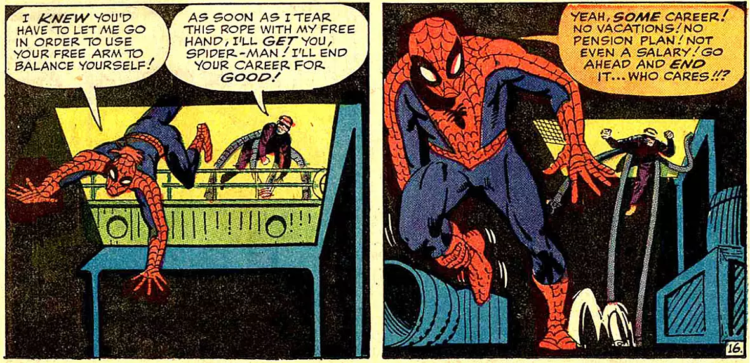
Whether the writing was an open point of contention at the time the comics were being produced remains unknown, as Ditko made no reference to ever raising the matter directly with Lee. However, Ditko would recall voicing objections concerning Lee’s sound effects (and, apparently, the use of ‘speed lines’)—and his recollection also provides an insight into how such disagreements could play out in their more general conversations:
“I often objected to his use of and placement of sound effects in and on my artwork, telling him that it corrupted my design for no good reason.
He responded by saying the sound effects will make for a stronger scene.
When I asked him what a battle scene in Hal Foster’s Prince Valiant would look like with Marvel speed lines and sound effects, he answered that Foster wasn’t doing a daily strip.
I used to get non-sequiturs like that from Stan whenever I would question or criticize one of his decisions.”
— Steve Ditko, ‘I Remember Sound Effects’, The Comics, Vol 33 1 No. 5 May 2022: the newsletter of Robin Snyder.
2.10. Dr Strange
While Spider-Man was finding his direction in the pages of his new monthly title, Ditko was developing another strip without Lee’s input. This would be centred around a mysterious protagonist skilled in the art of sorcery:
“On my own, I brought in to Lee a five-page, penciled story with a page/ panel script of my idea of a new, different kind of character for variety in Marvel Comics.
My character wound up being named Dr Strange because he would appear in ‘Strange Tales’.”
—Steve Ditko, ‘He Giveth and He Taketh Away’ (The Avenging Mind, 2007, reprinted in The 32 Page Series Vol 1, Overture 2019)
Another quote makes it clear that Lee was the one who named the character (and provided the final dialogue for the first story):
“The idea for the character, the 1st story is mine. The character was named, story dialogued by Stan from my rough page scripts, Dr. Strange because all the stories appeared in the comic titled ‘Strange Tales’.
— Steve Ditko, Letter shown in Steve Ditko Biographical Interview with Pat and Patrick Ditko by Alex Grand, video posted on Youtube by Comic Book Historians Channel, 18 October 2023
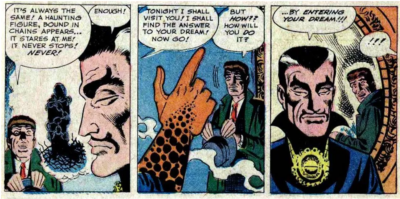
Ditko’s Dr Strange’, would debut as a back-up story in Strange Tales #110 (July 1963) and was further evidence of Ditko’s stature as a creative force at the company. Whether Lee had even requested or given approval for the development of a new feature is unrecorded. Regardless, Lee recognised potential in Ditko’s submission and announced the character in a 1963 letter to fan (and fanzine publisher) Jerry Bails. In doing so he indicated that he was not entirely satisfied with Ditko’s take, seemingly in anticipation of reader reactions. Lee also mentioned an early revision that had already been made:
“Well, we have a new character in the works for STRANGE TALES (just a 5-page filler named DR. STRANGE–) Steve Ditko is gonna draw him. Sort of a black magic theme. The first story is nothing great, but perhaps we can make something of him – ’twas Steve’s idea, and I figgered we’d give it a chance, although again, we had to rush the first one too much. Little sidelight: Originally decided to call him MR. STRANGE, but thought the MR. bit too similar to MR. FANTASTIC– now however, I just remember we had a villain called DR. STRANGE just recently in one of our mags – hope it won’t be too confusing! Oh well…”
— Stan Lee, The Comic Reader #16 (February 1963)
The decision to make the character a ‘Doctor’ would prove to be important, as Ditko’s initial story had not provided any background for the character (who also appeared to be Asian in his early appearances). When this was belatedly presented in Strange Tales #115 (September 1963) the narrative leaned heavily on the medical aspect to establish the sorcerer’s tragic beginnings and motivations. An introduction by Lee asserted that reader requests had prompted the disclosure of Strange’s origin at this late point.
Lee also created the character’s first name for that same origin tale:
“The name “Stephen Strange” was Lee’s idea. “It was Stan’s little joke,” Ditko said, adding that he never would have used his own first name for Dr. Strange.”
— Russ Maheras ‘Two Visits To STEVE DITKO’s Studio/Sanctum Sanctorum’ by Russ Maheras, Alter Ego, #160 p 49, TwoMorrows Publishing
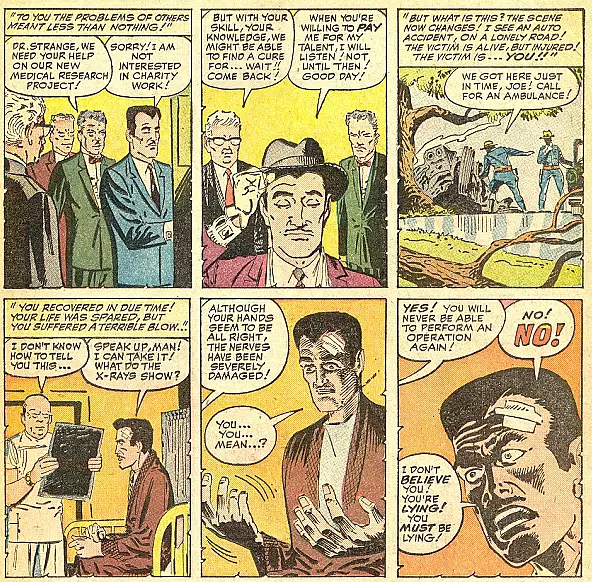
While the introductory tale was entirely Ditko’s, Lee was soon applying his own plots/storylines (via the use of written synopses) to the new strip, in addition to providing dialogue/narration. But Lee’s story ideas (strongly reminiscent of the team’s pre-1961 work) as well as the employment of his favoured crossover strategy (this time with the ‘Thor’ feature) proved unpopular with his collaborator. When recalling this situation many years later Ditko would disparagingly reference Lee’s letter to Jerry Bails, specifically Lee’s assertions about ‘making something’ of the then-new Dr Strange strip:
“And what were some of Lee’s ideas of ‘doing something with it’? We get Lee’s aliens, haunted house, guest star Loki from the Thor series, etc.”
— Steve Ditko, ‘He Giveth and He Taketh Away’ The Avenging Mind 2017 (as reprinted in The 32 Series by Ditko Vol 1. Overture 2019, p34
Ditko’s dissatisfaction with Lee’s input was further exacerbated by the decision to assign other inkers to the strip – none of whom met his standards. Regardless, Ditko continued to believe in the viability of his concepts:
“Even some poor plots by Stan and others and incompetent inkers, didn’t sink my basic ideas for Doctor Strange.”
“He never fit into Marvel’s world of heroes but starting out as a 5-page filler was a great opportunity to try out all kinds of ideas. I don’t know why Stan had other artists ink Doctor Strange.”
Stan did not really understand the potentials of Doctor Strange. He was used to his usual 5-page ghost, haunted house type of stories.”
— Steve Ditko, quoted by David Currie from letter September 2014, David Currie Ditko Shrugged p 65
The extent to which Ditko may have expressed his concerns directly with Lee remains unknown. Regardless, it would not be long before their ongoing creative differences would lead to significant changes in the Lee/Ditko working method.
2.11. ‘I Rejected Stan’s Idea’ – The Green Goblin
Amazing Spider-Man #14 (July 1964) would see the publication of a story that was quite different to the one originally envisioned by Lee, as Ditko opted to deviate significantly from key elements of the latter’s story synopsis/direction. Hence the introduction of a new villain known as the’ Green Goblin’ reflected Ditko’s re-imagining, rather than Lee’s conception:
“Stan’s synopsis for the Green Goblin had a movie crew, on location, finding an Egyptian-like sarcophagus. Inside was an ancient, mythological demon, the Green Goblin. He naturally comes to life.
I rejected Stan’s idea.
Why? For the same reason I rejected other ideas of Stan’s on Spider-Man.”
“A mythological demon made the whole Peter Parker/Spider-Man world a place where nothing is metaphyscially impossible. It would open up the story to anything goes.”
— Steve Ditko, ‘A Mini-History 1: The Green Goblin’, The Comics! Vol 12 No 7 July 2001 the newsletter of Robin Snyder.
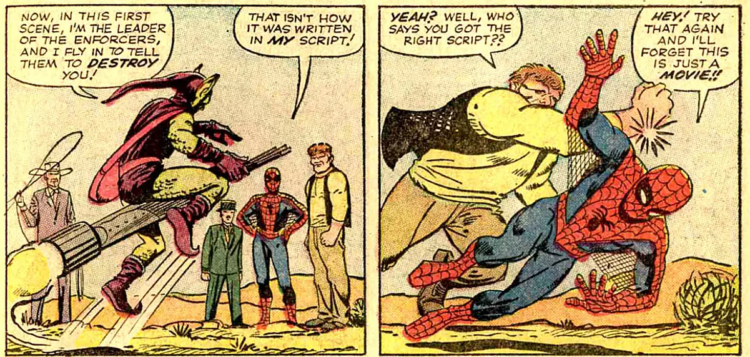
Ditko’s interpretation of the Green Goblin accorded with his preference for more grounded characters in the Spider-Man universe. A costumed human, his real face was obscured, and his identity would remain a mystery for the remainder of Ditko’s run. Significant planning was put into Ditko’s revision, reflecting the artist’s predilection for building longer term narratives spanning multiple issues:
“I had to have some definite ideas: who he was, his profession and how he fit into the Spider-Man story world. I was even going to use an earlier, planted character associated with J. Jonah Jameson: he [was to] be [revealed as] the Green Goblin. It was like a subplot working its way until it was ready to play an active role.”
“I knew from Day One, from the first GG story, who the GG would be. I absolutely knew because I planted him in J. Jonah Jameson’s businessmans’ club, it was where JJJ and the GG could be seen together. I planted them together in other stories where the GG would not appear in costume, action.”
“I wanted JJJ’s and the GG’s lives to mix for later story drama involving more than just the two characters”
“I planted the GG’s son (same distinctive hair style) in the college issues for more dramatic involvement and storyline consequences”
— Steve Ditko, ‘The Ever Unwilling’, The Comics! Vol. 20, No. 3 [March 2009], the newsletter of Robin Snyder.
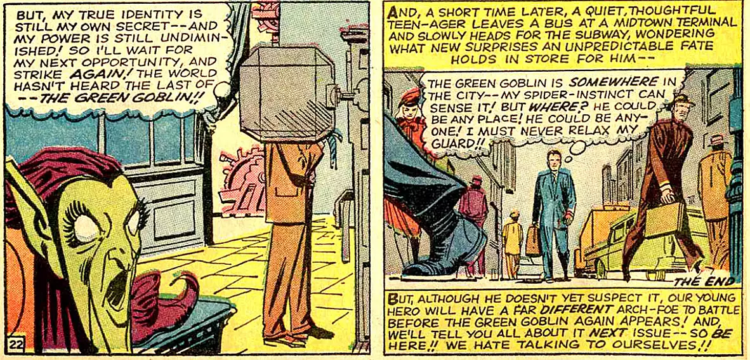
Ditko’s accounts of earlier open disagreements with Lee had depicted them taking place during the back-and-forth of creative discussions. In this instance, however, Ditko made a substantial change to Lee’s written direction, although whether this had any lasting effect on their relationship is unknown. Ditko did not elaborate on Lee’s immediate reaction, but this would be his last reference to working from Lee’s written synopses on The Amazing Spider-Man. The very next issue would introduce a new villain, ‘Kraven the Hunter’, one of a handful of villains for whom Ditko would specifically claim sole creative credit.
Lee’s influence on the Amazing Spider-Man title continued to be felt through the appearances of guest-stars in the following months (including ‘Daredevil’, the ‘Human Torch’, the ‘Beetle’ and the ‘Circus of Crime’). Even so, the letters page for issue 17 (October 1964) informed readers that Ditko would be solely responsible for the plot of the following issue, an off-beat tale in which Spider-Man would quit his superhero career for the first (but far from the last) time:
“And as for ol’ Spidey, next ish is gonna be real different! The whole plot was dreamed up by Sunny Steve and it was just nutty enough for Stan to okay it! You’ll see Spidey acting differently than ever before! ‘Nuff said!”
Letters page, Amazing Spider-Man #17 October 1964
Ditko, who was firmly of the opinion that “To see JJJ is to have the pleasure of reacting against him”, also used Amazing Spider-Man #18 (November 1964) as an opportunity to exaggerate Jameson’s facial expressions further than ever before:
“When I was doing issue 18 (1964), I deliberately drew the ugliest smile on JJJ that I could conceive on the splash page. All through the story I added bits, sequences, playing up JJJ’s facial features as much as I could.”
—Steve Ditko ‘A Mini-History 10 The OOs and JJJ’ The Comics! Vol 14 No 5 May 2003, the newsletter of Robin Snyder.
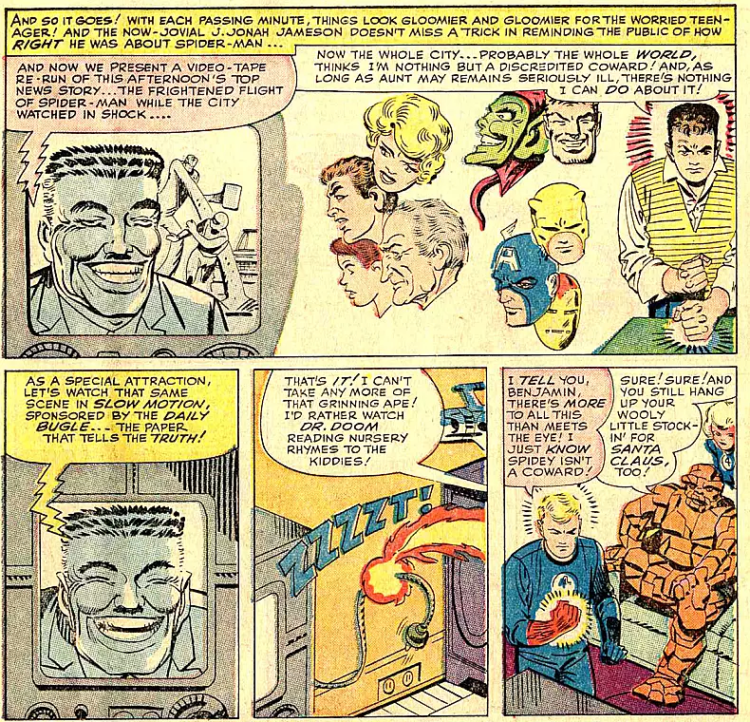
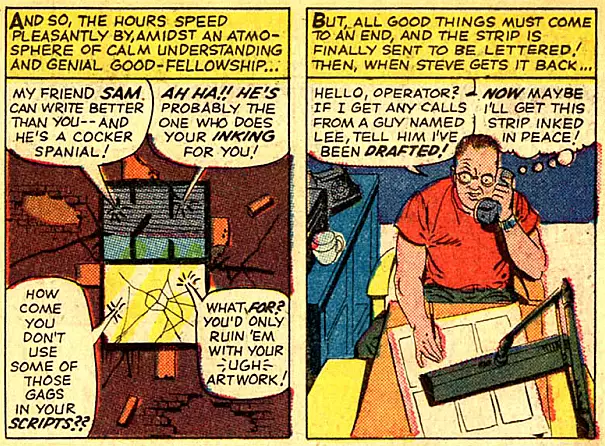
October 1964 saw another significant development with the publication of Amazing Spider-Man Annual #1. This included a humorous segment titled ‘How Stan Lee and Steve Ditko Create Spider-Man’, depicting the two creators squabbling as they worked on a new story. Ditko would later acknowledge Lee’s involvement in the conceptual stages of the Annual, but made it clear that the synopsis method was not employed:
“We only talked about the ‘ideas’ for the first S-M annual. Nothing was written by Lee.”
—Steve Ditko, ‘He Giveth and He Taketh Away’ Avenging Mind 2007 (reprinted in The 32 Series by Ditko Vol 1. Overture)
2.12. Tales to Astonish
If Lee had any concerns about the viability of the Lee/Ditko team in the face of creative discussions/disagreements that were taking place in 1964, they didn’t prevent him from approaching Ditko with the offer of working together on a third series. The result was a relaunch of the Hulk as a co-feature in the pages of Tales to Astonish #60 (September 1964):
“I was interested in working up an idea on my own as I did with Strange, again for the sake of variety. I intended to do a hero in street clothing to avoid special costume changes.
Stan offered me Daredevil. I had already helped with the first issue but I didn’t want to do him because he was too close to Spider-Man – spider senses, blind super senses – and I didn’t like the cane gimmick. I turned down Iron Man because I didn’t find the character with his weak heart gimmick interesting enough.
Stan had a list of possible old Marvel characters to choose from: Kazar, the Sub-Mariner, Hulk and other oldies.
I shelved my ideas because Stan wanted a character to publish soon. I decided on the Hulk because I could work on the military angle, one that was very different from Spider-Man and Dr Strange.”
— Steve Ditko ‘And Lo, There Was a Hulk’ The Complete Four-Page Series and Other Essays
Lee, having recognised the Hulk’s failure to resonate with readers in his short-lived title, was keen not to do “…the same Lee/Kirby-type feature”, which meant that there “…had to be a noticeable difference” with the new Lee/Ditko version:
“There were discussions between us about the 2nd Hulk. A big part centred on what Stan wanted to discard, what we could keep and why.”
“The military context would remain with the supporting cast of General Ross and his daughter. The aliens, monsters, outsized villains in far-out fantasies, were scrapped as junk material.
The more human type of villain, meaning the less super-powerful in contrast to the Hulk, were in.”
“So the more possible, logical, believable – a “realism” – was definitely in.”
— Steve Ditko ‘And Lo, There Was a Hulk’ The Complete Four-Page Series and Other Essays
There would also be a deliberate attempt to employ the humanising elements that had worked so well in the Amazing Spider-Man title:
“Since the Parker/Spider-Man type of problem was working successfully, Stan believed that was the direction to go with Banner/Hulk.
So there would be more emphasis on showing the psychological, social problems of Banner and his role as the Hulk and how it affects his relationship with others and with his life in the world.”
— Steve Ditko ‘And Lo, There Was a Hulk’ The Complete Four-Page Series and Other Essays
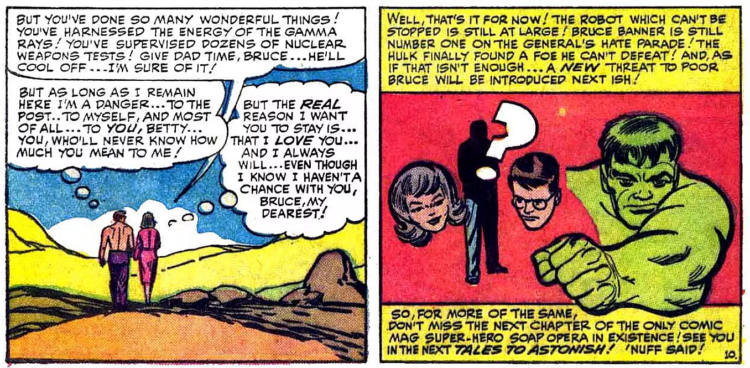
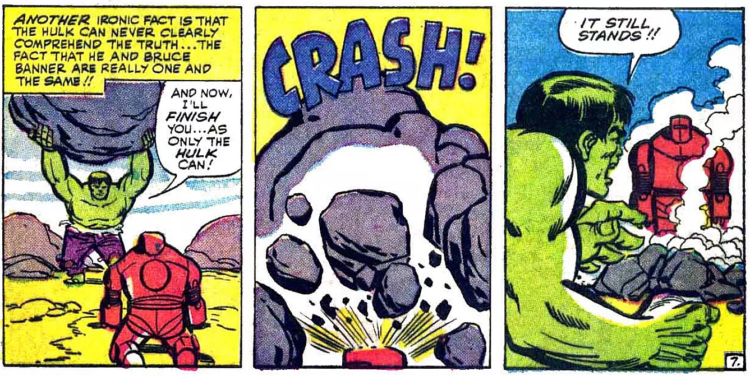
One major element that differentiated this new iteration of the Hulk was the decision to make stress/anger the trigger for Banner’s ongoing transformations. Although the new stories clearly capitalised on this, Ditko’s accounts made no mention as to who initiated it. The concept would be introduced to readers in a ‘Giant-Man’ story (which guest-starred the Hulk) appearing in Tales to Astonish 59 (September 1964) – one issue prior to the commencement of Ditko’s run.
During the course of this series Ditko again operated as ‘artist-plus’ in a working method that involved “…the usual Lee plot synopsis, my working out the story pages/panel breakdown, penciling of the art, rough script and then going over the material with Stan.” As with the Dr Strange strip, Lee chose to employ a separate inker on the strip, even though (as a co-feature) it required half the pages per month that a full issue would entail:
“It may have been because I didn’t believe I could do it each month along with Spider and Strange.”
— Steve Ditko ‘And Lo, There Was a Hulk’ The Complete Four-Page Series and Other Essays
This re-launch successfully re-established the Hulk as a viable property, even though Ditko’s tenure as artist from Tales to Astonish issue 60 (September 1964) until issue 67 (May 1965) was relatively brief (for reasons that remain unrecorded). It was also apparently a smooth collaboration, with no creative tensions being mentioned by either creator. Ditko would look back on the strip with a particular sense of pride – contrasting it with the original Lee/Kirby series:
“Setting aside the dispute between Stan and Jack Kirby as to the ‘creation’ of the Hulk, their Hulk ‘idea’ , ‘creation’, failed. Stan and I did the sixth and last issue (March 1963) of that Hulk series.
I was instrumental in bringing out the second version of The Hulk with different ‘ideas’ by Stan and me. The second Hulk went on to continuing success.”
— Steve Ditko, ‘Tsk! Tsk! Examining a “Creator”/”Creation” Claim’, The Avenging Mind p 137
Part Three (1965/1966)
3.1. ‘I took over the plotting, writing stories…’
As 1965 commenced the Marvel superhero line was firmly established and performing strongly, with the Lee/Ditko Amazing Spider-Man amongst the publisher’s most popular titles. Ditko was now enjoying a significant level of control over the strip’s narrative, and was largely free to ignore plot/character ideas from Lee that he considered banal or otherwise contradictory to his own vision:
“Stan was willing to go along with my not using his usual monthly plots – like having Spider-Man battle Attuma or introduce a Spider-Girl, a purely monthly episode.”
—Steve Ditko (letter to David Currie May 2015, quoted in David Currie Ditko Shrugged 2020. p 75)
The creative transition was, at least from Ditko’s recorded perspective, uneventful. Lee continued to provide dialogue and was actively involved as the strip’s editor. The two would meet regularly to review pencilled pages, discuss respective ideas/directions and produce cover designs. But the actual storylines were now effectively Ditko’s, and he viewed the new arrangement as one that worked well for both Lee and Marvel:
“I took over the plotting, writing stories long before any writing credit. It took some pressure off Stan and the titles weren’t ever late in publishing.”
— Steve Ditko Letter to David Currie July 2016 quoted in Ditko Shrugged, David Currie, 2020, p 71
Lee’s influence in relation to the employment of guest-stars seemingly continued, at least for a while. The Human Torch, whom Lee had utilised as a semi-regular guest-star since the first issue, returned for prominent roles in issues 19 (December 1994) and 21 (February 1965) to help Spider-Man battle foes like the ‘Sandman’ and the ‘Beetle’ (the latter having originated as a foe of the Torch in Strange Tales). But these would mark the Torch’s final appearances in the ASM during Ditko’s run, and the plotter/artist portrayed the team-up in a way that reflected his own sensibilities:
“I also deliberately made S-M and the HT ineffective as a “team” in capturing the B (Beetle)…In yet another S-M/HT team up (#19) I had two policemen capture the Sandman.”
— Steve Ditko, ‘A Mini-History: Guest-Stars: Heroes and Villains’, The Comics! Vol 14, No. 7 July 2003 newsletter of Robin Snyder
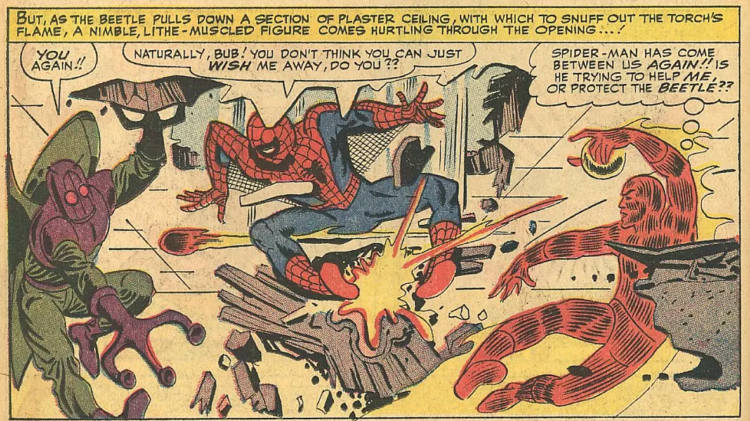
Crossover characters in the regular Ditko run would finally come to an end in Amazing Spider-Man #22, March 1965, with a return appearance from the villainous ‘Circus of Crime’ (featuring characters that had originally appeared in the early ‘Hulk’ strip). From that point on the focus of the strip was squarely on the titular hero and his homegrown cast:
“The less outside help a hero gets, the more he alone demonstrates his abilities, determination, to overcome obstacles (personal, social etc.) and defeat the villain. It is a greater, real test of his heroic personality, loyalty to real, pro-life values.”
— Steve Ditko, ‘A Mini-History: Spider-Woman/Spider-girl’ The Comics! Vol 13 No 5 May 2002, newsletter of Robin Snyder
3.2. ‘I was the only one who understood Dr Strange’s potentials’
Similar changes in narrative control also took place on the Dr Strange strip, which continued to attract an audience in Marvel’s Strange Tales publication. Ditko, dissatisfied with Lee’s story concepts (as well as his employment of guest stars and different inkers), later speculated that the sheer volume of Lee’s work during that period may have been a factor:
“Stan may have had too many characters, titles to handle, write for so he needed some formula approach for everything.”
It’s seen with Dr Strange’s early plots, stories about ghosts, haunted houses etc. and losing a consistent look having someone else ink Dr Strange.”
— Steve Ditko, Letter to David Currie p 67, Ditko Shrugged, David Currie 2020
In other commentary Ditko asserted that Lee was simply incapable of managing a character as unique as Dr Strange, referencing “…Lee’s inability to handle a novel idea that (was) not his usual, typical comic book ideas, powers, such as stretching, flaming, invisibility, monster types, etc.”
— Steve Ditko, ‘He Giveth and He Taketh Away’ The Avenging Mind 2007 (reprinted in The 32 Series by Ditko Vol 1. Overture p34)
Ditko believed Lee had “…a hard time coming with Dr Strange ideas”, and that this was the reason assistance had been sought from another writer, Don Rico. When the situation reached a point where Lee “…was ready to drop Dr Strange because of his difficulties…”, Ditko saw the opportunity to take ongoing control of the stories and implement his own vision: “…I told him that I should be inking and could do Dr Strange because I was the only one who understood Dr Strange’s potentials…”
— Steve Ditko, ‘He Giveth and He Taketh Away’ The Avenging Mind 2007 (reprinted in The 32 Series by Ditko Vol 1. Overture p34)
There is no mention of the tone of this discussion, but Lee evidently agreed to hand over full storytelling duties. Ditko returned as the strip’s ongoing inker for issue 126 of Strange Tales (November 1964) – a tale that also introduced the arch-villain ‘Dormammu’. Don Rico’s brief involvement as a credited scripter took place a few issues later, as of issue 129 (February 1965). In that same publication the following announcement appeared in the letters page:
“Our second surprise is that Dr. Strange begins a new, different type of series next month! Just for a change, Stan asked sunny Steve to dream up a real far-out plot, and if you hadn’t guessed before, you’re about to learn that sterling Stevey Ditko has one of the most inventive, off-beat imaginations anywhere! Don’t say we didn’t warn you! The next one’s going to be DIFFERENT!”
This was followed by a dramatic change in the storytelling as of issue 130, with the strip becoming one continuous, serialised adventure that was heralded as by Lee on the opening page as “…the greatest black magic spectacular ever presented…”
Lee continued to provide dialogue/narrative for most instalments (with credits sometimes referring to him as the scripter, other times as the writer) until Strange Tales #142 (March 1966).
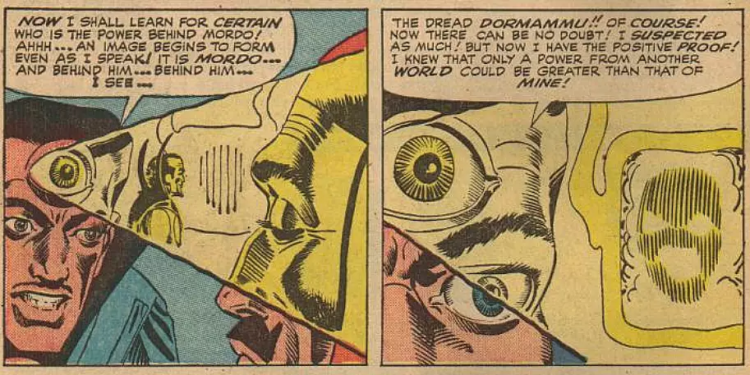
3.3. ‘About half of the Spider-Man stories were mostly mine.’
There has been much speculation over the years regarding the precise extent to which Ditko contributed to stories produced in conjunction with editor/writer Stan Lee.
While it is evident that Ditko assumed full plotting at some point on both the Spider-Man and Dr Strange strips, any specific analysis is complicated by the dynamic nature of their collaborations, as well as the challenge of determining precisely when particular events occurred.
From Ditko’s perspective, however, the answer was a simple one:
“The Dr Strange stories were mostly mine. About half of the Spider-Man stories were mostly mine.”
— Steve Ditko, 13 April 2018 ‘Correspondence, An Exchange of Ideas’, 32 Page Series Vol V Curtain p 222
3.4. Cover Conflict
Another key development also took place around this time, resulting in further changes to the Ditko/Lee working method. It may even have marked a significant turning point in their overall working relationship. In providing the background, Ditko recalled how he and Lee were still meeting regularly to discuss cover designs for the Amazing Spider-Man series:
“Normally, with Stan, when I brought in an inked S-M issue we would gov over the pages for a cover idea.
The cover was always done last and in this way: I’d take a blank sheet of paper, we’d look over the inked pages and Stan would suggest some S-M/villain action for the cover.
I’d rough out the idea…making changes or adjustments or he’d suggest a different idea- Nd I would rough out, adjust etc.
When the idea was what he liked, wanted, I’d pencil and ink the cover.”
— Steve Ditko ‘#45: Why I Quit S-M, Marvel’, The Four-Page Series no. 9, September 2015 (reprinted in The Complete Four Page Series And Other Essays 2020 p 49)
These meetings continued after Ditko assumed full plotting responsibilities but apparently not for much longer. Ditko’s description of their demise was unusually detailed, and suggested a tension absent in many of his other anecdotes:
“…(O)ne day Stan said our past covers weren’t good enough for some reason so our cover collaboration was badly flawed.
The next time to do a cover. I had the blank cover sheet.
Stan suggested some idea. I roughed it out but he really didn’t like it. He suggested another idea and again I roughed it out but it was again not really good enough.
At some point, he asked me for an idea. I told him he said our collaboration ideas weren’t good enough.
Fine. Tell me what you want, I’ll rough it out, you okay it and I’ll pencil and ink it.
Stan couldn’t decide on what to actually do for the cover.
At some point he, he told me to do the cover and from then on when I pencilled a story, I also pencilled the cover.”
— Steve Ditko ‘#45: Why I Quit S-M, Marvel’, The Four-Page Series no. 9, September 2015 (reprinted in The Complete Four Page Series And Other Essays 2020 p 49)
The new division of labour was succinctly summarised by Ditko:
“So it came to me doing the ideas for the whole S-M issue; the story line, villain, continuity and cover and Stan dialogued the material from my page/panel, story/dialogue notes.”
— Steve Ditko ‘#45: Why I Quit S-M, Marvel’, The Four-Page Series no. 9, September 2015 (reprinted in The Complete Four Page Series And Other Essays 2020 p 49)
3.5. ‘I had to leave without seeing or talking to Stan…’
While it is unclear how long this new status quo in the Lee/Ditko working method lasted, Ditko did provide some context for when it ended:
“Then, at some point before issue # 25, Stan chose to break off communicating with me.”
— Steve Ditko ‘A Mini-History, The Green Goblin’, The Comics!, Vol 12, No 7 July 2001] the newsletter by Robin Snyder
“It was already generally known at Marvel that Stan Lee chose not to communicate with me on anything since before issue #25 of the Amazing Spider-Man” (June 1965)
— Steve Ditko ‘He Giveth and He Taketh Away’ The Avenging Mind 2007 (reprinted in The 32 Series by Ditko Vol 1 Overture p 38)
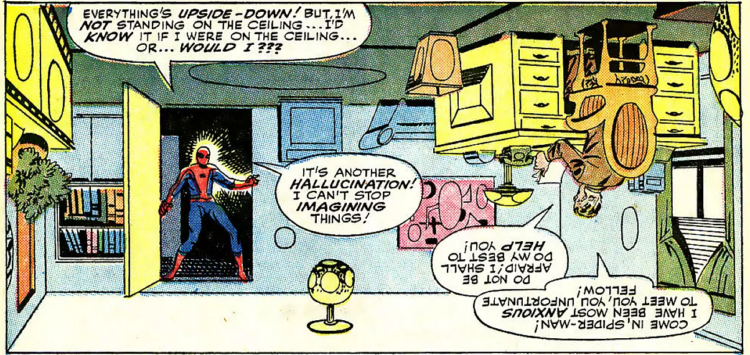
According to Ditko this major breakdown in his relationship with Lee was entirely unexpected, and it took him some time to recognise what had happened. He had arrived at the office as usual to deliver his latest pencilled pages:
“Normally when I took in a pencilled S-M or D-S job, Stan and I would go over every panel; he’d note anything he didn’t understand or something needed, wanted, more detail etc.
I’d mark any needed, wanted changes, correction, addition, to fix on the pencilled page I was to ink. Plus, I gave Stan typewriting paper showing my rough idea of what was being said in the story broken down into panels, Stan never wanted me to write any actual dialogue or names.
That goes back to our 5-page days. Writing, editing, dialogue, sound-effects, captions, were all Stan’s division of labour at Marvel.”
— Steve Ditko ‘#45: Why I Quit S-M, Marvel’, The Four-Page Series no. 9, September 2015(reprinted in The Complete Four Page Series And Other Essays 2020 p 49)
In normal circumstances Ditko would simply enter Lee’s office area if Lee was otherwise unoccupied. This time, however, Sol Brodsky (Lee’s assistant) intercepted him and asked for the pages. Ditko initially assumed that Sol simply wished to look at them, but to his surprise, Brodsky delivered them to Lee himself…leaving a confused Ditko with Lee’s secretary, Flo Steinberg.
Later, having received a call to come in and pick up the scripted pages, Ditko was again met by Brodsky. The pages were silently handed back to him for inking. When Ditko subsequently delivered the completed work at the office it was again received by a still-silent Brodsky:
“I inked the pages, took them in, Sol again took the pages from me and into Stan’s office – came out saying nothing – and I left.”
— Steve Ditko ‘#45: Why I Quit S-M, Marvel’, The Four-Page Series no. 9, September 2015 (reprinted in The Complete Four Page Series And Other Essays 2020 p 49)
Ditko returned to his office, expecting further ‘word’ on the next issue (presumably referring to any editorial direction from Lee concerning guest-stars, villains etc). When this was not forthcoming Ditko proceeded to develop the next issue entirely by himself:
“So, back at my office, I decided on my own to do the next, follow-up S-M with some new villain.
When done and there was still no word from Stan or Sol about the next S-M issue. I took my S-M story/issue and went through the same Sol/Stan routine.
When doing S-M, D-S, I always wrote down my ideas that came to me about the supporting characters, any possible, usable story idea.
At some point after they had been dialogued and lettered, I got my original, pencilled pages back and inked them.
That became our working method on S-M and DS.”
— Steve Ditko ‘#45: Why I Quit S-M, Marvel’, The Four-Page Series no. 9, September 2015(reprinted in The Complete Four Page Series And Other Essays 2020)
(Note: Ditko makes no mention of his departure from the ‘Hulk’ strip, even though his last instalment appeared in the May 1965 issue of ‘Tales to Astonish’. In the absence of any other information, it is impossible to know whether Ditko chose to leave the strip or whether it was Lee’s decision to replace him with the Hulk’s co-creator, Jack Kirby).
Issue 25 of Amazing Spider-Man (June 1965) introduced the threat of the ‘Spider-Slayer’, a robotic menace under the control of J Jonah Jameson. The story ran with the following introductory blurb from Lee: “Sturdy Steve Ditko dreamed up the plot of this tantalizing tale, and it’s full of unexpected surprises! Turn the page and see if you can guess what’s coming next…”
Of course, as Ditko would emphasise, it was certainly not the first time he had crafted stories with no input from Lee:
“The fact is that we had no story or idea discussions about some Spider-Man books even before issue #26 up to when I left the book.”
— Steve Ditko, letter to Comic Book Marketplace # 63 September/October 1998
But with no avenue for any real story collaboration, the Lee/Ditko team could now operate only within the broadest definition of the ‘Marvel Method’:
“Stan never knew what was in my plotted stories until I took in the pencilled story, the cover, my script and Sol Brodsky took the material from me and took it all into Stan’s office, so I had to leave without seeing or talking to Stan.”
— Steve Ditko, letter to the editor, Comic Book Marketplace #63, September/October 1998.
3.6. Plotting Credits
This final iteration of the Ditko/Lee working method would continue for many months, and coincided with a change to the way Lee’s credit boxes were written. Ditko received official recognition as the sole plotter of both Spider-Man (as of Amazing Spider-Man #25, June 1965) and Dr Strange (as of Strange Tales #135, August 1965). Plot credits for Ditko would be the norm from this point on with only a few exceptions (Amazing Spider-Man #31, Strange Tales # 139-140).
The inclusion of specific plotting credits presumably reflected Lee’s complete withdrawal from any story discussions/direction, since Ditko had (in his own words) essentially taken over the actual story construction ‘long before’.
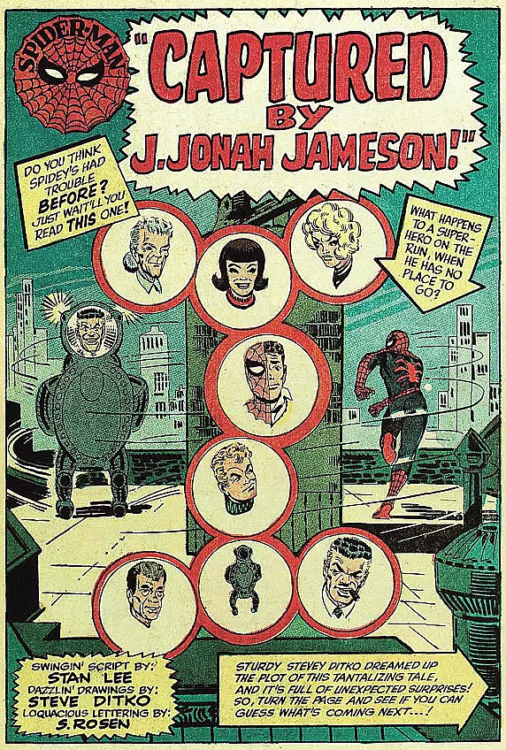
Astute readers may have noticed changes to the strips taking place around this time. These included the cessation of crossovers in both Amazing Spider-Man and Dr Strange, as well as the transition into serialised storytelling on Strange Tales. When looking back on this era Ditko would, perhaps sardonically, pose the question:
“Was my material, my run on Dr. Strange, no better or no worse than the standard Lee/Ditko/Bell issues?”
— Steve Ditko, ‘He Giveth and He Taketh Away’, The Avenging Mind 2017 (reprinted in The 32 Series by Ditko Vol 1. Overture 2019)
Regardless of his views on crossovers and the supernatural, Ditko did find justification for bringing both Spider-Man and Doctor Strange together for a memorable team-up that appeared in the second Amazing Spider-Man annual (published June 1965):
“A line has to be drawn for what is acceptable and not acceptable for a character. (I even had magic limits on Dr. Strange. Amazing Spider-Man Annual # 2 (1965) featuring Dr. Strange, was, as an annual should be, a special event. It does not necessarily have to connect with the monthly adventures. And Spider-Man was already long undercut with space aliens.)”
— Steve Ditko, ‘A Mini-History 1: The Green Goblin’, The Comics! Vol 12, No. 7, July 2001 newsletter by Robin Snyder
3.7. Ditko’s Opinions: Credits
Marvel was one of the first comic book publishers to adopt the use of consistent creator credits, something that was still relatively unusual during the early 1960s when many creators remained anonymous to readers. Since that time credits have become the norm within the comics industry, and there has been a corresponding expectation that creators be recognised for their respective contributions. This has led to some conjecture about the accuracy of the early Marvel credits as they applied to the ‘Marvel Method’ of production during the ‘Silver Age’ of comics.
Ditko’s commentaries make no reference to him raising concerns about the wording of credits directly with Lee while working at Marvel. That said, he held strong views on the subject that were expressed in a number of his later writings. In particular, Ditko was critical of the way in which Lee employed terms such as ‘scripter’ and ‘illustrator’. Ditko would assert that Lee’s approach constituted a ‘creative’ use of credits that mirrored those of unscrupulous Hollywood producers, and that it was employed intentionally to raise Lee’s profile at the expense of artists:
“Stan Lee had his ‘creative’ credit keeping method. Lee’s method served to unfairly upgrade him and downgrade others in what they did, achieved. It was done simply, easily, by his choice, by his way of identifying credit words, using false labels.”
— Steve Ditko ‘Creative Crediting’ The Avenging Mind 2007 (reprinted in The 32 Series by Ditko Vol 1. Overture 2019)
Ditko argued that credit boxes which simply labelled him as the illustrator of a tale had denied him (and others) of their rightful recognition as an ‘artist-plus’:
“..every illustrator credit for a needed artist-plus is worse than wrong. It is deliberately denying, rejecting, the need, worth, value of the one person who is actually making, turning, the abstract written ideas into a picture story.
The artist-plus makes the comic book writer’s story idea publishable, able to be brought, seen, read and enjoyed and go into ‘syndication’/reprints with all their future benefits, prestige (residuals).”
— Steve Ditko ‘Creative Crediting’ The Avenging Mind 2007 (reprinted in The 32 Series by Ditko Vol 1. Overture 2019)
Ditko did not view Lee’s granting of a formal plotting credit in 1965 as any improvement. For him, the revised credits were no more accurate that the earlier ones:
“There’s a long list of Lee’s ‘creative’ crediting style: ‘Script: Stan Lee, Art: Steve Ditko’, ‘Written by Stan Lee and Plotted, Drawn by Steve Ditko’; ‘Script and Editing by Stan Lee and Illustrated by Steve Ditko.’ None are consistent in fact and actual meaning and so all are non-objective, untrue.”
— Steve Ditko ‘Creative Crediting’ The Avenging Mind 2007 (reprinted in The 32 Series by Ditko Vol 1. Overture 2019)
Ditko’s rationale was that the revised plotting credit continued to include terms such as ‘scripted’ and ‘written’ – which (at least in Ditko’s view) suggested the existence of a ‘full script’ prepared prior to the artwork:
“By using such terms and phrases as ‘Scripted by,’ ‘Scripting and Edited by’, and Written by’ (in crediting himself), Lee implied, claimed that he had written not a synopsis but he had actually and factually written a full script.
All of these combinations of Stan’s credits of ‘Scripted by,’ ‘Script and Editing by.’ And Written by etc., are all claiming, implying a full script by Lee.”
“Lee’s ‘creative’ crediting style implied, claimed, that I was only following what he fully scripted for every panel and that I was only just ‘illustrating.’ All his panel ideas, his fully scripted page/panel ideas, that he had laid out in all the necessary detail.”
— Steve Ditko ‘Creative Crediting’ The Avenging Mind 2007 (reprinted in The 32 Series by Ditko Vol 1. Overture 2019)
This perspective explains why Ditko often (though not always) referred to Lee’s writing as ‘dialogue’ rather than a ‘script’ in his writings. For Ditko, a comic book ‘script’ had a very specific meaning, one that that did not apply to scenarios where a writer was providing dialogue/narration after the completed artwork:
“It is essential to understand what a full script is and means. A full script contains all the needed panels for every page, all the needed panel descriptions, for the type of panel (setting, drama, action, mood, etc.). The script has all the panel captions, all the dialogue, sound effects. The script is a complete comic book word story and is only lacking in everything visual (panel, pictures, illustrations). The illustrator’s to is to put to advantage the script’s specific people, places, action, etc. in a composition, a story panel picture.”
“There has never been a full Spider-Man script by Lee so on one is entitled to any kind of full script (creator) credit or even any implied full credit. That kind of full credit can only be achieved with ‘creative’ crediting.”
— Steve Ditko ‘Creative Crediting’ The Avenging Mind 2007 (reprinted in The 32 Series by Ditko Vol 1. Overture 2019)
In his essays Ditko proposed a solution that he believed reflected the division of labour in a more appropriate way. In doing so he drew a comparison with the elements of oxygen and hydrogen, both essential elements in the creation of water (neither being in itself the sole ‘creative’ element):
“A more honest crediting could have been ‘A co-creation by writer, Stan Lee and artist Steve Ditko’ (where neither one is oxygen or hydrogen ‘creating’ water).”
— Steve Ditko ‘Creative Crediting’ The Avenging Mind 2007 (reprinted in The 32 Series by Ditko Vol 1. Overture 2019)
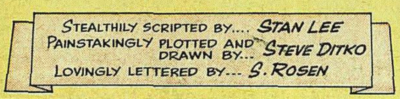
3.8. Ditko Goes Solo
Regardless of the dramas that had been transpiring behind the scenes, Ditko continued to reliably produce new art/stories for Lee and Marvel, with minimal feedback and a large degree of independence:
“When I picked up the pages to be inked I considered or ignored any story/art comments by Brodsky. I don’t know if the actual source was Stan or Sol.”
— Steve Ditko, ‘A Mini-History #1 The Green Goblin’, The Comics! Vol 12 No 7 July 2001 the newsletter of Robin Snyder.
The latter months of 1965 even saw a significant development within the Amazing Spider-Man series under his authorship, with Peter Parker’s graduation from high school and entry into college. It was a change that had previously been considered back in the more collaborative days, albeit one that was confirmed via Flo Steinberg:
“I remember I once asked Flo to ask Stan if he still wanted P.Parker to graduate from high school and go to college.”
“At some point Flo said ‘yes’. Stan still chose not to see me or to discuss anything about S-M, D-S or anything else.”
— Steve Ditko ‘Why I Quit S-M, Marvel’, The Four-Page Series no. 9, September 2015 (reprinted in The Complete Four-Page Series and Other Essays 2020
Ditko depicted Peter Parker’s high school graduation in Amazing Spider-Man #28 (September 1965), followed by the character’s first day at university in issue 31. The latter event was incorporated within a multi-issue storyline originally intended for the second Spider-Man annual, one that saw Spider-Man pitted against the ‘Master Planner’ (finally revealed as Dr. Octopus in issue 33’s conclusion):
“I was going to use this for the Annual but when Marvel planned so many reprints and only 20 pages or so of available for a new spider adventure and that not being enough to tell the whole story I decided to revise it and use it over a 3 issue spread because it would fit in very well with the issue where Pete goes to College.”
— Steve Ditko, 1965 letter to fan Glen Johnson, The Hero #37, Summer 2023 published by Robin Snyder (as presented in ’58 Summers Ago: Amazing Spider-Man Annual #2′, Marvel Mysteries and Comics Minutiae blog by Nick Caputo, August 8, 2023)
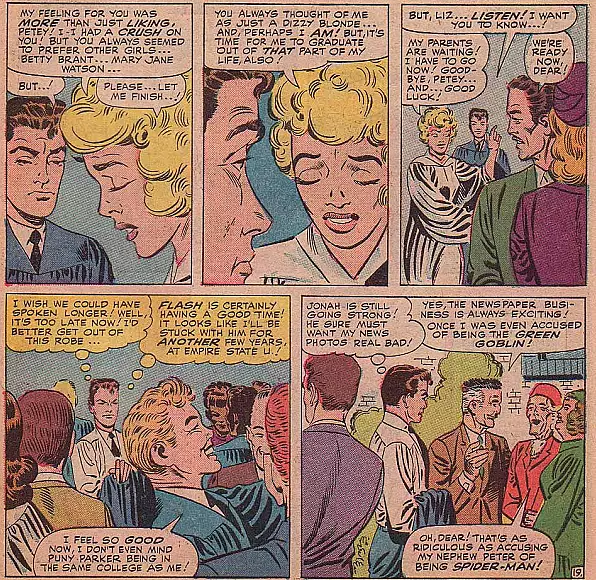
.
At this stage Ditko was working two issues ahead of publication on both the Spider-Man and Dr. Strange strips, developing all of the relevant plot ideas and using a large sheet of paper, taped up in his studio, to assist with the planning process:
“The sheet was for me to note any sub-plot ideas for S-M, PP, and the main supporting characters: J Jonah, Aunt May, the school kids, etc.
An example: Aunt May. What kind of problem, concern, would affect her, PP and S-M?
When would be the worst time for a real serious problem affecting her, PP and S-M?
His first day in college. So I slowly built up her heart problem to come to a climax on PP’s first day in college.”
— Steve Ditko, ‘Why I Quit S-M, Marvel’, The Four-Page Series no. 9, September 2015 (reprinted in The Complete Four-Page Series and Other Essays 2020
Ditko seemed to embrace his freedom from Lee’s input/directions, leaving any judgement of the outcome to others:
“Is that relevant, any big difference, any real improvement, over turning in an inked job on S-M and still having to figure out a cover and asking Stan “What’s next for S-M (DS)” and getting an answer like “Let’s have S-M fight fight Attuma” or “Let’s introduce a Spider-Woman,” a mythological Green Goblin, have guest heroes: Daredevil, Torch, guest-villains, The Beetle, etc.?
All S-M, DS and Marvel fans are free to decide which method produced the best results for S-M, DS.”
Steve Ditko ‘Why I Quit S-M, Marvel’, The Four-Page Series no. 9, September 2015 (reprinted in The Complete Four-Page Series and Other Essays 2020
As for Lee, he was now completely reliant on interpreting Ditko’s pencils and story notes when creating the final script for ‘Dr Strange’ and ‘Spider-man’. His opportunities for exercising editorial control were also minimal, though (as explained in his 2002 autobiography ‘Excelsior’) his role in providing dialogue/narrative still provided some measure of influence:
“I had the fun of trying to read the little notes he’d put in the borders, notes like ‘Spidey realises he’s out of web fluid’, or ‘Dr Strange can’t find his amulet.’ Sometimes I’d ignore those notes and write copy that would move the story in a slightly different direction.”
— Steve Ditko, ‘He Giveth and He Taketh Away’, The Avenging Mind 2007, (reprinted in The 32 Series by Ditko, Vol. 1 Overture 2019 p 35)
This was seemingly acknowledged by Ditko who, being familiar with Lee’s book, would directly reference Lee’s comments when providing his own thoughts on the matter:
“These notes are my page/panel dialogue sheets. To ‘write copy’ means adding Lee’s captions and dialogue. And ‘in a slightly different direction can mean what pleases him more.”
— Steve Ditko, ‘He Giveth and He Taketh Away’, The Avenging Mind 2007, (reprinted in The 32 Series by Ditko, Vol. 1 Overture 2019 p 35)
While both parties referenced the situation, neither provided specific examples of Lee’s scripting having any impact on Ditko’s storylines. Ditko presumably considered any instances to be of negligible importance, since he would also state that Lee had “…absolutely nothing to do with my own plotted, drawn and rough dialogue Spider-Man issues.”
— Steve Ditko, ‘He Giveth and He Taketh Away’, The Avenging Mind 2007, (reprinted in The 32 Series by Ditko Vol. 1 Overture 2019 p 35)
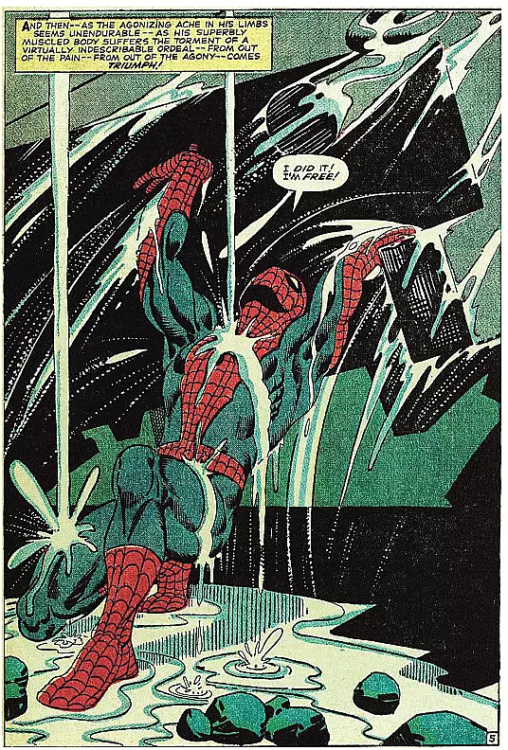
3.9. Ditko Departs
This final phase of the Lee/Ditko working relationship came to a conclusion in late November 1965, after Brodsky phoned to advise the third Spider-Man annual was coming up. It was then that Ditko experienced a moment of self-realisation:
“Later, thinking about what I could do for the annual, I asked myself “Why should I do it?”
Why should I continue to do all these monthly issues, original story ideas, material, for a man who is too scared, too angry over something, to even see, talk to me?
“…I decided to quit Marvel, S-M, DS.” My next visit to Marvel, I told Sol I was quitting Marvel.”
Ditko opted not to explain his reasoning at that point, as he believed the only person who had a right to know was his collaborator. Brodsky relayed the information to Lee while Ditko was still present. But if Ditko thought Lee might choose that moment to break the silence, he was mistaken:
“The only person who had the right to know why I was quitting refused to come out of his office or to call me in.”
Steve Ditko ‘Why I Quit S-M, Marvel’, The Four-Page Series no. 9, September 2015 (reprinted in The Complete Four-Page Series and Other Essays 2020
One of the first outlets to report this news to readers was a fanzine:
“Late the last week of November, Steve Ditko turned into Marvel the last Spiderman [sic] and Doctor Strange art that he would be doing for them.”
— Comic Reader #44 (December 1965)
An acknowledgement of Ditko’s departure appeared on the Bullpen Bulletin page of Fantastic Four #52, cover dated April 1966, citing ‘personal reasons’ for the decision:
“It’s hail and farewell to sturdy Steve Ditko! Spider-Man #38 and Strange Tales #146 (both now on sale) will mark his final appearances in any Marvel mags! (Except for the numerous reprints you’ll find in our king-size issues.) Steve recently told us he was leaving, for personal reasons. After all these years, we’re sorry to see him go, and we wish the talented guy success with his future endeavors.”
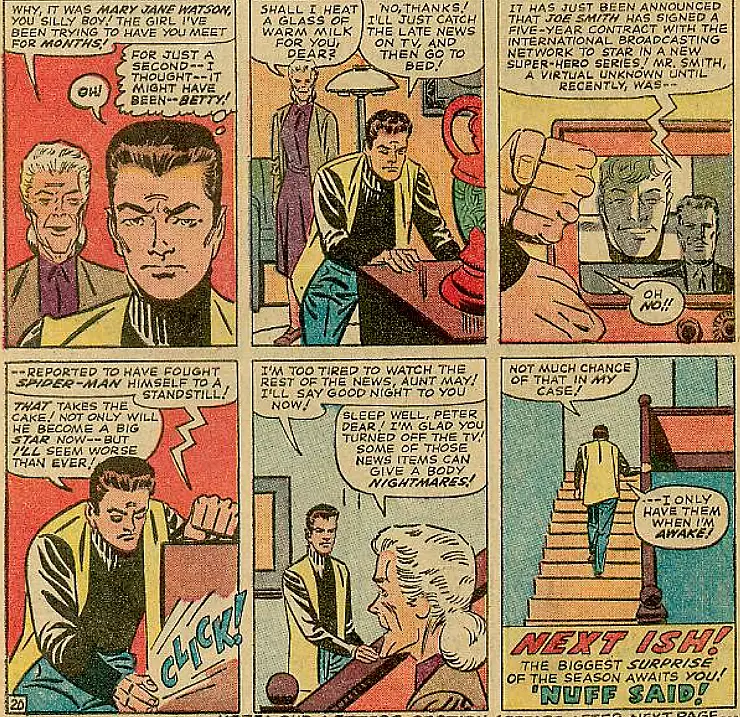
Afterword
Steve Ditko continued to produce work over the course of the following five decades for a variety of publishers. This included a return stint with Marvel during the late 1970s, with artistic runs on titles such as ‘Speedball’ and ‘ROM’ that lasted into the 1980s, though Ditko chose to never again work with the Dr Strange or Spider-Man characters.
In 1992 the team of Steve Ditko and Stan Lee almost reunited after Lee reached out with an offer to collaborate on a new series (‘Ravage 2099’) he was developing at Marvel. Ditko, for his part, agreed to discuss the project in person with Lee, marking the first time they would see each other in 27 years. The meeting proved to be a mutually friendly and respectful one, despite the circumstances of their prior estrangement. Regardless, Ditko did not have an affinity for the material and opted not to be involved. (See the ‘Endnotes’ section for some eyewitness accounts of the brief reunion).
In the years that followed their final meeting, the Lee/Ditko relationship would again deteriorate, with Ditko taking umbrage at various comments made by Lee that he viewed as purposely misleading or dishonest. It was a situation that would only worsen during the 2000s as Marvel’s brand became ever more embedded in the mainstream with the success of its movie properties, a scenario that brought Lee even further into the spotlight as the public face of the organisation.
The circumstances around Ditko’s departure from Marvel in 1965 would prove fertile ground for many commentators for a full five decades, a situation which only ended in 2015 when Ditko finally released an essay explaining the event. In that same document, he took the opportunity to reference the ‘outsiders/others’ who had been filling the void with their own explanations/speculations over the years:
“There have been many claimed knowers of Why I Quit S-M and Marvel. Stan and I were arguing over, disputing who is, or should be, the Green Goblin, over “not getting promised royalties,” and other known, floating, arbitrary “truths”, the “real” stories, reasons, fantasies, by CBFs and fan publications, “historians.”
All such claimers lack first-hand knowledge. All are guessing, creating, their own reasons, fictions and fantasies.”
… Steve Ditko ‘#45: ‘Why I Quit S-M, Marvel’, 2015, The Complete Four-Page Series and Other Essays by Steve Ditko p.48
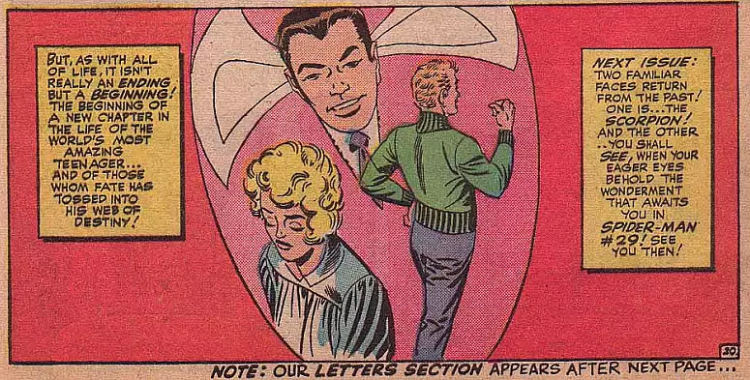
Personal Reflections
Steve Ditko’s decision to record his experiences at 1960s Marvel was prompted in part by the emergence of accounts that he considered inaccurate or misleading, particularly concerning the question of creation:
“After I left Marvel (1966) I wrote a rough record of my early involvement with Spider-Man (S-m), Dr. Strange and the Hulk. One reason was because Stan Lee and Jack Kirby were each claiming sole credit as “creator” of Spider-Man (and other Marvel characters). There was no real interest by them (and others) in whether the concept or claim of ‘creator’ was a self-imposed label, credit, or a claim that could and should be validated.”
— Steve Ditko, ‘A Mini-History: Some Background’, The Comics! By Robin Snyder, Vol. 12 No. 5 May 2001
His own commentaries might be described as straightforward, unsentimental, and occasionally brusque—lacking the polish of professional histories. More importantly, however, they have given us many details that would otherwise have remained unknown. There is also an underlying sense of fairness. For example, while Ditko famously included some strong criticisms of Stan Lee, he also acknowledged his collaborator’s creative input—often with a level of detail that Lee himself never provided. This balance, in keeping with Ditko’s personal views on truth and recognition, enhances the credibility of his commentaries.
Toward the end of his writings, Ditko even provided his reasons for departing Marvel in 1965. His essay “Why I Quit S-M, Marvel” ended years of fan speculation. However, it is best understood in the context of his other commentaries. Viewed as a whole, these depict an ongoing struggle over the “frontier of control” with editor/writer Stan Lee. We see how their visions differed, and how Ditko increasingly sought—and gained—the freedom to shape the characters he created or co-created. While Ditko appears to have encountered little resistance from Stan Lee in assuming narrative control, there is an underlying sense of tension in various recollections of their interactions. Even so, the subsequent cessation of their speaking relationship is attributed entirely to Lee, with Ditko professing no knowledge of why Lee would instigate such action.
For his part, Lee never explicitly acknowledged being responsible for the cessation of their interactions. His own accounts are often held in less regard than Ditko’s, and are certainly less consistent. But it is still worthwhile considering Lee’s perspective on the changing dynamics of their partnership:
“Steve was a very mysterious character. When he first started he was the easiest character we ever had to work with. I used to think that if everybody was as easy to work with as Steve, it would be great. I would call him in the middle of the night with an emergency ten-page script and Steve would bring it in the very next day without a complaint.”
— Stan Lee, ‘A Serious Interview with Stan Lee’, April 1975. interview with Stan Lee in Fantasy Advertiser International, April 1975 edition.
“But after a few years, something happened between Steve and me – and it was all on Steve’s part. I mean, I felt the same, but he got angry. He was angry about something and I never knew what it was, really. Specifically. He never told me. He came in one day and he did say, “Stan, I don’t like the way you’re putting in all the sound effects. “You’re ruining my artwork with those sound effects.” “Fine, I’ll leave them out.” I left them out. A little later, he would come in and say “Stan, I don’t like the plots you’re doing.” “Plot them yourself, Steve. Whatever he didn’t like, I said “Fine, I’ll change it.” But it didn’t help. I could sense he was unhappy about something. Then, one day – I don’t think he told me himself – I heard from somebody that he had said he wasn’t going to do any more Spider-Man. And that was it.”
— Stan Lee, ‘Stan Lee Looks Back: The Comics Legend Recalls Life with Jack Kirby, Steve Ditko and Heroes’ 2000 interview with Will Murray (originally published in Comics Scene, vol 3, no. 1, 2000, reprinted in Stan Lee Conversations, edited by Jeff McLaughlin, 2007)
Those recollections align with candid comments made by Lee during an interview with a New York Tribune at the time:
“I don’t plot Spider-Man any more. Steve Ditko, the artist, has been doing the stories. I guess I’ll leave him alone until sales start to slip. Since Spidey got so popular, Ditko thinks he’s the genius of the world. We were arguing so much over plot lines, I told him to start making up his own stories. He won’t let anybody else ink his drawings either. He just drops off the finished pages with notes at the margins and I fill in the dialogue. I never know what he’ll come up with next, but it’s interesting to work that way.”
— Stan Lee, quoted in January 9 1966 New York Herald Tribune article by Nat Freedland
And they even find some support in the light-hearted commentary that was appearing in the Marvel Comics of the 1960s, e.g.:
“Poor ol’ darling Ditko does about twenty pages of Spidey each month—plus ten pages of Dr. Strange—plus ten pages of the Hulk—and he still finds time to argue with Stan for a few hours each week!”
— Amazing Spider-Man #20 (letters column) January 1965
Ditko himself never described a deteriorating relationship in quite the same terms as Lee, but it isn’t particularly difficult to reconcile this aspect of their respective narratives. Ditko recorded creative differences emerging as early as the production of the very first issue of Amazing Spider-Man, and recalled repeatedly receiving what he regarded as non sequiturs from Lee—indicating that their disagreements followed an established pattern rather than being isolated incidents.
“I used to get non-sequiturs like that from Stan whenever I would question or criticize one of his decisions.”
— Steve Ditko, ‘I Remember Sound Effects’, The Comics, Vol. 33, No. 5, May 2022: the newsletter of Robin Snyder.
Ditko’s account of their final attempt at a cover collaboration is particularly interesting, as it suggests an underlying tension that is not fully explained by the situation itself. Nevertheless, the episode provides an intriguing glimpse of how their creative differences may have manifested themselves in practice.
It is also possible that some of Ditko’s grievances were never openly aired, and that these contributed to the breakdown between the two. This would be consistent with Lee’s recollection that Ditko became angry about something he never fully understood, even if the precise source of that anger remains unknown. Certainly, there are some topics—notably those relating to credit—that are conspicuously absent from Ditko’s records of his interactions with Lee.
Whatever the precise cause, Lee evidently found their interactions increasingly difficult and may have seen withdrawal as the most viable way to avoid an ongoing source of friction. With Ditko already handling the plotting and cover design on his own, it would have been tempting for Lee to minimise stressful interactions, particularly when they were no longer strictly necessary. Lee could still contribute his voice through the dialogue, and working this way may have seemed preferable to risking the loss of someone whose unique style was so beloved by readers. While the arrangement may have been awkward and potentially unsustainable in the long run, sales remained strong, and Lee’s own life could have continued largely unchanged for as long as it lasted.
Eventually, of course, it came to an end when Ditko opted to depart Marvel in late 1965. This was a significant loss for both Marvel and Lee, and undoubtedly a difficult decision for Ditko to make—one he attributed squarely to the breakdown of his relationship with Lee.
“Why should I continue to do all these monthly issues, original story ideas, material, for a man who is too scared, too angry over something, to even see, talk to me?”
— Steve Ditko ‘Why I Quit S-M, Marvel’, The Four-Page Series no. 9, September 2015 (reprinted in The Complete Four-Page Series and Other Essays 2020)
With both Steve Ditko and Stan Lee now gone, much of the speculation from ‘others/outsiders’ about their relationship can only remain an intellectual exercise. What we know for certain is that Ditko’s creative contributions to popular culture remain as vital and influential today as ever. His recollections are also an essential part of comics history, contributing to the enduring legacy of this creator/‘artist-plus.’
Rosco M
August 2026 (updated)
Endnotes Section
Endnotes: Introduction
“He shunned official interviews and convention appearances…”
Ditko did attend a small comic book convention while working at Marvel in 1964, which proved to be his last. He also participated in a brief interview via correspondence in 1968 with young fans Mike Howell and Mike Canterbury for the fanzine Marvel Main. This limited level of interaction was in contrast to that of various other high-profile comic book/strip creators of the time.
Over the years, Ditko often took umbrage at public comments and recollections made by others about projects he had worked on—especially regarding the creation of Spider-Man. Even so, he preferred to present his side of the story in writing rather than through interviews.
“Some, many believe an interview will address and/or solve a comics problem while evading the fact that it was interviews that created and sustain the “creator” issues.”
The creator issue could have been, should have been, solved by the fans, fan press, the first time Jack Kirby and Stan Lee claimed to be the “creator.”
The fans, press, never insisted on any burden of proof. Instead, we got (and still get) pandering to personalities and the nonsense that an interview will solve all problems. Interviews do not resolve anything more important than recording self-promotional exercises.”
— Steve Ditko ‘A Mini-History 4 ‘The Amazing Spider-Man #2’ The Comics! by Robin Snyder Vol 13 No. 1 January 2002
Author David Currie also recalled Ditko stating the following during their correspondence:
“Wanting, needing some public recognition status, being a public celebrity, a false ego-building, pandering to others, fans, crowd with interviews etc. is self-defeating.”
— David Currie, ‘Introduction The Last of the First’, Ditko Shrugged, 2020 p17
Note: In recent years Ditko’s family has shared a significant amount of information concerning Ditko’s personal life, as exemplified by the ‘Steve Ditko Biographical Interview with Pat & Patrick Ditko by Alex Grand’, posted on youtube (Comic Book Historians Channel) and an interview with ‘Rolling Stone’ magazine that was published online Jul 2, 2024 11:00 am
Endnotes: Part One (1961/1962)
1.1. “This description aligns with what is now often referred to as the ‘Marvel Method’ of producing comic books.”
Stan Lee provided the following explanation of the ‘Marvel Method’ at the San Diego Comic Convention in 1975:
“The way we worked, for those of you who don’t know, is not they way they work at other companies, where the writer writes the script, and it’s given to the artist, and the artist draws it, and that’s the end of it. With us, it’s a marriage of talents. The artist and the writer will discuss the plots together, then the artist goes off to his little nook where he works and he – without the benefit of script – with only this vague, ridiculous plot that he’s discussed – goes and draws the whole story all by himself…Then , when the writer has to put in the copy, just imagine how much easier it is to look at a drawing and suite the dialogue perfectly to the expression of the character’s face…”
“The artists are great storytellers themselves. They know which sequence to enlarge upon, which to cut short…They’d put in characters I knew nothing about…”
— Stan Lee, San Diego Comic-Con 1975, as quoted by Ben Saunders in his introduction to The Amazing Spider-Man by Stan Lee and Steve Ditko! Penguin Classics 2022
One of Steve Ditko’s contemporaries at Marvel was Stan Goldberg, a colorist and artist who began his career with Atlas/Timely in 1949. By the early 1960s—at the dawn of the so-called ‘Marvel Age’—Goldberg was working with Stan Lee as the illustrator on titles such as Kathy and Millie the Model. His recollections offer some insight into the emergence of the ‘Marvel Method’ from an artist’s perspective:
“He (Lee)was (writing full scripts for Kathy) at the very beginning. Then things started exploding at Marvel, and Stan needed to cut some corners at his end so he would come with new ideas. That’s when he developed the ‘Marvel Style’ of writing stories, where the artist did most of the plotting and he did the dialogue. He didn’t trust too many other writers, and this was a good way to keep control of the stories.
Some people weren’t happy about it, because Stan was putting work on the artist for no extra pay. Some artists resented it, but that was how it was done. I wasn’t happy about it at first, but I learned how to do it. I wanted to tell stories. So I’d start with something big happening, so I’d get the reader caught up in the story. And I wanted to keep on working and please Stan. And Stan was pleased with what I was doing.
I’m not sure if I was doing this before (Jack) Kirby and the others. I know Jack was getting detailed outlines even before they started doing ‘The Fantastic Four’. Whether they had talked the story out before that is something I can’t be sure of. The scripts Stan wrote became less detailed as he got busier. He went from full scripts to a detailed synopsis to the Marvel Method…”
Subsequently, as with Ditko, Goldberg assumed full responsibility for the plotting. This allowed Lee to concentrate on the written word:
“Stan would drive me home and we’d plot out stories in the car.
At that time, ‘Millie the Model’ was a soap opera comic. I’d say to Stan, “How’s this? Millie loses her job.” He’d say, “Great, give me 25 pages.” And that took him off the hook. It gave me a lot of work to do, but in the long run it made me a better storyteller. And I could do whatever I wanted. It didn’t give me an easy way out. I tried to challenge myself. And that helped me all throughout my career.”
“I’d bring in an entire book and Stan would write the dialogue. He was brilliant at it. Stan knew how to tell a story and make it work.”
— Stan Goldberg, ‘The Goldberg Variations’, interview by Jim Amash, Alter Ego #18, October 2002, TwoMorrows Publishing
With this division of responsibilities established, however, Goldberg found there was an expectation to deliver. In one instance, his desire not just to provide a plot, but to craft something beyond the ordinary, would lead to an awkward exchange with Lee:
“One time I was in Stan’s office and told him, “I haven’t got another plot.” Stan got out of his chair, walked over to me, looked me in the face and said very seriously, “I don’t ever want to hear you say you can’t think of another plot.” Then he walked back and sat in his chair. He didn’t think he needed to tell me anything more. After that, I could think of a plot in two seconds.
But I didn’t want to do just any plot. I wanted to come up something magnificent, so that’s why I said I couldn’t think of anything. Stan was able to think that way and so could I.”
Regardless, the Lee/Goldberg relationship—unlike that of Lee and Ditko—remained an amicable one. In later years, Goldberg would even describe Lee as one of his “oldest friends.”
— Stan Goldberg, ‘The Goldberg Variations’, interview by Jim Amash, Alter Ego #18, October 2002, TwoMorrows Publishing
Another artist who recalled the transition away from full scripts to the ‘Marvel Method’ was Don Heck, who worked with Stan Lee on a variety of strips during the 1950s and 1960s. Heck would go on to co-create many classic tales for Iron Man (Tales of Suspense), Ant-Man (Tales to Astonish) the Avengers and Thor (Journey into Mystery):
“I’d been so used to working from scripts, and then Stan said, ‘I’m going to give you a synopsis.’ Well, Jack Kirby was used to something like that because he was also a writer… he did some terrific stuff with all of these different characters, like back when he was doing Fighting American and all the rest of his early stuff, so it was easy for him. For me it was suddenly that someone says, ‘You’re going to do it!’ I said, ‘I’ll try it, but, I mean, it’s your gamble, not mine. I’m going to get paid for this.’
Then we started to work out the system, and then after a while Stan Lee used to, like, give you the first three pages, tell you who the character was you were fighting, and give you the last couple of pages so you’d know how it ended. And in between you’d put about 15 pages of stuff… And at the time, I thought, ‘Oh my God! This’ll never work!’ But then I’d sit down and start to figure different things that these types of characters could do. Then when I went back to working from a script, years and years later, sometimes I felt like I was a little closed in. I got used to the synopsis.”
— Don Heck, Interview with Richard Howell, Comics Feature #21, November 1982
As the 1960s progressed, there was a growing acknowledgement of the important role artists were playing in the storytelling process. A brief explanation of the (still unnamed) ‘Marvel Method’ was presented to regular readers in the ‘Bullpen Bulletin’ section of Marvel publications dated February 1966 (shortly after Ditko’s departure):
“It isn’t generally known, but many of our merry Marvel artists are also talented story men in their own right! For example, all Stan has to do with the pros like JACK ‘KING’ KIRBY, dazzling DON HECK, and darlin’ DICK AYERS is give them the germ of an idea, and they make up all the details as they go along, drawing and plotting out the story. Then, our leader simply takes the finished drawings and adds all the dialogue and captions! Sounds complicated? Maybe it is, but it’s another reason why no one else can bring you that old Marvel magic!”
Stan Lee also began discussing the topic during numerous interviews and public appearances. Amongst these was a 1967 radio interview on New York’s WBAI-FM, where Lee was joined by his most famous collaborator, Jack Kirby (note: a full transcript of this can be found in the Stan Lee Universe, edited by Danny Fingeroth and Roy Thomas, TwoMorrows Publishing, 2011)
A full history or critique of the ‘Marvel Method’—and the varied experiences/opinions of those involved—is beyond the scope of this document. Those interested in learning more are strongly encouraged to consult firsthand accounts from creators who worked at Marvel in the 1960s. Many such interviews are available online or in specialist publications; TwoMorrows, for instance, offers a wide range of material in both digital and print formats. The Romita Version (a comprehensive article available on this site) provides a focused look at the experiences of John Romita, Ditko’s successor on Amazing Spider-Man, while including relevant quotes from other artists such as Dick Ayers, Wally Wood, Gene Colan, Herb Trimpe and John Buscema. Marvel Method: Reconciling the Accounts of Jack Kirby and Stan Lee (also available on this site) explores the commentary of both Jack Kirby and Stan Lee, specifically in relation to story creation and the writing process.
1.1. Despite these changes, the series would reportedly face both creative and commercial challenges (see ‘Endnotes’ for more information).
One of the most frequently cited sources for this is Stan Lee’s 1974 book Origins of Marvel Comics, in which he recalls:
“‘Amazing Adult Fantasy’ finally ran its course. After issue #10 the sales began to soften and it seemed we were running out of steam. Apparently we’d been doing too good a job with our superheroes. The sale of the superhero magazines were soaring, which meant that AAF, with its five little featurettes per issue, was having an uphill battle bucking a trend. So it was decided that the fifteenth issue of Amazing Adult Fantasy would be the last one.”
In that same book, Lee described how the final issue presented the perfect opportunity to try out a new, offbeat character:
“Yep, I knew what I wanted all right, but where would I ever get a chance to try it? Where – except in a magazine that we were planning to kill anyway?
You guessed it. I figured there was nothing to lose, Amazing Fantasy #15 would be the last issue before its preordained demise. It wouldn’t matter what we did to it, what strips were included in it; it was doomed. That meant I’d have a chance to get this latest little gnawing idea out of my system once and for all. The die was cast. I would try a brand-new, totally different type of strip in AF#15. It would be a swan song never to be forgotten.”
— Stan Lee, ‘The World’s Best-Selling Swinger’, Origins of Marvel Comics, 1974 Fireside
Lee would repeat this narrative in later years. However, Amazing Fantasy #15 contained no indication that the title was ending. Instead, it included a prominent editorial promising that the new Spider-Man character would return as the lead feature in future issues. This has resulted in the accuracy of Lee’s recollections being questioned by various commentators, e.g.:
“(T)his shows, at the time of its writing at least, the plan is to continue running Spider-Man; Stan’s oft-repeated story of “It was the last issue anyway, so we just decided to throw it in” doesn’t hold water.”
— John Morrow, ‘Kirby and Lee: ‘Stuf Said (Expanded 2nd Edition)’, by John Morrow, TwoMorrows Publishing, 2003
The scenario, though, remains open to interpretation. Although readers were assured that the series would continue, the editorial also announced that its format had become unsustainable:
“We hate to throw in the towel, but we find that it is simply impossible to produce a magazine like AMAZING each and every month, containing five highly original and carefully plotted stories, without the quality eventually beginning to suffer. Rather than risk losing your confidence, we have decided to change AMAZING in such a way that it will STILL present the finest in fantasy—but in a different way!
As you can see, we are introducing one of the most unusual new fantasy characters of all time—The SPIDERMAN, who will appear every month in AMAZING. Perhaps, if your letters request it, we will make his stories even longer, or have TWO Spiderman stories per issue.”
Some months later, an announcement in Fantastic Four #10 (January 1963) provided the following update:
“Spiderman, who last appeared in Amazing Fantasy #15, has made no new appearances for a few months, because we waited to see what the fans thought of him. Well, your reaction has been terrific, and so we are launching a new series of Spiderman tales which will go on sale the beginning of December.”
Whether the original plan was to wait and gauge reader response before committing to a new series remains unclear. It’s possible Amazing Fantasy #15 was indeed seen as the final issue—with the proviso that it might come back if Spider-Man proved popular enough. If so, then the editorial promise of future Spider-Man stories in “Amazing” may have been a calculated attempt to generate demand that could justify continuing or reviving the series.
Ultimately, Spider-Man returned not through a continuation of Amazing Fantasy, but in his own ongoing title. The series adjective ‘Amazing’ was re-used (or, in a sense, retained) for The Amazing Spider-Man:
“We kept the word AMAZING out of sentiment, because it was part of the title of the magazine which SPIDER-MAN replaced. Also, it seemed to fit Peter Parker to a T!”
— ‘Spider’s Web’ letters column (response to reader), Amazing Spider-Man #4, September 1963
A belated acknowledgment—and explanation—of Amazing Fantasy‘s cancellation appeared on the letters page of The Amazing Spider-Man #4 (September 1963):
“As for Amazing Adult Fantasy, we are glad of this opportunity to explain its demise to all those who have asked about it. Judging by your mail, those who read the mag loved it, but judging by our sales, not enough readers bought AAF! So just for kicks, we decided to create a new super character (Spiderman) and throw away all the rules, making him as original and as different as we could. We planned to present him in the final issue of Amazing Adult Fantasy, just to satisfy ourselves. But, the rest is history! His surprise appearance jolted readers everywhere, and we were deluged with letters demanding that he be given his own magazine.“
Whether accurate or not, this aligned with Stan Lee’s later claims that Amazing Fantasy #15 was indeed intended as the final issue, and that the series was cancelled due to low readership. At the same time, it framed Spider-Man’s inclusion as a one-off indulgence by Marvel rather than as the launch of a new ongoing character—perhaps to underscore the narrative that Marvel was giving readers what they wanted.
In 1997, writer and comics historian Will Murray wrote an article for Comic Book Marketplace #44 (February 1997), entitled ‘Amazing Fantasy #16: The Untold Secret Origin of Spider-Man’. In it, he presented evidence suggesting that the lead story in Amazing Spider-Man #1 had originally been prepared for the never-published 16th issue of Amazing Fantasy.
“In CBM #44 (Feb. 1997)…I had told the startling story of the never-published 16th issue of Amazing Fantasy, which would have showcased Spider-Man’s second published appearance, if Marvel Comics publisher Martin Goodman hadn’t canceled the book before press time.
I had made my case primarily based on the job numbers attached to the lead story in Amazing Spider-Man #1 and to two Lee-Ditko back-up features, ‘Prophet of Doom!’ (Tales of Suspense #40, April 1963) and ‘My Fatal Mistake’ (Tales to Astonish #43, May 1963), the latter pair published shortly after ASM #1 but clearly also part of the unpublished Sept. 1962 Amazing Fantasy #16. The stories were consecutively numbered and all sported the trademark Amazing Adult Fantasy-style Art Simek story-title lettering.”
— Will Murray, Alter Ego #177, September 2022, TwoMorrows Publishing
1.2. “The lack of a hyphenated name was one of many differences between the character appearing in those pages and the ‘Spider-Man’ that is familiar to global audiences today.”
Ditko did not know who came up with the ‘Spiderman’ name, but he recalled that Lee had an affinity for the name ‘Hawkman’:
“For me, the SM saga began when Stan called me and told me I would be inking Jack Kirby’s pencils on a new Marvel hero, SM. I still don’t know whose idea was SM.
Stan said he always liked the name Hawkman, but DC had the name and characters.”
“So Marvel’s character would be called SM. Stan/Marvel would claim the insect category (Ant Man, Wasp) though technically a spider is not an insect.”
— Steve Ditko ‘A Mini-History 13. Speculation’, The Comics Vol. 14, #8, August 2003
The original artwork for Amazing Fantasy #15 has a hyphenated ‘Spider-Man’ title pasted over the original ‘Spiderman’ logo – apparently to reduce confusion with ‘Superman’:
“The only time I ever thought of Superman was after I made a logo for Spider-Man and realised it looked a little like Superman at first glance. That’s why I have always insisted on having a hyphen between Spider and Man.”
— Stan Lee, Comics Creators on Spider-Man by Tom DeFalco, interview by Tom DeFalco, Titan Books 2004
1.2. “The other four pages showed a teenager living with his kindly old aunt and hard, gruff, retired police captain uncle, a General Thunderbolt Ross-type (from The Hulk) who was hostile toward the boy. Next door or somewhere in the neighbourhood was a whiskered scientist-type involved in some type of experiment or project. The end of the 5 pages depicted the kid going toward the scientist’s darkened house.”
Ditko believed that Kirby’s original Spider-Man concept sounded very much like The Fly, a strip produced years earlier by the team of Joe Simon and Jack Kirby. The Fly was Tommy Troy, a boy who transformed into an adult superhero with the aid of a special ring.
The initial cast of The Fly included a gruff older male, Ezra March, who ran a household with Abigail March. He, too, could be hostile toward the young protagonist.

In The Fly, Tommy was given his ring by Turan, an emissary from ‘Fly World’ who went on to provide a mentoring role. The ‘whiskered scientist-type’ Ditko recalled seeing in Kirby’s pencilled pages may have been intended to serve a similar role.

Over the years, some commentators have pointed to these characters as further indications that Kirby was following The Fly template rather closely. This raises the question of whether the hostile Uncle figure in Kirby’s original pages was intended to be an ongoing character, as Ezra March was in the early Fly stories. Alternatively, it has been suggested that Uncle Ben’s fate was developed after Kirby’s involvement in Spider-Man ended, as part of the numerous changes made to distinguish Marvel’s new superhero from The Fly. If so, the decision to portray Uncle Ben as a kinder, more sympathetic character may have been intended to give his death greater dramatic weight.
1.3. “And, in an era where the value of original comic art/history was very different to today, they were simply disposed of.”
Many years later, former Marvel Editor-in-Chief Jim Shooter recalled sighting what was presumably Kirby’s presentation for ‘Spiderman’ in the Marvel offices. The fate of those pages is unknown:
“RE: Kirby Spider-Man pages: I saw, and held in my hand, exactly one such page. It was a page of design drawings. I remember that his version of Spider-Man had a “Web-Gun” and wore trunks, I think, like Captain America’s. He was far bigger and bulkier than Ditko’s version. There were no similarities to Ditko’s Spider-Man costume. I think he had boots with flaps. There were notes in the margin that described the character, again, nothing like the Ditko version. I think there was something about him being related to, or having some connection with a police official, which was how he’d find out about trouble going on. It was a long time ago, I can’t swear to that last item, but I can swear to the fact that it wasn’t similar to the Ditko version. I remember thinking, “This isn’t at all like Ditko’s.””
— Jim Shooter, ‘My Short-Lived Inking Career’, JimShooter.com, March 21, 2011
Ditko eventually received a portion of his original 1960s artwork back from Marvel:
“From Marvel I received many of the 5-page filler story/art pages I produced…I believe I received most of the Dr Strange story/art pages. I received story/art pages from 3 Spider-Man issues: 2 complete issues (inside pages) and 3rd which had three pages missing.”
— Steve Ditko, ‘The Sore Spot Cause and Crusade’ 1993, as reprinted in Avenging World, 1993
There are also secondary accounts of Ditko retaining unpublished Dr Strange stories, e.g. from Marvel writer/editor Ralph Macchio:
“He (Ditko) has a couple of Doctor Strange stories that he’s never turned in,” said Macchio, who maintains an ongoing relationship with the artist. “No amount of prying could get them from him, but there are a couple of completed Ditko Dr. Stranges out there.”
Macchio did his best to explain the value of the stories to Ditko, telling him they were worth their weight in gold, but-as the editor remembers, “It didn’t impress him.”
— Rob Steibel, ‘Ditko: The Mystery Behind the Man’ by Rob Steibel, Wizard #124, January 2002
No original art pages were found in Ditko’s estate. His surviving family have since stated that they believe they were destroyed by Ditko (as seen in the ‘Steve Ditko Biographical Interview with Pat and Patrick Ditko by Alex Grand’, video posted on Youtube by Comic Book Historians Channel, 18 October 2023).
1.4. “Ditko never referred to the written synopses as being prepared during (or as a summary of) any specific story conferences between the two.”
Although the synopses were provided by Lee, this does not preclude the possibility that some of the ideas came from other sources. For example, it is impossible to say how many of Kirby’s original ideas or suggestions were incorporated by Lee into his written synopsis for the first ‘Spider-Man’ tale in Amazing Fantasy #15. Ditko himself also mentioned an instance in which the idea of a villain with mechanical arms was incorporated into Lee’s outline for Amazing Spider-Man #3.
It should also be noted that Ditko’s accounts of working from Lee’s synopses differed significantly from those of fellow Marvel creator Jack Kirby, who claimed full credit for their contents:
“The only time I was given any kind of written synopsis was after I’d give Stan Lee a story and take it from what I told him. I was the one creating the story line, the pictures, the story itself.”
— Jack Kirby, ‘A Comic Book Artist KO’d: Jack Kirby’s Six-Year Slugfest with Marvel’ Village Voice Vol 32 #49, 8 December 1987 (available for viewing online at the Jack Kirby Museum and Research Site).
Over the years, some commentators have conflated the contrasting accounts given by Ditko and Kirby concerning Lee’s written outlines, incorrectly assuming that they described the same process. For instance, in his contribution to a special reprint of Origins of Marvel Comics celebrating 50 years since its original publication, famed illustrator Alex Ross states:
“As these creators [Kirby and Ditko] would attest, these outlines were largely a follow-up to an in-person meeting where they had discussed the plot. Both artists often said that they were pitching the plots to Stan, and his later composed outlines were summaries of what they’d conceived.”
— Alex Ross, ‘More to the Story’, Origins of Marvel Comics (Deluxe Edition), Gallery 13, 2024
1.4. “In his writings, Ditko did not express an opinion on whether the use of synopses was better or worse than a ‘full script,’…”
There is some evidence that Ditko preferred working from a brief story synopsis—at least in his later years. Comic book writer Tom DeFalco worked with the artist on titles such as Machine Man and Speedball following Ditko’s return to Marvel in the 1970s. Their first interaction occurred after DeFalco had handed in his first plot for Machine Man, having taken over as writer from Marv Wolfman:
“A couple of days later I get this call…and this voice on the phone says ‘Is this Tom DeFalco?’
I said ‘yes’.
And he [Ditko] says ‘What gives you the right to write about heroes?’
And I thought, ‘What gives me the right to write about heroes?’, and I said, ‘Who is this?’
He says ‘This is Steve Ditko.'”
After a detailed, sometimes heated discussion, Ditko reportedly concluded, “Well, this has been fun, we should do it again,” before hanging up.
Despite the unusual start, the two men’s relationship would subsequently improve, with DeFalco describing Ditko as “…very brilliant and charming guy.” He would also recall Ditko asking him for less plot direction:
“He said: ‘Your plots are too detailed. I want you to cut them down.’
I said, ‘Okay, Steve…what would you like in terms of a plot?’
He says ‘A paragraph will be good enough.'”
When the two men subsequently reunited on Speedball, DeFalco offered Ditko the opportunity to handle the ongoing plotting of the series, while noting that Ditko “…didn’t want to write the dialogue.”
— Tom DeFalco, ‘Creator in Conversation ep. 77’, TASQ Art (YouTube channel)
1.5. “Stan’s synopsis to me did not mention any (two) wrist shooters, or hidden belt, or any specific costume or specific spider-like actions. Those are my ideas and creation.”
Artist Eric Stanton (who shared an art studio with Ditko between the years 1958 – 1968) recalled providing Ditko with artistic and conceptual assistance during a 1988 interview:
“My contribution [to] Spider-Man was almost nil. When we worked on storyboards together, I added a few ideas. But the whole thing was created by Steve on his own. The whole thing was Steve Ditko. I think I added the business about the webs coming out of his hands, and we talked about the characters, and in turn, he helped me with my stuff.”
Did a Bondage Fetish Artist Help Co-Create Spider-Man? (cbr.com)
Stanton also mentioned discussing the character of Aunt May with Ditko, and asserted that there was a connection between her portrayal and his real-life Aunt Mae:
“We’d give each other ideas and characters. My Aunt Mae is the Aunt Mae (sic) in Spider-Man.”
— Eric Stanton, The Art of Eric Stanton For the Man Who Knows his Place, Edited by Eric Kroll, Taschen, 1997
Both the ‘Aunt May’ and ‘Uncle Ben’ names had been used in an earlier short story by Lee and Ditko (‘Goodbye Linda Brown’) which appeared in Strange Tales # 97 with a cover date of June 1962.
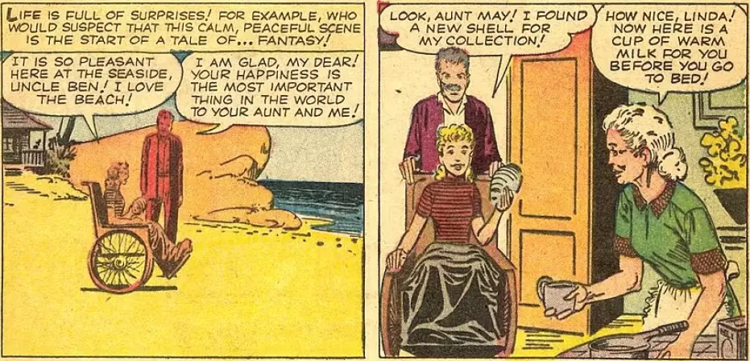
Another anecdote relating to Aunt May’s origins comes from Alex Garland, who visited Ditko’s studio in later years:
“During one of my visits to Ditko’s studio he told me that Stan Lee originally wanted the Aunt May character to look like (famous Italian actress) Gina Lollobrigida! Ditko wanted the Aunt May we know, for all the drama/storyline reasons you guys spoke of. I remember he said something about the elderly aunt being a sort of impediment for Peter’s relations to other kids; that Peter would feel awkward inviting kids to his house. Aunt May was a factor that separated him from his contemporaries. As far as I know, that was never part of a storyline, but like a good actor Ditko had imagined his character’s lives and personalities very vividly and in more detail than was seen by the audience!”
— Alex Garland, Facebook comment from the Steve Ditko Letters Facebook page, as reported by Brad Douglas in the online article ‘Stan Lee Wanted a Younger Aunt May, Stan Lee Didn’t?’ on the Spider-Man Crawlspace internet page, 24 August 2018
If accurate, Garland’s recollection suggests that Lee may originally have wanted to move the new Spider-Man even further away from the vision presented in Kirby’s original pages. An Aunt May modelled on a glamorous Italian actress, after all, was presumably not the character Ditko remembered from Kirby’s pencils. Speculatively, this would make sense if Lee wanted to avoid any comparisons with the Simon/Kirby ‘Fly’ character. However, neither Ditko’s nor Lee’s accounts confirm this interpretation. It is also possible that Garland, or Ditko himself, was conflating this incident with the occasion when Lee reportedly asked Ditko to make Aunt May “more attractive, more visually appealing” in response to reader feedback (see 2.7, ‘The Influence of Others’, in the main article).
1.5. “There is a strong implication in Ditko’s commentaries that Spider-Man’s web-spinning and wall-crawling abilities were amongst those ‘spider-like actions’ left unspecified by Lee.”
Ditko’s recollections differed from Stan Lee’s with respect to what detail was included in the latter’s directions for Spider-Man’s origin tale.
For example, during the late 1990s Ditko publicly expressed dissatisfaction with credit taken by (and given to) Lee in relation to Spider-Man. In response, Lee produced an open letter (dated August 18, 1999) to publicly acknowledge contributions made by Ditko to the character. Lee wrote that he had originally given Ditko his “…idea for a shy, teenaged high-school science student who’d been bitten by a radioactive spider, thus gaining the ability to stick to walls and shoot webs…”
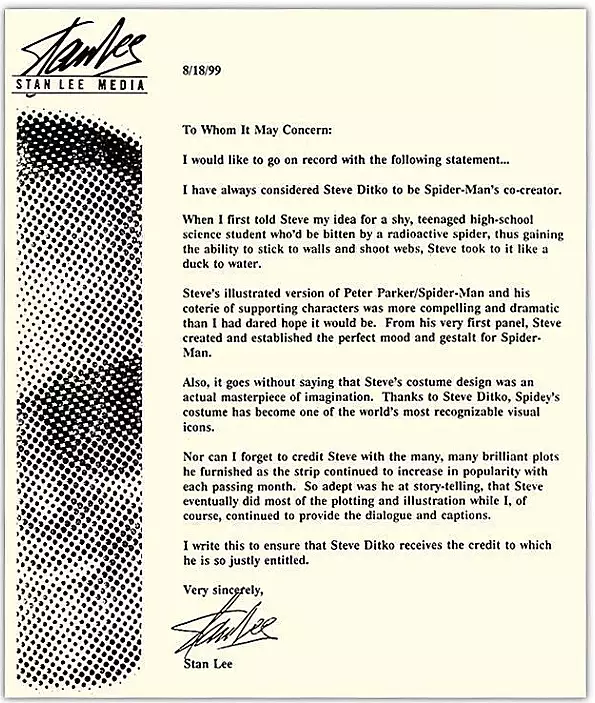
Although this was intended to improve relations between the two creators, Ditko took issue with some of Lee’s statements, i.e.:
“Stan wrote, “when I first told Steve my idea for a shy, teenaged high-school science student who’d been bitten by a radioactive spider, thus gaining the ability to stick to walls and shoot webs, Steve took to it like a duck to water.”
“The error and fallacy is in Stan’s “my idea” about S-m’s ability to stick to walls and shoot webs. (This) is never supported but stated as self-evident, proven, because I drew sticking and web-shooting scenes in the stories.”
— Steve Ditko ‘Tsk Tsk Examining a Creator/Creation Claim’ Avenging World 2002, p 137
Ditko’s response implied that, while Lee provided the basis for Spider-Man’s abilities. i.e. the bite from the radioactive spider, there was little direction as to what those abilities would be. If Ditko’s recollections are correct, this could mean various memorable scenes in the origin story were either described in very general terms in Lee’s synopsis (for interpretation by Ditko) or wholly added/created by Ditko (in his role as ‘artist-plus’).
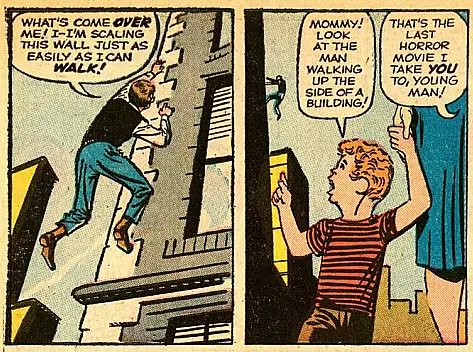
Ditko didn’t elaborate further as to what elements he brought to Spider-Man’s origin story, but his creative contributions were undoubtably significant. His general commentary concerning Lee’s synopses noted that it was largely up to the artists such as himself to determine the ‘what, how and why’ for each panel that was drawn. And, in the case of Spider-Man, Ditko also developed the character’s costume, hidden belt, web-shooters and ‘specific spider-like actions’:
“…Lee had nothing to do with many, many creative ideas beyond his page-and-a-half synopsis that he claims are his “ideas.””
— Steve Ditko, ‘He Giveth and He Taketh Away’, Avenging Mind 2007 (reprinted in The 32 Series by Ditko Vol 1 Overture)
According to Ralph Macchio, Ditko later told him in later years that the famous line — “With great power, there must also come… great responsibility!” — which appears in the final panel of the story, originated with Stan Lee. The line elevated the story’s twist ending, transforming it from a personal reckoning into a broader ethical mandate that would define the character for decades.
“I remember I discussed that phrase once with Steve Ditko, and he said that was all Stan’s thinking. Steve believed it was too heavy a burden to place on a young man. He didn’t elaborate.”
— Ralph Macchio, ‘A New Kind of Hero’, Marvel Comics Library: Amazing Spider-Man Volume 1, 1962 – 1964, 2022, Taschen
1.5. “One of the first things I did was to work up a costume…”
Jack Kirby also claimed credit for the Spider-Man design in some interviews, e.g.:
“I drew up the costume, I gave him the character and I put it in the hands of Marvel, because Stan Lee had contact with the publisher. I didn’t.”
— Jack Kirby, interview by Leonard Pitts conducted in 1986 or 1987 for a planned (but unpublished) book, as published in Creators of the Superheroes Thomas Andrae, 2011 Hermes Press
However, he was not consistent in this assertion. For example, in 1972 presentation Stan Lee asked him about the origins of the outfit during a college presentation:
“Stan Lee: “Hey Jack did you make up the Spider-Man costume or did Steve copy yours. Or did we just forget yours and Steve make up his own?”
Jack Kirby: Gee, Stan, I don’t remember.””
Stan Lee’s Vanderbilt University speech (1972) transcribed by Harold May, as quoted in Spider-man: The Case for the Defense (A reply to Spider-Man: The case for Kirby)
Former Marvel Editor-in-Chief Jim Shooter has recalled raising the subject directly with Kirby during the mid 1980s:
“Years later, 1986, I had occasion to talk with Jack (Kirby) at the San Diego Con. He insisted that he created Spider-Man. I told him that I’d spoken to Steve Ditko, Sol, and other people who were there at the time, including Stan, obviously, and that they all agreed that Steve’s version was the one that was used, though Jack did his version first. I reported everything I’d seen and heard. We talked about the costume — the bib and belt combo, the stripes down the arms, the mask, the symbols, a very Ditko-esque design. Jack was having some problems with his memory by then, but he thought about it for a minute, then said that maybe Steve should get the credit. He’d be okay with that. A little later, he was onstage and clearly had forgotten our conversation.”
— Jim Shooter, ‘My Short-Lived Inking Career‘, Blog posted 21 March 2011
In recent years commentators have also noted the existence of a 1950s/60s Ben Cooper ‘Spiderman’ Halloween costume that would have been available in stores at the time Spider-Man was created. It employed a somewhat similar use of webbing (albeit on a predominately yellow background) to the Marvel character and has prompted speculation that it may have served as some sort of inspiration. (At one point there was even an unsubstantiated rumour that Jack Kirby had worked for Ben Cooper in costume design.) The question of whether there was any connection was put to Ditko in writing in 2014 by comic book and toy dealer John Cimino, who enclosed relevant clippings of a 1954 Ben Cooper advertisement. It garnered the following response:
“The burden of proof is on the person who makes the claim, assertion, charge. Some clippings etc, are not rational proof anything but some clippings etc”
— Steve Ditko, Ditko Shrugged 2020 as quoted by author David Currie, 2020 p 63
1.6. “The crucial point came after Stan and I went over my pencilled pages…”
Remarkably, the original interior pages for Amazing Fantasy #15 survived, having emerged from obscurity in 2008. The pages include various notations that provide further insight into the collaborative process between Lee and Ditko.
1.8. “Determining who should receive official credit for creating ‘Spider-Man’ is complex, given the circumstances surrounding the character’s creation and the differing accounts from those involved.”
There are many excellent articles/publications delving into the creation of Spider-Man and the (sometimes contradictory) accounts of those involved. The following information is provided only as a general background.
In a 1982 interview Jack Kirby first stated that Spider-Man could be traced back to The Silver Spider’– an unpublished superhero idea originally conceived in discussions with Kirby’s long-time collaborator, Joe Simon:
“It was the last thing Joe and I had discussed. We had a strip called, or a script called, The Silver Spider. The Silver Spider was going into a magazine called Black Magic. Black Magic folded with Crestwood and we were left with the script. I believe I said this could become a thing called Spider-Man, see, a superhero character. I had a lot of faith in the superhero character, that they could be brought back, very, very vigorously. They weren’t being done at the time. I felt they could regenerate and I said Spider-Man would be a fine character to start with. But Joe had already moved on. So the idea was already there when I talked to Stan.“
— Jack Kirby, ‘Shop Talk’, Will Eisner’s Spirit Magazine 39, 1982, Kitchen Sink
This was reiterated elsewhere, notably in a handwritten account of Marvel’s early days, believed to have been produced in the 1980s:
“Spiderman grew from a different script called “The Silver Spider” which was written by Joe Simon’s brother-in-law Jack Oleck – who is now deceased.
Joe was out of the field at that time & I utilized the “Silver Spider” script to create a single new character. This was given for development to Steve Ditko after I drew the first cover with the original costume.”
— Jack Kirby, ‘Lee & Kirby: The Firsthand Account of Jack Kirby’, The Tom Brevoort Experience 18 September 2021
In his memoirs Joe Simon wrote that he had been unaware of any connection between the Silver Spider and Marvel’s Spider-Man until hearing of Kirby’s comments. He did, however, confirm the existence of a Silver Spider concept. Simon revealed that the Silver Spider idea had eventually led to The Fly, while noting that various other creative hands had also been involved in the development.
Simon further asserted that he (rather than Kirby) had come up with the Spiderman name, prior to deciding on the Silver Spider. He had even created a Spiderman logo, which he’d loaned to Kirby while the two were still working together.
Simon recalled phoning Kirby after finding out that his old partner had presented the Spiderman concept to Lee/Marvel:
“I called Jack. He confessed to an old indiscretion that, in the curious biology of comic books, made me responsible for bringing Spider-Man into the world.
“But why, Jack?”, I demanded.
“I had no work – I had a family to support, rent to pay – what else could I do?””
— Joe Simon, ‘The Birth of Spider-Man’, The Comic Book Makers by Joe Simon with Jim Simon, Vanguard Productions 2003
In the meantime, Stan Lee had been stating that the Spider-Man name/concept was his (e.g.: in the 1974 book ‘Origins of Marvel Comics’). He continued to express that view for the remainder of his life:
“I really don’t what to say about (Kirby claiming credit for the creation of Spider-Man). I honestly don’t understand it. Years ago, when I wanted to do SPIDER-MAN, I called Jack and told him: “I want to do a character called SPIDER-MAN who sticks to walls, who does this and who does that.” And I told him I wanted him to draw it, how I wanted it done, and I told him I didn’t want it done in his usual style.”
— Stan Lee, interview with David Anthony Kraft, David Anthony Kraft’s Comics Interview Super Special: Spider-Man, 1990
Lee’s account of events usually mentioned that Jack Kirby had initially drawn some rejected pages (even before Kirby’s later Silver Spider revelation). However, Lee never talked about the differences between the Spiderman in those pages and the published Spider-Man. Nor did he recall Ditko noting any similarities between the original ‘Spiderman’ and the Simon/Kirby Fly character. Lee’s explanation of why the strip was given to Ditko was as follows:
“Regarding Spider-Man, I told Jack that I wanted to try something different. I didn’t want him to be overly heroic-looking, I wanted him to be just an ordinary guy who happens to have a super power. He was to be not too handsome, not too glamorous, not too graceful, not too muscular – in other words sort of the way I might be if I had a super power…”
“…(W)hen I saw the first few pages that Jack had drawn, I realized we had a problem. They were too good. Try as he might, he had been apparently unable to deglamorize Spidey enough. All those years of drawing superheroes must have made it a little too difficult to labor so mightily and come forth with a superloser, or if you will, a supershnook. Actually, I was almost relieved. Jack was so busy with his other popular features, and I had so many additional new ones to give him, that I realized it might be better to let someone else try Spider-Man rather than give the jolly one more than he could comfortably handle.”
— Stan Lee, ‘The World’s Best-Selling Swinger’, Origin of Marvel Comics, 1974 p 135
Although Lee often referred to himself as the creator of Spider-Man (e.g. in the opening credits for Amazing Spider-Man #100, September 1971) there were also instances where he referenced Ditko as a co-creator. This included the following message in the UK publication Super Spider-Man TV Comic #475, 14 April 1982, which was accompanied by a photo of Lee standing alongside someone in a Spider-Man costume:
“Yep, believe it or not its two decades since yours truly and Steve Ditko dreamed up my buddy here. ‘Course we’ve put him through a lot – fighting nearly every super-villain under the sun…”
— Stan Lee, Super Spider-Man TV Comic #475, 14 April 1982
A more specific example appeared in the 1986 Overstreet Price Guide, which also referenced his work with Jack Kirby:
“…I had the unbelievable good fortune to work with the most incredibly talented artists of time. There was Jack Kirby, with whom I co-created The Fantastic Four, The Incredible Hulk, The Mighty Thor, Sgt. Fury and his Howling Commandos, Nick Fury Agent of Shield and The X-Men, just to name a few. Then there was Steve Ditko, my collaborator in the creation of Spider-Man and Dr. Strange. And leave (sic) us not forget Don Heck who toiled with me so mightily to bring forth Iron Man, while Bill Everett was my partner in creating Daredevil.”
— Stan Lee, Overstreet Comic Book Guide #16, 1986
In an open letter dated August 18, 1999, Lee wrote that he had “…always considered Steve Ditko to be Spider-Man’s co-creator.” In the same document Lee said that Ditko had established the “…perfect mood and gestalt for Spider-Man”‘, created the iconic costume and eventually assumed (‘most’) of the plotting. But Lee was not consistent in highlighting Ditko as a co-creator during subsequent interviews.
In the 2007 BBC Four documentary ‘In Search of Steve Ditko’, (available on youtube) Stan Lee was pressured by host Jonathon Ross to definitively say whether he truly believed that Ditko was the ‘co-creator’. At one point Lee replied: “I really think the guy who dreams the idea up created it” before expressing regret for those words, adding: “…you made me say that in this documentary that you’re doing, and I’m sorry I said it, because I’m happy to say I consider Steve to be the co-creator.” At the conclusion of this segment Lee reframed his thoughts on the matter, stating “…If Steve wants to be called the co-creator, I think he deserves to be called the co-creator, because he had done such a wonderful job.”
The Ditko/Kirby/Lee/Simon accounts all generally confirm Kirby’s initial involvement in the creation of a Spiderman prototype. And both Steve Ditko (who described the original pages) and Jim Shooter (who apparently saw Kirby’s original ‘Spiderman’ presentation piece) provided recollections supporting the substantial differences between that prototype and the published Spider-Man. But it is impossible to know how Kirby’s original Spiderman tale would have unfolded, or how many of his ideas made it into Lee’s subsequent synopsis for the origin tale.
There was one recorded instance in 1972 in which Stan Lee publicly spoke about the creation of Spider-Man with Jack Kirby present, though the event offered no insight into Kirby’s conceptual contributions:
“…When we first started to do Spider-Man, we thought Jack Kirby ought to draw the strip. Now, Jack was always my first choice, because I always felt he was about the best at anything … So Jack tried a few pages of Spider-Man and did a fantastically beautiful job, but instead of making him look (creepy) he made him beautiful and heroic … So by common consent, Jack decided would go with the other things…”
This was despite Kirby himself being brought into the discourse at one point:
“Stan Lee: “Hey Jack did you make up the Spider-Man costume or did Steve copy yours. Or did we just forget yours and Steve make up his own?”
Jack Kirby: Gee, Stan, I don’t remember.””
Stan Lee’s Vanderbilt University speech (1972) transcribed by Harold May, as quoted in Spider-man: The Case for the Defense (A reply to Spider-Man: The case for Kirby)
None of the interviews with Jack Kirby delved into the contents of his rejected Spiderman concept or sample pages. Nor did Kirby ever mention Stan Lee contacting him regarding the similarities that Steve Ditko reportedly recognized between Spiderman and the Simon & Kirby character The Fly.
Over the years, Jack Kirby did make various statements relating to the creation of Spider-Man and Steve Ditko’s contributions. A selection of relevant quotes is presented below:
“I’ve never worked with Steve Ditko; he’s kind of a shy fellow and I saw him rarely. He’s very likeable and very intelligent. I am a real admirer of his work. He’s a very creative man. Actually, Steve created Spider-Man, and the thing caught on because of what he did.”
— Jack Kirby, ‘Jack Kirby Interview’ (transcript of radio interview with Tim Skelly conducted 14 May 1971), The Nostalgia Journal #1, July 1976 (Published by Gary Groth)
“I did a mess of things. The only book I didn’t work on was Spider-Man, which Steve Ditko did. But Spider-Man was my creation.”
— Jack Kirby, ‘Kirby Takes on the Comics’, Howard Zimmerman, Comics Scene #2, March 1982.
“The Fantastic Four is mine. Spider-Man is mine. The Hulk is mine. They’re all mine. I couldn’t handle Spider-Man because I was handling everything else. I was handling the entire line. So Spider-Man was given to Steve Ditko who did a wonderful job on it. Ditko developed Spider-Man. Ditko’s style sold Spider-Man. Ditko’s stories, which were wonderful, developed Spider-Man. Ditko did the Spider-Man that is popular with everybody today. It’s Ditko’s Spider-Man that does it.”
— Jack Kirby, ‘Superheroes The Language that Jack Kirby Wrote’, by James Van Hise, Comics Feature, March 1984
“I can tell you that I was deeply involved with creating Spider-man. I can’t go any further than that, really, because there’d been so many variations and different things done with Spider-man, but I can tell you at the beginning, I was deeply involved with him.”
— Jack Kirby, Robert Knight’s Earthwatch, Jack Kirby radio interview conducted by Warren Reece and Max Schmid, WBAI New York, 28 August 1987.
“My initial concept was practically the same (as the published version of Spider-Man). But the credit for developing Spider-Man goes to Steve Ditko; he wrote it and he drew it and he refined it. Steve Ditko is a thorough professional. And he is an intellect. Personality-wise he’s a bit withdrawn, but there are lots of people like that. I haven’t seen him for a long time.
Steve developed Spider-Man and made a salable item out of it. There are many others who take credit for it, but Steve Ditko, it was entirely in his hands. I can tell you that Stan Lee had other duties besides writing Spider-Man or developing Spider-Man or even thinking about it. I didn’t present it to Ditko. I presented it to Stan Lee. I drew up the costume, I gave him the character and I put it in the hands of Marvel, because Stan Lee had contact with the publisher. I didn’t.”
— Jack Kirby, interview by Leonard Pitts conducted in 1986 or 1987 for a planned (but unpublished) book, as published in Creators of the Superheroes Thomas Andrae, 2011 Hermes Press
“I created Spider-Man. We decided to give it to Steve Ditko. I created the character. I created the costume. I created all those books, but I couldn’t do them all. We decided to give the book to Steve Ditko…”
“It was Steve Ditko that made Spider-Man the well-known character that he is.”
— Jack Kirby, Interview with Gary Groth, The Comics Journal # 134, February 1990, p 82
Note: There are many publications articles that delve into Jack Kirby’s extraordinary career and his contributions and experiences at Marvel. Ten sources (by no means a complete list) for those wishing to know more on this topic are suggested below:
– Jack Kirby Museum & Research Center (website)
– ‘Jack Kirby: TCJ Library Vol.1: The Comics Journal Interviews’, by Gary Groth, 2002
– ‘Kirby and Lee: Stuf’ Said (Expanded 2nd Edition)’, by John Morrow, TwoMorrows Publishing, 2003
– ‘The Jack Kirby Collector’ – ongoing fanzine published by TwoMorrows
– ‘Kirby: King of Comics (Anniversary Edition)’, Mark Evanier, Abrams 2017
– Comic Book Historians (website)
– ‘Creators of the Superheroes’, Thomas Andrae, Hermes Press 2011
– ‘Tales to Astonish’, Rojin Ro, Bloomsbury, 2004
– ‘According to Kirby‘, and ‘Kirby at Marvel – Not the Official Version Vol 1: 1956 – 1963‘, both by Michael Hill, Lulu
– ‘The Comic Book Makers’ by Joe Simon with Jim Simon, Vanguard Productions, 2003
The Comic Book Historians website’s articles section includes Marvel Method: Reconciling the Accounts of Jack Kirby and Stan Lee, which compares and contrasts the perspectives of Jack Kirby and Stan Lee in relation to their roles under the Marvel Method.
There are also many other online amateur articles, such as Stan Taylor’s “The Case for Kirby”—which attempts to analyze Kirby’s work for connections to the early Spider-Man concept and plots—and Dusty Miller’s “Spider-Man: The Case for the Defense (A Reply to ‘Spider-Man: The Case for Kirby’)”, which offers a critical response to Taylor’s assertions. Both approach the topic with a level of analysis and speculation that falls well outside the scope of this document.
1.8. “In making his case Ditko was aware of Kirby’s claims of having brought the ‘Spiderman’ name to Lee…”
Ditko originally believed that Lee came up with the name ‘Spiderman’:
“In a discussion with me about Spider-Man, Stan said he liked the name Hawkman but Dc had the name and character.”
“From that I believed that Stan had named the character.”
— Steve Ditko ‘An Insider’s Part of Comics History: Jack Kirby’s Spider-Man’, Avenging World, 2002, p 57
1.8 “If Marvel’s Thor is a valid created work by Jack, his creation, then why isn’t Spider-Man by Stan and me valid created work, our creation?”
Jim Shooter, who served as Marvel’s Editor-in-Chief from 1978 to 1987, has recalled taking the opportunity to speak to all three parties — Steve Ditko, Stan Lee and Jack Kirby — concerning their respective contributions to the published version of Spider-Man:
“I asked Steve, I said, “Percentage wise, what is it?” He said, “70 me, 30 Stan.” I said to Stan, “What was it?” He said, “50/50.” “
“Jack tried to say that everything was his… And then I talked to him for a while, and he conceded that I was right. He’d said, “No, you’re right. Spider-Man was Steve and Stan. Stan contributed to everything…”
— Jim Shooter, Jim Shooter Biographical Interview by Alex Grand & Jim Thompson – Comic Book Historians, 30 September, 2021
Endnotes: Part Two (1963/1964)
2.2. “Another noteworthy aspect of ‘Amazing Spider-Man’ #1 was Lee’s addition of regular creator ‘credit boxes’ on the splash pages, something that was rare for comic books of the era. Within these brief descriptions Lee credited himself for the ‘script’, presumably reflecting his responsibility for providing finished dialogue/narration.”
In a 1978 letter responding to a fan query, Lee explained his method for arriving at a script:
“My method for the construction of the script consists of discussing the story with the artist and having the artist do the penciled art on his own, drawing whatever he wants so long as it tells the story we’ve discussed. I would then put in the dialogue and the captions and indicate where the dialogue balloons are to be placed and where the captions go, and then the script goes to the inker—it’s lettered of course. Then I have it proofread and that’s it. I proofread it myself if it’s my own story.
“My method of working with the authors and artists is to try and be as friendly as possible, be as fair as possible, and get the most work out of them as possible. Let them work as much as possible in their own style. Tell them the type of results I want, but not how to obtain them.”
— Stan Lee, letter to Éric Leguèbe, as reproduced in Kirby and Lee: Stuf’ Said, Expanded 2nd Edition by John Morrow, TwoMorrows Publishing, 2003
2.4. “Stan named him Dr Octopus and worked up a legend.”
Editor/writer Jack C. Harris, who collaborated with Ditko on various projects at DC Comics, recalled that “… he never called them origin stories. He called them legends.”
— Jack C Harris, Working With Ditko TwoMorrows Publishing 2023
2.5. “What I did on Spider-Man I was paid for.”
Ditko’s statement concerning his remuneration on Spider-Man should not be confused with his position regarding creator credit (see ‘3.7. Ditko’s Opinions: Credits’) and there are also secondary accounts which indicate his interest in royalties. Regardless, the quote does strongly align with a 2021 anecdote by comic-book creator/editor Jim Shooter that concerned Ditko.
According to Shooter, he was present at a Comic Book Creator’s Guild Meeting in the late 1970s to represent Marvel management. In attendance were a “couple of hundred” comic book creators, including Steve Ditko. During the proceedings the meeting’s organiser, Neal Adams, began advocating for ‘justice for old creators’ and attempted to reference Ditko as an example, noting that the latter had retained no ownership to anything:
“Steve jumped up…he said ‘I’m not going to be a poster boy for anything.’ He said ‘I was an adult when I made that deal and I will honour it. If they want to give me money fine…but…’ he said, ‘…don’t make me into your…cause celebre.'”
— Jim Shooter Jim Shooter Biographical Interview part 2 by Alex Grand | Comic Book Historians (youtube.com) posted 6 May 2021 37.21
Despite Ditko’s apparent views on the matter, it is not uncommon for commentators (both online and elsewhere) to include his name when asserting that artists working under the ‘Marvel Method’ were not compensated adequately. For instance, author Abraham Riesman, after quoting Ditko’s dissatisfaction with Lee’s credits, makes the following claim:
“Perhaps more important, the writer/artists weren’t being paid for the massive amounts of writing they were doing. Stan was getting freelance cash for his writing duties, given that his staff job was still as the editor, but guys like (Jack) Kirby and (Steve) Ditko, who were laboring without the benefit of staff positions, were also being denied writer’s fee’s that were by all rights theirs. There was no union for comics, and these writer/artists were desperate for work, so no great commotion was raised about the matter. But it was unfair exploitation of labor, plain and simple.”
— Abraham Riesman, True Believer – The Rise and Fall of Stan Lee, Crown New York, 2021
Although this may not have reflected Ditko’s own perspective, it is true that Jack Kirby – at least in later life – publicly expressed dissatisfaction with the payment he received under the Marvel Method. Wally Wood voiced similar criticism, and relevant comments by both men may be found in related articles available on the Comic Book Historians site (‘Marvel Method: Reconciling the Accounts of Jack Kirby and Stan Lee‘ and ‘The Romita Version – Exploring John Romita’s Accounts of Spider-Man, Stan Lee and the Marvel Method’).
With respect to Riesman’s broader claim, it was specifically addressed by Marvel writer Roy Thomas:
“As for the page rates: Riesman insists artists “weren’t being paid for the massive amounts of writing they were doing” (italics are the author’s). Well, that kind of depends on how you look at it. Certainly, by the mid-’60s at least, whenever a new artist came on board, they knew that choreographing the story, including adding details, was part of the job description of “artist” at Marvel. If they didn’t want to accept that, they were free to work for some other company.
Stan got the publisher to raise page rates whenever he could, and part of the reason he fought for that was because he knew how important the artists were to the process. Maybe the later-despised “controversial Marvel Method” (as Riesman anoints it) of doing a story is one reason that Marvel writers’ rates generally tended to lag behind DC’s for some years: so that the artists could be paid as well as possible.”
— Roy Thomas, Stan Lee’s Protege Pushes Back on ‘True Believer’ Biography, Hollywood Reporter Online article by Roy Thomas, posted 23 February 2021
Herb Trimpe was one of the artists who began working for Marvel in the latter half of the 1960. He worked directly with Stan Lee on the Incredible Hulk and enjoyed the artistic freedom and responsibility that came with the Marvel Method. Trimpe was aware of the argument that artists should have been paid more for their story contributions, but viewed the arrangement as a ‘privilege’:
“I was an excellent storyteller, and I think that’s what sold Stan. Because Stan’s genius – never mind the dispute between characters and who created what – his revelation to comics was having the artists visualize the story.”
“Some people don’t consider it a privilege. They think we should have got paid more money for it, but I wasn’t thinking about the money at the time. I was already making more money than I had ever made in my life, starting at $135 a week, and within a few months, I was making $200 a week, so I wasn’t complaining.“
— Herb Trimpe, interview with Dewey Cassell, The Incredible Herb Trimpe, by Dewey Casll and Aaron Sultan, 2015, TwoMorrows
2.7. “It was an approach that had obvious benefits, ones that were recognised by fellow creators like Jack Kirby.”
Legendary comic book creator/artist Jack Kirby acknowledged the benefits of reader feedback/suggestions:
“An idea can come from me, it can come from Stan, it can come from a reader. Sometimes we’ll get ideas expressed in letters from readers that we utilize in the comic. We’ll build a plot around that type of story. I feel that Stan Lee is very wise in looking over the letters from the readers, and keeping tabs on the progress that the character is making.”
— Jack Kirby, August 1969: Jack Kirby interviewed by Shel Dorf and Rich Rubenfeld, as quoted by John Morrow, Kirby and Lee: Stuf’ Said, Expanded 2nd Edition, by John Morrow, TwoMorrows Publishing, 2003
Stan Goldberg, who was working as an artist and colorist at Marvel in the early 1960s, recalled some of the early feedback on Fantastic Four that prompted Stan Lee to introduce their iconic costumes:
“I remember seeing the first issue of ‘The Fantastic Four’ and they were just a bunch of letters and I remember Stan said, ‘We just got these letters suggesting we ought to put the Fantastic Four in costumes.‘”
— Stan Goldberg, ‘The Goldberg Variations’, interview by Jim Amash, Alter Ego #18, October 2002, TwoMorrows Publishing
2.7. “Stan had a tendency to believe complainers, OOs, know best. He granted them some kind of superior insights, knowledge. So they should be given arbitrary authority over the ideas of the editor, writer and artist.”
Ditko had the opportunity to come face-to-face with some of those ‘others/outsiders’ when he attended the first New York City Comic Book convention on July 27, 1964, at the request of organiser Bernie Bubnis. A very small-scale affair compared to later years (and lasting only five hours) it was none-the-less an interactive experience:
“…I was continually asked questions about things of which I could never have any kind of knowledge, information: policies of comic book companies, people I never met, arbitrary, scattershot, off-the-top-of the head questions by those wanting some emotional gratification.”
And it helped shape some of Ditko’s views in relation to comic book fans (‘CBFs’):
“CBFs want to know things because they want to know what they want to know for some emotional gratification, for some fan prestige, some bragging rights such as in having someone’s autograph or publishing a private, personal letter.
These self-indulgers have no sensible purpose or need.”
— Steve Ditko, ‘#43: The 1st New York City Comic Book Convention’, The Four-Page Series #8, May 2015, as reprinted in The Complete Four-Page Series and Other Essays by Steve Ditko.
Ditko expressed particular consternation at seeing how fans handled original comic book art (brought along by DC representatives) noting that “Some CBFs took art pages and laughingly TOSSED the UP in the air and over their heads” while others “…laughingly joined in the collective FUN.”
And, although he engaged in individual conversations and even drew illustrations for attendees, he was upset by some of the reactions:
“I gave some CBFs in my talking, writing, that which was private and personal. They gleefully blabbed, publicly TOSSED, PUBLISHED, the personal material for some prestige or FUN.”
— Steve Ditko, ‘#43: The 1st New York City Comic Book Convention’, The Four-Page Series #8, May 2015, as reprinted in The Complete Four-Page Series and Other Essays by Steve Ditko.
This experience would mark Ditko’s first and final convention appearance.
2.7. “Stan rightly believed that (Betty’s) death would cast a negative pall over (Peter and Spider-Man).“
Ditko elaborated on this as follows:
“The death of BB would have introduced and sustained a heavy negative emotional baggage similar to Captain America’s continually mourning, self-pitying stance over the 20-plus years earlier death of his teenage partner Bucky.
There could be no going back to the “fun and games” as if BB had never existed, never meant anything important to PP’s life. A teenage feature should show a more benevolent view of life and existence. It should show a hope of being able to grow up in a better world and that one should be actively striving for it.”
—Steve Ditko, ‘A Mini-History 8 Others, Outsiders (OOs): Complainers and Complaints Against Betty Brant’ The Comics newsletter by Robin Snyder Vol 14 No 2 February 2003
An attempt to explain to readers that Betty was younger than Peter appeared in the letter page of Amazing Spider-Man #12, May 1964.
A humorous reference to Betty Brant’s changing hair style that appeared in the ‘Special Announcements’ section of Amazing Spider-Man #12 (May 1964) possibly reveals another point of disagreement between Lee/Ditko:
“By the way, do you like Betty’s new hairdo? Hope so, because Stan had to argue with Steve for months before Mr. D. would make the change!”
2.9. “For many readers, Lee’s dialogue and narration contributed significantly to the distinct charm of Marvel Comics in the 1960s”
In a 1968 interview Stan Lee spoke about the elements that he identified as being behind the success of Marvel, placing special emphasis on the dialogue:
“We’ve done stories that were quite successful with the readers, judging by the sales we’ve had and the mail we get, and then, after rereading the story, I would say to myself, well, the story was really nothing. It was just the hero meets a villain, fights him, defeats him, and then goes off into the night. But I suspect it was the little subplots, and the little asides, and the little things and depth, the characterization, and so
forth, that we throw in that, if anything, makes our books a little better than some others. I think it’s those extra little touches rather than the basic ideas, because I think most of our ideas are pretty much the same from issue to issue. It’s practically the same plot all the time, just tackled from a different direction.“
“The dialogue I have always felt is the most important thing. Just as in a radio show, certainly the dialogue is the most important thing, I think in a motion picture, or in a television show, it’s what the person says that matters. Good dialogue can make a very banal plot seem very important and very profound, and I think bad dialogue can make the greatest plot in the world seem corny and hackneyed. The one thing that everybody seems to go for is realism. It seems the more realistic you can be, the more successful you are, in any media. Now, to me, the thing that gives a story realism is having the characters talk and react, and, of course, you can only tell their reactions by what they’re saying, like real people. Therefore, the thing that we spend, I guess, about 99% of our time on is the dialogue. I will rewrite one sentence a dozen times if I don’t feel I’ve got it right.
Now, I’m sure nobody else, certainly nobody at any other comic company does this or worries about this. They’re, many of them are still writing these things the way they were being written twenty years ago. The hero sees the villain running down the street, he says, ‘There goes the monster! Let’s get ’im!’ That’s it, and it doesn’t matter what character it is, they all speak the same. They don’t have any different speech mannerisms. So we’re really hung up on this business of everybody has to talk in his own distinctive way. We wouldn’t have Daredevil really speak the way Captain America speaks, and we wouldn’t have Spider-Man speak the way Iron Man would speak. We try to get a shade of difference in each one, and we feel we know the characters that way.”
— Stan Lee, Feb. 8 (or 18), 1968: WRSU 680AM Radio (campus of Rutgers University in New Brunswick, New Jersey) interview with Stan Lee, as quoted in Kirby and Lee: Stuf’ Said, Expanded 2nd Edition, by John Morrow, TwoMorrows Publishing, 2003
From a speculative standpoint, Lee’s view of dialogue as the essential ingredient in storytelling may help explain why he often reserved the term “writer” (and the credit “written by”) for those responsible for the written word. This practice may have reflected the particular value he placed on dialogue and its role in shaping character—elements he saw as crucial to elevating a story beyond its basic plot. By his own account, it was the voices of the characters—their distinctive speech patterns, emotional nuance, and realism—that gave the stories their true impact. In this light, writing became less about inventing narrative beats and more about how those beats were expressed in words on the page.
2.9. “I often objected to his use of and placement of sound effects in and on my artwork, telling him that it corrupted my design for no good reason.”
Stan Lee provided the following account in 1992, as Marvel was celebrating 30 years of Spider-Man:
“I used to create and design all the sound effects that appeared in the strip. I also added the innumerable speed lines which I felt helped to liven up the action scenes. I was real proud of my little artistic contributions and always wondered why Steve never complimented me for dressing up the panels. Well, here’s the punch line – it wasn’t ‘til years later that I learned that he hated speed lines and sound effects. I don’t just mean hated – I mean HATED”
— Stan Lee, ‘Stan’s Soapbox’, Marvel Age 114, July 1992
Ditko’s response to Lee’s recollection was belatedly published in a 2022 article:
“As to Stan’s sound effect version.
He is mistaken.
I often objected to his use of and placement of sound effects in and on my artwork, telling him that it corrupted my design for no good reason.
He responded by saying the sound effects will make for a stronger scene.
When I asked him what a battle scene in Hal Foster’s Prince Valiant would look like with Marvel speed lines and sound effects, he answered that Foster wasn’t doing a daily strip.
I used to get non-sequiturs like that from Stan whenever I would question or criticize one of his decisions.”
— Steve Ditko, ‘I Remember Sound Effects’, The Comics, Vol 33 1 No. 5 May 2022: the newsletter of Robin Snyder.
It is worth noting that, elsewhere, Lee did in fact recall the topic being discussed while the two were still working together:
“But after a few years, something happened between Steve and me – and it was all on Steve’s part. I mean, I felt the same, but he got angry. He was angry about something and I never knew what it was, really. Specifically. He never told me. He came in one day and he did say, “Stan, I don’t like the way you’re putting in all the sound effects. “You’re ruining my artwork with those sound effects.” “Fine, I’ll leave them out. I left them out. A little later, he would come in and say “Stan, I don’t like the plots you’re doing.” “Plot them yourself, Steve. Whatever he didn’t like, I said “Fine, I’ll change it.” But it didn’t help. I could sense he was unhappy about something. Then, one day – I don’t think he told me himself – I heard from somebody that he had said he wasn’t going to do any more Spider-Man. And that was it.”
— Stan Lee, ‘Stan Lee Looks Back: The Comics Legend Recalls Life with Jack Kirby, Steve Ditko and Heroes’ 2000 interview with Will Murray (originally published in Comics Scene, vol 3, no. 1, 2000, reprinted in Stan Lee Conversations, edited by Jeff McLaughlin, 2007)
2.10. “The decision to make the character a ‘Doctor’ would prove to be important, as Ditko’s initial story had not provided any background for the character (who also appeared to be Asian in his early appearances).”
Writer/Editor Roy Thomas recalled the situation as follows:
“In fact, Marvel editor Stan Lee later revealed the hero was nearly christened ‘Mr Strange’, but instead he got promoted to being an actual doctor, because Marvel already had a ‘Mr Fantastic.“
‘Roy Thomas on the History of Doctor Strange’ hHttps://crimereads.com
In a YouTube documentary titled ‘Steve Ditko: Beyond the Myth’, Dr. Jack Kruse (author of ‘Mysterious Travelers: Steve Ditko and the Search for a New Liberal Identity’) recalled correspondence with Ditko that reportedly confirmed the character had originally been intended as Asian.
— Dr. Jack Kruse, STEVE DITKO: BEYOND THE MYTH [FULL DOCUMENTARY], posted 8 August 2026 on the TASQ Art Channel.
2.10. “An introduction by Lee asserted that reader requests had prompted the disclosure of Strange’s origin at this late point.”
Writer Jack C. Harris, who worked with Ditko in later years, recalled Ditko telling him he was simply waiting to see if the character was a success before providing an origin.
“Steve just wanted to wait and make certain the character would continue…”
— Working With Ditko Jack C. Harris TwoMorrows Publishing 2023
2.11. “Amazing Spider-Man 14 (July 1964) would see the publication of a story that was quite different to the one originally envisioned by Lee…”
It is impossible to know how much Ditko was contributing to Spider-Man stories at this point, even if Lee was still providing written synopses. For example, a blurb appearing in issue # 9 (February 1964) seems to reference Ditko as a co-writer for the following issue:
“Smiling Stevey Ditko doesn’t want us to tell you what the next Spiderman will be about! He thinks you’ll get more of a kick out of it if you’re surprised. (If you ask us, he and Stan just haven’t written it yet!)”
— Amazing Spider-Man #9, February 1964
(Issue #10 is notable for a speech by J. Jonah Jameson revealing the motivations behind his hatred for Spider-Man, which some commentators see as evocative of Ditko’s Objectivist beliefs.)
2.11. “I knew from Day One, from the first GG story, who the GG would be… I absolutely knew because I planted him in J. Jonah Jameson’s businessman’s club…”
There have been various conflicting claims over the years that the identity of the Green Goblin was a source of contention between Ditko and Lee.
Ditko asserted that he knew from ‘Day One’ who the Goblin would be, pointing to his early depiction of Osborn in the strip as evidence. However, the Green Goblin first appeared in ASM #14 (July 1964), whereas the earliest depiction of an unnamed Norman Osborn (the Goblin’s alter-ego) was almost a year later, in ASM #23 (April 1965).
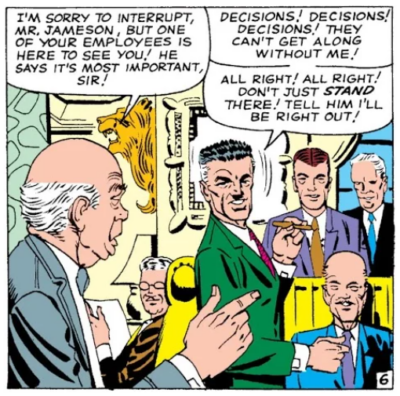
If Ditko did know the villain’s identity from ‘Day One’, that that would mean that he waited almost a year after the Green Goblin was introduced before giving any kind of visual clue to readers. Even then, the audience had no idea who Norman Osborn was until he was finally named in ASM #37 (June 1966). The connection to his son was also a long time coming, as Ditko didn’t introduce Harry Osborn until ASM #31 (December 1965).
Various recollections from Lee have him recalling that Ditko wanted the Goblin to be someone readers had ‘never seen before’. They also suggest that discussions about the villain’s identity didn’t occur until sometime after the Goblin’s introduction, e.g.:
“The ultimate bone of contention was a recurring villain called the Green Goblin, whose identity had always been hidden. When it became time for the long awaited unmasking Lee recalls that Ditko said ‘it should be somebody they’ve never seen before, just some person’. Lee, on the other hand, felt that a startling revelation had been promised. ‘Every reader in America is going to think we’re crazy. They’ll be angry. It’s got to be somebody, Lee said. Ditko left without drawing the story.”
Les Daniels, Marvel, Five Fabulous Decades of the World’s Greatest Comics, Abrams, 1991
Lee goes even further in some interviews, asserting that it was he (rather than Ditko) who wanted the Goblin to be revealed as Osborn, e.g.:
“I had a big argument with Steve Ditko, who was drawing the strip at the time. When we had to reveal the identity of the Green Goblin, I wanted him to turn out to be the father of Harry Osborn, and Steve didn’t like that idea,” Lee explained. “He said, ‘no, I don’t think he should be anybody we’ve seen before.’ I said ‘Why?’ He said ‘Well, in real life, the bad guy doesn’t always turn out to be someone you’ve known.’ And I said, ‘Steve, people have been reading this book for months, for years, waiting to see who the Green Goblin really is. If we make him somebody that they’ve never seen before, I think they’ll be disappointed — but if he turns out to be Harry’s father, I think that’s an unusual dramatic twist that we can play with in future stories.’ And Steve said ‘Yeah, well, that’s not the way it would be in real life.’ And I said ‘In real life, there’s nobody called The Green Goblin.’ And so Steve was never happy about that, but since I was the editor, we did it my way.”
— Stan Lee, Stan Lee Reveals Argument With Steve Ditko Over Green Goblin (comicbook.com)
This particular version is certainly inaccurate. Harry Osborn was not even introduced to readers until ASM #31 (December 1965) – six months after Lee had ceased communicating with Ditko. It may be that Lee was conflating earlier conversations with later fears that Ditko (by then solely responsible for plots) might indeed choose to surprise readers by revealing the Gobin as ‘somebody they had had never seen before’.
Roy Thomas, who worked with Lee after joining Marvel in 1965, recalled Lee’s concern that Ditko might unmask the Goblin as a ‘nobody’. He also noted that a precedent was set with Ditko’s unmasking of another villain, the Crime Master, in issue 27 of Amazing Spider-Man (which was produced soon after Lee and Ditko had ceased talking):
“Stan hadn’t been happy about that…but he’d gone along with it. Stan said they fought over story lines too much, but figured things were working out well – sales of the books were good – so why look for trouble? The unspoken alternative was to remove Ditko, and he didn’t want to do that.”
— Roy Thomas, as quoted by Blake Bell Strange and Stranger, The World of Steve Ditko 2008
“I know Stan felt the Green Goblin should turn out to be somebody important to Spider-Man. He didn’t want to repeat that bit with the man in the Crime Master’s mask (Amazing Spider-Man # 27), who turned out to be some nobody. I don’t know if that had been Stan’s idea or Steve’s but I know that as a reader I found it dramatically unfulfilling. Still, I appreciated the realism: just because you take off a guy’s mask doesn’t mean you’re going to recognise him. This shows that Stan and Steve were thinking increasingly differently. Stan was doing quite well editing and writing a whole line of comics, and Ditko was feeling his oats too, because he knew he was doing good work, and people were responding to it. Certainly Stan liked it; everybody liked it. Yet Ditko felt he and Stan weren’t on the same wavelength. He was probably right.”
— Roy Thomas, ‘Rascally Roy Thomas Talks About the 1960s and Early ‘70s’. Alter Ego #50, July 2005
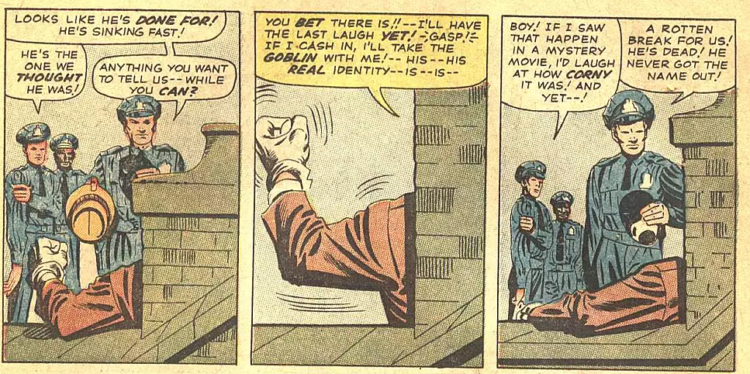
Adding to the mystery is an article that appeared in a 1966 fanzine, in which interviewer Bob Sheridan describes his discussion with artist John Romita. This took place during the very early days of Romita’s run on the Amazing Spider-Man title, when the artist’s memories were presumably fresh:
“In my discussions with Romita, I learned something of why Steve Ditko left Marvel. It seems that when he started out, Ditko was basically an amateur, with little confidence in himself. Stan Lee convinced Ditko that he was a good artist, that he should stick it out. Ditko became convinced. He began to slack off his direct contact with Lee, until he never came to the bullpen anymore. Then, when he didn’t feel like doing the story the way Stan wanted it, he did it his way…often making the task of writing an unintelligible story a real task for Lee. That’s how Ditko began getting credited as plotting the stories.
By the way, the choice of Norman Osborn as the Green Goblin was Ditko’s. Lee was going to have GG revealed to be Ned Leeds, but Ditko was too fond of Ned, so he drew the mags so that Osborn had to be the Goblin. Lee was finding it extremely difficult to make sense of Ditko’s stories, but the mags were selling well, and Stan didn’t want to fire Ditko.”
— Bob Sheridan ‘Rambling with Romita’, The Web-Spinner (fanzine) #5 1966
No direct quote is presented to support these claims, and in later years Romita’s recollections would accord more with Lee’s. Regardless, this 1966 interview can’t be completely dismissed. Ned Leeds was introduced in ASM #18 (November 1964), following an anonymous cameo in the previous issue. This was only a short time after the Green Goblin himself was introduced and was during the period when Lee and Ditko were still communicating. And Ned Leeds was a viable suspect for a while, at least up until ASM #23 (April 1965), when a sub-plot revealed that he was in Europe at the time the Goblin was battling Spider-Man in New York. Co-incidentally or not, that is the same issue in which the unnamed Norman Osborn appears for the first time.
From a completely speculative perspective, it is possible that Ditko was conflating certain memories and hadn’t decided the Goblin’s identity until he first drew Norman in issue #23. If so, he may have taken that same opportunity to insert a scene that ruled out Lee’s preference (Ned Leeds) as the villain. Such a move could have been a flashpoint in the Lee/Ditko relationship, as the Sheridan article indicates. And, intriguingly, it would only be a short time after this that Lee reportedly ceased communicating with Ditko…a decision that would eventually result in Ditko’s departure.
2.11. “And the very next issue would introduce a new villain called ‘Kraven the Hunter’, one of a handful of villains for whom Ditko would specifically claim sole creative credit.”
Ditko provided little information with respect to the creation of most of the villains appearing in his Amazing Spider-Man run. However, during one of his open responses to claims made by Lee, Ditko would specifically take credit for creating ‘Dr. Octopus’ and ‘Kraven’ (as well as ‘Dr Strange’) from the period they were actively working together on stories:
“Is Lee claiming the “original idea” for Dr. Strange, Dr. Octopus, Kraven and what “original idea” for the Green Goblin and for all the “ideas” for stories (the lifting sequence) and comic book issues I did on my own?”
— Steve Ditko, ‘He Giveth and He Taketh Away’, Avenging Mind 2007 (reprinted The 32 Series by Ditko Vol 1 Overture)
Jim Shooter, who served as Marvel’s Editor-in-Chief from 1978 to 1987, has recalled speaking with both Stan Lee and Steve Ditko in later years. He shared the following anecdote about the creation of Kraven the Hunter, though he did not specify which of the two was his source:
“And I’ll tell you this also, about Stan… It’s that, when Stan had an artist who was good, he played to their strengths. For instance, Kraven the Hunter, okay. Why was there a Kraven the Hunter story? Because Steve Ditko told Stan, “Hey, I like to draw animals.” So, Stan did, Kraven the Hunter. And that was Stan, it wasn’t… Steve didn’t make that up, Stan did.”
— Jim Shooter, Jim Shooter Biographical Interview by Alex Grand & Jim Thompson – Comic Book Historians, 30 September, 2021
Writer Mark Evanier, who became a friend of Jack Kirby in the late 1960s, is on record as stating the following:
“Jack Kirby told me that he’d designed some of the early Spider-Man villains and Mr. Ditko agreed, though neither man could tell me for sure which ones Jack did. Both men were more than imaginative enough to come up with something like that.”
— Mark Evanier, ‘Doctor Octopi’, News from Me (Internet blog), Posted on Tuesday, March 28, 2023 at 10:59 AM
However, there is nothing in the direct commentaries of either Kirby or Ditko to support this or to provide further context. There is also the possibility that any such recollections related to Kirby-designed characters such as ‘Doctor Doom’ (from Fantastic Four) or the ‘Circus of Crime’ (from the Incredible Hulk), or even the ‘Beetle’ (as Kirby drew the latter’s cover appearance for his debut in Strange Tales).
2.11. “When I was doing issue 18 (1964), I deliberately drew the ugliest smile on JJJ that I could conceive on the splash page. All through the story I added bits, sequences, playing up JJJ’s facial features as much as I could.”
Amazing Spider-Man #18 (November 1964) marked the first time Ditko was given sole credit for plotting. However, rather than being reflected in the credits box, the information was presented to readers in the ‘Special Announcements’ section of the preceding issue, which emphasised the off-beat nature of the tale:
“As for ol’ Spidey, next ish is gonna be real different! The whole plot was dreamed up by Sunny Steve and it was just nutty enough for Stan to okay it! You’ll see Spidey acting differently than ever before! ‘Nuff said!”
Ditko’s storyline featured Peter Parker contemplating quitting as Spider-Man after a previous incident led to the perception that the hero was a coward. Instead of the usual fight scenes, there was a sequence where Spider-Man fled from the Sandman. This was an obvious departure from what Ditko perceived as Lee’s general rationale for a superhero story, which was “to show the costumed hero in action.”
— Steve Ditko ‘A Mini-History 4: The Amazing Spider-Man #2′ The Comics by Robin Snyder Vol 13 No. 1 January 2002, the newsletter of Robin Snyder.
Nevertheless, an announcement in ‘Avengers’ #9 (October 1964) assured the audience that ‘Amazing Spider-Man’ 18 still had plenty to offer:
“…in the past we’ve told you that one mag or another had the most action possible! THIS time we wanna tell you that you’ll find LESS action than usual in Spidey’s tale—but, there’ll be a lot of surprising plot twists and unexpected developments to make up for it!”
2.11. “October 1964 saw another significant development with the publication of Amazing Spider-Man Annual #1.”
A month earlier, Marvel had released the first Marvel Tales Annual, which featured photos of the Marvel Bullpen, with Steve Ditko being a notable exception. He would also not appear on ‘Voices of Marvel,’ a flexi-disc recording produced for the ‘Merry Marvel Marching Society’ in 1965. According to a later fanzine interview conducted by Mike Howell, this was all by Ditko’s choice:
“Howell: “During your years at Marvel, you were only depicted once, and that time by your own hand (‘Amazing Spider-Man Annual’ #1) whereas you were left out of the Bullpen photos (‘Marvel Tales’ Annual #1) and the record. Was this by your choice?
Ditko: Yes”
‘An Interview with Steve Ditko’, Marvel Main #4 (fanzine publication, October/November 1968), conducted by Mike Howell
2.12. “I was interested in working up an idea on my own as I did with Strange, again for the sake of variety. I intended to do a hero in street clothing to avoid special costume changes.”
This concept would subsequently be employed for Ditko’s post-Marvel creation ‘The Question’, a character that debuted in Charlton Comics’ Blue Beetle #1 (June 1967).
2.12. “I turned down Iron Man because I didn’t find the character with his weak heart gimmick interesting enough.”
Ditko completed several episodes of Iron Man in Tales of Suspense issues 47 (November 1963) – 49 (January 1964). His involvement was even referenced in Lee’s cover blurb for issue 47: “Special Super Issue! Lee, Ditko and Heck team up to bring you…Iron Man, greater, more true-to-life than ever, as he battles “The Mysterious Melter!” An 18-page epic!”
Endnotes: Part Three (1965/1966)
3.1. “Stan was willing to go along with my not using his usual monthly plots…”
Ditko’s recollections suggests an amicable hand-over of responsibilities. This can be compared to accounts by Lee in the ‘Conclusions’ and ‘Endnotes’ sections.
3.2. “Lee evidently agreed to hand over full storytelling duties to Ditko (on Dr Strange).”
A handwritten note from Ditko, in which he references a hardback collection of ‘Dr Strange’ tales, includes some more comments about the character’s creation, while also indicating the point at which he assumed ongoing control of the storytelling for that series:
“The idea for the character, the 1st story is mine. The character was named, story dialogued by Stan from my rough page scripts, Dr. Strange because all the stories appeared in the comic titled ‘Strange Tales’. For some unknown reason I pencilled the following stories but the inking was done by someone else. The stories on page 13, 76, 85, 89,103. From page 153, all the following story ideas are mine but, again dialogued by Stan from my rough script.”
— Steve Ditko, Letter shown in Steve Ditko Biographical Interview with Pat and Patrick Ditko by Alex Grand, video posted on Youtube by Comic Book Historians Channel, 18 October 2023
3.5. “At some point before issue 25 Stan chose to break off communicating with me.”
Lee later denied being responsible for the breakdown in communication with Ditko:
“He has told other people that he quit because I wouldn’t talk to him. Can you believe that? I talk to everybody. Most people wish I would stop talking. Why wouldn’t I talk to him? He was one of our best artists and I loved his work. I don’t know what he means when he says I didn’t talk to him. I just remember that I was angry over the way he quit. He left in such a way that I wasn’t tempted to call him back and ask why. He just showed up one day and announced that he was quitting. In fact, he didn’t even tell me. I think he told Sol Brodsky, who was our production manager at the time.”
“I must have done something to offend him, but I swear I don’t know what it was.”
— Stan Lee, Comics Creators on Spider-Man, by Tom DeFalco, Titan Books, 2004, interviewed by Tom DeFalco
Editor/writer Roy Thomas (who worked for Marvel during the second half of the 1960s) recalled being by both production manager Sol Brodsky and Stan Lee that the communication had ceased because of the arguments that had been taking place:
“I’m sure, for instance, that it was from Sol that I learned, during my first couple of days at Marvel, that Stan Lee and Steve Ditko were no longer on speaking terms. Naturally, this verbal tidbit startled me. What did Sol mean—the writer/editor and the artist/plotter of Amazing Spider-Man and “Doctor Strange” weren’t talking to each other? Since when? And—why? The short answer, Sol version (and soon backed up by Stan when I brought up the matter with him), was that Stan and Steve had been arguing so much over precise storylines that “they” had decided it was best that Ditko —whom I hadn’t yet met by the time I learned of this anomaly—simply plot and pencil the yarns; then Stan would add the dialogue and do whatever else he felt he needed to do editor-wise.”
— Roy Thomas ‘Roy Thomas: A Life in Four Colors‘, TwoMorrows Publishing, 2026
Although he was told the decision was mutual, Thomas felt it was likely Lee initiated the break:
“It probably was Stan, because Ditko didn’t have the authority to do that: he was the artist bringing in to an editor who’s his superior in the company. If it was Stan’s decision, he probably felt that was the only way the two of them could go on working together. Maybe it would’ve worked better if Stan had gone on trying to talk to Steve, but it’s hard to say in retrospect, because nothing had ever existed quite like the working relationships between Stan and Steve and Jack. It was a somewhat different arrangement than comics was used to. I won’t say it had never existed before, but it was a relatively rare one.”
— Roy Thomas, ‘Rascally Roy Thomas Talks About the 1960s and Early ‘70s’. Alter Ego #50, July 2005
“Somehow, by some sort of Daredevil radar sense, Stan never walked into Sol’s office while Ditko was there. You’d think It might’ve happened just once by accident, but it never did during those several months I was around.”
— Roy Thomas, ‘Rascally Roy Thomas Talks About the 1960s and Early ‘70s’. Alter Ego #50, July 2005
3.5. “Ditko initially assumed that Sol simply wished to look at them, but to his surprise, Brodsky delivered them to Lee himself…leaving a confused Ditko with Lee’s secretary, Flo Steinberg.”
Some have speculated over the years that Flo Steinberg (1939 – 2017), Lee’s young secretary, was an inspiration for Ditko’s portrayal of the ‘Betty Brant’ character in Amazing Spider-Man. In a 2019 article written for Alter Ego, Bernie Bubnis recalled visiting Steve Ditko’s art studio as a child during the 1960s and witnessing Ditko being teased by fellow artist Eric Stanton in relation to an awkward interaction with Flo Steinberg:
“I learned later that Ditko asked her (Steinberg) to lunch. She politely said no. I was only 14 at the time, but I understood rejection. That day Steve Ditko had the look of a 14-year-old boy. One who just got turned down by the prettiest girl in art class.”
Years and years later, I asked Flo if Steve ever asked her out more than once. She said, “Probably, but times were different then. You didn’t date fellow employees.” I could not help but ask if she would have said “yes” if they did not work together. I never remember a discouraging word from Flo and this answer would be no different, “Bernie, sometimes the answer is just… no.”
— Bernie Bubnis, ‘A Life Lived on his Own Terms, Encounters with Spider-Man’s Co-Creator, 1962 to 2017’, originally published in Alter Ego #160, September 2019, TwoMorrows Publishing
3.7. “Ditko’s commentaries make no reference to him raising concerns about the wording of credits directly with Lee while working at Marvel.”
Over the years, some have stated that the new plotting credit was in response to specific demands, e.g.:
“By issue 25, Ditko’s Randian views couldn’t allow him to hold his tongue any longer. He demanded that Lee add more to his credit than just ‘art by Ditko.”
— Blake Bell, Strange and Stranger – the World of Steve Ditko, Fantagraphics Books, 2008
While often presented without substantiation, the following quotes from Mark Evanier and John Romita are sometimes cited in support of this claim. Notably, each mentions both Steve Ditko and Jack Kirby:
“Stan (Lee) told me something interesting. There was one point in the Spider-Man books when the credit changed from “Art by Steve Ditko” to “plotted by Steve Ditko.” At that point Ditko had demanded to receive more than just pay and credit. The credits changed, but their method of working didn’t change substantially. Stan said that simultaneously he offered the same thing to Kirby – to give him a co-writing credit – and Jack, instead, asked that the credits read “Produced by Stan Lee and Jack Kirby” or some variation of that.”
— Mark Evanier, Comics Interview #2, 1983
“I didn’t ask for it (plotting credit). Jack Kirby demanded it, and Ditko demanded it. I didn’t demand it because I didn’t feel the need for that kind of stuff.”
— John Romita, ‘An Interview with John Romita’ by Tom Spurgeon, Comics Journal # 252, May 2003
In the case of Romita, the origin of this information was never identified, leaving open the possibility that he was drawing his own conclusions or repeating something he had heard elsewhere. Evanier, however, specifically identified Lee himself as the source.
The first-hand accounts from both Lee and Kirby support the view that credits were openly discussed between them, although the two creators offered somewhat differing accounts. For example:
“Kirby never asked me for co-writing credit. It was he who originally suggested the ‘By Stan Lee and Jack Kirby’ credit, and as far as I knew he was quite contented with that.”
— Stan Lee, Jack Kirby Collector #33 interview by Jon B. Cooke, conducted 11 October 2001
“Well, he would always put created by—everything was created by Stan Lee. And finally we started arguing about it, and then they finally put on ‘Produced by Stan Lee and Jack Kirby’…”
— Jack Kirby, August 1989-June 1992: Ray Wyman’s conversations with Jack and Roz Kirby, as quoted in ‘Kirby and Lee: Stuf Said’ by John Morrow, Second Edition, Two Morrows Publishing
(Note: Kirby was presumably conflating ‘created by’ with ‘written by’ or ‘story by’. The phrase ‘created by Stan Lee’ never appeared in Marvel’s credit boxes during the 1960s, and the broader narrative of Lee as the creator of Marvel’s characters developed later. The credit ‘Produced by Stan Lee and Jack Kirby’ appeared as early as Fantastic Four #36 (March 1965), several months before Ditko’s plotting credits began in Amazing Spider-Man #25 (June 1965). However, it was not until Fantastic Four #56 (August 1966) that the broader ‘Stan Lee / Jack Kirby’ credit format, which appeared in various forms, became the norm.)
In contrast to the Lee/Kirby relationship, however, there are no known accounts from Lee or Ditko confirming that they ever discussed the question of credits.
Ditko wrote in later years that the regular plotting credit began after he and Lee had stopped communicating directly—first with Amazing Spider-Man #25, and shortly afterward with Doctor Strange (likely due to differences in submission or scripting timelines). He provided no further context for the change, and there’s no indication that he requested or expected it. Nor is there any confirmation that the matter of credits was ever explicitly discussed between them. Given Ditko’s well-documented views on creator recognition—and the records he made of various interactions and disputes with Lee—it would seem uncharacteristic for him to omit any reference to such a conversation, especially given his stated aim of clarifying the historical record.
It is also worth noting that Ditko made it clear that he saw the addition of the plotting credit as no improvement on the previous arrangement:
“There’s a long list of Lee’s ‘creative’ crediting style: ‘Script: Stan Lee, Art: Steve Ditko’, ‘Written by Stan Lee and Plotted, Drawn by Steve Ditko’; ‘Script and Editing by Stan Lee and Illustrated by Steve Ditko.’ None are consistent in fact and actual meaning and so all are non-objective, untrue.”
— Steve Ditko ‘Creative Crediting’ The Avenging Mind 2007 (reprinted in The 32 Series by Ditko Vol 1. Overture 2019)
Ditko even recorded his own alternative wording for what he believed would constitute ‘a more honest’ byline. It is markedly different from what he received, and makes no mention of the word ‘plotting’ at all, (though it does bear a resemblance to the general credits that Kirby received):
“A more honest crediting could have been ‘A co-creation by writer, Stan Lee and artist Steve Ditko’ ….”
— Steve Ditko ‘Creative Crediting’ The Avenging Mind 2007 (reprinted in The 32 Series by Ditko Vol 1. Overture 2019)
Such considerations raise the possibility that it may have been Lee, rather than Ditko, who initiated the shift. If so, this was presumably a response to the unique circumstances of their working relationship, as no other artist received the same ongoing plotting credit that Ditko did.
There had been precedents for plotting being attributed to Ditko. An announcement in Amazing Spider-Man #17 (October 1964) —presumably approved, if not written, by Lee—informed readers that Ditko was responsible for the unconventional plot in the following issue (even though the official credits in Amazing Spider-Man #18 still read ‘written by Stan Lee’ and ‘illustrated by Steve Ditko’). That same message warned readers that Spider-Man would be behaving differently and described the upcoming plot as “just nutty enough for Stan to okay.” While the tone was light-hearted, it may also have been Lee’s way of preemptively deflecting any negative feedback for an unconventional storyline he hadn’t contributed to. A somewhat similar message appeared in Strange Tales # 129 (February 1965):
“Dr. Strange begins a new, different type of series next month! Just for a change, Stan asked sunny Steve to dream up a real far-out plot, and if you hadn’t guessed before, you’re about to learn that sterling Stevey Ditko has one of the most inventive, off-beat imaginations anywhere! …The next one’s gonna be DIFFERENT!”
By the time Amazing Spider-Man #25 was published, direct communication between Stan Lee and Steve Ditko had ceased. Lee was no longer in a position to approve plots in advance, and requesting significant redraws would have been difficult. This alone may have been sufficient reason for him to alter the credits. However, another factor may have been the differing visions Ditko and Lee had for how the strip should be executed—a divergence reflected not only in Ditko’s own commentary but also in the recollections of fellow Marvel artist John Romita.
“Stan and I were plotting Daredevil verbally, and we would often get into conversations about the other people he was working with. Stan told me that he was having disagreements with Steve Ditko over almost every Spider-Man plot. Ditko was plotting the stories by himself and Stan was very unhappy with the results. Ditko had a different take on storytelling than Stan.”
— John Romita, Comics Creators on Spider-Man, by Tom DeFalco, Titan Books, 2004, interviewed by Tom DeFalco
With Ditko now providing unfiltered storylines, there was a heightened risk that Lee would have to work with material he wasn’t entirely comfortable with — and no way of knowing how readers would respond. Under such circumstances, it may have seemed prudent for Lee to formally distance himself from the evolving narrative by assigning Ditko ongoing plotting credit.
If there were any anxieties about Ditko’s unfettered approach, they may have surfaced immediately. Amazing Spider-Man #25 introduced the Spider-Slayer—a bizarre, remote-controlled robot antagonist operated by J. Jonah Jameson, whose gloating face was humorously spotlighted in multiple panels. This was despite negative readership reactions to similar imagery in earlier issue (see 2.7.). Ditko also unveiled Peter Parker’s future love interest, Mary Jane Watson, previously mentioned in the strip, though he obscured her face with a strategically placed flower. Lee’s personal discomfort—if any—may have been reflected in the issue’s letter column, which opened with a pointedly self-aware, humorous remark:
“– Admit it now! This may not have been the greatest story ever written, but it sure had more sub-plots than you could shake a Daily Bugle at! And what did you think of Mary Jane Watson? (What you could see of her at any rate?) Oh well, no sense asking you now – as soon as your letters start arriving, we’ll have the official verdict!)”
Of course, the theory that Lee initiated Ditko’s plot credit is difficult to reconcile with the recollections of Mark Evanier, who said that his information had come directly from Lee. If accurate, this would suggest that Lee either mis-spoke or that the conversation was not being recalled accurately, although other explanations cannot be ruled out. Evanier, for example, may have inferred that Ditko had requested recognition and incorporated that assumption into his interpretation of Lee’s comments.
That said, the theory does broadly align with what is likely the earliest published explanation for Ditko’s plotting credit. This appeared in a 1966 fanzine article by editor Bob Sheridan, following his interview with Romita. While the article doesn’t discount the possibility that Ditko asked for the new credit, it links its appearance to both Lee’s lack of involvement in story development and the nature of the material being submitted:
“In my discussions with Romita, I learned something of why Steve Ditko left Marvel. It seems that when he started out, Ditko was basically an amateur, with little confidence in himself. Stan Lee convinced Ditko that he was a good artist, that he should stick it out. Ditko became convinced. He began to slack off his direct contact with Lee, until he never came to the bullpen anymore. Then, when he didn’t feel like doing the story the way Stan wanted it, he did it his way…often making the task of writing an unintelligible story a real task for Lee. That’s how Ditko began getting credited as plotting the stories.“
— Bob Sheridan ‘Rambling with Romita’, The Web-Spinner (fanzine) #5 1966
A well-substantiated aspect of the historical record is that Ditko’s concerns about credit emerged during his collaboration with Lee in the 1960s, rather than being a later development. For example, a 2024 Rolling Stone article recounts how Stephen Ditko, Steve Ditko’s nephew, overheard a conversation in which family members urged the artist to ‘stand up for himself’:
“With journalists happy to give Lee credit for the entire Marvel universe, Lee wouldn’t speak up about Ditko’s contributions, and even Ditko’s family couldn’t avoid reading the press.
“They were outraged,” Stephen Ditko remembers. It reached the point where during one of Ditko’s Johnstown visits, his siblings confronted him. His nieces and nephews, playing in a room nearby, heard the outbursts. Brothers and sisters forcing Ditko to cross worlds. Telling him he needed to stand up for himself. Giving him advice. Ditko sat there silently. “Visibly upset, and very out of character for him,” Stephen recalls. The men huddled around him, speaking in low tones, asking him what he planned to do. Ditko finally spoke up, and though Stephen couldn’t hear it, he came up with a plan.””
— Jay Deitcher, The Secret Life of Steve Ditko: Spider-Man Co-Creator’s Family Opens Up’, Rolling Stone, published online Jul 2, 2024 11:00 am
The article’s author was evidently unable to uncover what the ‘plan’ entailed, whether it was enacted, or what the outcome might have been. The description of the event (and its placement in the article) suggests it took place prior to the publication of Amazing Spider-Man #25, though no specific date is provided, and what transpired as a consequence is a mystery.
The Rolling Stone account notably portrays Steve Ditko as being relatively passive, with his family members encouraging him to take action. This contrasts with a recollection from Dick Giordano, then Executive Editor at Charlton Comics, who visited Ditko shortly before his break with Marvel in 1965. At that time, the credits evidently remained an issue for Ditko, who was visibly upset:
“I was visiting his New York Studio while he angrily insisted (as did Jack Kirby later) that that he, not Stan Lee, was writing the scripts for Spider-Man. To make his point, he indicated a chart on the wall that clearly outlined the Spider-Man storyline for the next three or four issues. Stan, of course, did write the dialogue, but Steve, rightly or wrongly, still insisted that he should get scripting credit.
“Neither agreeing or disagreeing with Steve’s contentions, I didn’t pursue the matter at the time because I felt it was inappropriate to get involved, but a short time later Steve severed his ties with Marvel…”
— Dick Giordano, Foreword to Action Heroes Archives Volume 2, 18 December 2006
In an earlier recollection of the same event, Giordano recalled Ditko using slightly different terminology. But again, there was no mention of Ditko ever having raised the matter of credits directly with Lee:
“The dispute was he thought he was writing Spider-Man, but Stan was getting the credit. As proof he showed me a chart he had up on the wall that said when certain things were going to happen for the next six issues…plots, sub-plots, and how they were going to interact over that six-issue span. Stan would dialogue it when the pencils came in, shouldn’t Stan be considered the writer? You can argue the point, Steve argued that it wasn’t. And because of his new philosophy or social order, he felt it was criminal for someone to take credit for something he didn’t do. That’s what led to the break-up with Marvel and Steve Ditko.”
— Dick Giordano, Interview in Comic Book Artist #9, interviewed by Jon B. Cooke (2000). As quoted in Kirby and Lee: Stuf’ Said, Expanded 2nd Edition, by John Morrow, TwoMorrows Publishing, 2003
While both the Rolling Stone article and Dick Giordano’s recollections highlight Ditko’s frustration about credit, neither confirms that he ever confronted Stan Lee about it. And if he did, he evidently didn’t receive the outcome he was hoping for.
Writer/editor Roy Thomas has shared an anecdote about Stan Lee adjusting credits in response to feedback from Steve Ditko, though it had nothing to do with plotting. According to Thomas, Ditko was upset about a joke Lee had written on the splash page of Strange Tales #136 (September 1965), which originally read: “this series was voted ‘most likely to succeed’ by Stan Lee and Steve Ditko.
““Stan told me”, says Thomas, with a certain amount of puzzlement, that Steve said, “You shouldn’t have said that. I didn’t say that! I didn’t vote for anything!” Ditko’s name was removed and the blurb changed to ‘By Stan and Baron Mordo,’ the villain from Dr Strange.”
If this is true, then Ditko’s concerns were either conveyed by a third party, or Ditko was so much further ahead on his Dr Strange stories than on Amazing Spider-Man that he/Lee were still speaking at the time.
— Blake Bell, Strange and Stranger, The World of Steve Ditko, 2008, p 91
3.7. “Ditko argued that credit boxes which simply labelled him as the illustrator of a tale had denied him (and others) of their rightful recognition as an ‘artist-plus’“
In one essay, Ditko highlighted the comic book industry’s failure to implement satisfactory, consistent credits from the beginning. (There was no broad obligation for publishers to include credits, and even during much of the 1960s, many creators were still working anonymously on stories). He asserted that this situation allowed Stan Lee to take advantage of the process at the expense of others:
“And the ‘creative’ crediting stunt was not done by the front office. Regrettably the ‘creative’ crediting was done by one who was a working story/art partner (like hydrogen and oxygen).
A more honest, just crediting, showing the actual division of labor used in publishing comics, was needed from the very start. That shortcoming, error, shows, demonstrates, that what is not made explicit is not in conscious control. So whoever has any advantage can try to make the most of it at another’s expense.”
— Steve Ditko ‘Creative Crediting’, Avenging Mind 2007, (as reprinted in The 32 Series by Ditko Vol 1. Overture p 32)
3.5. “Ditko makes no mention of his departure from the ‘Hulk’ strip, even though his last instalment appeared in the May 1965 issue of ‘Tales to Astonish’. In the absence of any other information, it is impossible to know whether Ditko chose to leave the strip or whether it was Lee’s decision to replace him with the Hulk’s co-creator, Jack Kirby.“
While the timing of Ditko’s exit from the Hulk strip in Tales to Astonish appears unlikely to be coincidental, there is nothing to suggest whether it was his decision or Lee’s.
The only example Ditko ever provided of Lee replacing him on either a story or a strip related to an early issue of Amazing Spider-Man:
“Since I was a freelancer, Stan Lee could have taken me off Spider-Man anytime he wanted – he did it once for a Spider-Man story pencilled by Jack Kirby, I inked it.”
— Steve Ditko, as quoted from letter dated July 2016 by author David Currie, Ditko Shrugged 2020, p 71
(Note: This is presumably a reference to the ‘Spider-Man Tackles the Torch’ story that appeared in Amazing Spider-Man #8, January 1964 – which guest-starred the ‘Fantastic Four’.)
3.6. “Ditko received official recognition as the sole plotter of both Spider-Man (as of Amazing Spider-Man 25, June 1965) and Dr Strange (as of Strange Tales #135, August 1965).“
Some commentators have speculated that the change in credits also resulted in additional pay. However, there is nothing in Ditko’s commentaries (or anyone else directly involved) to suggest that the new credits coincided with a separate plotting payment, or that any additional pay was requested.
Comments by Roy Thomas regarding a planned pay raise at the time of Ditko’s departure strongly suggest that all compensation for work performed continued to be solely reflected in the page rate.
“Apparently he (Ditko) gave no particular reason that day, or any other time, to either Sol or Stan, as to why he was quitting. (I knew it wasn’t over a page rate, since Sol had at that time, on his desk, a memo he had intended to mention to Steve that gave him a $5 a page raise, not a totally inconsiderable sum in those days. It was probably a 10% increase or thereabouts.)”
— Roy Thomas, Alter Ego #160 Vol. 3, September 2019, TwoMorrows Publishing
3.7. “A more honest crediting could have been ‘A co-creation by writer, Stan Lee and artist Steve Ditko‘”
Ditko’s wording retains Lee as the ‘writer,’ reflecting his responsibility for the written dialogue/narration. And, while it doesn’t specifically mention ‘plotting,’ the ‘co-creator’ label is broad enough to encompass Ditko’s significant contribution to the development (or ‘creation’) of storylines.
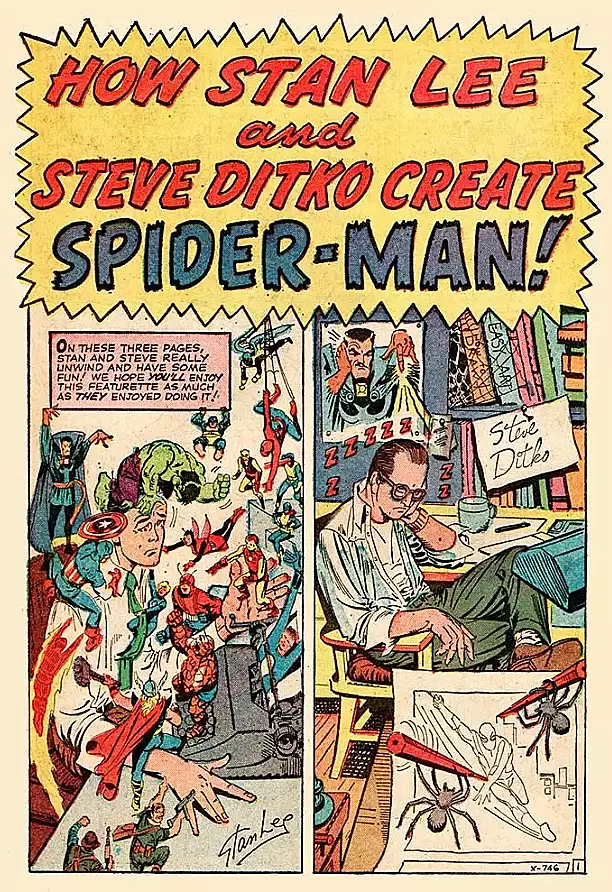
3.8. “The sheet was for me to note any sub-plot ideas for S-M, PP, and the main supporting characters: J Jonah, Aunt May, the school kids, etc.“
Many years later, Stan Lee would later publicly praise Ditko’s storytelling in his introduction to a Marvel Masterworks edition that included Ditko’s final eight issues (31 – 38):
“While I wrote the dialogue and the captions and tried to inject whatever personality I could into the yarns, the basic story structure was itself, for the most part, fashioned by the dazzling talent of Mr Ditko. As you read each and every now-classic adventure, you’ll notice for yourself how every little subplot weaves in and out of each episode, embellishing the main theme and finally becoming a main part of the later story lines. The more you study the delicate fabric of each tale, the more you have to admire the subtle skill and meticulous planning that Steve brought to each and every installment.”
— Stan Lee, ‘If Unpopularity Ever Became Popular’, 1991 introduction to Marvel Masterworks: Spider-Man Volume 4
3.8. “As for Lee, he was now reliant on interpreting Ditko’s pencils and story notes…”
Few of Ditko’s note pages appear to have survived, but some were published in the TwoMorrows publication Alter Ego #68, May 2007. This example shows Ditko’s rough dialogue for six panels (from Strange Tales #143, April 1966) alongside the published version (scripted by Roy Thomas):
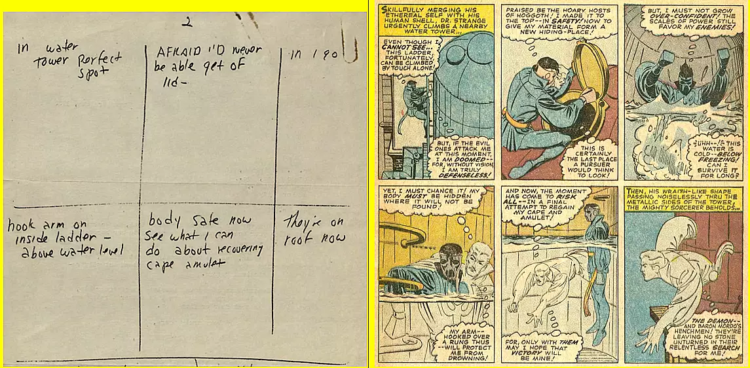
The lack of communication between Lee and Ditko occasionally resulted in confusion. In Amazing Spider-Man # 30 Lee’s script has a member of costumed gang wrongly refer to their leader as ‘The Cat’ (the name of an unrelated cat burglar shown in the same issue).
In issue 36 (May 1966) Lee interpreted a pencilled figure for Spider-Man and dialogued it accordingly, only to find that Ditko had delineated the character as the villainous ‘Meteor Man’ when the inked pages came back. A frustrated Lee then had the panel redrawn by artist Carl Hubbard to match his script.
‘Rascally Roy Thomas Talks about The 1960s and Early 70s’, Alter Ego #50, July 2005
3.9. “The only person who had the right to know why I was quitting refused to come out of his office or to call me in.”
Ditko’s account can be compared to recollections provided by Roy Thomas, who was in the office at the time:
“The next memory I have is of Steve coming in one day to drop off and/or pick up pages from Sol, breezing in and out as usual while Stan, utilizing some kind of radar sense that would’ve made Daredevil envious, as usual managed to remain in his office until the artist had left, so that in all my life I never saw the two of them together. As my wife Dann likes to point out to me, as far as I knew, they could’ve been one and the same person, leading some kind of perverse double life! But on this occasion, I quickly learned—after Stan did, from Sol—that Ditko was quitting, that he’d informed Sol he would complete the “Spider-Man” and “Doctor Strange” stories on which he was currently working, and that would be it for him and Marvel. Apparently he gave no particular reason that day, or any other time, to either Sol or Stan, as to why he was quitting. (I knew it wasn’t over a page rate, since Sol had at that time, on his desk, a memo he had intended to mention to Steve that gave him a $5 a page raise, not a totally inconsiderable sum in those days. It was probably a 10% increase or thereabouts.)”
— Roy Thomas, Alter Ego #160 p3 Vol. 3, September 2019, TwoMorrows Publishing
“Steve walks in and turns his work to Sold Brodsky and walks out. Sol gets up and trots into Stan’s office and comes back a minute later and tells me Ditko has quit. He said Ditko just came in and said he’ll finish up the Spider-Man and Doctor Strange he was working on now, and then that was it. He didn’t give Sol or Stan any kind of reason.”
— Roy Thomas, True Believer – The Rise and Fall of Stan Lee, Abraham Riesman 2021
3.9. “One of the first outlets to report this news to readers was a fanzine”
Lee would provide further detail on Ditko’s departure during a talk to students at Princeton University on March 10, 1966, for which audio recordings still survive (and remain available on youtube):
“Now we just lost the artist that does Doc Strange, Steve Ditko, who also does Spider-Man. I feel as badly about it as you do. He’s a very… peculiar guy. He’s a great talent, but he’s a little eccentric. “Anyway, I haven’t spoken to this guy for over a year. He mails in the work, and I write the stories, and that’s the way he liked to work it. One day he just phoned and he said, ‘That’ll be it.’ So that was it.“
–Stan Lee, Princeton University on March 10, 1966, uploaded on youtube by Sean Howe, 29 December 2013
(Note: Lee states here that Ditko was only mailing in his work during the period in question. However, other first-hand accounts, including interviews with Lee himself, confirm that Ditko continued visiting the Marvel premises to deliver at least some of his work until he quit).
3.9. “An acknowledgement of Ditko’s departure appeared on the Bullpen Bulletin page of Marvel’s publications cover dated April 1966, citing ‘personal reasons’ for the decision.”
It would be half a century before Ditko finally explained his reasons for leaving Marvel. In the meantime, he would continue to interact with a variety of individuals in the comics community. Various anecdotes began to emerge, and there would also be much speculation as to what had prompted the decision.
Roy Thomas would have the opportunity to talk to Ditko just a short time after the event:
“I saw Steve only a few weeks after he quit, at a party at Dave Kaler’s new place on the Upper West Side. I said to him, “I’m not spying for Stan, and I won’t tell him what you say, but why did you quit?” All I remember from Steve’s vague response is a sentence fragment: “well, you know, when a guy’s working against you…” I doubt if he meant Stan was consciously working against him, just that he felt Stan should leave things to him since he was plotting the book.”
— Roy Thomas, ‘Rascally Roy Thomas Talks About the 1960s and Early ‘70s’. Alter Ego 50, July 2005
Bob Beerbohm, a well-known comic book historian and retailer who was publishing a fanzine titled ‘Fanzation’, contacted Ditko in the late 1960s and provided this account:
“Back in early 1969, my friend Steve Johnson and I called up Steve Ditko on the phone… and he tells us a tale of WHY he left Marvel. He put it forth plain and simple. He had been promised royalties if/when Spider-Man took off, which it did. Martin Goodman made promises of royalty sharing through Stan Lee—the latter acting as conduit for his boss.”
— Bob Beerbohm, Aug. 31, 2011. The Comics Journal website (as reproduced in Kirby and Lee: Stuf’ Said, Expanded 2nd Edition, by John Morrow, TwoMorrows Publishing, 2003)
“On the 2nd call he asked us not to publish any thing about the royalties he said were promised to him by Marvel’s publisher. We complied – he sent this letter on creativity for us to print instead.”
— Bob Beerbohm, Facebook posting on the ‘Steve Ditko Letters’ group, 15 September 2023
Beerbohm also heard that Steve Ditko had encouraged Jack Kirby to join him when he left Marvel in late 1965, as part of a strategy to pressure Goodman into a royalty deal with the artists. He later wrote of verifying this during a meeting with Kirby (and his wife, Roz) at the first San Diego Comicon in 1970:
“During the course of this dinner was when I first asked Jack, along with Roz, about Ditko’s afore-mentioned claim regarding ‘royalty’ concepts. That Ditko had tried to get Kirby to walk at the same time.
Jack corroborated Ditko’s “testimony” of initially agreeing to walk, then backing out at the last moment, So did Roz. The thought pattern as envisioned by the two which Ditko had presented to them was paralyzing Marvel so Goodman would finally listen.
Jack, and rightfully so, a product of the Great Depression of the 1930s, was ever fearful of not being able to provide for his kids month in, month out. He could not take the risk. He had earlier burned a bridge via DC via a scenario over Sky Master newspaper comic strip with Jack Schiff who was still working there.”
— Bob Beerbohm, ‘Goodman vs Ditko & Kirby’, Kirby Museum Website, posted 11 February 2012
A 2004 interview with Stan Lee provided further evidence that royalties were, at the very least, a point of contention with Ditko:
“I always wanted Steve to come back and do more Spider-Man or Doctor Strange, but he always refused. I spoke to him one time – either in person or over the phone – and I told him that I’d love to work with him on Spider-Man again. He told me that he would not do another Spider-Man unless Marvel started paying him a royalty on the character. It’s a funny thing, but I think Jack Kirby always felt that way too. Both Ditko and Kirby felt that I was getting royalties and they weren’t, but it wasn’t true.“
— Stan Lee, Comics Creators on Spider-Man, by Tom DeFalco, interview by Tom DeFalco, Titan Books 2004
Comic book creator Dick Giordano, who became the Executive Editor of Charlton Comics in 1965, visited Ditko’s studio near the end of Ditko’s run on Amazing Spider-Man. There he heard Ditko’s frustration with the way Lee was writing the credits. In later years Giordano came to believe that this was the central reason for Ditko quitting Marvel:
“The dispute was he thought he was writing Spider-Man, but Stan was getting the credit. As proof he showed me a chart he had up on the wall that said when certain things were going to happen for the next six issues…plots, sub-plots, and how they were going to interact over that six-issue span. Stan would dialogue it when the pencils came in, shouldn’t Stan be considered the writer? You can argue the point, Steve argued that it wasn’t. And because of his new philosophy or social order, he felt it was criminal for someone to take credit for something he didn’t do. That’s what led to the break-up with Marvel and Steve Ditko.”
— Dick Giordano, Interview in Comic Book Artist #9, interviewed by Jon B. Cooke (2000). As quoted in Kirby and Lee: Stuf’ Said, Expanded 2nd Edition, by John Morrow, TwoMorrows Publishing, 2003
Giordano’s recollections confirm that Ditko was concerned about the wording of credits during the 1960s — or at least by 1965. However, his 2000 account suggests that Ditko specifically took issue with Lee being credited as the “writer.” This seems inconsistent with some of Ditko’s own commentaries, in which he often referred to Lee as the writer and even proposed that an “honest” credit would be: “A Co-creation by Stan Lee (Writer) and Steve Ditko (Artist)” (see 3.7. Ditko’s Opinions: Credits). The likely explanation is that Giordano slightly misremembered the conversation, as he later recounted the same meeting in 2006, this time referring to Lee as the “scripter” instead:
“I was visiting his New York Studio while he angrily insisted (as did Jack Kirby later) that that he, not Stan Lee, was writing the scripts for Spider-Man. To make his point, he indicated a chart on the wall that clearly outlined the Spider-Man storyline for the next three or four issues.
Stan, of course, did write the dialogue, but Steve, rightly or wrongly, still insisted that he should get scripting credit.”
— Dick Giordano, Foreword to Action Heroes Archives Volume 2, 18 December 2006
It is well documented that Ditko associated the word script with the “full script” process, in which a complete story — including dialogue — was provided to the artist in advance. He was therefore concerned that readers might assume he was working from such a script, rather than operating as an “artist plus,” even when he received specific credit for plotting. In contrast, Stan Lee used the term script to refer only to the dialogue — which was written after the story had already been visualized. Since Ditko was solely responsible for the storylines by 1965 and was making all the creative decisions that would normally be part of a script, it’s understandable if he told Giordano the “script credit” belonged to him, not Lee.
As Giordano noted, fellow creator Jack Kirby shared Ditko’s view on the term ‘script.’ This is supported by the following quote, in which Kirby explains that his use of the word ‘script’ is equivalent to what the interviewer referred to as a ‘plot’:
“You can call it plotted. I call it script. I wrote the script and I drew the story.”
— Jack Kirby, Interview by Leonard Pitts (available online at 1986/7 Jack Kirby Interview | The Kirby Effect) conducted 1986/1987
In 1970 another prominent comic book creator, Mark Evanier, had his own opportunity to visit Ditko’s studio (alongside friend Steve Sherman). Years later, he recalled Ditko outlining the grievances he’d had at Marvel:
“…(Ditko) believed Marvel’s then-owner was reneging on certain promises about sharing in the revenues of the characters Ditko co-created, Spider-Man and Dr. Strange. He was upset with the way his comics were then produced, feeling that he was doing most of the writing work on the comics he did with Stan Lee, but that Lee — as dialogue writer — was getting too much of the credit and money. (Marvel’s two other best artists of the period, Jack Kirby and Wally Wood — both good friends of Ditko’s — felt the same way.) There were also personality clashes between Lee and Ditko — they didn’t speak for the last eighteen months or so of their “collaboration” — and Ditko was displeased by many of the creative choices Stan was making, treating Spider-Man as a morally-confused, troubled protagonist. Ditko…didn’t like heroes who didn’t rigidly adhere to his own interpretation of good and evil, black and white.”
Noting that Ditko (who had not yet written his 2015 ‘Why I Quit S/M’ essay) had shared similar things with others, Evanier went on to say: “(Ditko) may write things like “My reasons are my own (for quitting Marvel) and I’ve never divulged them to anyone” but we don’t have to believe that. Besides, what other reasons could there have been?“
— Mark Evanier, ‘Ditko Doc Posted on Tuesday, September 11, 2007 at 12:12 AM’, News from ME blog
Much later, in a 2024 blog, Evanier again referenced the visit:
“His (Ditko’s) stated reasons for leaving Marvel then were frustrations with Stan changing his stories, Stan being too often credited as the sole creator and writer of comics that Ditko largely plotted, and with the company heads not making good on promises that he would share in the merchandising and profitability of Spider-Man.”
This time, he specifically addressed Ditko’s 2015 narrative that his departure from Marvel was linked to Stan Lee’s decision not to speak with him. While recognizing the possibility that this “may be true,” Evanier noted that Ditko “never said anything” about it during their 1970 meeting.
Evanier himself had met with Lee in the same office that had been used during the Lee/Ditko collaboration. In his opinion, it would not have been difficult for anyone to approach Lee if they had wished:
“If (Lee) didn’t want to talk with me but I wanted to talk with him, I would have just walked into his office and confronted him. I don’t think he kept his door locked but if he did and Ditko tried to see him, I think Ditko would have mentioned that.”
Evanier also recalled having discussions with Stan Lee (who passed in 2018) and Sol Brodsky (who passed in 1984) and obtaining their perspective on what had transpired:
“Both Stan and Sol told me it was the other way around; that Ditko refused to talk to Stan and would deliver the work to the office on the days when Stan was not there. It was no secret that Stan worked at home on certain days of the week.”
— Mark Evanier, ‘Spidey Sense’ , Posted on Wednesday, July 3, 2024 at 4:57 PM, News from ME blog)
The suggestion that Ditko may have been the one who initiated the situation is also present in at least one interview with Marvel artist John Romita, who joined Marvel in 1965:
“Stan and I were plotting ‘Daredevil’ verbally, and we would often get into conversations about the other people he was working with. Stan told me that he was having disagreements with Steve Ditko over almost every Spider-Man plot. Ditko was plotting the stories by himself and Stan was very unhappy with the results. Ditko had a different take on storytelling than Stan.”
“Steve would just drop off the pages with Sol Brodsky and never talk to Stan about them”
— John Romita, interviewed by Tom DeFalco, Comics Creators on Spider-Man, by Tom DeFalco, Titan Books, 2004
And those comments are consistent with others Romita reportedly made to fanzine editor Bob Sheridan during a 1966 interview:
“In my discussions with Romita, I learned something of why Steve Ditko left Marvel. It seems that when he started out, Ditko was basically an amateur, with little confidence in himself. Stan Lee convinced Ditko that he was a good artist, that he should stick it out. Ditko became convinced. He began to slack off his direct contact with Lee, until he never came to the bullpen anymore. Then, when he didn’t feel like doing the story the way Stan wanted it, he did it his way…often making the task of writing an unintelligible story a real task for Lee. That’s how Ditko began getting credited as plotting the stories.“
— Bob Sheridan ‘Rambling with Romita’, The Web-Spinner (fanzine) #5 1966
In 1999 another commentator, Ron Frantz, recalled conversations with Ditko that he’d had a ‘dozen’ years prior, in which the artist cited creative interference by Marvel publisher Martin Goodman:
“The reason Ditko left the book (‘Amazing Spider-Man’) is that he was unwilling to follow Goodman’s demands. Evidently, Ditko didn’t like Goodman and he didn’t like what Goodman wanted to do with Spider-Man.”
— Ron Frantz, email, 19 July 1999, ditko-l@egroups.com discussion group, as quoted by Blake Bell, Strange and Stranger, The World of Steve Ditko, 2008
Whatever the true circumstances were, it is worth emphasizing Ditko’s 2015 explicit dismissal of the stories and theories circulated by others:
“There have been many claimed knowers of Why I Quit S-M and Marvel. Stan and I were arguing over, disputing Who is, or should be, the Green Goblin, over “not getting promised royalties,” and other known, floating, arbitrary “truths”, the “real” stories, reasons, fantasies, by CBFs and fan publications, “historians.”
All such claimers lack first-hand knowledge. All are guessing, creating, their own reasons, fictions and fantasies”
… Steve Ditko ‘#45: ‘Why I Quit S-M, Marvel’, 2015, The Complete Four-Page Series and Other Essays by Steve Ditko p.48
Endnotes: Afterword
“In 1992 Steve Ditko and Stan Lee almost reunited on a new project.”
Ditko was offered the role of artist for Lee’s new series, ‘Ravage 2099’. Despite the circumstances of his original departure from Marvel in 1966, Ditko agreed to meet with Lee in person to discuss the proposal. This would mark the last known meeting between Steve Ditko and Stan Lee.
Marvel writer Tom DeFalco (who had himself worked with Ditko) was present during this historic occasion and later described what he witnessed:
“Steve came in, very flattered to be asked. The guys started to shake hands, then gave each other a big hug. It was a very warm reception between the two of them, and it was obvious these were two guys who really liked each other and really respected each other.
“Stan laid out his ideas for the series, they had a really terrific discussion going back and forth. A lot of Steve’s discussions had been fiery, but this one was just so warm and friendly.”
— Ralph Macchio, ‘Ditko: The Mystery Behind the Man’ by Rob Steibel, Wizard #124, January 2002
Jim Sacrilup, a Marvel editor during the 1980s/1990s, recalled that Lee suggested Ditko revisit the Spider-Man character during that same meeting:
“We set up a meeting, we met in then-Marvel President Terry Stewart’s office (Stan’s old office), and it was a lot of fun. The two men clearly still had great respect for each other, and I think if I wasn’t planning to leave Marvel myself shortly, I could’ve got them to do a project together again.
Steve explained to Stan why he didn’t want to do Ravage — he didn’t want to do a negative version of the future, he wanted to do something with a more positive view, like the original Star Trek TV series.
Stan then made a pitch to do a Spider-Man graphic novel with Steve (“Think of all the money we’ll make!”), and again got turned down, with Steve saying he could never care about the character as much as he did originally.
Stan was truly disappointed, and Steve, I believe, would’ve been willing to do another project with Stan, but unfortunately, it was not to be.”
— Jim Sacrilup ‘The LEE-DITKO Spider-Man Graphic Novel That Never Was’, 13th Dimension website, posted By Dan Greenfield on Nov 14, 2018
In an article for Wizard magazine (issue 124, January 2002) Ralph Macchio (who had worked as an Editor at Marvel) also recalled discussing the possibility of a new Spider-Man story with Ditko during the 1990s:
“I said, ‘Steve, you can do something really different”, Macchio explained. “‘Go back to where you left off and do that next story that you wanted to do.’
“He was saying, ‘Well, I was thinking about doing Peter Parker…what he did during that summer. What happened after he graduated? What did he do with his life?”
“Unfortunately, it didn’t come off, but we really were getting close with it.”
— Ralph Macchio, ‘Ditko: The Mystery Behind the Man’ by Rob Steibel, Wizard #124, January 2002
In a 2020 interview, comics historian Alex Grand mentioned rumors that the proposed new Ditko Spider-Man project had failed due to concerns over Marvel’s Untold Tales of Spider-Man series, which presented new stories set during the Lee/Ditko era. When asked about the validity of these rumors, Marvel Vice President Tom Brevoort responded:
“Yes. Although, I don’t know that Untold Tales itself was the reason he backed out of it. Ralph Macchio who was then the Spider-Man editor, long-time Marvel editor, spoke to Ditko a couple of times about reuniting him and Stan for one last Spider-Man book. And Ditko had serious conversations with Ralph about this, deep enough that I know that he was saying, “Well, we’ll set it during his last summer before he graduates high school, because Ditko, his opinions over the years had only grown more intractable and he was really of the opinion that they never should have graduated Spider-Man from high school to begin with because it’s okay for a high school kid to be sort of insecure and to make mistakes and to foul up, but if a grown man does that, he’s not a hero anymore. He’s a failure. He’s not allowed the same stumbles as a kid is.”
“So Ditko said that during his last summer. So Ralph sent him some books for reference to showing what was going on and to keep him enmeshed and stuff as they were going to plot this out. As Ralph relayed the conversation to myself and Glenn Greenberg after it all happened, he got on the phone with him and Ditko said something like, “Oh, I have collaborators now, do I?” Talking to the Untold Tale stuff. And it was one of the things where the very fact that that stuff was there and whether or not… I don’t know, maybe, I would have been egotistical enough to say, “Oh, no, no, no. Ralph, you can’t let him do that because it’ll contradict Untold Tales of Spider-Man.””
“I like to hope that I would have been smart enough to go, “Steve Ditko, let him do whatever the hell he wants on that Spider-Man story. It’ll be fine. It’s not going to hurt Untold Tales. But either way, Ditko felt like this stuff was there. It was more of an impediment and between all of that, that project never happened. It actually transformed. It turned into the ‘Spider-Man Kingpin: To The Death’ book that Stan did with John Romita instead of Ditko. That was the book that took its place. If things had gone differently, it might have been a last Stan and Steve Spider-Man story.”
— Tom Brevoort, Tom Brevoort Biographical Interview 2020 by Alex Grand & Jim Thompson | Comic Book Historians, interview conducted by Alex Grand, posted on youtube 28 August 2020
In 1996 Marvel published Marvel: Heroes and Legends #1, a special issue that utilised the talents of many silver-age Marvel artists including Gene Colan, John Romita and Steve Ditko. The story (plotted by Fabian Nicieza) was based on the 1964 Fantastic Four Annual (originally produced by Lee and Kirby). Lee provided the final script, making this the last time any new Lee/Ditko material was produced.
“In the years that followed their final meeting the Lee/Ditko relationship would again deteriorate.”
Ditko would express frustration with Lee on numerous occasions following their 1992 meeting, often in relation to the issue of creator credit. This situation was likely aggravated by the abundance of interviews, articles etc. that accompanied Lee’s growing fame as the public face of Marvel in the 1990s and 2000s.
A notable example related to a 1998 interview in which Stan Lee was asked for his thoughts about Steve Ditko:
“Steve is a little bit of an enigma to me. He is a very private person. I don’t think he likes to be interviewed. (Unlike me!) He is incredibly talented and is a little bit like Ayn Rand- he’s got definite convictions, and he sticks with them and he’s true to them. There is nothing I could say about Steve that wouldn’t be positive and flattering. I’m a big fan of his. I don’t think Spider-Man would have been as successful if he hadn’t drawn it in those early years. I think he gave it so much of the look it needed and the quality it needed.”
Lee proceeded to praise Ditko’s narrative contributions but, on this occasion at least, failed to mention that Ditko had taken over plotting entirely during the second half of their ‘Spider-Man’ run. More crucially, whether intentionally or due to poor memory, Lee stated that a well-known scene from Amazing Spider-Man #33 (February 1966) was based on his suggestion:
“It is not common knowledge, but Steve’s also a good story man. I didn’t write out detailed scripts with him, I would just tell him (as I did with Jack) what I thought the story should be and he went home and drew it any way he wanted to…and the way he drew those things would be fantastic.
It was very easy for me to write them because visually the stories were just so beautifully laid out and so clear and exciting. There is a very famous scene he did in a Spider-Man story where he was trapped in a subway tunnel and had to lift some heavy weight over his head. I just mentioned the idea but Steve drew it incredibly…devoting I think 3 or 4 pages to Spider-Man lifting those heavy weights. I hadn’t thought of devoting that many pages to it, but it was a brilliant, brilliant move on Steve’s part and made that episode absolutely unforgettable and as dramatic as anything could have been. I’m still Steve’s biggest fan.”
— Stan Lee, ‘Stan the Man Lee – Maestro of the Marvel Mythos’, Comic Book Marketplace 61 July 1998, interview by Bob Brodsky
Ditko subsequently wrote a letter to the same publication to correct the record:
“In your Comic Book Marketplace #61, July 1998, page 45, Stan Lee talks about “…a very famous scene…” of the trapped Spider-man lifting heavy machinery over his head.”
The drama of that sequence was first commented on and popularized by Gil Kane.
Stan says “I just mentioned the idea…I hadn’t thought of devoting that many pages to it…”
I was publicly credited as plotter only starting with issue #26. The lifting sequence is in issue #33.
The fact is we had no story or idea discussion about some Spider-man books even before issue #26 up to when I left the book.
Stan never knew what was in my plotted stories until I took in the penciled story, the cover, my script and Sol Brodsky took the material from me and took it all into Stan’s office, so I had to leave without seeing or talking to Stan.”
— Steve Ditko, published letter to Comic Book Marketplace 63, October 1998
Ditko would also take Lee to task for his tendency to describe himself as ‘creator’ rather than ‘co-creator’, e.g.:
“…Lee earlier said, “I like to say that I co-created these characters” meaning all Marvel heroes and villains. Yet, Lee’s paper trail interviews reveal him rarely saying ‘co-created’ even when and where it is really needed. It’s actually very, very rare that Lee ever used the term ‘co-creator’ and actually named who the co-creator actually is.”
— Steve Ditko, ‘“He Giveth and the Taketh Away’, Avenging Mind 2007 (reprinted in The 32 Series by Ditko Vol 1 Overture, p 29)
The following comments provide further insight into Ditko’s view:
“Lee’s real, authentic achievements are not good enough for him. He wants more. His ‘idea’ to gain more, even gain all, had to involve denying all others their authentic achievements from Goodman down.
The full, objective reality “script” of what actually happened inside Marvel is rejected by Lee for his “synopsis” version, for his “idea” of being the sole cause, “creator”, of the creation of Marvel’s success excluding all others.
“Lee rejected his authentic and, in justice, his earned and deserved achievements for the status of the only one who really made Marvel’s success possible for the popular, public, celebrity benefits.”
— Steve Ditko, ‘Creative Crediting’, Avenging Mind 2007 (reprinted in The 32 Series by Ditko Vol 1 Overture, p 29)
Readers are encouraged to refer to Ditko’s original essays for a full understanding of his criticisms. Some of Lee’s views on the matter can be found in the Jonathon Ross documentary ‘In Search of Steve Ditko’
Endnotes: Personal Reflections
“This balance, in keeping with Ditko’s personal views on truth and recognition, enhances the credibility of his commentaries.”
Lee didn’t comment directly on Ditko’s articles, though Roy Thomas was evidently reading them in the mid-2000s and provided this opinion:
“…I’m glad he wrote the articles he did, even if they must be taken skeptically just like any other recollections forty years after the fact. I suspect that much of what he says is true…and that all of it is sincerely stated…but he’s not the possessor of the final word on the subject.”
— Roy Thomas, letters section, The Comics! Vol. 15, No. 4, April 2004, the newsletter of Robin Snyder
“For his part, Lee never explicitly acknowledged being responsible for the cessation of their interactions.”
More from Lee’s 1975 commentary is provided below:
“Steve was a very mysterious character. When he first started he was the easiest character we ever had to work with. I used to think that if everybody was as easy to work with as Steve, it would be great. I would call him in the middle of the night with an emergency ten page script and Steve would bring it in the very next day without a complaint. He was just beautiful. But, little, by little, he became tougher and tougher to work with. After a while he’d say to me, “Gee, Stan, I don’t like those plots you are writing for Spider-Man.” So I’d say okay, because I couldn’t have cared less, Steve was so good at drawing stuff, I said, “Use your own plot, I’ll put the dialogue in.” So he’d do his own, and I’d switch them around, and I’d put the dialogue in and make them conform to what I wanted. Then he’d say “I don’t like the sound—effects you’re putting in:” So I told him to use his own, I didn’t mind. I’d bend over backwards to accommodate him, because he was so good and the strip was so successful. But it was like Chamberlain giving in to Hitler, the more I appeased him, the harder he got to work with. Finally, it reached the point where he didn’t even come up to the office with his artwork —he’d just mail it in. Then one day he said he was leaving.”
— Stan Lee, ‘A Serious Interview with Stan Lee’, April 1975. interview with Stan Lee, Fantasy Advertiser International, April 1975 edition.
Many years later, Lee was still giving his thoughts on the matter—notably in his 2002 autobiography:
“Little by little I notice that Steve was beginning to give off hostile vibes. At first I thought it was my imagination, but after a while I realized that something was bugging him. Steve wasn’t the most communicative guy in the world, and to this day I’m not quite sure what the problem was. It just seemed to me that he had a growing resentment toward me and the work I did, particularly in connection with Spider-Man.”
“As far as I can guess, part of the problem was that I was the editor at Marvel as well as the writer. When reporters wanted to do a story about Marvel and Spider-Man, I was the one they inevitably came to interview. I often suggested that they talk to Steve as well, but it turned out that he didn’t really want to be interviewed; he was a very private person.”
“Although, when interviewed, I always mentioned Steve’s importance in regard to Spider-Man, the stories that appeared in magazines an newspapers often made it seem as if Spider-Man was a one-man show and I was that man.”
“Even today, whenever I talk about the origin of Spider-Man, I always say I started it with Steve Ditko. I tell everyone that after I came up with the basic concept and the cast of characters, I selected Steve out of all the artists I could have chosen because he not only had the perfect illustrative style for designing the characters and creating the look of the strip but his plotting input was also extraordinarily valuable.”
The same publication included Lee’s reflections as to whether it might have been possible to address the issues that arose with respect to both Ditko and Jack Kirby:
“I’ve often been asked if it would have been possible to salvage my relationship with either Jack Kirby or Steve Ditko. I think it would have been if either of them were less laconic. There was never a time when Jack Kirby just sat down and told me what, if anything, was bothering him. The same held true for Steve Ditko. It’s hard to correct a misunderstanding if you don’t know what’s misunderstood.”
— Stan Lee, Excelsior, The Amazing Life of Stan Lee, by Stan Lee and George Mair, Fireside, 2002
“…His recollections are also an essential part of comics history, contributing to the enduring legacy of this creator/‘artist-plus.”
A frail Stan Lee, in the final months prior to his own death, acknowledged the passing of Steve Ditko in a youtube video posted on July 14, 2018 (‘Stan Lee Remembers Steve Ditko’, Marvel Studios Movies). In this video Lee praised Ditko’s artistic talents and referred to his former colleague as “…one of the most important creators in the comic book business.”
— Stan Lee, ‘Stan Lee remembers Steve Ditko’
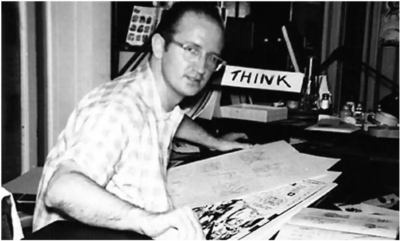
Copyright © 2025 Rosco M
This article contains original commentary and excerpts quoted under fair use for educational, journalistic, or critical purposes.
All original text is © Rosco M; quoted material remains the property of its respective copyright holders.
Join us for more discussion at our Facebook group
Check out our CBH documentary videos on our CBH Youtube Channel
Get some historic comic book shirts, pillows, etc at CBH Merchandise
Check out our CBH Podcast available on Apple Podcasts, Google PlayerFM and Stitcher.
Use of images are not intended to infringe on copyright, but merely used for academic purpose.
Images used ©Their Respective Copyright Holders