Rob Liefeld Biographical Interview by Alex Grand
· September 26, 2024 · by Alex Grand · Interviews
Alex Grand: Well, welcome back to the Comic Book Historians Podcast. I’m here with the pioneer of the Extreme age of comic books, known as putting the intense storytelling and artistic impact into comic books. And it was really Rob Liefeld who I felt was the tip of the spear of this comics revolution. He had a huge impact on the audience, and the industry really just kind of chased what he was doing in any way they could. Spider-man, Clone Saga, Death of Superman all the reaction to just try to keep up with what Rob was doing. Rob is also known for upgrading the New Mutants into the powerful X-Force, and by doing that, he shattered the illusion of change that was predominant in Marvel, and also showed that generation X could also become great in their own right, and maybe even better than the generation before that. Rob, thank you so much for being here.
Rob Liefeld: Great to be here, Alex. Excited to talk to you, man. What are we going to talk about?
Alex Grand: What I want to talk about is the inner child. And I think being able to powerfully stay connected to the inner child may be in my mind and tell me if I’m wrong. A strong part of what’s manifested in your comics and Marvel legacy. What do you think about that?
Rob Liefeld: Wow, that’s a great uh. I would have to agree with it 1,000% based on the fact that I got copies of my new book that comes out Wednesday. Deadpool team up number two, and I did this on my last job as well. And I put a series of double page spreads that literally go back to back to back. And it’s an indulgence that you don’t see as much in today’s comic book. You just don’t see it in today’s comic books. That much, that much storytelling indulgence. And the the, the the guy I’m trying to please is, is basically it’s like, right before I did that, I took a whole, you know, a table of Jack Kirby powder. And I sniffed it and I inhaled it because I’m trying to replicate the kind of comics I love the most when I was a kid. Yeah. And when Jack Kirby came back to Marvel in the 70s, he was in full. He knew exactly what he was capable of. Uh, for for we can debate. And the comic book historians such as yourself have been debating forever, uh, the impact of his fourth world New Gods, forever people. And that stuff is genius to me, and in fact, probably informed more of my early career and my work than anything else I’ve done. But so what I’m doing these this morning, I’m sitting there, I’m like, this is what the kid in me would dig.
Rob Liefeld: I, I, I opened up each splash page, uh, in the multiple copies I had, and I laid them out. And I’m like, this is fun. I do fun comics. I want my comics to be fun. There’s a time to move you and to be mysterious, but especially on my way out the door with Marvel Comics. If this is going to be my last like ride, I’m going to make it as bold and fun as possible. And I understand writers who don’t want to write a lot of action and dynamics, because that doesn’t seem like they’re working their writing muscle. But that’s not what Marvel Comics like. Marvel Comics was built on. Fun and bold imagery and big, larger than life characters. So I am feeding the child in me at all times. Alex. So that is that is 1,000% at this point. And I know you have to for me, I have to throw something in there that is also clever enough to keep you following me. But I’m also telling you that if you want some badass comic book superhero action, I’m probably your best ticket at this point. And there is a there is an audience for that. Always, always there.
Alex Grand: Is, there is, there is always an audience for that. And and I think it brings back that same visceral feeling I had when I was reading your stuff, um, when it was coming out initially in real time and, you know, going back to that inner kid, you know, you, you know, on your observation podcast, uh, number one comics, pop culture podcast that’s out there, um, your, your passion is visceral. You people feel it, and and I know from you growing up, your dad, I think, was a pastor or a minister, and he I think likely it sounds like did sermons of his own. Do you feel is passion? Is that a life trait? Is that something that you kind of absorbed when you were a kid watching your dad, and now you’re bringing that out in in what you love? Is am I thinking about that correctly?
Rob Liefeld: Well you are. There’s really two people who have told that to me. You’re one and Jim Lee is the other. When in 1992, after spending a great amount of time together as we were forming Image Comics, he’s like, you’ve got that pastor thing going, man. You can tell your dad was a minister. You’ve got that you. And really, what it is, is just being the expression. It’s being able to express your passion. And I’ve seen you, you express your passion. We all are able to in some way or another. And and look, in studying comic book history, as we both have, you’re going to find guys who really do and approached comic books as their, uh, brand of literature, which is great. And I’m sure Jack Kirby would tell you he did the same thing. But there’s also a language of comic books that, when spoken a certain way, is its own thing altogether. It rises above literature and, and, and whatever we think of as comic books and, and there are many genres and there have been many authors. And certainly you wouldn’t put Neil Gaiman on a shelf near me, anywhere near me. Um, it’s interesting with Alan Moore in my workings with him, how much more of the inner kid in himself he was trying to activate, which I think he gave himself completely over to when he did work for extreme. He wanted to just have fun and do it in a clever manner. And that’s what the work that he was doing on Supreme, you know, really reflected. But yeah, I think, look, I’m able to convey my passion and if that means I’m a little more of a, a minister, uh, or a preacher about comics, I’m totally cool.
Alex Grand: I love that actual subtitle. Uh, Minister of Comics. I mean.
Rob Liefeld: I’m cool with that moniker.
Alex Grand: That’s the best mic I can I can think about. So now, as far as the inner child reading comics, you mentioned Jack Kirby. Um, we could talk about each of these people that inspired you. Each one could have its own podcast, but I want to put a number from 0 to 10 next to some names. I’m going to read off some names. Tell me. 0 to 10. You know, the potency and the power that fed inner child as a kid reading comics. So. Okay. 0 to 10. John Byrne.
Rob Liefeld: Oh ten.
Alex Grand: Ten. George Perez.
Rob Liefeld: Seven and a half. Frank Miller. Ten.
Alex Grand: Jack Kirby.
Rob Liefeld: Ten.
Alex Grand: Yeah. Okay. Steve Ditko.
Rob Liefeld: About a seven and a half.
Alex Grand: Yeah. And that’s interesting because I know Steve Ditko has some influence, but I don’t hear you talk about it as much. So that’s why I was curious as especially.
Rob Liefeld: You know, what I look right now, here’s the interesting thing is, I’ve said to people, I just happen to have a pile of these right here, this character that Deadpool is fighting. Yeah. Is Steve Ditko creation that Marvel did not know about. They were not aware. Uh, his name is Raoul Dorn. Uh, he is the Dragon Lord from. I think it’s Fantastic Four annual 16. And these villains are connected to him. This dude with the horns. Um, this entire. He and Ed Hannigan created this. And as a kid, I just loved it. But the. So the reason I don’t talk about, uh, Steve Ditko more is because I don’t love Spider-Man. I if I, if if we were only to talk about Steve Ditko, I mean, if we were only going to talk about Spider-Man and Doctor Strange, I only want to talk about Steve Ditko. But the big influences in my career, in my as and as a fan, the stuff I chased was X-Men, Avengers, Fantastic Four, Daredevil. It was very much the Avengers and X-Men family of books. And then what Frank Miller did to Daredevil, uh, and, and and so I’m always very upfront with people. I really I dig Spider-Man when he’s done right. But I love fighting with people about, um, you know, this is so funny, Alex. This came up last night at a dinner with some friends, new friends, and the husband has a comic book collecting hobby that the relationship between my wife and and this friend of hers and the guy is my age, was collecting comics.
Rob Liefeld: His dad was a military guy, so he collected comics on base and now he’s amassing his collection rebuying everything he couldn’t bring back over with him overseas because they can only take like one box. But he started talking about Romita Senior’s Spider-Man and how it got so great. And as we were walking through the door after the night is over, she, my wife Joy said, I really thought you were going to lay into him about Steve Ditko being the greatest Spider-Man artist, but but you let that go. And, uh, three years ago, right out of the pandemic, here at the local, uh, our local kind of theater performance art center, uh, they did a month of, uh, radio plays of, uh, re-enacting the the John Romita. Stan Lee. It’s where he throws his Spider-Man costume into the trash. Uh, that. It’s a kingpin story, and it’s great, but in the intermission, because the guy who was throwing it knew my friends and my friends brought me there blind, like, as a surprise. Like they thought I’d enjoy the heat that evening, which I really did. The craft that they put into the voices and the special effects was great.
Rob Liefeld: But he literally comes out and he has the Romita Senior Spider-Man, uh, artist edition, and he’s like, look, man, I got all the art from the promos and the flyers because, man, there is no better Spider-Man than this. Ever. This is. And I just kept going. That’s not true. Not that that’s not true, but so. So, look, I can do the Ditko thing all day long. And this is really, I think my. Because I don’t talk about him enough. Um, like I wanted to I’m like, if this is where I’m going to be, if this is where I’m going to get off the train at Marvel Comics, I’m going to do it with this, uh, Steve Ditko character and expose him. Uh, this is him right now. That that again. That is that is Ralph Dorn, the Dragon Lord. And and I ever since I was a kid. I’m like, I’m going to do a story with him. Yeah, but but also seven and a half is very high for me. That’s very high. I just know the full tilts are the tens. They’re the like I got, you know, it’s like, look, I’m mostly eat Reese’s peanut butter cups, but you can give me a Kit Kat. I’ll eat the Kit Kat. I just don’t assign a ten to the Kit Kat. But the Kit Kat is awesome.
Alex Grand: Okay, that is fair. That is fair. It is awesome. And then last one. 0 to 10 Fred Hembeck.
Rob Liefeld: Uh, you know, a good a good six because he was a ten for about two years of my life. Because I consumed him. I thought he I loved his humorous take on everything, and it was when he was getting his own platforms in a way that he would not before or after. So there was like a period in the comic book industry. I thought he was wonderful. And I’ve shared with people how he did an entire comic book as a junior hire. It’s it’s you have to understand, I am 12 when I’m making this comic where I’m drawing just like me and my friends, just like Fred Hembeck. So, yeah, I mean, look, there are so many incredible, you know, influences, but but the guys who hit the ten, they I probably own their original art. I have most of the I have more of their comics, more of their comics in the certain condition because that romance went the deep, the deepest, you know?
Alex Grand: Yeah. Now, when you were speaking of, you know, drawing comics as a kid, um, when you were first doing that, what were some of those initial emotions? Was it like wonder and your inner kid, just curious about world creating, character creating? Was was there some anxiety that it wasn’t good enough in the beginning? You know, how how were are those initial emotions going into when you first started to draw?
Rob Liefeld: I think you just know that you want to, uh, tell stories. And so I ironically, there was a there’s an account called The Spinner Rack, and they put the first chapter of this up today. And I mean, like, it stops me when I check. And I see this came out September 21st, 1976, because I can tell you exactly the time of day, the afternoon that I walked in with that issue, I plopped down into our sofa chair and at that moment in time, that was my favorite Avengers comics ever. And that’s probably about a year and a half into me buying The Avengers from 1974 through now, 1976, fall 74 to fall uh, 76. And it it’s when Attuma and the Atlantean hordes invade and attack the Avengers in the mansion. And there’s this giant kind of genetically bred Atlantean called Tyreke. And Tyreke is just taking everybody out. But Captain America gets up and summons you know the courage to to to be the guy that takes him down. But it’s the first part of a multi part story with a comic that was coming out called Supervillain Team Up. And the reason I’m telling you that is it unlocked. And the next chapter in this, I think it’s Avengers. It may be. 156 155 I’m not sure if I’m right on these numbers, but, uh, there’s a depiction of Prince Namor that to this day, everybody my age thinks this is the best version of Sub-Mariner. He explodes out of the ocean and attacks the Avengers. They’re on an oil rig and goes blow to blow with Wonder Man and Beast.
Rob Liefeld: So I created my own aquatic super team. Wait for it. They were called the Aquaman. Okay, I love that. Yeah, big, big, big leap for ten year old Rob Liefeld. The Aquaman. Okay, but, uh. But I had all these different characters, and I started making my own comics based on the Aquaman with huge influence of of these three issues that had the Avengers squaring off against Attuma and the Atlanteans. And, uh, I would draw those super tight and really dark pencil on eight and a half by 11 pages and I. And you know what? It’s so funny because one of my friends says that’s a that bird is considered dumb by the leader of my team was called the albatross. And, and and it was goofy, but he just he he was angel. He was basically angel with big giant wings. And my friends are like, that’s not a cool name. I’m like, that’s the name I gave him. But, um, you know, I had the Hydroman it was Alex. They were goofy, but a lot of the adventures were were undersea with bubbles and coral. Because I loved how George Perez drew people under the ocean. And I was also watching reruns of the Aquaman cartoon that came out in the 60s, that was stripped in the afternoons for me. And then, of course, Aquaman was in, uh superfriends. So I had a real thing for aquatic characters, but I wanted to tell stories. So I told about a ten page story, and and then I would go to my dad’s office where he had a copy machine, and I would get copies, and I’d distribute them to my friends, um, like my own little mini Aquaman comics.
Rob Liefeld: I did the lettering, the logos, all that stuff. And I think in that way I’m not alone because, you know, you look at somebody who is as completely in a different kind of artistic realm than I am as a as a painter, as an illustrator. But like 20 years ago when Alex Ross did his art of book and he showed that he was redrawing George Perez pages, uh, of the Legion in the, in the, in the same way that I did or I look at Todd McFarlane’s art of book, we were all trying to recreate the Frank Miller, the John Byrne and the George Perez of all, all of the kids my age from that era. So, you know, it’s just it comes from a place and they all did storytelling. You just want to tell your own stories because I think it’s it’s such a telling. Comics, to this day is such a simple indulgence. If you want to do it. I don’t mean the craft is easy to obtain, but if you want to grab a piece of paper and start telling your own stories, there’s the paper, there’s the pencil. Go. You don’t need a sound crew. You don’t need lights. You know you don’t need an internet connection. You can just go and. And that base instinct is what I felt back when I was nine years old, and it never got away from me.
Alex Grand: Now, when you were getting older and honing that, and you got some of your first stuff put into the megaton comics and really kind of starting to, like, come into your own a bit more. How was that experience? Where was your inner child meter at, you know, while you’re doing the megaton stuff? And how was that excitement and how was that experience working with them?
Rob Liefeld: Uh, so I graduated in June of 1985. I turned 18th October 1985. I graduated when I was 17. I was a very looking back, had no idea what a young graduate. I was just thankful that I was put forward in kindergarten when I was so I could track and be in the grades and know the people that I knew. But everyone else was turning 19 that fall and I was turning 18 after after high school, my senior year, my art, you know, that one hour a day of of my sixth period, I was seniors could kind of make their own curriculum. And so I worked out with my teacher that I was going to do a bunch of sequential art. And of course, I was told, you know, there’s no money in that. Why are you wasting your time? That’s a kid’s indulgence. Do you even know what you’re doing? And I’m, like, blocking out dumb art teacher who is, you know, himself a first year guy. Um, all the art teachers that I ever had really discouraged until, you know, some of them in the 90s became comic book specialists, which I is a completely different story. But you’re like, wait, you were telling me not to do comics, but you saw there was money in teaching comic book art classes, so now you’re. But yeah. So right out of high school, I started doing samples, but I was doing them my, my, my senior year.
Rob Liefeld: And I continued on that path and I mailed out samples. The other day, I pulled out, uh, there’s an entire dark horse story that they hired me to do, which is a werewolf take on little Red Riding Hood. I think it’s a six page story, and the writer’s name is on the tip of my tongue, And I fully penciled it. I could print it today. It’s print worthy. Uh, it’s of the same quality of the stuff that I got, you know, hired to do, but, uh, megaton. So Dark Horse had hired me to do that short story, and I did it. She comes across a naked man in the middle of the little Red Riding Hood, in the middle of the road, and then that naked man, you know, he’s hiding in the behind the rocks and, you know, positioning himself to to hide his nakedness. So it’s not completely creepy, but eventually he emerges as a werewolf. And so this was this take on this story. But then megaton contacted me and Malibu Comics contacted me, and I just drew what I was given in terms of stories. Megaton gave me an, uh, a megaton story. Uh, that was, I think, a 12 page story. I don’t know what issue it ran in, uh, with a character named Ultragirl, and I just went crazy.
Rob Liefeld: I’m like, I’m in. I’m in a, you know, do this to the best of my ability and hopefully find more work. And and at that point, the more work you do, the more work you know, the more the more storytelling you do, the more kinks you’re going to work out, the more doors are open. But the kid in me was like, I’m going to do this. This is going to happen. My parents had fallen on really hard times financially. My dad really never recovered from multiple, uh, surgeries, brain tumors. Cancer really devastated us. My parents made some decisions with their finances that weren’t the brightest. And I knew, like, I had to, uh, I had to provide. Probably not just for myself, but start really thinking about providing for them. So I was working all sorts of side jobs. I’ve. I’ve talked about this. Uh, I was a busboy. I worked construction six days a week, and then I delivered pizzas for my buddy’s pizza place. And in my, you know, in my spare time, I was doing comics. And then as I got more of these stories, I would quit one of the jobs and instead of having three, I’d have two. And then I have one. And then there were enough checks coming in that I could just make comic books. My living. And Alex, at that point, you’re just you can’t believe you’re walking into the bank, you know, in 1986, 87 and cashing checks for comic books.
Rob Liefeld: And, you know, everybody else in my family is like, can you believe it? Robbie is making money drawing comics. It’s funny, you know, I my dad was always hugely supportive. Just go get him, Rob. Go after it. Uh, my first encounter with comic books was when he had shared, I don’t talk about it much because they were really beat to hell. Uh, early Captain America comics. I mean, they were in terrible condition. He had brought them with him out here from Southern California to Southern California, from Michigan, where he was a kid. But my dad understood. He understood the connection. My mom did not. I think the rest of my family thought, again, it’s I’ve talked about it, especially in the the time that I grew up reading comics, it was definitely seen. You were seen as partaking in a childish indulgence and you were probably not very mature. Maybe you. Perhaps you were stunted. It’s nowhere near when my boys leave the house with their Fantastic Four shirts and their, you know, Green Lantern logos. Like, now comics is just cool. And I know what that was like. It was a little bit of a you kind of hid your interest, especially if you wanted to date girls.
Alex Grand: Before I go to the next question, I want to slide in you and your entry into the mainstream. You know, the Levi’s commercial? Yeah. Dennis Miller show, all that stuff. You brought comics more to like non comic book mainstream people and made it cool. Yeah. You helped make comics cool. So that’s that’s something I just want to kind of throw out there. And that’s from a historical perspective that comic book historian approved.
Rob Liefeld: Yeah, I, I’m going to tell you just real quick the reason I made that call to Levi’s, people ask me all the time, and I had the first wave of Button your Fly commercials were playing all the time on MTV, and I said, man, if I could get comic books on TV via representing, like I was thinking of the industry and the hobby at large, not for how it would affect me personally like that. It was just like, man, we’ve got to get comic books represented. And uh, that so so I, I’m just obviously thrilled it worked out the way it did. But you do when you’re in it and you and you see the work that’s being done by these incredible masters, you just hope the entire industry is, is turned on to it. And we needed help. We definitely needed signal boosts.
Alex Grand: With the experience from megaton, you entered DC and getting experience with Hawk and Dove. Yeah. How was that experience? Did you enjoy that? You know, where was the inner child meter at, let’s say, compared to some of the later stuff you ended up doing? And, uh, tell us about that DC experience, Alex, I.
Rob Liefeld: Can tell you from experience and I’ve tried to tell my, my, my, my one, my son who’s had some great success early on out the gate as an actor booking some roles, but I’ve tried to come to him and said, hey buddy. There were times I was waiting on a script, waiting on a plot, and there was no work coming in, and I just had to keep my spirits high and I had to keep, you know, just honing my craft because. Right. I got a few short stories at DC comics and, uh, and they were not like nothing was emerging for me. But the summer of 1987, I met the Keisel’s, uh, Barber and Randall, who were, uh, Barbara and Carl, who were married at the time. I was a big fan of Carl’s, uh, inking. He had been inking like the dedicated John Byrne inker at DC comics, and he had done a lot of stuff over Perez. So he was on everybody’s radar. He’s he’s fantastic. They said they had a two page proposal for Hawk and Dove. Well, I loved every iteration of the Teen Titans ever the 70s iteration that didn’t. The late 70s iteration that didn’t get off the ground. I bought every issue. I always believed that these characters could be bigger and more effective than they were in the marketplace. And Hawk and Dove had had had had appeared in those comics. They had just barely appeared in the Titans books. Uh, and and but I was very familiar with Hawk and Dove, and I had the Steve Ditko issues, and I had the Gil Kane issues, so.
Rob Liefeld: So I’m like, let’s go. And as, as a weird kind of I had learned what after Frank Miller’s Daredevil is when I got the back issues, upon learning that Steve Ditko and Gil Kane had done Hawk and Dove as a fan before I was a pro, I grabbed those in the back issue bin. They were affordable, and I and I saw how much, especially the Gil Kane issues. Um, that there is a there are a lot of influences. The shots, the rooftops, the pursuit across rooftops that those Gil Kane, Hawk and Doves had on Frank Miller’s Daredevil. So I’m like, I’m learning. Wow. Gil Kane is a huge influence, you know, and you’re starting to put together pieces of fan and seeing who influenced the guys that you idolize. But that two page treatment that the keystones gave me was awesome. I was like, I need to be a part of this. I remember on the floor of the show, having stepped away to read their treatment, said, please, do you have an artist? No. We’re waiting to be assigned an artist, but we will throw your name in in the mix. They were totally supportive, totally just as supportive as you could possibly, um, you know, hope, but the editor just didn’t think I was ready, had seven other people in mind, and two of those people were my friends who had just broken in as well. And so I would just call and, hey, did you take. No, I’m turning that down. Okay. Boom. Scratch that guy off the list. I’d be like, how many? They’re like, there’s four more people they’re out to.
Rob Liefeld: It’s from 7 to 4. And and I. It’s with great joy that I tell people when you’re getting picked for teams baseball, basketball in for Hawk and Dove, I was the guy the last guy picked. And you’re like, you picked the right guy because I’m a totally land this plane for you. Nobody else was going to have anywhere near the passion. The diesels knew this. I had really strong opinions on how dove should be portrayed, and it was weird. I got a lot of pushback. They basically not. They. The editor wanted dove to basically be just the dove costume from the original with breasts. And I’m like, we are leaving a whole lot of of available like visual, a longer shawl hair. I finally just won by getting the ponytail. Alex. But that my fights with the editor were greater than any fights that I had, because I didn’t have any fights with Barbara and Carl. It was smooth sailing. I like the work that we were doing. I thought Carl and I clicked the best. Issue two. I was like, oh my gosh. Issue one you’re feeling yourself out. But he was learning, I think, my pencils more and I was doing full pencils and I, I loved I love Hawk and Dove. One, two, three, four and five is completely compromised, uh, because I drew 12 of it sideways, 12 pages sideways. And that’s now now, now, here’s the deal. As as maybe your listeners know, by the time you get the comic, like like the comic like like Deadpool, Deadpool team up to I.
Rob Liefeld: This is in your hands. On September 25th, I drew this June 11th. I wrapped that book up in June. I’m about to start on issue five of Deadpool Team-Up. That’ll be coming out around Christmas. So issue five of Hawk and Dove in the middle of Hawk and Dove, I was called by Marvel. They said, we really love what you’re doing on this book, and we would love to have you come work over with us in the X office. I thought I was being pranked and punked. I hung up the phone. I said, give me your number. I want to make sure this is from Marvel. And I called back and they’re like, do you believe now? And I’m like, yeah. So when my editor raged on me for drawing those pages sideways and for your listeners Post-Crisis, DC was supposed to be about continuity, continuity, continuity. The chaos realm had been depicted by my friend Eric Larson in Doom Patrol just a few months earlier. He turned the whole book sideways when the Doom Patrol went to the Chaos realm. We are going to the Chaos Realm. I turned it sideways, thought, what a kick. My editor was gone during that period. He was on the set of the late 1980s Superboy show that was shooting in Florida, and he left everything with his assistant, who I got along with. Great. But by the time he returns, I’m done. I’m now drawing an issue of X factor for Marvel, and I will tell you, I’ve talked about it on my podcast, but there he would not be allowed to treat people the way he treated people.
Rob Liefeld: H.r. uh, he wouldn’t, he would. He would either be have been seriously rebuffed, written up, removed. I found him to be a very abusive guy. Uh, the way that he spoke to me, screamed at me, yelled full throated, uh, over the phone, and and would draw these ridiculous conclusions. And so I’m finished with Hawk and Dove. I’ve never been told once that I’m doing a good job. It’s the editor is always kind of not happy with what I’m doing. I think issue four has the letters page and every letter is like, really digging my work. You’re like, what’s going on here? I said, why didn’t you tell me? People like this? He goes, you’d have gotten a big head. I didn’t want I needed you to keep working. You didn’t need to get a big head. I’m like, okay, I understand that point of view as well. But it was just nice to know that people were liking it. And so then he tells me, you’re going to redraw the sideways stuff. I said, no, the hell I’m not. I stand by that work. It’s great. It works. The storytelling is meant to go sideways. Uh, to this day, Karl Kesel has said that he regrets going along with the fact that he cut it up and reassembled it. Uh, and what you got was not the sideways pages, but he. When I told him about the continuity issues, I don’t give a fuck what they’re doing in Doom Patrol. That that stuff is awful.
Alex Grand: Wow. Okay.
Rob Liefeld: We don’t do that. We don’t do that here. I would have never. I don’t give a shit what they’re doing over there. And I’m like, I’m just trying to make it all consistent. Man like Hawk and Dove was a great experience for me and even the way it ended I don’t have resentment over. I laugh about because Alex, I was already working in the X-Men. I went from Hawk and Dove to the Ex-office. I had a career trajectory that I only dreamed of, and I loved my editor in the ex-office, Bob Harras. Uh, he he I mean, they were throwing me covers, annuals. They’re like, we’re going to find something for you to do, but we just want to make sure that you’re. And in this office. And at the same time, I got offered Doctor Strange. I got offered to be the artist of spectacular Spider-Man. My. You know, I really got to experience, like, what it’s like to have, like, all these offers. And then I go back to prior to Hawk and Dove begging to get short stories assigned to me from DC. And you know what happened, Alex. And it happens in the business. There were editors that had their clicks that they like to work with, and they would feed as much work to those people.
Rob Liefeld: And if those people needed work, they got the work first. And, you know, you could. I was I was doing sample pages. I was already in the industry getting paid to make comics by Marvel and DC because I had done, uh, a bunch of Marvel Universe handbook entries. But DC got me stories for some short stories. But while they’re waiting for me to do something, I mean, in in the summer of 87, if I don’t hustle and get myself considered for Hawk and Dove, I don’t know what’s happening next. No one was really at that point looking out for me, and I had really thrown in with DC as far as knowing the people there, but but you, I at the time I knew it, there were certain guys who wanted to give their friends names and I’m not going to name names, but it there were definite dudes who wanted to feed their their friend’s work first and foremost. And then I’ve also encountered there’s a guy I encountered who just about ten years into my, my, my career said, I don’t break talent, ever. I don’t break new talent. That’s not what I do. I leave that to the people who are interested in breaking talent.
Rob Liefeld: So, look, I’m glad I got the job. I was the last one picked. Uh, you know, I watched as some talented guys turned it down. I mean, it was funny, the people who turned it down, like I wouldn’t be caught dead doing Hawk and dove, and I’m like, you’re missing out this story. Like what? Their two page thesis for their mini series. It was all there. I knew exactly where we could go visually, what we could do. And the great thing is, as my editor is yelling at me to literally when I said, hey, I’m not going to change these, I’ve already been paid for them. I’m not going to compromise. He’s like, uh, we need you to do the new series. We’re spinning off Hawk and Dove as a as a regular series. That’s how successful this was. Yeah. So I’m already working for Marvel. No, don’t tell that they use us as a farm team, don’t you understand? And I’m like, that’s a winning argument. That’s not that that that like, I shouldn’t go with them because they take your talent and treat them better is not a winning argument. And so there there are my thoughts on Hawk and Dove. I hope I didn’t go too over.
Alex Grand: No, I love it. And and it really strikes that that whole editorial, you know, some editors see it, some editors don’t. And it’s really the ascendance. I see your story as the ascendance of the generation X. Yeah. Effect in comic books, because it was just boomers doing the same old thing. And and so you made it a point. And Gen X, people like me like it registered with us. And we thought we were kind of coming into our own while you were coming into your own. And it’s, uh, and it meant a lot to me just as a reader. Just, you know, that, too. Um, now I just want to say, my inner child wants to tell you that I first saw your stuff in a Spider-Man annual. That you did? Yes. With She-Hulk. Yes. And, you know, Atlantis attacks. And look, She-Hulk was sexy. Spider-man was awesome. Abomination was, like, ferocious. Like, I was, like, afraid of him and nothing like that before. Like, I was like, whoa. Like you can. You can get it. You can get hit with that imagery right in your head and you’ll never forget it. And I still don’t forget those panels. And so. And I love your new mutants obviously. But but when I first saw it, boom. Like I.
Rob Liefeld: Appreciate it. No, I that annual is nothing but great memories to me. I mean the to be fed annuals and and and you got to understand the guy that we all worshipped was Arthur Adams. And all Art Adams did during that time was annuals. So you’re like, oh, if I can get to do annuals, you know, and I grew up Perez Byrne, Michael Golden, they did annuals and they really resonated. And you, you, you know, the even though Marvel was turning their annuals into more kind of these crossover events every summer you could get a good fun story. And I had grown up so. So that Avengers Atlantis storyline I told you about in 1976 is written by Gerry Conway. And the guy who wrote my annual is Gerry Conway, and it has Atlanteans and it has underwater and it has the abomination. I mean, trust me, I was like, oh my gosh. And the editor on Spider-Man, he was really trying to recruit me to do the spectacular. He’s like, if I can get you on spectacular and Todd on Amazing, we can give the X-Men office a run for their money. And I just didn’t really. I felt like Todd was the pace horse, and it wasn’t like with the New Mutants, where I could go and build out my own neighborhood.
Rob Liefeld: Like, Todd was so the preferred, uh, flavor on Spider-Man and was just blown up that I knew, like, I could come in and I could do side stories, But you weren’t going to take you weren’t going to take the crown from Todd. He was he was the Spider-Man guy for that generation at that time by in 1989. And so that’s why I just kept Jim. I said, I love you, man. You’re such Jim, such a great guy. And I just could not, uh, give myself over to Spider-Man. And that’s the other thing. Like, I want to tell a lot of guys today. And you know what, Alex? One guy asked me for advice once, and I don’t know why he gave it to him, because he didn’t do anything. I told him. And when I give, if you ask me for advice, I’m going to give you advice that I believe will better you in every possible way. Make you have. Have you sell more comics, make more money, help your family? I feel just an obligation. If you’re going to honor me and request solicit wisdom, I will give you wisdom. And then this guy, he approaches me, he arranges to meet with me and I give it to him. And his wife is behind him, rolling her eyes, and I’m like, oh, this isn’t going well.
Rob Liefeld: And is this not in like, well, we already made a decision. And I’m like, okay, well, uh, then then I’ve said, well, I’m going to say, but sometimes you, you don’t take every job that’s offered to you because not every job is going to lead you where you want to be in your career. And I mentioned I was being offered Doctor Strange, and that was happening around the same time. And I thought, wow, I could do for Doctor Strange, which Todd, what Todd is doing to Spider-Man at the time, which is really pulling all the the Ditko stuff, pull it into the modern era. And because he’s got the great cape, uh, the Eye of Agamotto, all of the great Ditko expressions of of of the supernatural, mystic energies, mystical, you know, effects and they’re like, no, no, no, no, no, we’re not doing any of that difficult stuff. We’re turning them into like a they’re like, are you familiar with the TV show Kolchak The Night Stalker? And I’m like, yeah, we watched it as a kid when I was a kid, but that’s not Doctor Strange. Well, that’s what we’re. We’re turning you into, like, an in an occult investigator.
Alex Grand: Ghost detective.
Rob Liefeld: And I go, I don’t want anything to do with that. I want Mephisto, I want, I want nightmare, I want Baron Mordo. I, I’m like, I need, I need, you know, the Mindless Ones. I need Clea, and they’re like, no, we’re we’re we’re firmly doing this direction. And I said, no. And that editor said, listen, buddy, I don’t think you know what you’re doing here. I’m offering you work and you’re turning it down. Are we are we clear here? Because that’s going to get around that. You just turned down a series assignment. I’m like, oh my God, I get threatened by these dudes. Like. And I’m like, I’m I’m sorry that you’re offended. This is not for me that the occult stuff is a bridge too far. I want nightmare Mordo. Dormammu. I want the Ditko stuff! No! And then I’m like, well, then it’s a no for me. And the idea was that I should have just bent the knee, kissed the ring, and been like, I’ll do whatever you want, even though I have zero passion for that. And I, you know, it’s not a popular. I hear editors cringe when I talk like this because that means don’t comply. But no, it means there’s a better job for you. There’s a better assignment that you really got to follow your passion. Do you really want to get up and go to war every day? And I’m going to add on this, and it may kind of preface something where you’re going, but it’s just at the time and I’ve talked about how this speaks to the passion and how sometimes you have to be crazy to do this.
Rob Liefeld: Todd would laugh. You’re doing a team book, you and Jim Lee, you. He goes, I couldn’t run fast enough from a team book. I did that on an Infinity Inc. for DC. He goes, you gotta straighten the eyes. Draw the nose, the mouth, the lips, the facial hair. Get the hairstyles, measure the ears. He’s like, you’re you’re you’re crazy. You should have done Spider-Man. But I’m like, nope, I’m I’m I believe that I can make an impact on New Mutants and that that it is it’s a larger cast. It’s a lot more drawing, uh, especially in those those crowded, you know, when the team is together, team shots and and I go, but but I’m going to wake up every morning. And I have passion for this because I believe I can turn this around. I that that that challenge. Because like I said, I was just such an X-Men. I was an X-Men kid. The X-Men. I loved them first and foremost. And more than anything, I mean, it was just a no brainer. But yeah, Doctor strange, the occult investigator. No, thanks.
Alex Grand: Yeah, that sounds boring.
Alex Grand: Um, now the the new mutants, you know, you you took that to a whole other level. You didn’t just, you know, do the X stories, you expanded on the X stories. And what I get from some of that vibe is almost like bringing elements of the Terminator series, where people from the future are coming back, and it’s an expansion of the X-Men universe. So cable, for example. Yeah. Being the child of Madelyne Pryor and Scott Summers and almost having like a T-800, almost a fusion of mutant and Terminator, you know. Tell us about creating that character, expanding the mythos, because this isn’t, you know, Days of Future Past. This is a whole nother kind of thing you did here. So tell us about creating that character, that mythos there.
Rob Liefeld: Look, Days of Future Past is one of the if not, it’s it’s one or 2 or 3, and it’s more likely one in terms of the most impactful, most fun, most exciting interaction I had with anything as a kid. When I turned that corner and saw that comic on that shelf, because that particular day there weren’t it wasn’t spinner racks. They were on shelves in this particular market. And I saw Wolverine with the great temples and oh my gosh, what’s going on here? And I had seen the warriors, the, the, the, the gang running the whole night. You know, I Walter Hill movie The Warriors and I saw in the first three pages I’m like, Chris Claremont seen the Warriors. These guys, Wolverine’s facing with their Mohawks and their vests. They look like a futuristic gang. I mean, I love talking. You could always see Chris. I’ve told Chris would go see aliens and he’d have aliens in the book. We’d go see that. Chris was very reflective of films and the stuff that he dug. Yeah, but having that that future component to Marvel, to the X-Men specifically, was such a thrill, and I didn’t think they were tapping into it anywhere near where the fans wanted to take it. And, you know, you were getting to the place like you like you said, Gen X myself, Jim Lee was portacio.
Rob Liefeld: We loved the Claremont X-Men stories the most. That’s the stuff we dug. We basically wanted to see continuations of many of those threads and and threats that we had never experienced because Chris, to his credit, always wanted to push ahead and push ahead and without pushing ahead, you know, he doesn’t put them in an outpost in Australia where, you know, uh, Aborigine man teleports them everywhere. I mean, what a bizarre setting. But it worked, you know? Um, and he was always pushing forward, but you could tell with Jim, Jim and I and Will’s loved a certain area, and we hold the X-Men back into ideas and concepts from that point of time. And look, I could I it’s very, uh, it’s very basic. And it was very obvious to me as a young 20 something who was watching MTV 24 hours a day when I would draw MTV was on Monday morning all through just music videos. And for your listeners, that’s music videos directed by spike Lee, Dave Fincher, Michael Bay, um, a bunch of really talented guys and many I’m forgetting. But, you know, they really took making those short films, uh, seriously. So you’re getting a lot of cool visual, very and very, very condensed storytelling. Smash cut, 2.5 minute little movies. And that was influencing, I think, our generation of work as well.
Rob Liefeld: But the idea that The New Mutants. I could have if I just drew the stories that I was being given. The New Mutants is canceled as they predicted, and it doesn’t have a gear shift. I said, we got to change their costumes, and we have to give them a leader. And, you know, the the X-Men had really been bouncing between Xavier and Magneto’s visions at that time. And I said, I want to introduce a third voice. And the great aspect of cable, more than anything, especially in those early years, is the mystery around him. And so I pitched what I wanted to do, and there are Marvel Age issues. This is when people say, I bring the receipts. They say Rob Liefeld has brought his new characters and concepts to The New Mutants. It doesn’t say anybody but Rob Liefeld because I showed them in my sketchbooks the names, the powers, the the, the identities, the mysteries, although some stuff I had to keep really close because the the comic book is at every creative endeavor music, film, television, novels, comics is treacherous. You want to protect your secrets, don’t let them get out, you know, because somebody else will jump on it. Pounce on it immediately. You’ll there’ll be ten of something that you intended before you can get to it.
Rob Liefeld: If you don’t protect that secret. So, cable and all of the secrets of cable I kept under my hat. I was promised that I would write the book and that there was a transition period, um, until that time. And that probably got accelerated, even though, you know, look, I’ll tell you what my editor did, that was really difficult. He made tough calls in regards to Chris Claremont and everybody else who was working on those books at the time, because they had been there for over a decade. And it’s its hard. Look at how hard it is for coaches to bench players who clearly don’t belong. Like being with starting five or in the starting lineup anymore, you just get in today’s society. There’s press conferences and the coach is like, this quarterback is no longer our starting quarterback. And then, oh my God, the whole world blows up. And multiple sports outlets and every sports reporter and they’re all these decisions are heavy. They’re a big deal. My editor saw that he had to push towards the future and and that that that Jim Lee myself while we were the future. So he started like letting us do whatever we wanted. That created conflicts. And yet the success was in the numbers exploding. The X-Men books were already number one, not New Mutants.
Rob Liefeld: Woo! And that’s the other thing. I am so grateful I never threw any of my magazines away. The comics values monthly these month. Some of these magazines just had retail reports because just like with everything I read, the spin off New Mutants was doing fine without Lifebelt. No, it wasn’t that that like, I it’s so funny. I like there are certain things I’ll get up for in my passion and my my kid will start kicking because it’s like, no, no, no, no, no. I was literally told because Alex have told us before they offered me X factor, they didn’t offer me New Mutants. And I was like, oh, I’m not following Walt Simonson. Hell no. That’s a career killer. You never follow the legend, never follow the a guy, let somebody else do that, and maybe then be the guy that cleans that up. But, uh, I said I won’t do it, I won’t, I won’t, I won’t do that. I love the original X-Men. I think it’s great, but Walt has just had this killer run, and I will be a step down. And they’re like, well, we got the New Mutants, but we’re about to cancel it. It’s really lagging behind. And Marvel kept introducing new titles. Excalibur. Wolverine. Solo series. So New Mutants went from being the very first X-Men spinoff to now the sixth book, and it was the lowest selling, lowest performing, least engaging.
Rob Liefeld: And so they said, Rob, do whatever you want. We’ll, we’ll, we’ll we’ll greenlight all these characters. You can you can just go and basically tell the tell your stories. We’ll work it out over here. We’ll transition transition you fully in. So that I went in with that promise. And to his credit, my editor stuck with it. And here’s the deal. You know, you know who’s super happy that he made those? Um, the accounting firm at Marvel is super happy that he made those decisions. Yeah. Um, you know, I mean, I had Todd McFarlane telling me I should not expect more than a million sales on X-Force, if that. And so 5 million copies later. And I’ve got those memos. I’ve showed those on social media. The sales manager who was like, Rob, we’re going to stay with it. We’re going to we will crack because they kept turning it down. I said, I’ve transformed this book. It deserves to be its own thing now. X-force is or exterminators, whichever we were going to go with. But New mutants. This book needs an X in it. But but but Alex, it was. It was a struggle. It was a fight. But cable represented an entire new path for the book.
Alex Grand: It did.
Alex Grand: When did you connect them to Nathan Summers, the kid?
Rob Liefeld: Oh, that. That option was day one. I’m like, I, you know, there were all sorts of every character I always do. I would give three options. You want a, you want B, you want c I want I want to make sure all the ideas are something that I’ve put forth and like I’ve heard over. It took me 30 years to hear how he presented it to the other side. We’ve got this Character. His name’s, you know, my editor, I think, acted to the other parties as if I’ve been helping Rob formulate this character. And this is how we’re going to go with this. Are you okay? He’s going to do this. And then they’re like, well, we think this. No, Rob won’t do it that way. Um, he was really accommodating to young talent and and and he deserves more credit than he gets. And maybe he gets a lot of credit. But Bob Harras, you don’t get that. Summer of the Jim Lee relaunch Larry Stroman on X factor. Wilson on uncanny me on X-Force without Bob being a visionary editor.
Alex Grand: Harras. Yeah.
Rob Liefeld: And and cable clearly had a ton in the tank, a ton in the tank. All the characters I loved had tons of mystery but slow reveals and and look, X-Force number one, he’s telling you he’s a summers kid, and you got to understand, Alex, we gotta we gotta do our math here. Because sometimes people forget. Cable arrives in The New Mutants in 1990. We are launching X-Force number one in the summer of 1991, and in 13 issues, that book has become the number one X book. New mutants 100 outsold X-Men 275. And if you don’t think I have that chart right over there, I do. It was very satisfying to take from last to first, and that was on the back of all of the crazy new ideas and direction that I had introduced, and done so with such excitement, because I really believed that we we could build the X-Men beyond what they were doing, and we could build the X-Men universe out further than what was already established, which was the original. Right. You know, and then and then Chris’s X-Men. So X factor, X-Men, Excalibur had shown like, that ability to just completely go in a different way. But the X-Force one comes out, you know, basically a year and a half those characters did not exist for a year and a half before, you know, it was it’s some of the most accelerated. It is acceptance of characters. And I’m thrilled to have have generated been there to watch it happen, experience it in real time. And and it was a game changer for me. And it was a game changer for Marvel.
Alex Grand: And not only did you go trans time to expand with cable, you went trans dimensional, if I’m understanding that right with Shatterstar by making him like a mojo world. Yes, kid of Dazzler and Longshot, which like, they should have had a kid. I mean, you made that happen and I wanted.
Rob Liefeld: I wanted access to longshot, I loved longshot, I loved Art Adams, I love Mojo, I loved all of it. And, you know, even his name, uh, is an old one of the early comics I was getting in 1975 was the Inhumans. And George Perez had done the early issues of that which I really dug, and there was a villain named Shatterstar and he never left me. I called up mark Gruenwald, who was kind of the name police, and especially if you want to re, uh, repurpose an old name, which they were doing, uh, quite a bit. And I said, hey, Mark, I have this name that I want to use that was in the Inhumans in 1975. But best of my knowledge, he never reoccurred. May I have access to him? Because I think I have a better use for that name. It’s such a cool name. And he got back to me within 24 hours and said, Rob, you’re cleared.
Alex Grand: So cool.
Rob Liefeld: And you go, you know, so, so sometimes there is a lot of positioning, uh, behind the scenes. And I’ve talked about it on my podcast. I wanted Wolverine in New Mutants, almost like four issues in. But I had to wait 6 or 7 because there was a process and, and I had to wait out the process, and it was probably better that we waited. You know, I feel like everything kind of works out for its own benefit, but, you know that all of that stuff needs clearing, and you have to tell, hey, I want to, I want to I want to connect this to the summers family, and I want to, you know, and then there, look, there was when I was revealing that strife was an evil clone of cable that also came with its behind the scenes machinations.
Alex Grand: Clearances.
Rob Liefeld: And, like. Rob, are you sure? Well, I’m not, you know, but but I’m going to be honest. And I will name check these guys because it was a source of great, I guess, pride again. The kid in me as you accessing that same childish thrill that I had when both Geoff Johns and Robert Kirkman have isolated to me what New Mutants 100 meant to them, and that it blew them away in the store. They couldn’t believe it. What was going on here? Oh my gosh. And they then. And then they said. And then you weren’t done. You had that twist with Domino. And I’m like, dude, I watched a lot of soap operas.
Alex Grand: That’s so great because that’s what it felt like.
Rob Liefeld: So it is really fun to know that that it was impacting the next generation.
Alex Grand: And now something I want to ask, you know, what it was actually I think new I forgot which new mutants it was. But Cannonball was standing there next to boom boom. Yeah. And I was like, that’s a good looking couple right there. And, uh, and then I thought, man, look at that physique Cannonball has now. Uh, and so I literally did my first set of push ups after reading that issue. And it was literally because of Rob Liefeld that I did my first push up. I’m not kidding. Okay.
Rob Liefeld: I’m going to tell you, I’m so honored to hear that. I was probably just doing my first push ups around then too. Um, but the thing is, because I after high school, I had really laid off any sort of athletic indulgences whatsoever. Disciplines. But but the funny thing is, I like Cannonball, but he was he was being drawn increasingly goofy. And you know what? We all went through our goofy stage, our awkward period, and I figured, I am gonna draw him more handsome. I’m going to pin his ears back. I’m going to basically, we’re going to look back. And that was his his adolescence. But now he’s a more handsome guy. I think it served the book. Look, we go to comics to escape and we went to comics to escape. So the what we were escaping to in the 80s was to the very traditional. The business is not very traditional anymore. There are ten versions of what traditional is going to mean to anybody, but at that point you’re you’re basic leading man, you know, had this certain way that they looked and, and I just said I if I want to get this book up and running, I need to get Cannonball through his adolescence fast. So thank you for acknowledging that that you noticed that I changed him up and I had no idea. But Alex, that’s that’s really exciting.
Alex Grand: It was. And, um, and, uh, so and I still do push ups now, literally, because. Hey, so just so you know, that, um, so then, uh, now, uh, the Terminator movies, Sylvester Stallone movies, Arnold Schwarzenegger’s, uh, movies. Speaking of muscles, were those an influence on you while you’re.
Rob Liefeld: Oh, oh, oh, look. I’ll bark. Oh. Oh, um, I would go see movies every night with my buddies. All my college age buddies were going to college or starting their jobs, and from I. And look, this is this is. You know, you can’t anticipate being a dad until you’re a dad. And I understand you’ve been going through this exact same stage, and I love the stage you’re at with your kids. I see your family growing up on Facebook. Um, but when my kids, uh, my my, my my son was 16 and his birthday was the week Civil War released, and we took his entire basketball team to go to the Imax. And, you know, it was it. I just laughed, I go, I can’t believe my my son and his his birthday request is that he and his teammates all go see a comic book movie. It’s so weird. But over the years, I had discussions with my oldest, who was way more into them than than my my youngest son. And I said, look, your tastes are going to change. I said, when I was 18, 19, uh, you know, I had I had I had left kind of the PG stuff behind. I had seen Blade Runner, I had seen alien. Aliens came out when I was 18. I had not yet turned 19 yet that summer.
Rob Liefeld: Um, and so the age of Cameron, uh, Terminator prior to that, uh, the Lethal Weapon movies predator, RoboCop, that’s all like 8788. The the swell of the R-rated First Blood had more people talking my sophomore year on at high school that weekend. I had to go see it that Tuesday night. Everybody was talking about it on Monday. I hadn’t gone and seen it. The entire football team was talking about about first blood and and so that age of R-rated action, violence, humor, uh, we were my again. My generation was reflecting on the page 1,000% Jim Wills, me Silvestri we were consuming. And think of those directors Ridley Scott, James Cameron, uh, John McTiernan. Some of the best ever were just Paul Verhoeven with RoboCop. I mean, my, my I was screaming at RoboCop when me and my buddy saw the 10:00. I mean, I would see movies all the time, and there was an action movie every week back then. I mean, there’s the lesser, the Von Doms, the Steven Seagal’s. We were watching every single movie I love now, like listening to podcasts where people rewatch them and talk about them, and I’m like, so much of it is being there. But it was definitely the age of the glistened muscle action, you know, formidable leading man. And that was that had become the standard for sure.
Alex Grand: Yeah, I love that stuff too. Um, now you know Deadpool. Everyone loves Deadpool. And actually I got my son, the X-Force, uh, the Deadpool game, uh, for X on Xbox just recently I got I got one for 70 bucks, but I had one already before. Just and after playing that, you know, he was Spider-Man was his guy. Then he was Spider-Man and Deadpool. Now that he’s played the Xbox game, now Deadpool is number one. So that’s what’s happened with his evolution of preferred superhero. Tell us you know about how you created Deadpool. His humor, the whole Merc with a mouth concept. It’s genius because he can use humor to like, deconstruct genres, people, universes, everything. He’s become like this fusion, I think, culturally anyway, even though maybe a lot of people don’t know this. And maybe I’m wrong of Spider-Man, Plastic Man, Howard the Duck, Punisher kind of all in one composite character that’s like really culturally relevant. And it’s what people need. They need that. They need to be able to laugh and have guiltless laughter. So how did you create Deadpool?
Rob Liefeld: It’s so clear when I just pour it out because it’s it’s it’s it’s. Since I gave interviews on him in the 90s, part of it was the Todd on Spider-Man. Um, knowing that he could be done with a panel so quickly with a fully masked character. So I kind of, you know, if you if you were to put webbing on Deadpool’s costume, you’re going to get a costume that’s more reflective of Spider-Man than you could possibly imagine. But where there was an opening and I say this to people, and the people who are there understand it. And I know the omnibus is behind me over here. I could go grab it, but I’m not going to. But Spider-Man was very dark from the opening Kraven storyline of his own Spider-Man that he was writing and drawing to, then the Morbius vampire storyline to, um, the his Wolverine Wendigo uh, storyline was was about somebody murdering kids in the woods. Like it was pretty grisly and they were trying to, you know, make it about Wendigo. But he was very the book was dark. He and MJ’s relationship was on the rocks. The reason I’m spending so much time telling you about where Spider-Man was is it didn’t reflect the Spider-Man that I grew up with, the win win Gerry Conway. Costain was not writing Spider-Man when I was growing up and and my, my favorite stories were by Len Wein and Gerry Conway and and their stint and Marv Wolfman, who had done a stint when I was a kid.
Rob Liefeld: And again, the Spider-Man that’s kicking your ass while cracking jokes. And I felt like, this is where in my first full, you know, where I’m getting to do story and art and it’s it’s the it’s always the credits that screw people up. But if you if you are if it says story or plot, again, you are conceiving of everything involving character interaction, character interplay, uh, the direction of the story, the pacing of the story, the introduction of, of new identities. So I just figured it was time to have a guy that would also help expand cable’s backstory, given that he was a mercenary and you said he’s an amalgamation of a bunch of stuff. And yes, first and foremost was the 1970 Spider-Man that I grew up with. But as you can tell, I have a penchant for gear and knives and swords and guns. I grew up, you know, with my love of G.I. Joe and, uh, you know, there was a guy ringing me up, uh, bringing my comics over about a decade ago, and I had known him for about five years. It was his store, but he’d never gone there. And he’s like, you know, Liefeld, you know, you know what I love about Deadpool? He was like a wise ass snake eyes. I’m like.
Rob Liefeld: Bingo, you know? But wise ass refers to the Spider-Man element. I literally saw an opening. Now, Marvel was publishing other Spider-Man stories, for sure, but Todd was the pace force, and it was more me a my reflection to how Dark Todd had made made Spider-Man. There was virtually no humor in those books whatsoever.
Alex Grand: That’s cool.
Rob Liefeld: I figured I figured I figured Deadpool could be an asshole mercenary. And the most important aspect was when I asked, I want him to come from the weapon X program. May I have that clearance? And at that point, because of the success cable had had, they literally said, Rob, do whatever you want. We’ll give you the clearance you can time.
Alex Grand: That’s so great.
Rob Liefeld: I’ve shared with people over the years, again, speaking to the Schwarzenegger of it all, having become having been obsessed with Wolverine. He was my favorite character. He had the most mystery. He was the most visceral. I’ve even talked to my podcast. So I think he tapped into kids who had bad tempers. Uh, like, I liked all the bad tempered characters. I liked all of them. The thing Wolverine, Luke Cage, Prince Namor, they were my guys, more so than Captain America, who was noble and stoic. I liked the guys who had trouble with their tempers. And so but the fact that Wolverine, they had hinted at all these, you know, weapon X Department H. So I said based on when I, when I saw twins, it just all came to me how I pulled this off. Because Arnold was the junk. No, Arnold was the perfection of the program. And Danny DeVito as the scientist who had genetically engineered both of them in this action comedy, said Danny DeVito was the trash. And I’m like, Wade Wilson was the trash. They hadn’t perfected what they were doing yet, which is why he’s so really screwed up and why he’s, like, almost demented. They really messed him up. Marvel just signed off on all of it, and a great way to introduce a character is to have them come in and take everyone else down. It gets the reader’s attention. So he came in, he took cable down. He took Sam down. Boom, boom. Richter takes the whole team down. And then who takes him down with a knife to the back is Domino when he’s not looking and drops him because even though he can heal, it’s you’re going to stop his motion in that time.
Rob Liefeld: And then of course, they tie him up and they send him back to his boss, and his boss is named Tolliver. And it in Tolliver was in my little, you know, 22 year old mind was my nod to Jabba the Hutt. Uh, the function of Deadpool’s job was of a mercenary. So the most popular, most favorite mercenary that I had was Boba Fett. And he visually looked like he came from a Spider-Man family, and he was going to be a wisecracker and somebody the other day. It’s funny, I do a live stream and someone said, you know, Deadpool wasn’t funny in his first appearance. I’m like, uh, au contraire, mon frere, I have not. I have a facsimile comic right here. And I read it out loud and we got to eight jokes and closed the book, and I’m like, I think we’ve, you know, disproven that. And in his in his next appearance, which was moved up. And this is like this may be the one time cable was a very accelerated pace, but nothing like Deadpool. And I’ve talked about this and I love talking about this Marvel, said Rob. This is the most fan mail we’ve gotten on a new character in 15 years. Like you have no idea. And they’re like, you have to put him in the next issue. I said, I just mailed the next issue off. It’s the.
Alex Grand: Last issue.
Rob Liefeld: 100 is I’m not going back and redrawing any pages. And they’re like, Rob, could we do like, um, like like for X-Force number one, let’s make him one of the trading cards. Okay. Let’s give him a fact file, okay? And then they’re like, Rob, I know on your outline it says that you’re bringing him back in issue seven. Is there any way we can move him up and put him in issue two? And so not only was he in 750,000 copies of New Mutants 98, which was reaching a huge audience, he is then in X-Force number one, which reached 5 million accounts, and even if 1 million people. Bought five covers. I’ll go with that statistic. A million is a big deal. The second issue of X-Force sold 1.6 million copies. That’s what you get after you do five of the first. And as you know, the opening 12 pages is Deadpool. And we continue to mine the weapon X connection by by introducing. Because now they’ve given me a voice with the weapon X program. So I introduced Garrison Kane, who is himself now the latest product of weapon X. So I hope anyone listening watching this, you have to understand I loved Wolverine. I had given I was obsessed, I had given was given access to Wolverine’s world origin mythology lore. I wanted to, you know, pull it together. And as bad as it is portrayed in Wolverine Origins 2009, Wolverine Origins, you see, the manifestation of that Wade Wilson is is involved in the department. They want to experiment on him. In their case, they’re doing it after the fact. I warned them, what are you doing? Showing his mouth. This is this is a betrayal of the character.
Rob Liefeld: No, no, no, you don’t understand. You don’t understand. We know what we’re doing. I remember, and they told me Wolverine Origins is about launching Gambit more than anything. And I’m like, uh, okay, you like you that that may be all well and good. Also an initiative that, as we know, fell flat on its face. But, uh, Deadpool was not given the proper treatment, but he was reflecting again the tie in to the weapon X stuff that I had established in 1991. So look, Deadpool, um, what I tell people now, and I and I flip through a bunch of Deadpool comics yesterday, I, they mailed me one of the new omnibuses and I opened it up and I revisit, look, I don’t enjoy every depiction of Spider-Man. I don’t enjoy every depiction of Hulk, and I certainly do not enjoy every depiction of Deadpool. Um, there are certain writers who write him funnier than others. There are people who make him more like I call mad magazine. Like he’s he’s more kind of almost just pure parody. Uh, and then there’s kind of a balance that I favor the most. And I got to be honest, I think the movies have always maintained the balance. I’ve seen those guys. I’ve walked into the with the Deadpool writing team, and I’ve seen the issues that are more wacky of Deadpool. And I go, what do you think of those? And they go, we can’t. That’s. The audience won’t relate to that. We try. And up until Deadpool three, they really left the grounded stuff behind, but they were given a road to it via the Time Variance Authority. That was their road to what was established in Loki. Now they could access to.
Rob Liefeld: You know, not be as grounded. And I think it was the right move at the right time. But I think the original two Deadpool films are much more grounded and reflect that balance. He’s funny, and certainly, and I have no problem whatsoever. I enjoy saying it. I tell people if the fourth wall break is what you love about him, then Joe Kelly is your guy. I had nothing to do with that. Um, that is that is Joe’s contribution. And and you you had already mentioned Howard the Duck and Lobo and all of those fourth wall breaking characters. I loved them, too. I did one his name is Blood Wolf. I did Blood Wolf in 1992. He turned towards the camera. He broke the fourth wall, I love that. Um, if that’s the element of Deadpool that you love, then then then certainly, um, that, uh, I’m not the guy, but everything else has maintained and and and I was able to watch the fan just like overload. And I’ve always told it. It never gets old. I thought Marvel had bought me a washer or a washer and a washer and dryer. The boxes were so big that were delivered to my door and I’m like, oh, hot damn, look at this, I said to my assistant Murat. I said, Murat, I guess I’m getting rewarded. Like like, you know how they give Tom Cruise Porsches? I’m getting an appliance. Like, this is cool. And then I was like, oh, these aren’t heavy. These. These boxes aren’t heavy. They’re very light and they’re full of fan mail. And I sat there and for probably 4.5 hours, read every single piece of mail on New Mutants 98.
Alex Grand: Wow. That’s awesome.
Rob Liefeld: And I know I’ve gone long, but in the in the letters page of New Mutants 100. Because there are things that miss, I miss too. But somebody said, Rob, it’s right here. That guy who wrote a letter that got published in New Mutants 100 and the letter says, Rob, I just have to tell you, I love New Mutants 98. I love Deadpool. He’s Spider-Man with guns and swords, and that’s how I pitched him. So that, like I said, when you talk about your own son and it’s something that I can talk about, like I’ve watched the evolution with kids. Look, when we were kids, I think every most kids, they, they try it on whether it fits or not, which is the Cowboys. You know, I got my six shooters. I’m, you know nowadays with with with with the video game evolves.
Alex Grand: Yeah.
Rob Liefeld: Maybe maybe you’re a Navy Seal. Maybe you’re a, maybe you’re an Army guy. But we love the the plastic rifles, the toys, the gear, the rubber knives, the, you know, making making ourselves into men of action, as I’ll call it. And there is something to be said, and I look, Spider-Man is the platinum tier. He is the the mountain to climb. He is the top of the heap. But today’s generation, they do love their. They love their katanas. They love their pistols. They love their knives. They love their action heroes. And I think it is. Deadpool really is a bridge for people who maybe like Spider-Man. And then they pivot to Deadpool. I’ve seen it, I’ve watched it. I’ve had parents tell me.
Alex Grand: Yeah, there’s a connection
Rob Liefeld: Look, here’s cable right here, and he’s got a big giant gun on his back. He’s got a big giant gun that he’s holster. He’s got a big, giant gun. He’s. You know, I really went all in with my characters in terms of weapons because I enjoyed them. I love when my character’s not my character’s. My action heroes use them. So it’s not lost on me that I’ve had some great success utilizing that kind of that design element.
Alex Grand: Your inner child is is creating for Marvel in the x-universe they love so much as a kid. And you had mentioned that the contracts Jim Shooter helped pioneer in the early 80s made Marvel a lucrative place, which I think is awesome. Yeah, and when you were able to then bring your own childhood characters, the Youngblood characters, into image? Not necessarily why and all that, because you’ve talked about on your podcast or documentaries on it, and we all love that you did that. The inner child meter. Okay. Let’s say, what number was your inner child meter from 1 to 100 at Marvel. Then what was your inner child meter when you created Youngblood and got it published? And essentially founding Image Comics?
Rob Liefeld: Sure. So the answer if if I created a character, no matter where it is, it’s ten. Um, Alex, I took so seriously the fixer upper that was New Mutants. I knew everything depended on it. I’ve talked about this too. Let’s go to see. I do a lot of stuff with sports. And the other day before the latest Monday night game, I’m sorry, Thursday night game with Aaron Rodgers and the Jets. You know, that day all the sports stuff that I listened to talked about the competition that Aaron Rodgers felt with Eli Manning and Tom Brady. Um, when Eli when when Aaron Rodgers won his first Super Bowl, uh, Tom had hit like a ten year lull. They had gone to Super Bowls that they were no longer winning them. And that early burst that Tom Brady had, Patriots were now kind of kind of in a lull. Peyton Manning hadn’t happened yet. Aaron Rodgers comes in and then they’re like but then Peyton activated and Tom Brady started winning again. And they moved away. According to this very popular sports figure they moved away from Aaron Rodgers. There was separation. You see it in music acts. I’ll tell you, you know, whether it’s NSYNC, Backstreet Boys, New Kids on the block, Jessica Simpson, Britney Spears, Christina Aguilera, all hitting at the same time. Um, they feel it. Their representation feels it. Your friends feel it. You’re in a competition. Todd had Spider-Man. Jim had Wolverine.
Rob Liefeld: The best selling book. I had a girl with a giant pink bow and a guy with a leather vest. I needed to do work fast. That that patient needed a complete, you know, a head to toe. I mean, I had to I had to recreate. I had to Frankenstein that and and the excitement of turning the New Mutants around and creating the X-Force franchise, which had doubters and people who were skeptical. My friends laughed like, what are you doing? Why didn’t you take X factor? Because. And I was told, Rob, when I, I forgot to put this in, they spoke to me on a financial level. My editor said, Rob, X factor pays big royalties, pays big royalties. The money’s very little on, you know, New Mutants is selling very low. So the thrill of watching cable, Domino, Deadpool, Shatterstar, strife just blow up and transform was there’s no way that’s not a ten. But then realizing that I could take that. That was the first big risk and and launch image comics be the first image comic. Have Youngblood and watch the fans rally to that which I was not expecting. And as I have covered because trust me, nobody was certain I was the I was the guinea pig. I was the test. Jim is older than me by maybe six years. Todd seven eight. They were married, having kids. I’m the reckless single Rob Liefeld bull in a China shop and I think they’re like, let let Rob try it.
Rob Liefeld: If it works, we’ll follow. If not, We won’t miss him. He went off a cliff back to work. And, uh, Alex, I, I just was like, I’m doing it because, you know, there was a there was a page of gyms that sold in auction recently, a Batman last week at the heritage auction, and it was one of his sample pieces that he was proposing to DC, uh, because Todd had put everything on pause and said, well, maybe we don’t do this thing that Rob wants to do. Maybe we go do Batman for DC and, and, and sell many more millions of comics. And that really wasn’t that interesting to me. But Youngblood was such a expansive idea, I could peel off a couple of those characters and propose them as Teen Titans characters. Why? Because I didn’t want to get left behind myself. Well, what if they go to DC? And that was the move. Okay, so but ultimately, Paul Levitz did not see fit to satisfy anyone’s requests. Mine, Todd’s or Jim’s. And so image was back in full mode and watching those books connect. And the most important thing that I have felt in the last ten years, I did a ton of conventions. Ten years ago, from from from 2014 1516, I was doing 8 to 10 big shows a year. I pulled back, I barely do any shows now, but you.
Rob Liefeld: The people who have supported you your whole life, and they tell you how much the first two years of Image Comics meant, or that X-Force meant the cable, Deadpool, shaft, Badrock, profit, eventually whatever. And it is incredibly moving. And you’re you’re feeling it as the 20 something that created it more so than the 50 something person. I, I often say, man, if I could go back and hug that Rob Liefeld kid, he was driven almost to the point of possessed. Uh, worked nonstop hours, very little sleep. But he knew the goals that were at hand. But he also felt the competition. The competition was when you talk about my generation, we are an incredible generation from from Dale Keown, Ron Lim, Todd Jimmy, Eric Larson, Wolf Portacio and then the guys that we spawned from our studios J. Scott Campbell, Michael Turner, Dan Fraga, Murat, Steven Platt, all these people we were. That is a rare class of talent. But you couldn’t ever relax. You could never relax. You had to stay on your toes and either push the envelope, storytelling, page design, character concepts, mysteries, you know. But yeah, if I created it and you’re like, are you really giving Badrock a ten at the same time that you’re giving Deadpool a ten? Yes. I love when Deadpool Deadpool movie years are great. Deadpool movie years are awesome. They’re big celebrations. They’re super fun. He’s everywhere. But then that abates. And then maybe they never make another Deadpool movie again. Okay, so so now you’re just you’re thinking about the next thing. And right here I look at it every day. Uh, we had an Extreme Studios reunion. Uh, did a store here in Orange County. Pretty much everybody showed up. I did this cover. But on here are the signatures of all 30 of the guys that showed up that night.
Alex Grand: That’s great.
Rob Liefeld: You know, I have one copy for myself, but it’s like, this is a magic time. Extreme starting a clubhouse. Because that’s really what I started was a clubhouse of comic books and was grabbing young talent as fast as I could find them. Um, that was its own challenge in and of itself. And and about a year and a half in, you’re like, I’m managing like 60 people now. Is that what I wanted to do? I want to make comic books. You know, maybe I need to start segueing out of this. And certainly I loved all of those experiences, and I handpicked every single one of them to tell stories that I wanted to tell. But, you know, the fruits of that era. And to me, it’s a really all one era. It’s the I don’t get to do, Youngblood. I don’t get to do Extreme and Image unless Cable and Deadpool land. That’s that’s a fact. I love them all. Ten. Ten. Ten. Ten.
Alex Grand: Now, last question. And you know, you’re one of the few people who comment or who can comment on the Stan Jack thing, because you’ve actually worked with both of them. And, you know, you you, Stan asked you to be on comic book greats because he knew that his stuff would sell more if you were on that. And then also you worked with Jack on image with some stuff that got him very well paid. The whole Stan Jack debate, I mean, should it exist? And do you land on one side of this?
Alex Grand: Yes.
Alex Grand: What percent, let’s say, of the Marvel Universe of the 60s. What percent was Jack? Did he of actual creation versus Stan?
Alex Grand: So, Alex.
Rob Liefeld: Let’s put on our Cerebro helmets. I know you have one and I have one. Okay. And we. Because we love comics history. One. One thing I’m going to tell you is that the thing that shocked the crap out of me, I was actually put on a panel with Jack in 1989, and I was a little overwhelmed that the convention promoters would want me on a panel with Jack. It was me, Jack in the center, and Mike Mignola on the other side. And so the three of us at an LA comic convention, you know, spoke to a room. And really, Mike and I didn’t have much to offer. We just wanted to hear Jack. And I was mesmerized. And afterwards, you know, Roz and Jack were very kind. And that started a relationship with them. And I think only other than myself, it’s Jim Valentino. No, but I go. All those other guys had that same opportunity and it’s just it baffles me. And I’m I’m certain they regret it. But not going out to dinner with Jack, not going to Jack’s home, not spending time breaking bread with him. And because let me tell you something, you don’t know what you’re getting when you walk through that door. You are getting access to Six Flags, Disneyland, Knott’s Berry Farm, every theme park ever. Like ride Jack is just in a in a very gentle manner.
Rob Liefeld: He and Roz sweet, beautiful people and and and and to look at the work that was there, the work on the walls, the work he was doing, listening to the stories multiple times, you know, multiple visits. Um, I was always and, and will always be a Jack guy. And when I say the historians part, Steve Ditko, Wally Wood and Jack Kirby were not tight. They were not. They didn’t really share lives. They came at it from different places, and they all tell the same stories of their time at Marvel. Where I will go soft is I think Stan was enabled by his family and opportunity. And I don’t think there’s an opportunity he ever took, even in his final days, that he was like, I’m not going to squeeze everything I can out of this. But I think it was part of the business to treat the artists lesser than they were, you know, intended to be. And even now, I encounter people who try and lessen my contributions, and I won’t ever take it sitting down. They are worth fighting for. And you know, Jack, one day just got fed up. And we all saw what he did when he went to DC. And that’s I started this with you saying the same thing.
Rob Liefeld: People I see people debate it, but I’m like, boy, when you look at that fourth world stuff, first of all, what’s to debate that those characters and concepts and designs aren’t incredibly impactful? I can show you where the forever people impacted my X-Force and my Youngblood designs. I can show you where Orion and Lightyear and then get out of here. Darkside became the preeminent DC go to villain and apocalypse and all of that lore. And that comes from the genius that was in that man’s head. And I don’t believe that the books that he left were ever better after he left them. I don’t. Um, with with Steve again, I like how bold Steve got in his claims, but, you know, the shame is they all passed, and now it’s left up to other people who have opinions at best. Maybe some family ties to speak up on their behalf. Um, I’ve addressed this on my podcast many times, and my soft landing is because I cannot believe later this year we will turn on the TV again and Ryan Seacrest will be bringing us American Idol. The brand is American Idol. He is the host. He has been the nonstop host. Stan Lee was the Ryan Seacrest of Marvel Comics. He would introduce the the talent and he would host the show.
Rob Liefeld: And there’s nobody better. And when people say there was no better ambassador, he. Stan, is a great orator. He carried the message. But as far as do I do, I believe there is a bunch of blank pages. It’s Stan Lee and blank. Blank walls and blank pages without Jack and Steve and Wally and. And here’s the other thing. The guys who are really, uh, you know, they they toe the line that that Stan had more to do with it. Um, look, my wife has been with me. When we were with Stan, who I, I can say I enjoyed Stan. I enjoyed what he contributed to comics. I just don’t believe that everything contributed to him is, uh, correctly contributed to him. And I have no problem saying that. And I think the genius of Jack is. And Steve and all the guys, it’s obvious it’s in all these omnibuses. And how is it that we don’t elevate them higher given the volume of work they did? You know, um, Jack was doing three issues a month, you know, Holy crap. You know, but, uh, you know, there are people that they’ll be like, oh, Mr. Joy and I will be standing there when a fan will go, Mr. Stan, we just love all the comics that you wrote. And drew and I just go, oh, shit. And then I asked my kid.
Rob Liefeld: Hey, Luke, do people think Stan Lee drew the cut? Yes. They think he drew the comics, too. And I’m like, see? And then you go, where does that failure to communicate fall? Where in the pipeline did that get so blurred? Why did it get so blurred? And it really gets back to the enabling of the corporation that was writing the checks at the time. Okay, I’m certainly not going to pin it on current Marvel current. I’m too smart to pin it on current Marvel. I’m talking about the 60s Marvel that I didn’t exist in that empowered the 70s Marvel that that I would that I would encounter. Um, so but I think it is, uh, it’s a shame that the proper people aren’t credited. But also the biggest shame is that Steve was a recluse who wouldn’t come out and speak and make his case in the best possible way. And I will tell you the greatest. What if that Marvel could do is what if Jack Kirby had lived, you know, and didn’t die in 1994? Uh, the public would have swarmed to Jack Kirby. They would have. They would have surrounded him with love and affection. He was your favorite grandpa. And that voice.
Rob Liefeld: He talked with and and very engaging. Okay. And and I believe that had he not passed, he would be revered in a way that is 100 times that he is revered now. So, um, but but you gotta understand, people get hung up and I and I’ve encountered people who, even in the last week who really want to rag on a version of Jack they don’t like without looking at Jack’s, you know, early Captain America, 1940s work without his early 60s Fantastic Four, his mid 60s. Um, I’m not talking his age. I’m talking the years, just to be clear. And the thing is, uh, his staging, his storytelling, his pacing, uh, and his drawing and and and the the gestures, the strength of the figures when somebody who who I’ve also just absolutely glorified when I as often as I can on my podcast when John Buscema when someone who has as, as, as as incredible a mastery of the form as John Buscema says, well, I started looking at Jack two like I was just looking at Jack trying to master Jack Neal Adams, the same thing. Neal Adams is an incredible illustrator. It’d be like Jack tapped into something. He is, I believe the. So. So Jack Kirby to me is, as far as an impactful artist, more influential, uh, than Walt Disney, than Steven Spielberg. Uh, he just he he lives on his own kind of platform, but Stan was a great ambassador to comics. But there are things that are contributed to him that literally now it’s like, what do you do when the toothpaste is out of the pit? You. What are you going to you’re going to drive around every comics one day, stand in and draw that.
Rob Liefeld: What a waste of our time. Like people will come to their own. People will come to their own discovery. I don’t get vitriolic about it. And both the extremes on both sides want to get vitriolic. And I don’t really. I don’t think that serves anybody. But I believe more attention should be given to the guys, as I’ve said this before, and it’s not to take away, you know, what you want to tell me to shut up and not you, but anyone when I go to that, this is a visual medium and we buy them for pictures. Go write a great novel. Dunk on me. Go write a number one selling novel where it’s only your words on the page, and that everyone is celebrating that. Go be Stephen King, okay? Go be John Grisham at his you know, most potent in the 90s. The the comic book form that we love is built around visuals. And the guys that keep naming Wally Wood, Steve Ditko and Jack Kirby were some of the most spectacular visual artists ever. And we’re all biting them. What, like, Todd wasn’t biting Todd? I mean, wasn’t Todd wasn’t biting Steve. He tell you what? I’m trying to bring Steve’s creepiness back to Spider-Man, who had become very, almost stand up straight, just very cookie cutter superhero. Todd in Todd’s mind, he did a modern version of Ditko. You know, everything I’ve touched, I’ve tried to apply Kirby dynamics to, uh, so, so the visual components are the most important components of the comics, and I’ll always fall on the side of the visual. The guys who are representing visually getting the most, Uh, a claim. And if that, you know, miffs somebody, so be it.
Alex Grand: Yeah. Well, look, Rob, you have a positive impact on your audience onto me. You also have a positive impact on my son. Other kids who want to draw and create characters and, you know, be, you know, on behalf of all of them, uh, an entire generation and beyond, you know, thank you for everything you’ve done. Uh, in the world of comics, in the world of people, in the world of entertainment, um, it’s been it’s been a really wonderful discussion we’ve had today. Thank you so much for being here, Alex.
Rob Liefeld: I’m super excited for you. I know you got your book. Do you have two books? You have a book out? Um, just just, uh, keep at it. This was a really fun conversation, and we can circle back. Uh, I hope you were prepared for how much I talk. Uh, but but but. Yeah, let’s do this again.
Alex Grand: I’m excited.
Rob Liefeld: Thank you for having me. This this was this was a lot of fun. Thank you.
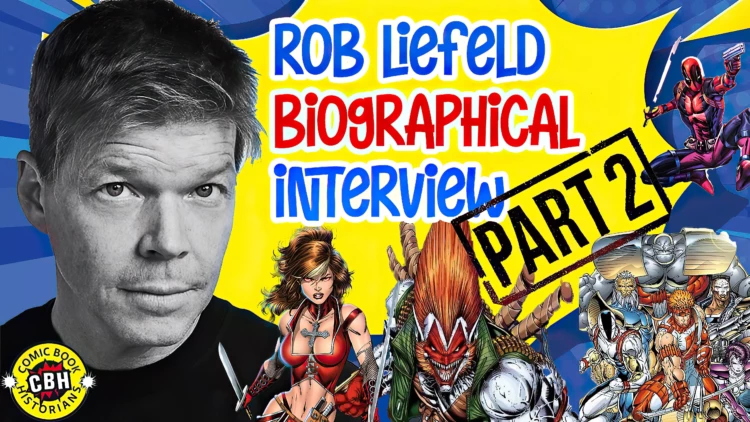
Rob Liefeld Biographical Interview Part 2:
robpodcast.2mp3.mp3
Alex Grand: [00:00:00] Welcome back to the Comic Book Historians Podcast. It’s an absolute pleasure to have Rob Liefeld, the action superhero genius that pioneered a brand new flavor of comic books in the 1990s. Rob, thank you so much for being here.
Rob Liefeld: [00:00:13] Alex. Always great to talk to you. Thank you for having me.
Alex Grand: [00:00:15] Continuing from our last interview. Right. So this is essentially like part two, you know, so, so many cool revelations from the last one. And for the audience to know your podcast lays everything in absolute incredible detail. I mean, for anything anyone hears here, there’s going to be like one sentence. There’ll be an entire episode on his podcast. The details are incredible. The receipts are there to continue. From our last interview, we mentioned the inner child theme, your story as a kid up to launching Youngblood. It ran like the movie Star Wars The episode four. You were the first generation X guy to make a huge impact in comics. I look at it as the Luke Skywalker that brings back the heroic super characters in the tradition of the old Jedi. Jack Kirby. Gil Kane. That flavor of comics seemed to fall in the face of an increasing amount of neurotic comic books. Okay, and you spearheaded image to bring back the action, superheroes and the extreme age. That is fact. You went to Greece and Rome recently? Yeah. It looked to me like a heroic Mecca, in a way. I mean, how was seeing the mythos of the old gods? The old myths, Ares, Mercury, Pan cable, and Deadpool brings back a lot of that energy. I mean, was this, like, a Mecca type of experience for you?
Rob Liefeld: [00:01:37] It was spectacular. And every time. You know, we’ve been back a month and every day my wife asked me, what was your favorite part of our vacation? I said, oh, uh, you know, it was Greece because we had never gone. Uh, I believe I understand. I think you’ve been. I had I had never been, uh, to Greece, and I just. I drank it all up. And you when you are in. Uh, I’m really impressed with how they present the Acropolis and and and all of the, uh, you feel like, oh, man, I’m going to go be part of this terrible tourist experience. But it’s it’s not that at all. There’s we actually went for the last two hours of the day. So from 6 to 8 it was the lightest, I think the traffic, we were told it was the perfect time to go the it was beautiful. But walking through all of those, um, ancient ruins and, and just it does inspire you and and it it kind of, uh, you know, I on my own you mentioned my podcast recently. I on an upcoming episode, I talk about how, uh, the Olympian gods, uh, specifically Hercules, Marvel’s Hercules. But every iteration of Hercules was always somebody who I really related to as a kid, because I think he was temperamental. He wasn’t refined. He was very emotional. And, uh. And I think I was always drawn to those. So. So he’s a, uh, basically a flawed hero, uh, that great expectations were put upon, and he had to kind of navigate everyone else’s expectations on top of his own desire to have his adventures.
Rob Liefeld: [00:03:17] So, uh, in a nutshell, I’ll be honest, Alex, as I get older, there are memories. A photo will trigger a memory and it will rush back into me. And it’s clearly a memory that I have buried because I’ve been running so hard, so fast in this business. But, uh, with San Diego Comic-Con coming up and, uh, there’s a woman who’s who’s, you know, on the board, I don’t know what you call on the council. She’s very much part of Comic-Con. Jackie Estrada, she shared her a 1991 photo of me. And what it’s what’s distinct in that photo is that I’m at the escalators. What? What what do you mean, at the escalators? And, uh. And I’m not. You can. You can see on my face. I’m not terribly thrilled. Uh, and and I remember family members had come to help me. That’s the first year, uh, again, I just it washed over me. I was triggered immediately that, uh, this is the first year in this building. 1991 was the first time they entered into the new facility. It was only like Hall A, B, and maybe half of C, what would become eventually, you know, and for a couple of years there in the in the 90s, in the early 2000, they kept adding all the way up to what we now have as Hall H where the real estate ended. But X-Force had been out maybe a week or two. It was the biggest book in the country. The number one selling book, X-Men was inevitably going to outsell it, but it hadn’t arrived yet.
Rob Liefeld: [00:04:51] So X-Force was the belle of the ball. I’m there with some friends and family. We sit down an artist alley, a giant line of enthusiastic fans. The kind of fans that you didn’t used to see at the shows either, because I’d been going there and it was the I’d been going there since I was a kid, and now I saw the demographics skewed closer to the my own youth. The all the image guys will tell you whether it was the skateboard kids who were getting into baseball cards, who preferred some of that baseball card interest into, hey, let’s check out comics. Whatever. Lord them in. They were suddenly appearing, and within about 30 minutes, San Diego security surrounded me. They said, we’re stopping, you’re signing and we’re moving you off the floor. Off the floor. Like, again, I’ve only been in the business five years and I’ve got the biggest book in the industry, but the lines are upsetting people. It’s not something that they planned on. And they said, look, we’ll tell people, you know, we’re, we’re we’re we’re going to put you. I go, what do you mean, off the floor? Follow us. They didn’t tell us. Uh, we go off the floor beyond, you know, the snack stands beyond the concessions out the doors, where you will find the escalators and the stairs up to the upper levels. I mean, it’s basically you’re in the back, you know, the back hallway, and they put me at a table. And here’s the kicker.
Rob Liefeld: [00:06:16] This is not, you know, a photo get shared I share it I, I, I, I’m very measured in how I share my feelings of that time because it was a semi form of banishment. And, uh, somebody contacted me and said, you know, Rob, I was at the end of that line. There was about 35 of us when they moved you, and I was 14 years old, and I could tell you were upset you weren’t taking it out on the customers. He said. You were so nice to me. I was like the second to last in line. And the line never. Nobody ever lined up behind us. We were. We were it. And and you had been signing in and talking to everybody, he said. But I could tell like it was almost like they your feelings were hurt because it’s like, Alex, I showed up. I loved the show. I’m now in the off the floor next to the escalators, and there’s this photo that triggers all these memories. And the reason I’m sharing it with you is I think I just like the guy said, this guy who contacted me said, and you told me that you were leaving pretty quickly, that it was obvious that I had informed this 14 year old who who contacted me through Facebook Messenger and told me this whole story, and it tracks, I actually know this person and they’re like, Rob. But he said, my mom was with me and she felt bad for you. And and you said, I think I’m not going to be back tomorrow.
Rob Liefeld: [00:07:47] I think I’m going to, you know, just pack up for the night and go back to Orange County. But I’m glad I was here. But it was just there was this. It was, I think, the first time that the old guard met the new guard. And it was like we represented something different, a different energy. Um, it wasn’t the same old setup, uh, that there was. And look what you get now, uh, in that hall is is. Look, everything has to be reinvented all the time. Nothing stands still. Everything’s changing constantly. It’s up to you as the artist, as the manufacturer, whoever’s making the stuff, whether that stuff is action figures or Funko Pops or comic books, you’ve got to keep up. But I remember the next year when we when we arrived as Image Comics, one year later, we were Image Comics. Yeah. And again, there were security guards. There was some hot tempers, and it was like, I think there was a realization of, what do we do with these guys? Yeah, they there’s not nothing there. It’s a wave we can’t stop. It’s a wave we can’t stop. And I guess I. I realize now that my my career has been an odyssey of, like, overcoming all the all the obstacles, all the different obstacles. And and as we saw with the passing of our mutual friend Jim Shooter, suddenly agendas that maybe people didn’t know were there just completely that they run them up the flagpole. I mean, the guy has not been cold and people want to share agendas and they want to they want to punch down on a guy who is no longer among us.
Rob Liefeld: [00:09:27] And what I’m saying is, I’m telling you, maybe another ten years and and I, I, I can connect, I can, I can tell all the agendas that I’m aware of all the backdoor stuff. Yeah, but you have to be careful, uh, in this place and time because. But. But some of these people, they are retiring there, expiring their uh. And there’ll be a time to go. Oh, hey, this was connected to this, and this was connected to this, and this was somebody who had a seat of power at this company. At this organization. Because I’m telling you, man, when I say it’s the Odyssey, I do feel like it’s it’s I am up for the challenge. And that’s what I think. I think that’s what takes everybody by surprise, because I’m I get it. I don’t ever relax. And I said to my buddy this week, in my 40 year career, you can never relax. You can never take for granted that what is there today will be there tomorrow because someone else is trying to get to the same goal. And they’ve, uh, uh, they are formulating their own game plan and, and to, to, to grab that brass ring. And there’s not an infinite amount of the brass rings. Right. That’s to achieve that level of success. So I’m going to take a break. And, uh, and as you go, what did he just say? I will also ponder what I just said.
Alex Grand: [00:10:50] No, I’m following now to prepare for this interview. I’ve enjoyed listening to hours of your podcast. Okay. Like, I need to collect information before I shoot my mouth off and ask questions. And. And as I’m asking questions, look, if I get something wrong, I need you to correct me. Yeah, okay. Because I am humbly listening. So. Sure. 1992 and on. I’m seeing it as like there’s some arcs. There’s Empire Strikes Back, there’s return of the Jedi. Yeah. And I don’t think a lot of fans understand, you know, the some of the corporate and financial and legal pressures of all this stuff. So what I’m gathering from a lot of listening to your podcast is that your inner child managed to stay alive through these ups and downs, and I’m thinking it takes more than just an inner child. It takes like the inner faith, the faith and purpose. God, your place in the universe, family to maintain the outlook that keeps your inner compass focused through like. I mean, there’s gigantic sharks okay out there. All right. Um, and not just individual sharks. Groups of people can become a shark. Like, it’s it’s really something. Before I go on to my follow up question, am I correct in reading this?
Rob Liefeld: [00:11:56] No, you’re you’re everything tracks. Everything tracks.
Alex Grand: [00:11:59] You founded Extreme Studios mega success with Youngblood, the first, uh, of Image Comics. You know, there’s there’s Blood Strike, profit Supreme, high energy super team expansion. Okay, you’re an IP factory with ideas that sell. And I liken you to being, you know, a Tom cruise style of entertainer because you’re focusing on the stuff people need to see as you’re doing this. You’re also, I think, fostering talent in the next generation of comic creators that are actually coming through. You gave a lot of people chances to prove themselves. You did so like there’s a comic creative renaissance here. How did that work flow? Generally work.
Rob Liefeld: [00:12:38] So I’m doing Youngblood. The focus of Youngblood is to just do those characters, those concepts. I can really work everything through that book. That’s how I’m seeing it. And like the Fantastic Four that I had absorbed the entirety of the Kirby Stan Lee run and all of those characters that came through. Whether it was Inhumans, Silver Surfer, Black Panther, Galactus, I mean, so much of, uh, the Fantastic Four was was a conduit to a bunch of new worlds and new characters. And I said, well, this is what we’ll do with Youngblood. Well, imagine so. There aren’t a whole lot of blood comics your audience should understand in 1992. There’s a lot of textbooks. There’s some Batman books, there’s some Spider-Man books. That blood is not a common name. So Youngblood number one does very well exceeds all expectations, sells out of a million copies, has to go back to press. Uh, really lays the groundwork for everything that’s coming. Spawn launches three months later. It’s really. And there’s an artist who just did a cover for me. Uh, one of the most in-demand guys in the business. And he sent me this lovely letter and he said, Rob, outside of Archie Comics when I was a kid, uh, I really didn’t interact with comics. And when I went to the first one, when I went to the comic store, Youngblood was the first comic I got, and then Spawn in Youngblood, and spawn became like my first meaningful comics. And he said, and they changed my life.
Rob Liefeld: [00:14:07] Okay, the reason people say Youngblood and Spawn together a lot are because we were the only Image Comics out for most of the summer of 1992. Uh, April, may, June, July, August. Then you get Savage Dragon and Shadowhawk and I think Wildcats is in August of that year. It’s later, but it was Youngblood spawn. We were out there kind of grabbing. We were the stuff that was available to purchase and available to interact with, and everything else represented a promise of something that was coming. But imagine after Youngblood launches. So this is the spring of 1992. You wake up about six weeks later and you see these announcements in the press. Uh, Marvel and DC. I don’t believe they did it together. I believe this is a coincidence, but each had the same agenda. Marvel announces that their summer crossover is called bloodlines. Or maybe that’s the DC one I didn’t. I think DC is called bloodlines, and I think Marvel’s is called New Blood. And what’s happening is in each annual for one of the companies. Uh, is, is is going to be a new character and, and that’s the new blood. And the other one is bloodlines. And I’m like, they’re coming for me. Like, you feel it, you wake up and you go. This is aimed at diminishing a competitor. Before you say, Rob, you’re crazy. I have evidence from 24 hours ago of another top one of the top two companies identifying what we are doing at image as competitive.
Rob Liefeld: [00:15:50] Telling another person, well, they said, why doesn’t this company upset you? Because they’re not a competitor to us. Actually, the words were they’re not a threat to us. Like Image Comics, this is 2025. This is 2025. This is July 2025. These competitions are real. They have not diminished in any way, shape or form. And right then back in 92, they are leaning all the way. Like I can tell you what they both saw. Oh, Liefeld thinks he’s got a big thing with Youngblood Barrett. This is what the corporate, you know, salespeople bury it make. That’s how they make blood. Super common. Everything is blood. Make it hard. At one point, a year later in a in a marvel comic, they had a, uh, they had a group introduced called Young Blades. Look it up. Young blades. Okay. Uh, so so you’re being fired upon. And so I go, wow. Not only is it bloodlines and new blood are these two separate events happening over the spring, the summer and the fall with the two major companies now, they’re also introducing tons of new characters, which means names. And one of my, uh, a guy who I had really revered in my career and I looked up to, uh, had made a quote to a magazine and says, you know, I don’t like Rob Liefeld, but he has a thing. He actually said, I thought every good name in comics had been used. And this guy has names, just the, you know, like, he he just has great new names, you know, pouring out of him.
Rob Liefeld: [00:17:26] I think it’s what he said. And I’m like, wow, you. When other people talk about you, you know, you’re you’ve been noticed or marked or you’ve got a mark on you. Um, it’s just it’s no different, as I say to people, than in sports. You know, I always say to people, are you a Dodger fan? Do you hate the Giants? Do you hate the Padres? Are you a Yankee fan? Do you hate, you know, the Mets? I mean, every fan base understands what it’s like. Well, it’s like that in comic books, too. So my point is, what I’m leading up to landing the plane is suddenly I go. I’m not sure I can wait to introduce all these characters in the pages of Youngblood. So I’m going to announce Brigade. I’m going to announce Blood Strike. I’m going to get these out there since suddenly blood is on the radar and now new characters are going to be a thing, so I’m not sure my names are safe. Because when your character names are everything. Names of titles, names of characters. Um, I’ve got five new characters coming out in the book that’s coming out in San Diego. I’ve, I’ve. I’ve got white silhouettes. I won’t show you what’s on the cover today. Somebody said, well, can you at least tell us their names? No, I’m not going to tell you their names a week in advance, that you’re going to pick it up and you’re going to go so, so names designs.
Rob Liefeld: [00:18:34] Well, this is the landing of the plane. This is the point. One of my partners at Image Comics at the time called me up and said, oh man, I see what you’re doing. I see what you’re doing, man. You see the money that’s pouring in on Youngblood, and you’re just you’re trying to get as many number ones out there as possible. And I’m like, yeah, that’s not it. And everyone around me knew, like, we didn’t know that brigade would sell a million copies. I it suddenly caught fire. It caught fire. And everything that was coming out of image Brigade launched to a million blood strike. Launched a million? That wasn’t my master plan to make a lot of money. It was to get my creative stuff out there and protect my intent, because I was being hunted by the major two. Suddenly you’re under, you’re in your you’re you’re under the microscope. You’re on their radar. You can feel it. So the excitement around doing those was I’ve got to. I won’t be able to wait a year to do this. I’m feeling the pressure. Bloodlines. New blood. Giant corporate movements. Boom! And yet, like I said to this day, that this guy thinks I did it for purely transactional reasons. It was. I gotta get this out here. I didn’t believe that this brand new team of talent that I had assembled, Marat Michaels and Norm Raymond, would, would be received in the same way.
Rob Liefeld: [00:20:03] Nobody. Logic says that the reason the Youngblood book was doing well out the gate was because, and to spawn and all that was because of our star power. Um, I’ve often said the first seven books of Image Comics. I mean, let’s think about it. Were you really buying it for spawn? Were you buying it? No. You were buying it for Todd McFarlane. What? What were you buying when you bought Youngblood number one? You were buying Rob Liefeld. Number one, Todd McFarlane. Number one, Jim Lee, number one and number one and so forth. So on and so forth. There was. You had no history with those characters. They were coming out fresh. But I spun my stuff off and I was excited to do it. But I didn’t do it. What I didn’t. It wasn’t part of a business plan. Oh, this is my next move. Flood the zone? No, it was like, I gotta. I gotta shoot up these flares. It was what I did out of desperation. Worked out. Worked out phenomenally. But we were not assembling the books with that in mind. But. And then slowly, it wasn’t just that guy that I was hearing it from. Other people were starting to say the same thing. And it’s like, no, no, no, no, you don’t understand. Um, and the reason I have all these characters is because I’ve been writing and drawing them on my lined paper and in my notebook since high school, and, and I haven’t developed them my, most of my teenage life up until my young adult life to to to watch those names get hijacked or those designs.
Rob Liefeld: [00:21:30] So really immediately being under the in the pressure cooker, I’m like, I want to preserve what I have. And and so, you know, it wasn’t part of a yeah it’s cash out central. It’s I don’t I’m not going to have the same luxury of time. Because what I’ve done has grabbed a lot of notice. And so I need to get this stuff out. And and so Alex, it really was fast tracking, but I certainly I mean, I’m 23, 24 years old at the time and I’m surrounded by 20 somethings and I do need talent to pull this off. And we started building Extreme Studios with, you know, uh, guys that I was meeting randomly. I met Murat as a teenager at a convention in Los Angeles. He was, you know, four years younger than me. I probably was a senior. He was a freshman, um, or I was at junior high, and he. Um, but it was all, you know, it was that eighth grade kid who was six feet one, like. Yeah. You’re like, hey, you’re taller than me. What do you mean? You’re you’re you’re you’re 14, right? But we started talking in corresponding. And then when he could, uh, drive, I think 17 or 18. And his parents gave him the clearance. He started driving down to be my assistant and then became it became his full time job about 1990 through the launch of Brigade, when he had his own gig as as a penciler.
Rob Liefeld: [00:22:51] But he would be my assistant, my role dog, my my my my carpool guy when I had to make Fedex back when we had to actually get Fedex and put stuff in boxes and there were no scanners and there were no computers. Um, uh, the both of them are like superstar inkers. Danny, Mickey, Norm, Batman I met at comic book stores. They showed me their work at comic book stores, and they found there that they had a job a week later. So, I mean, there was a ton of robust, very, uh, sincere and organic energy. And I think people responded to that. And I was like. I saw a flyer in the office. Norm Reitman and Danny Miki were doing a signing, uh, somewhere in Southern California in late, you know, late 92. They both inked about 1 or 2 books. And Alex, I was like, wow. In my lifetime, so far in my following comics, I had never seen two inkers do store appearances, Joe Rubenstein and Dan Green. Or I hadn’t seen Terry Austin in like. But my two inkers went and I swung by and there was a thousand people like that. Like they were rock stars that like the these inkers who were just arriving on the scene fresh with credits or were being received, like enthusiastically. And those two guys love the interaction. They love the fans. And so, look, I can just speak to the fact that we were filling a need and what I felt, what image traded on.
Rob Liefeld: [00:24:25] When you say the action dynamic, we at a time when everything was getting smaller and smaller and smaller visually, we decided to go bigger, bigger and bigger. And, and I, I kind of feel like I can draw tethers to right now. I can draw like. This week, DC comics announced DC echo and part of the all fights. Tons of action. Yeah, and this reflects what’s going on in manga. Yeah. And and and then then I see, uh, and the, the best selling book in the industry is Absolute Batman right book right time. But it does not ever forget to whoop a bunch of ass. Uh, Batman is thumping down on people in a way that he does not in any other title. And my retailer buddies have told me, Rob, when a guy will bring his two friends in and he’ll go there. That, that that’s the Batman book where he kicks all the ass. Like. So there’s times where we slow it down. And I love a good art film. I love a good look. I’m going to see Edington tonight. I saw I saw a materialist a couple of weeks ago. I’ve always been I like the slower, the quieter art films as much as I like the blockbusters. But you don’t want to see me do a romance comic. You want to see draw people kick an ass, right? So that’s what we did.
Alex Grand: [00:25:47] I wouldn’t mind seeing a Rob Liefeld romance comic to me.
Rob Liefeld: [00:25:49] Yeah. Trust me, trust me. Alex, you’re very kind. That’s never happening. Um, but the thing is, uh, I got so many more fists to throw kicks to, I just. I am an action guy, right? And, uh, I can pop the raid in. It’s great to have them boys as they grow up. And I’ve seen you do the same thing. Uh, I’ll be boys tonight. It’s time to watch the raid. What’s this? Dad, you’re not going to care in 15 minutes, okay? It’s going to be like, how is this guy kicking all these people’s asses and, uh, you know, and then suddenly, like, what else is like this? Oh, about, uh, 40 years of martial arts films. Where do you want to start? But, uh, look, action travels. It travels the world. Um, we like books that have creative ways of kicking ass. Nobody did it better than Jack Kirby. He’s kind of the touchstone for all that stuff. If ever I’m in a funk, I don’t. Right over here is my entire Jack Kirby bookshelf. Whatever. I’m grabbing the New Gods, Black Panther, Captain America, Thor, Fantastic Four, Machine Man, devil Dinosaur, devil freaking dinosaur is more exciting than 90% of the comics that I’m going to interact with, and it’s very action based. Okay, so, uh, I don’t like I said the time 1992 was crazy. We definitely enjoyed the time we had, but we were under the gun immediately. Uh, I was not threatened with lawsuits. My partners were, uh, this character is infringing. That’s their story to tell. They they came at us legally. They came at us creatively. Um, we were very much. And as I want to reiterate, just this week, reminded again. Image comics is a threat because if creators continue to be empowered and have success being empowered, then that is less or less talent for the corporations.
Alex Grand: [00:27:38] Extreme was putting out more books than a lot of the other than the other Image studios were. And so since each book paid, you know I like to follow money stuff too. So each book that paid a flat percent to image, right. So you were upholding most of the company’s overhead. And so you’re losing financially a little bit by supporting most of it, that the other ones were kind of riding along the coattail of financially, possibly as far as operationally. So it sounds like the way image cut off Malibu Studios, I think maybe partially. And if I’m correct or if I’m wrong, tell me you funneled some of your output into the imprint Maximum Press in 94, which was outside image with Evangelion, War Child Asylum, Battlestar Galactica licensed. Yeah. So? So to me, this makes sense. Like, like you’re just doing a little bit of the same thing, like even out some of the output with the other people. Like be a little more fair, but, you know, look, I still want to create I still want to do like a whole bunch of stuff. So it seemed to me like a good balance personally, just the way I’m thinking about it. But it created friction. Uh, it’s it’s an insane story, from what I understand. And people got mad. Maybe. Maybe Todd got mad. You know, you guys are friends now. Of course, but. But there was friction at the time. Tell us about that. The the exit from image. And how does faith ground you in all this stuff?
Rob Liefeld: [00:28:51] Well, yeah. Here’s the deal. Whether whether you have, Whatever your Faith.If you don’t believe in yourself, uh, look, it’s scary to go out on your own in any in any iteration. It’s scary. Let me start this by saying a talent contacted me this week, said Rob. I’m on this book. I’ve been listening to your podcast, the the episode of the Rob Liefeld Show, which that that’s the YouTube version of it all the the podcast platforms, it’s observations. They they said the episode where you talk about the actual titles and the names of the different jobs and how they’re broken down. He goes, I really was so, uh, you know, interested in that. And he said, look, I’ve got some questions about my own input that I’m doing on this book that I’m working on, and I’ve talked to my other friends and they all think that I have like, I have a stance that I should be able to take on this. And it was, you know, the part where business and art meet. He felt that he should be compensated for something that he was doing that maybe was being taken for granted. And I said, where do you stand on this? And I said, I, I agree, from what you’ve just told me, if this is indeed the case, I believe that you have a leg to stand on and that you have a viable position. I said, but and I need to really cover my base here. Uh, you’re going to get brushed back from this. This is not something that’s not going to come with a tremendous, uh, reaction. This is not going to go well, and you have to be braced for that, because I don’t want to give you advice that’s going to harm you.
Rob Liefeld: [00:30:39] But you’ve you’ve come to me. And I said, uh, you’ve got to be very, you know, just just aware that this is going. And he’s like, I’m ready to ruffle the feathers. And I said, well, you’re an adult. You’ve made this, you know, you have made this decision for yourself. I said, I said, good luck. I gave you it. You came to me. You asked for advice, I give you advice. And I cautioned you that doing this is going to probably create maybe It’s going to upset the apple cart. And and when you raise your hand in this business and you say, hey, uh, I’m not sure I’m crazy about the way this is going, there will be a brush back to that. Um, I’m going to circle back to that as we go further into answering your question. But at the top, I’m doing all these books because now, I mean, like I said, Brigade has been well received, bloodstock has been well received, profit has been well received. There is a period in, from 1992 to 1994 that I am experiencing the Rumplestiltskin everything or Midas everything I spin. Everything I touch is turning to gold. It started on New Mutants, with X-Force, with cable, with Deadpool, with Domino, and transform that book. So I am just riding a wave that’s very organic and, uh, continuing to expand. And what? Kid? Because I’m still a kid. And I’m like, from not knowing a single artist or or person in comics in Orange County.
Rob Liefeld: [00:32:15] Early in my career. Uh, having to drive up to LA and interact, suddenly I have a studio where every day I walk in, there’s 60 of us all making comic books under one big giant tent, and it’s a blast. So I am that. That also wasn’t a business plan. That’s just, uh, this is super fun. Okay. And and I am rewarding everybody because I want them to feel like I appreciate them in a way that maybe other people, uh, in the business, you always hear people feeling like I’m not. I’m not worth. I’m not getting paid what I’m worth. Well, I’m going to take that out of the equation. I’m just going to make you feel really good about what you’re doing for us. So we are we are producing a lot of books. There is no obligation from any of the partners to produce books. You can produce one book. Some guys dabbled And, uh, and I’ll be honest, Todd had a book he was really excited about called Boof and the and the Bruise Crew. I think I think that’s right. Boof and the Bruise Crew. And he thought, I am going to hit maybe that Teenage Mutant Ninja Turtle market. So he’s trying to expand outside of spawn. Long story short, Boof and the Bruise Crew. Boof doesn’t go over as well as he’d hoped, so he shuts it down. But he tried. He tried.
Rob Liefeld: [00:33:32] We all had books we put out there that maybe didn’t get the same response as our best stuff. So Valentino, Eric Larson maybe had four books. Well, suddenly when we leave Malibu, we have to finance our own offices. We’re hiring a controller. We’re hiring a publisher. We’re hiring marketing, sales, uh, production people. So how we’re paying for that is a percentage of our books are going towards that collectively. So a Marc Silvestri book, a Rob Liefeld book, and we’re all paying the same per book? Yes. Over the time. Over time. You know, two years in, I’m making 22 titles a month. Uh, glory, Supreme prophet, blood Wolf, bad rock and company. Team. Youngblood. Youngblood. Youngblood. Strike! Okay, we’ve got a great line of books and what you mentioned in it. I’ve shared it. It’s a printout from diamond that shows the most successful families of comics in the industry. And it was X-Men extreme studio, the X-Men family, the Extreme Studios family. Uh, Spider-Man was third. Batman was fourth. Our percentage of the comic book pie was enormous. That that is that is how successful we were with those titles. The publisher of Image Comics at the time, Larry Marder, came to me and said, Rob, he had heard I was going to maybe scale back. And he’s like, this will subtract this much money from the company. And and we actually need every penny given our overhead. And I’m like, okay, I. What I didn’t do was tell those other guys to do more books, that that wasn’t part of the mindset.
Rob Liefeld: [00:35:09] You did your own thing and what everybody should realize, because what I’ve realized over time, everybody had their own different reason for doing Image Comics. Mine was never. When I hear people say it, it’s like, no, no, no, I can’t that that is so wrong. And you can’t find anything that that that supports this from me. I didn’t leave Image Comics because I was mad at Marvel. I had nowhere else to go. I what do I do after a book that did not exist and characters that did not exist 18 months before X-Force, when those hit number one sell 5 million copies, the second issue selling 1.8 million copies. They’re making toys. They’re merchandising it. I said, my window is open. What am I going to do with that window? What you don’t do is go, hey, can I do another book? One of my. Can I do one of my all time favorites? Can I? Can I do fantastic for like, in two years? No, the window is open. I’m looking at all this merchandise on my my, my wall over here, wondering if I can pull any of it off and show it, but I’m just going to keep it where it is. The thing is, I go, I need to go and and and see what I can do. I’ve done the Deadpool cable. I’ve done these characters that I have. I have equity in that. I have part, you know, ownership in, in the 90s and and now what if I owned this? What can I do with characters that I own completely? Other guys agenda was I’m going to show them.
Rob Liefeld: [00:36:35] I’m going to show them they did me wrong. They took me for granted. That was never my agenda. My agenda was build up a catalog build up like a catalog of characters. I mean, eventually I had trading cards for Roman, for a brigade. I mean, we did trading card deals. We did action figure deals. This is what, owning your own stuff. It’s tremendously fun. It was the unknown because as I’ve said again and again and again, I thought I was going to sell 100,000 copies of Youngblood. I thought not being under the Marvel banner, but my life at 100,000 would have been great. It would have been fine. It would have been. It would have been better than me staying and doing X-Force for the deal that I had. Then. The royalties on 100,000 copies in 1993 would be huge. So yes, I build this up. Suddenly I’m told that they’re dependent on the income of my books. The reason I do maximum press is I’m like, I feel like maybe I should have a golden parachute for myself. I feel like at this time I should have a different wing. And I inform all the partners. This is going to be for my non superhero and this stuff isn’t going to collect. It’s at the launch of maximum. It’s going to be more genre.
Rob Liefeld: [00:37:51] I’ve gotten the license to Battlestar Galactica. I’m going to do this sword and sorcery title called War child. I’m going to do this new book about an angel called Evangeline that takes place outside of that is my backup plan, my plan B, my golden parachute, because I just feel when Larry comes and says this to me and he’s looking out for the collective, he’s looking out for everybody and everybody that worked an image. They were all cool people. And, you know, it’s something you’re hearing about when when shows get canceled, like what it’s going to happen to the staff. And if you have any humanity, you’re like, I want to make sure that the staff is taken care of. So I take my, uh, my responsibility as my 22 books paying in, but it gets even more severe. Larry comes to me and says, you and Jim Lee are like 70% of the company. Jim does 18 books. You do 22 books. We can’t afford to lose Extreme or Wildstorm. And I said, well, I as much as I appreciate that, I’m not going to let that, uh, I’m not going to let that kind of. Pepper whether I need to pull back or not. And if I lose a book, I’m not going to necessarily replace a book. So yes, two and a half years into image, we’ve created a monster that needs fuel, okay. All the time. And and I decide, you know what? I’m going to I’m going to what we’re leaving out here is Marvel comes knocking and says, guys, we’d like to talk to you.
Rob Liefeld: [00:39:21] We would like our original line of books that is selling poorly. Fantastic four, Captain America, Iron Man, Avengers. We would like to. And if you’re your listenership needs to understand that this isn’t the Avengers of 2012. The Avengers is not the best selling brand at Marvel. X-men is. Spider-man is. They come to Jim and myself under the Heroes Reborn umbrella, and they want us to to do this, and we investigate it. And I kind of find it exciting because now it’s not 1992. I don’t have to worry about my next move. I’ve got my own catalog. I wanted to build up a catalog that I could manage, that I could have for the rest of my life, that I could do whatever I want. With. This catalog has reached the the maximum amount of eyeballs, the maximum amount of readers. So wow, what would it be like? Because I’m now approaching 30 and feeling like I’m 100 years old. Man, I may never get it. I may never get a chance to do Captain America or the Avengers ever again. So I’ve got this successful thing set up. Let’s let’s investigate this. They asked Todd to go back and do spider. He was he was invited. It wasn’t that they were talking to they. They asked the three of us. Todd declined. And then resentment definitely build up and and I didn’t imagine it.
Rob Liefeld: [00:40:40] It was told to my face. Jim and I were, uh, I wouldn’t say scolded, uh, but I just don’t have another word other than scolded in. But in 1995, the duration of the deal and the negotiations of it, and Jim and myself would go up to Burbank, uh, Los Angeles and meet with the Marvel attorneys and build out this deal to the point where it was too good to say no. And then it was like, oh my gosh, the Marvel is going to outsource their books to the West Coast, became a giant behind the scenes panic button throughout Marvel. So now I got that stress thrown on top of me. But what I really believe now is, you know what? My comics, uh, could use a fresh coat of paint, and I’m not really comfortable with things that are being said to me in meetings, stuff I’m not going to divulge at this time. But that resentment is is obvious. It’s coming off like it’s it’s, uh, voices are being raised. And the idea that we would go back in business with Marvel. And you know why not let them real? Why not let them fail? Okay. Really funny stuff. Uh, because I’m like. I feel like this is too personal. I and again, I don’t have never did have that agenda that I was leaving to hurt Marvel. So yes, resentment forms and I’ve I’ve talked about it. The panel in 1996. We are a few months out of the launch of Heroes Reborn.
Rob Liefeld: [00:42:15] The books are going to press. I have a preview. I have, I think, 50. Captain America number one with no word balloons is is what I have, uh, as a preview book that I am selling, uh, at San Diego in the summer of 1996, the weekend of July 4th, uh, my Captain America was the program book, was the t shirt. It was the first time I’d seen them advertising San Diego Comic-Con on all the movie screens for me in Southern California. So I’d go to the AMC, I’d go to the Regal, and there’s my Captain America t shirt that for San Diego on the screen saying. San Diego Comic-Con, you know, July 4th weekend. I’m like, oh my gosh, this really tracks at that. We’re all doing. We did our Image Comics panel, so it’s all of us together, and we were starting to get Marvel questions. And I’m Todd cut that off very quickly, very tersely, and instructed them that if they wanted to ask Marvel questions, go to a marvel function where Robin taught art and asked them, this is the place for Image Comics. And he wasn’t wrong, but you’d have to be deaf, dumb, and blind not to see that he was angry and resentful because there was a huge focus. Uh, I have all sorts of theories as to why some of this stuff was playing out. I’m not going to share those theories at this time. I was just there, and I was I was part of it.
Rob Liefeld: [00:43:37] So then, um, there’s hostilities, uh, brewing between Marc Silvestris, Top Cow and myself. And to be honest, that is over the services of an artist named Michael Turner, who is no longer with us. Uh, Michael Turner wanted more work. He, uh, had developed a relationship with a gentleman named Matt Hawkins, who was an editor of mine. And Matt was like, hey, it was a poker game with Mike. I always did, uh, he would love to do something for us. Mike had agreed to do an Evangeline three issue mini series. And, uh, he was not under any exclusive with Mark. Uh, but Mark and I love him to death. Have the most respect. I think he’s the single. I’ve said this a thousand times. I’ll say it a thousand more. He is the best draftsman illustrator of my age. And among the partners. Uh, I’ve never seen more beautiful men, women, environment, storytelling. He’s the whole package. He’s the best of the best. Uh, early on, he had conversations with me and I don’t. I don’t mind sharing it. Um, because this is 30 some years ago. But both he and Jim Lee said, you’re paying your guys too much. And I said, you don’t get to make that determination. He goes, well, my guys are hearing what your guys are making. That’s not my problem. Like, what about a million sales isn’t enough to go around, okay. I mean, that’s just that’s just my my thinking. But everybody does not approach the business of comics the same.
Rob Liefeld: [00:45:09] Um, I have heard things in the last two weeks about what people are getting paid, about what this guy gets paid here and what this guy gets paid here. And this guy was told that he’s not a big name, so he doesn’t qualify for for I mean, it’s it’s literally like I, it’s, it’s it’s Groundhog Day. It’s like it never changes. It’s always the same discussions. But going back to 1992 at the launch marks, like, your guys are too young, they’re too fresh for you to be paying them these rates. And I just said I, I just I disagree, uh, going back to what I said earlier, not knowing that you were going to ask this at all, I wanted to take care of my guys. I wanted them to do very well and success was rewarded, especially if you were suddenly doing a, you know, knocking out an entire book of lush, delicious, amazing pencils in a week. As a guy named Jeff Matsuda was who just stormed into Extreme Studios and started doing 22 pages a week. I’m like, I have the second coming of like, John Burn. So did I pay him $700 a page? I did because I didn’t know what the book was going to sell, and I want to take care of him on the front end. And you know, the funny thing about a guy like Jeff is suddenly he put a down payment on a house, he had a sports car.
Rob Liefeld: [00:46:16] And I’m like, of course he does. This guy’s doing 30 pages a week for me every week. Do the math. 1992, 1993. He’s doing well for himself. He sent his envelope to me through the mail. I hired him through the mail. I flew him out. I put him up. We had a house called the extreme House that I rented in orange. No, I bought it and I ran it to them. Sorry. It was near near the studio near Anaheim Stadium. And it was a really cool, uh, house on a cul de sac. And we could put we could. Five guys could get their own room in this two story house. If I flew you out, it was like, you can live here for, like, 3 to 4 months until you find your way. And then there’s probably going to be new guys that we need to put here. But what with what they were getting paid, they were doing very well. So the friction between Mark and myself, you overpay your guys and and and and I hear about it from my guys who aren’t paid as well. I think it was all playing itself out on this big stage with Mike Turner. Mike Turner was not going to come work for me other than these three issues. And as, uh, the story goes, Mark resigns and says, Top Cow is going out on its own and and all fingers are pointed at me. So now I’ve got the added benefit of is I pissed Mark off enough for him to leave? Now before I go any further, we had this understanding that we weren’t going to, quote unquote, poach each other’s talent.
Rob Liefeld: [00:47:47] And at the time that this might turn a thing went down, I was about a year into, uh, Wildstorm giving offers to my guys. Uh, Todd McFarlane productions hiring my guys. I had guys who were under exclusives to me who were discovered to be doing work, and I just had to say, hey, buddy, you know how much I dig you, but you have an exclusive contract with me. I have to let you go. What you really want to do is do this. I don’t want to keep you here. And, uh, so my Eric Stevenson, who is now publisher, uh, and I and Matt Hawkins were like, what’s going on? We’re honoring these agreements, the no poaching, but everyone’s taking our guys, like Wildstorm is offering gigs and Todd is offering them gigs. And one of my guys says, oh, you know when I won’t say the individual when one of the partners was here for the meeting because it was a Southern California meeting. Because we would go around and maybe Jim would host a San Diego meeting of the partners. We’d fly to Arizona, meet with Todd in the in the Orange County Extreme Studios meeting. My one, it was Matt Hawkins who told me, uh, I saw this guy, pulled this guy away, and I overheard them talking about doing work like they were here.
Rob Liefeld: [00:49:04] For.
Rob Liefeld: [00:49:04] Like, recruiting on the spot. So this is stuff actually, I haven’t really talked about in in depth, and it doesn’t really bother me. It’s just it is what it is, right? So when I hear then another talent from another student, I’m like, I’m kind of tired of all my guys, you know, getting approached, but I’m honoring that no approach thing. Yes. So the mic, the mic thing was something that I was willing to engage in. It was three issues. It enraged Mark, and I’m going to say something Mark did not have the same quality of advisors and consilium around him at that time, as he does now. Matt Hawkins has worked at Top Cow for, I think, the last 25 years, maybe, maybe 26. And I love Matt, and I was so happy when he landed at Top Cow with Mark, obviously, because Mark is such a massive talent. But there were people with Mark at the time and boy, this this is something no one’s ever heard before. I don’t think I’ve talked about it. There was a period that I right before this time, right before this goes down, maybe nine months before I had said, hey, Mark, what if we merged our interests top down extreme and we go and find a financier, somebody in Hollywood to back us, or maybe at the very least, do a toy deal with Mattel, some of these other big. And Mark and I met twice in person, and his consigliere would say to me, who’s no longer in the business, but was, um, who’s that dude? Oh my gosh.
Rob Liefeld: [00:50:40] Warm tongue.
Rob Liefeld: [00:50:41] It was Mark silvestris version of worm tongue from Lord of the rings. Okay. And and, uh, man, this guy’s like. Well, look, it’s clear you need this. I’m like, no, no, no, no, I’m. This excites me. I think we could do a lot. We can make a lot of magic together. And and I’ve got the I’ve got the Heroes Reborn thing coming. I’m. I’m set. But I think extreme and Top cow together we we merge our interests and we go out and we we we we try and make a big label. This is stuff that I, I initiated, but I’m suddenly being treated like, well, you need us and not by Mark. Mark is very quiet. It’s this poison consigliere that bent his ear and really had a, uh, uh, just a brief and eventually I think he told somebody, this guy, uh, Rob Liefeld has a face that I just want to hit repeatedly, which I which made me laugh. And I imagine that is probably true for a lot of people. But I was like, that’s funny that that that that that’s funny. And and knowing that he said that and putting all this in perspective. So there was bad blood, ill will being stirred up. Mark. This all leads to Mark resigning, which then causes a whole lot of guys to be really upset. And at the same time, they’re finding out that I am moving my books to Maximum Press, and then I get the angry facts, uh, back when people don’t understand fax machines, wax paper coming through in real time, it was like a real time telegram, and I’ve shared it.
Rob Liefeld: [00:52:18] I can hold it up. If I knew we were going to talk about it, I’d go get it. And it’s it’s in my files and it’s signed by Todd. And he says, we have learned of your moving Youngblood and Supreme to maximum press Us that had already been done because like I said, suddenly I’m getting applied a lot of pressure to provide for everybody. And it was at a time when everyone was scaling back and we were expanding. At that point, I did not feel safe anymore and I wanted to just image comics for certain, was not fun for me anymore. Extreme Studios was fun. Making comic books was fun, but politics is not something I’m interested in or never been very good at. Yeah, and so I responded to this letter because we had submitted our stuff like the image catalog is being assembled for the fall. And so this is the, you know, probably late July and this, this they they learned that Rob is moving to Signature Books into his maximum press catalog. And that causes a knee jerk reaction that comes with a threat. And if you don’t do this, we’re going to start stripping stuff. And I basically said, well, I’m not going to move the books.
Rob Liefeld: [00:53:33] So take that however you’d like. And Eric Stevenson, publisher now, Matt Hawkins, head of Top Cow, and Larry Marder, who was the publisher, are all aware that I had a letter of resignation from Image Comics that Larry had kept in his drawer for about seven months. Uh, he’s like, can you not act on this? Can you not? I just wanted to be free of all of the politics, and I have never lacked for confidence. As I said, our our initial mission statement to start our own, create our own label that benefits our creators. We had fulfilled it. It had it that had worked, and it was going to continue to work. But my catalog, my interests, uh, I felt like I, I, I, I was in good shape. Now put the Marvel stuff on top of this. And this is just a stew of anger, resentment. Mark. Mark knew what he was doing. I got to tell you, Mark. Uh, it was a great move. It was, uh, it was like in, in, in, uh, in the in the political arena. Resigning immediately, upset the applecart, uh, put a lot of stink on me and everybody who worked with me. And Mike was like, Rob, I’m sorry. I didn’t know that this would go this way. I maintained a great relationship with Mike up until his passing. Uh, Joy, my wife and I, uh, Dan Fraga.
Rob Liefeld: [00:55:00] We would go up to his place in the Marina. We’d hang out, uh, we’d watch movies, play games, go out to dinner. I thought Mike was just a lovely guy. The. The irony is that Mike would end up leaving Top Cow a couple of years later like that, you know, certain he had a desire to step outside, uh, in the same way that we had a desire to step outside. And just so your people know everybody extreme will remember. Uh, I gather everybody into a giant meeting room. 60 people could meet in our giant meeting room. And I gathered everybody, and I stood on the chair and I said, hey, everybody, just so you know, this is Camelot. What we’re experiencing right now in 1983 is Camelot. This is not going to last forever. Make sure you take care of your affairs and get ready when the Grail gets lost, because it’s going to get lost. I just don’t know where or when. And I also said, um, I can never tell you to be loyal to me. Uh, I from your position and what how you’re looking at me right now, I’d be a giant hypocrite because you’d be like, well, you weren’t loyal to Marvel. You worked for Marvel and built up this big title, and you left them. And I said, so I will never ask for your loyalty. And one of the other partners told me that that’s what he stresses above all, his loyalty, loyalty, loyalty.
Rob Liefeld: [00:56:23] That sounded very mafioso to me. And I’m like, what you should be loyal to is yourself. And everybody at extreme will attest to that. That is how I presented myself. If you have a better deal and I can’t match it, leave we. You know, we had people who came in and said, Rob, I’ve been offered the X-Men and, and and I that’s the one thing you can offer me. You can give me all this incredible money and benefits, but I just and I said, go with your heart, man. You know, have fun. And and, uh, another guy was like, you don’t have enough work for me here. So I’ve contacted Marvel and it’s true. You if you’re the last one in the door and another eight inkers each are doing X amount of work, and we’re offering you like short stories and you’re like, but I want my own series. And I’m like, well, I’m not sure how I can put you ahead of these other guys. It’s like, it’s like sports. It’s like, it’s like the guy who wants to get in the game. But who are you going to? Who are you going to get him in, you know. So. So that guy eventually left. I’m on good terms with him to this day. It’s just very practical. And be loyal to yourself.
Alex Grand: [00:57:28] Right? You approach it like a sports team. More so than some corporate weird asshole guy.
Rob Liefeld: [00:57:33] That. That. That’s how I’ve always looked at it. And because I grew up with all that stuff and look, movie stars that they’re not beholden to one studio, it’s like, be loyal to yourself. That’s what we practiced. But I wanted to take care of the people that we had. And so this begins my exit from Image Comics. And when it is certain from their end that I am not going to budge, and I am in fact, leaving. And again, not all of this is vetted. Grab Eric Stephenson, grab Matt Hawkins. Uh, Eric doesn’t work for me and hasn’t worked for me for, you know, 27, 28 years. If anything, I work for him now. He’s the publisher and Image Comics. He’s an owner. Um, Matt Hawkins works from for for, uh, Top Cow. Larry Marder is at really out of the business. They’re all going to tell you the same thing. Rob was looking to leave for a year. He was looking. And then when it came time to leave and the threats of we’re going to punish you. And then, as I said, other people were being dispatched. They flew out. Hey, Rob, can we take you to lunch? Take you to dinner? Uh, Gharib. Sheamus of Wizard magazine, who? I did not have a good relationship to begin with, but he’s like, let me tell you something, Rob.
Rob Liefeld: [00:58:50] If you leave image, you’re going to lose all the benefits. There’s lots of people who aren’t going to like you anymore, and they’re not going to be your friend. And I’m like, hey, thanks for the advice. Um. Take care. Like this. I just at no point do I ever wish that I had gone back and made a different decision. That time was done because what was important to me was building a catalog. I built a catalog. I built a catalog. Um, I then. And you know what? When you build something and you own it, you can sell it, whether that’s a good idea or not. But it’s yours to sell. You can buy it back. You can get it optioned. Um, you know, I the great benefit of what I started in 1992 is when I go and I meet with all the different companies that I’m meeting with this last year, uh, production companies, game companies, toy companies. And I’m able to make a blood, blood wolf figure, a blood strike figure because I own them. Okay. And when a company comes to me and says, we’d like to dip our toe into this Cabot blood strike 19, 1990 31I gave this.
Alex Grand: [00:59:58] Nice.
Rob Liefeld: [00:59:59] To Robert Kirkman, to Eric Stevenson. And they’re like, Rob, these are some of the best made figures ever. The guys that collector really nice. Crushed. Crushed on these. Different arms, different faces, different guns. I, I made him in he he appears in Youngblood number three. Okay. 1992 Toys are getting made. They were concerned. They sold them all out. They had to get a letter from me to let them go back and make more, because they sold out of these action figures. And and you’re like, there is no Blood Strike movie yet. Cartoon yet game yet. But I own it and I’m able to control that destiny. And that is a result of what I started. I didn’t get into Image Comics to make money. I didn’t get Image Comics to look at spreadsheets. Uh, I got into Image Comics to make fun worlds and characters, and by 1995, 96. And here’s the last element, I guess, that we need to introduce Maximum Press. This little indulgent label was paying all my bills. Suddenly, Evangeline was our best selling book. But. And it wasn’t even close. Eventually it is outselling Youngblood Supreme Prophet. I was the last one into the warrior woman or the hot girl uh, face.
Rob Liefeld: [01:01:12] And I thought, well, we’re we’re going to suffer from being behind Vampirella, lady Rawhide, she, Witchblade, uh, Lady Death. We’re going to we’re going to suffer. We’re going to have to run. No, no, no, we jumped right to the head of the line. And Evangeline suddenly is the is is our biggest selling book. Hundreds of thousands of units and paying all of the Extreme Studios bills like everything else was gravy. Evangeline was had done crazy great Battlestar Galactica, I think I bought the license for $3,000. And Universal Studios said, are you sure you want this? Like nobody wants this? I’m like, it’s my favorite. It’s my favorite show. My childhood. I have to have this. What am I paying you? And they’re like, well, some royalties, but 3000. They then came to me after our three years was done and said, Rob, you’ve done such a good job. We now have multiple bidders for this, and we’re doing an action figure line. And uh, the, the, the price is substantially more. And I said, I told every story I wanted to tell. I was actually having trouble.
Alex Grand: [01:02:16] I mean, I mean, they had a TV show. Me too. I mean, that’s cool.
Rob Liefeld: [01:02:18] I mean, they had the TV show, I think 2003. Yeah.
Alex Grand: [01:02:22] But we it’s probably from what you did. I mean.
Rob Liefeld: [01:02:24] Well, they told me they, they said, Rob, you turned the lights on. You gave a greater. This is universal. People saying Rob like nobody was asking for Battlestar Galactica and now it’s back. It’s a thing. So the Maximum Press label was doing very, very well for me. And so putting books into from the image label to Maximum Press is me trying to do better with my books, and I did not expect it to be met with the fury that it was met with, and it was met with fury. And there is all of this stuff is is tracked. I’ve got the letters, the, the, the, the back and forth and you know, they when when I formally resigned, uh, one partner stood up. So here’s, image comics had a law firm that we employed from people that I hired myself, but they didn’t serve me. The minute they took the job, they served the rest of them. They were located in Irvine, uh, in a big, giant glossy building in Irvine, California. I drove to the building, and I’m pretty sure there was another law firm in the building. And there was. And I went up and I asked to meet with a this guy and this gigantic he I thought he was a bodybuilder, not an attorney. He sits down, I tell my story. He goes, you know, I know. And he says the name of the attorney that represents Image Comics.
Rob Liefeld: [01:03:57] He goes, I’d love to go up against him. He there just one floor below us. I said, great, I want all this being handled in one building. So this is terrific. So there is one day during this that the partners are on a different floor than I am, And the attorneys are going up and down in elevators meeting. And, uh, this is why this stuff is it would be great television. Um, but the thing is, uh, you know, they told my new attorney, uh, one of the partners stood up and said, we are never going to let him leave. That’s way too easy. We’re not going to make it easy on Rob. And if and if. And the guy goes. Because it really is easy. It’s a really easy send off. Um, since we’ve gone this far, I’ll tell you the end of the story. We then, you know, they then inform me that they’re going to hold all my money, and we’re hearing stuff like that right now. Like how Diamond’s holding other publishers money. Uh, I had, I think Bedrock Wolverine was my first Marvel Extreme crossover, and that had generated hundreds of thousands of dollars in revenue. Uh, we didn’t. We made it. Uh, we made it a prestige format book, like. Like Dark Knight format. And so it had a higher price tag. These funds are coming in. And when I’m about to get paid out on them Larry Marder God bless him.
Rob Liefeld: [01:05:17] Very nervous, very. Rob I’m, I’m, I’m sitting there at my drawing table. I am drawing Captain America and I am told, Rob, we’re not releasing the funds. We’re holding your funds until. And I’m like, oh, so now I’m getting sweated out. That is 1,000% a fact that suddenly. So now we’re now we’re in counter lawsuits. I want my money frozen up. They want things to be handled in the way that they want them to be handled. Here’s where faith comes into it. At one point, my wife, upon hearing all of this, I’m in the kitchen and she says, why are you laughing? This seems really, like upsetting. And I said, joy. Like I said, just relax. It’s going to work. It’s fine. It’s it’s going to be fine. There’s. There’s just a lot of smoke screens here. There’s a lot of. There’s a lot of blurring of what’s at hand. And all we have to do is get in hand and we’ll solve this. Well, a meeting is called. Apparently, the partners have given their proxy to Jim Lee. Jim Lee is going to speak for all of them. I have to go to La Jolla. I have to meet with Jim, the image attorney. Uh, Jim is also having his own attorney who’s in La Jolla, and Larry Marder will be there. Myself and my sister, who had been doing business, had been had been working at extreme in a business capacity.
Rob Liefeld: [01:06:53] We take the drive down there. We go to the La Jolla offices. Uh, Jim says, so here’s the situation. This is your position against us. This is your our position against you. He says, uh, here’s what my solution is. You have a bill to the printer. Outstanding on some of these books that needs to be paid. We can call Gabe. Gabe is no longer with us. Uh, Gabe was the representative at the printer. He said you can call Gabe right now, and you can, uh, confirm that you’re going to take care of that bill. And then our business is done. Oh, I forgot that he, uh, had Larry and all the attorneys leave the room. So now it’s Jim Lea, myself and my sister, and I said, are you serious? What’s going on here? Uh, and Jim’s like, no, this this needs to be resolved, and this is the best. And I’m like, so it’s going to be as simple as it is. It always should be. Like, he’s like, whatever money that we’re holding for you, that you have any debt to the company, we’re going to take that out of that, you’re going to pay this bill. We’re going to go our separate ways. No more lawsuits. And Alex, I’m like, what’s going on here? This is incredible.
Rob Liefeld: [01:08:11] I’m going to we’re both going to be able to put this behind. You really stumbled into something today. I never told this story in this way. This well. So then Jim calls people back in. My attorney, uh, his attorney, the image attorney. And Larry Marder. I will not tell you which one said this is not what the partners agreed to. And Jim Lee, in his firm, a way, as he ever said, leaned in and said, I have proxy. This is what we’re doing. It was firm. It was to the point. I’m going to unveil I’m going to I’m going to get to the behind of that. So I’m you. Have you ever been in a situation where you’re like, okay, this isn’t supposed to be going as well for me as it’s going? How do I get out of here as fast as I can? Some docs were drawn up, some signatures were laid down. I couldn’t have run to the car fast enough with my sister, and I’m like, what in the hell just happened? It’s over. Uh, and the another person said, I’m not sure how the others are going to receive this. This won’t be going well with the rest of them. Jim stood firm. I get a call. I won’t tell you who’s on the other end of that call.
Rob Liefeld: [01:09:26] Mysterious benefactor, uh, says, hey, how’d you like how that went? And I’m like, are you aware? He goes, oh, yeah. He said, um, Jim is shopping Wildstorm and he can’t have a lawsuit on the books. And his entire intention today was to get this off because some people who are interested in him say, you have a lawsuit against you. Now, I do know that Jim said to me, to my face, and I, I believe he’s aware of this. And there is let me, let me, let me. Alex, there is no hard feelings. I, I have the. My career has been kick ass. I love it, I love all of the hurdles. Okay. Uh. Jim, when the Marvel, uh, when Marvel went into bankruptcy and they said we have to, you know, because you and Jim are contracted at a certain level, we have to inform you ahead of time. So I knew 48 hours before the world news, because I was I was contacted by the president who said, it’s my obligation. And I just said, I got a phone. This is also the day before Christmas. And joy goes, what was that ago? Marvel’s filing bankruptcy. I was like, let’s get back to like, it was like, you know, kind of the worst case scenario is going to happen. It’s going to happen, is going to happen.
Rob Liefeld: [01:10:40] And Marvel had already flown out and met with us in this tumultuous period. But they said, you know, we if you don’t take the reduced deal, Jim has already said he will take the reduced deal. This is something I’ve said on my podcast ad nauseam, and it was basically like, if you don’t take the 50% cut or whatever, Jim’s already told us he’ll take it. Well, that’s not going to convince me. I’m. I’m. And once again, I told my Captain America story. At the beginning, it had a middle at an end. I had some fun, other stories. But my saga, my rebirth of camp and bringing him into the modern day and how I wanted to establish it, I’d done. And the Avengers. I had had fun through 6 or 7 issues, and I’m like, no, I’m good. Jim told me he called me. So this is a couple of weeks. This is about two months after the image thing is wrapped. Yeah. Uh, and Jim said, hey, Rob, if you hadn’t sued me, I wouldn’t have taken these, these, these terms. But you sued me, and I’m like, you were holding my money as an image partner. Like. Like, let’s not leave that part out of it. Okay? So, uh, but I get it, okay.
Rob Liefeld: [01:11:51] You know, honor among thieves. Whatever was going on, I got, I got it. He he he stated it, uh, to my face, and I understood, but it was kind of like I didn’t feel. It’s like reading James Gunn the other day. I didn’t feel bad about joining DC. Somebody said, do you feel bad that you’re now a DC guy? He goes, no, they fired me. Like we all, you know, have a motivation, have something if something we cling to and with, uh, with. So I appreciate that Jim was up front. Like, if you hadn’t screwed me, I wouldn’t have taken this position that lessened your position. But I’m like, Jim, that’s fine. I’m moving on. Uh, I would then enter my next dance with Marvel phase over the Fighting American imbroglio, which which we’ve spelled out several times on my show, but. So so that resolution of image comics that was just leading with faith. This is going to work out. I’m not worried. We’re going to what? The industry was already changing. We had had the boom of 91, 92, 93, 94, 95. It’s now 96. And and what was happening at all the big companies was the time for young talent to be explored with oohs and odds. And who’s the next guy was being replaced by what established names are you bringing to the table? Jim and I are two of those established names.
Rob Liefeld: [01:13:12] We’re bringing Rob Liefeld and Jim Lee to restore the earliest. Okay. We’ve got Mark Waid and Alex Ross doing Kingdom Come. Um, we’ve got Alan Moore doing it was suddenly people didn’t want to gamble. They wanted sure things. So we were entering the phase of sure things in my studio had thrived on young talent, but the industry was changing. It’s just like anything in Hollywood, you know, you read after three years, the horror boom, the horror boom, the horror boom is now turned into the horror bust like appetite has run its course. Um, things run their course. You have to, you know, adjust the the plan. So we were already looking to scale back because the industry was no longer being receptive and not just to my studio, to every studio, to every company, but that that resolution in La Jolla. And I could, if Jim stood his ground as firmly with the partners as he did with the people who were quite literally losing their shit in front of me. I had to get past these people to get to my car to go home. It was over. We weren’t in a pissing match anymore. Uh, we because it there was no there was no. There, there.
Alex Grand: [01:14:23] Right.
Rob Liefeld: [01:14:24] And no matter what, I’ve heard some other. I’ve heard some crazy. Theories, I was there. This is what happened. And, uh, you know what what what what occurred after that and and the chase to run Marvel Comics. Uh, that I had nothing to do with but would kind of take shape in the, the the back half of Heroes Reborn. And how Marvel would look on the other side of the bankruptcy. Um, you know, what happened is a year later, Jim is selling Wildstorm. So what I was told in that car was, you know, nothing just happens like this. It there was already stuff, groundwork being laid.
Alex Grand: [01:15:04] There’s like other dominoes falling at the same time.
Rob Liefeld: [01:15:07] And in full disclosure, Jim and I shared an agency we were both represented by CAA at the time, and there was one time his agent called me. Our shared agent called me about business and agent, I should say an agent called me and I said, you shouldn’t be telling me this stuff. You. Jim has his own company. I have my own company. You shouldn’t be telling me this. I don’t have anything to do with that. And you should call Jim about that. Well, I’m really concerned.
Rob Liefeld: [01:15:33] Okay? That’s not my concern, like I. So. But, Jim, if if Jim isn’t shopping his company, he doesn’t shut down the deal. And I don’t know what I’ve never known. I’ve never asked what that looked like, but I don’t believe that it differed from the emotions that were pouring out right in front of me. This isn’t what they agreed to. This is this is not going to go down well with the other, you know that they’re going to be furious. I’m proxy. I was made proxy that Jim very firm that don’t f with me energy. Right. So so that is the, uh. I just gave you the saga. I gave you that. That is the saga. And you know what? Here’s the deal, Alex. People tried to allow that to define me. You know, and again, when you go to faith, you go, I am not going to let this define me. And I do not believe. I believe this is nothing more than like a bump in a in a career. And what I what I did learn over time because I’ve been called several times. Hey, Rob, you’ve put up with some crap.
Rob Liefeld: [01:16:44] How would you handle this? I’ve got decades of this. The 2000 have gotten a lot of calls. How did you cope? How did you. Well, it was never really in my hands to begin with. Like what I needed to wake up every day and do was to apply myself as best I could. Uh, and and, uh, to, to to fill, to fulfill my end of the bargain. Uh, work hard and, you know, don’t have idle hands. Keep them busy. Keep working. Uh, and there’s something you said about an hour ago, and it was the one element that we didn’t put in here is my love of comics is, uh, somebody else’s love of their favorite sports team. Their favorite actor movie franchise. Look, man. And we’ve all seen it because we’ve all seen how the people who don’t understand why we’re so into comics look at us. I had that my whole life, like, wow, that guy. Really? Who? Whatever’s happening in that comic book, what’s going on? I now have adult friends who are like, you still read those things? I’m like, yes. What? What?
Rob Liefeld: [01:17:48] You know. You’re a grown man, I am. I will be reading comic books until I croak. If that’s tomorrow or 80 or whatever. But I love comics. There’s magic in these pages. They are an American art form. They are unique to to what we do them, I think. Uh, over the course of history, we do them really, really, spectacularly well. I mean, there are certainly masters of the craft, uh, European masters of comic books. And in Asia, the Chinese market, the Japanese market, the Korean market. I mean, they they have done amazing things with their formats, things that we could frankly learn from. But I love comic books. Everything else is gravy. Everything else. The. But if you’re going to make action figures, I’d like to be the guy that can shape that contract, you know? Uh, if you’re going to call me and say, hey, we’d like to make this a movie. Guess what? You know what? I won’t be ghosted at my own premiere when I own the project. You know, um, there are all sorts of upside to taking this the distance. But if you’re asking me if I feel like I’ve had a blessed career, uh, 1,000%. And, you know, uh. For some reason, I’m controversial. I always read about this controversial guy.
Alex Grand: [01:19:07] That’s really. It shouldn’t be that way. And I don’t think there’s anything controversial about it. I think you just brought something fresh, new, exciting. A lot of people just try to copy it and then whatever, you know, and then. And that makes waves. But also, you know, you’re the first generation X guy and and some of the and some of the older guys, they’re just like, who’s this young guy, you know. You know, no, it’s too bad. This is the new wave. And there’s going to be a person that’s going to do that. And and that should be treated with love in my eyes.
Rob Liefeld: [01:19:37] And you know what? I just, uh, I’m just fortunate that I still get to do this, like, uh, that the market exists, that, you know, I go to Arizona. Uh, it’s a couple days before we’re leaving on our vacation, and, uh, there’s a guy named Bill said he has a great, great, great store, uh, in, uh, called Fantastic Worlds Comics. I asked him if he’ll host me. I’m going to bring my Youngblood book there. And so here’s here’s the peek behind the curtain of every comic creator. You don’t ever go to a signing thinking there’s going to be a ton of people there. You think, uh, I need to be brave in the face that, um, maybe very likely nobody shows up. And so those are the skills that you have to get, like, get ready. It’s going to be a long day. Uh, if there’s ten people, you need to be as good to those ten people as you possibly can and be thankful that they show up. But no one goes, oh yeah, man, I’m going to the comic store and I’m going to all of my adored know, we we went and saw an act in Newport Beach. Uh, the Hyatt It has like eight weeks of musical acts, and it bothered him that the front row was not sold out to the point where he said, I can’t do this anymore. I’ve already done five songs. I can’t keep these five empty seats bother me. Somebody come down here and take them.
Rob Liefeld: [01:20:57] It’s late enough. We’re given these seats, come down. And he wanted them filled. It’s a musician guy with number of number one hits. And you go, you know it. It bothered him. He wanted those seats filled. You never take the stage thinking, oh, yeah, I’m going to go out there to you know, I’ve also had musicians who call out, you’re late. This entire section’s been empty and you and your friends are late, and it’s a bunch of very alcohol induced people stumbling down the stairs. But they were having a good time somewhere else, you know? But I go to this comic store in Arizona last weekend of May, and I didn’t know that there was a giant Phoenix Comic Con the next week. It was the only date that he had available because I couldn’t do before or after Free Comic Book Day. So this is a very negotiated like this is the window that works for him. The window that works for me. Oh my gosh, I didn’t know there was a convention the week after because that sometimes affects things. I got on that plane, uh, I signed for 6.5 hour. I think it was 400 people. The store said this is the biggest turnout we’ve had. And he said we’ve had some he had some really big names in the last couple of years. And I was just like, I’m so honored and why I’m telling you this is I am now getting fathers and sons and daughters and entire families.
Alex Grand: [01:22:18] Oh, absolutely.
Rob Liefeld: [01:22:19] And, you know, they’re introducing, uh, their family to a passion, a characters creators that are very important to them. I have people repeatedly tell me how much Youngblood means to them, the Extreme Studios titles. Um, will we be seeing more of these characters? And you go. Wow.
Rob Liefeld: [01:22:38] Like that is when you just you never are more grateful than at that point because it’s, it’s, you know, it’s, uh, just shy of miraculous.
Alex Grand: [01:22:50] Love is there and and, uh, something that it was like my son this morning having an interview. Rob, I feel today, his eyes brighten up. Huh? Really? You know, and, uh, it’s it’s a beautiful thing, you know? Um, and I want to. And I want to put out, uh, that when you and Jimmy did the the Heroes Reborn stuff first, that stuff outsold the stuff before and the stuff after, so that that should be put out there. Also, there’s something about the the sleeper Captain America. Yeah, they reused that for Winter soldier. So there’s very much a legacy to be proud of. And you transition to awesome comics right there Supreme with Alan Moore. Right. Eventually also working with Joe Simon from a licensing perspective on Fighting American. And and you created a whole new brand awesome comics. And and from my perspective, if I’m thinking about this, right. The Supreme by Alan Moore is very much a commentary on Mort Weisinger as Superman and Joe Simon’s Fighting American. When you were doing that was very much a commentary not on modern Captain America, but really the patriotic hero of the era of those creators from those days.
Rob Liefeld: [01:23:55] Yes.
Alex Grand: [01:23:56] What was your mission with Awesome comics, and how would you compare working with Alan Moore versus Joe Simon? I mean, this is your legend, working with other legends.
Rob Liefeld: [01:24:04] Now that I do YouTube, I didn’t realize how, um, uh, how fun the the comment section is. And there is always, uh, just a ton of really positive, just effusive energy coming at me in those, those comments. But occasionally you get a guy who’s like, I quoted Robert Kirkman in a recent interview saying, you know, writing’s not that hard. And he’s talking to artists, not to the general guy. The artist that draws the comics, that that’s used to it. He’s basically saying you should try writing your own comic as well as drawing it. That’s what he’s saying. Well, I say this, this guy goes in there and says, you guys weren’t saying that when you begged Alan Moore to come and write for you and hang your hats on, and I’m like, 0000, okay. So, so let’s let’s just course correct. And this is when you go what is going on? But in the 90s, the giant juggernaut that was Alan Moore, Swamp Thing, Watchmen V for vendetta had that was over it. He wasn’t writing anything for anybody. I think he felt betrayed by DC. So he wasn’t working with them, but he had just kind of vanished. Now, you know, he’d end the, uh, the, the from hell stuff that he was doing in the late 90s is. Like, whoa.
Rob Liefeld: [01:25:29] Oh, my God, Alan is all the way back. Alan called Us. Hey. Y’all. Are you going to work and work? Is it sound like.
Rob Liefeld: [01:25:41] Eric Stephenson is like Roberts? Really? Alan Moore and we didn’t have any work for him. And he’s like, I’m writing this violated book. I’m not going to do my full Alan Moore. I don’t have the voice for it today. Uh, he just said, I’m writing this violator book for Todd McFarlane because, you know, Todd figured this would be fun. So he’s coming back writing violator with Bart Sears. It’s fun. It’s a monster book. But we are not in any way, shape or form making any qualms about the fact that this is Watchmen level an attempt for him to regain this critical form. Yeah, he’s just wanting to have fun and he’s. Like.
Rob Liefeld: [01:26:22] Well, maybe violator could fight one of your heroes. And we’re like, okay, take your pick. I like this bedrock fella, okay? The we Eric and I are like, It’s Alan Moore on the phone. We’re not going to tell him what to do. He we would just say yes. Alan, you know, if Alan said, I want to come by tomorrow and paint the office, we’d be like, we’ll have all the paint for you. Like it was just we. Then when he’s doing violator versus bedrock. Yes, everybody. Alan Moore wrote violator versus bedrock. And we didn’t put a gun to his head. We didn’t bribe him. He’s just like, this could be fun. And we had a brand new artist named Brian Denham, and he enjoyed working with him. And they had their own separate discussions. And then I’m having these kind of long, funny talks with Alan. It’s very really just cracks me up. He’s funnier than anybody is aware. Very wry sense of humor. Uh, but he then calls Eric Stevenson and says, would you mind if I take a crack at Supreme? Would you mind if I take a crack? Yeah. We worked. We had just hired new people and we had to fire them. We’re like, we’ll find you other work. I’m not laughing because we we we felt really bad, and we made sure that those people had another six months of work on other books rather than their supreme arc, that they had been hired.
Rob Liefeld: [01:27:47] Uh, that they had pitched us. Because you move everything out of the way if Alan Moore calls. Okay. Yeah. And, uh, if Michael Jordan calls you in 1996 and says, I’m going to play for your team, you’re like, who are we trading? And how do we get him? Uh, so so you’re just, you know, you’re you’re we’re now in the Alan Moore business, and he starts writing supreme, and it’s super, ridiculously genius level. Meta. It’s packed with commentary, with fun, with love. And it suddenly becomes a critic, critical darling. And I think he wins a couple different. I think he wins a couple. I’m not sure if they’re Eisner, if they’re Eagle Awards, but he starts winning the awards and, uh, people like Mark Waid, who did not like me because I was replacing him on Captain America, were like full throated. If you’re not, I think I think it was the Comic Book Buyer’s guide. He, he he made some comment and he said, if you’re not reading Alan Moore’s Supreme, you’re missing out. It’s the best comic on the stands. I’m like, okay, that’s how impactful what Alan is doing. And then Alan said, you know, I’ll take a crack at this now. He just he would. We never. The only time I asked Alan, could you do a giant, huge cosmic crossover? Is that in your wheelhouse? And he called me back, and he basically wanted to do a political statement on the O.J.
Rob Liefeld: [01:29:09] trial, and I gave him a name. I gave. I gave him Judgment Day, like Earth’s final judgment. And he made it a very personal little story about a murder mystery. So be careful what you wish for. It’s. You know, when we asked him to do something, he made it uniquely what he wanted to do. But it was, uh, I think everybody Jeph Loeb, myself, Eric Stephenson, we would compete to see who got to talk to Alan the longest. And and Alan, I mean, like I said, he’d walk out of Pulp Fiction. He’d want to talk about Pulp Fiction for two hours. And what was Quentin Tarantino going to do next? And I mean, the guy just was so much fun. Uh, but he on Super Supreme Year three, he said, I want you to hire my neighbor. And I said, I’m not going to hire your neighbor, because also and I’ve tried to explain this to people. Um, he is now about to go do this ABC book line of books with Wildstorm, which is a great line of books. And we were excited. But Steve Moore eventually made his way onto all those books. Alan was very serious about working with him, but he’s like, Robbie, he’s my neighbor. But he’s a genius.
Rob Liefeld: [01:30:16] And, and and he taught me everything I knew was basically the pitch. And I’m like, if I suddenly announce that Supreme is no longer being Written by Alan Moore. But by Steve Moore. Who no one’s ever heard of before. At this point, the American audience didn’t. I said, then I look like the idiot. Uh, it looks like we lost it. It was not going to go well in any way, shape or form. It was better to just do the last Alan Moore stories and shut it down. Um, because then I’m explaining to everyone all the time. Suddenly we’re explaining Supreme to everyone. Why isn’t Alan doing it? Oh, so he made those priority. It was just best. Sometimes you just got to know when to end it. Joe Simon, completely different animal. Uh, I think he was 80 and the smartest, uh, most cunning, most competitive dude you’ll ever meet. And, uh. Oh, my gosh, I learned so much from him in a short period of time. And, uh, you know, it’s still, I don’t believe, the easiest thing possible to get the Simons and the Kirby’s to work together, but Roz Kirby gave it her blessing while she was still alive. Uh, and but but Joe had the proxy. Let’s stick with that. To represent the entire. The entire property. And, I mean, I’ve got all manner of Joe Simon comics and toys that he would scribble these wonderful messages to me. Rob, I loved doing business with you. This is the greatest fighting America, and I’m so glad we were able to bring him back and did it.
Rob Liefeld: [01:31:57] And, uh, when Marvel decided to sue me over fighting American and and so again, when I was starting to write and draw Captain America, I was on the phone with Dan Jurgens right when I was starting it. And Dan had just drawn Captain America as part of the DC versus Marvel storyline that they had been doing. And Dan said, Rob, there’s something special about drawing Captain America, and you’re going to feel it on the page when you draw him. I’m so happy for you. You’re going to have a great experience and say, oh, wow, Dan, I’m feeling it now. I definitely know what you’re what you’re saying. I was done with Captain America when the bankruptcy came up with Marvel, but what I also didn’t realize was how much I loved drawing a patriotic character. And I really found that to be rewarding. And I think the work that I did on those books. Here’s a funny thing I realized the other day, sometimes you go, oh, I don’t have a single page in my Captain America run. Six issues. They all sold. They’re gone. They’re done. People bought them. They’re in people’s collections. The Fighting American stuff is now also gone. Was gone. Actually, back then, before the before 2000, in the 90s, I think I put some of my best work on those pages, and I did some sketches and worked it out, and I felt like this would be a fun bridge because while I don’t need to do Captain America anymore, patriotic characters are cool.
Rob Liefeld: [01:33:26] I had never drawn a character with the flag with the red, white, and blue motif and none of it, and I did really respond. And so now I’m following my artistic muse and Joe Simon allowed that to go forward. He then defended us when Marvel in their filing because they thought they literally said we thought we were going to get the TRO. The temporary restraining order against you. I’ve said that I’ve talked about this. We have Fighting American. It’s coming out now. Now there’s about 15 to 20 witnesses of this. All the names I’ve already shared with you. Now add Jeph Loeb and I had a financial partner in Al Austin comics. He’s there. We get served at 6 p.m. our time. They were obligated to send it, and they sent it at 9 p.m. Eastern Standard Time that they were seeking a temporary restraining order the following Morning in New York City. It was basically a good luck. Good luck defending. We scrambled and asked Matt Hawkins about this. He will vet this. He is an awesome comics with us. We put him on a plane. We put him on the red. I jumped my my my partner in awesome comics. A gentleman named John Hyde had an attorney in New York City and said, here’s what we need you to do. We need you to show up and oppose Marvel’s hearing tomorrow.
Rob Liefeld: [01:34:49] We need opposing counsel to argue why the judge should not grant the temporary restraining order that will prevent us from making these comics. Mad Hawkins jumped off the plane, got to the courthouse, met with the attorney, and he said, Rob, the Marvel attorney, came in. Some dude they hired. He said he had a donor in his mouth and his briefcase, and he looked over to see people at the opposing table and was like, what the hell? And they said, we didn’t think you guys were going to show up. We thought this was a slam dunk. Had they had I been granted a temporary restraining order? Had Marshall been granted a temporary restraining order preventing me? I’m now looking at three months, six months to unwind that if I can unwind it in their complaint because I don’t it says that Rob Liefeld I have the complaint. I have their complaint. It states Rob Liefeld is attempting to fraudulently, uh, draft off the success of Captain America with his creation, Comma Fighting American. Now, you and I both know a judge is going to go. This looks like Captain America. How dare that asshole. Here’s your restraining order. He didn’t know. As our attorney said, uh, Judge Marvel published Fighting American in a really handsome hardcover collection ten years ago. Judge, not only did Rob Liefeld not create them, Marvel published this character that they are now saying we cannot publish because they no longer have the license and the judge.
Alex Grand: [01:36:26] Is an independent property too.
Rob Liefeld: [01:36:28] That’s correct. But the Marvel I’m not saying it was the Marvel staff, but this attorney, whoever they handed, thought they’re not going to show up. I’m going to present my facts, which are completely misleading. And it is written as if Rob Liefeld created Fighting American and he is ripping off. Right. So now the judge says, well, boys, we’re going to have a hearing on this. I do not grant your temporary restraining order, and I’m going to have another hearing. And I’m going to tell you, I’ve never gone you’ve never seen Eric Stephenson, Matt Hawkins, Jeph Loeb, Joy Liefeld, Rob Liefeld, everybody who worked at the office and we had an office in Century City and man Jeph Loeb came to play. He was part of it. We put together a notebook. A thick notebook of not only patriotic characters, but characters who had shields and every patriotic character from the 30s, every patriotic character that DC had published, that Marvel had published, that had been independently published. And look. Long story short, we won the case. Um, Marvel threw in there. We don’t want him to throw the shield. Well, he wasn’t throwing the shield, but if that’s what you’re going to do to call yourself a. So, you know, at the time, Wizard magazine said Marvel wins, right? To prevent Rob Liefeld from throwing Captain America’s, I mean, fighting American Shield. How about fighting American did not have a shield prior to this. Okay, I’m giving him a shield and was able to give him a shield. And to quote Jeph Loeb, we don’t need to throw it. We’ll have him fire missiles out of it. And I’m like, that’s right, that’s right. So like but this gives you an idea of.
Alex Grand: [01:38:12] Of their games.
Rob Liefeld: [01:38:12] I had become everybody’s, uh, I mean, literally, uh, just I had a big giant target on me. And there was a the most shrapnel I would take was for 1996. No, no, no, it would be 90. Yeah. No, 96 through about 2000. And what. And we see it now in all different arenas, whether it’s entertainment, politics, sports, what they really want is just to discourage you and to just make what you’re doing so miserable that you just give up and you go, this isn’t worth it anymore. When Gharib Sheamus flies out to say, people aren’t going to like you anymore if you leave comments. I’m good with that. You know who likes me? My family. I’m good. And you know what? Um, none of those partners in Image Comics were responsible for any of my success. They didn’t draw and write New Mutants or X-Force or Youngblood, and I’m just going to do my thing. Certainly I was in an embattled guy, but I’d like to think that it only reaffirmed, uh, that I’m pretty good at what I do, and I can keep doing it as long as I get up every day and I apply myself, and I honor the talents that I’ve been given. And, uh, and, uh, and pursue it with, with some pretty pure intent. You know, the quiet thing is, I’m pretty boring. I’m not. Every move I make seems to garner clicks because we live in a click world now. And, you know, I now have people taping my live streams to see if I’m going to screw up and say something in a live stream. You know.
Alex Grand: [01:39:43] It’s crazy out there.
Rob Liefeld: [01:39:45] Yeah, yeah yeah, yeah. I mean, I’m meeting with, uh, Margot Robbie and Olivia Wilde as they are. I have been told that they want to make Evangeline into a movie. Okay, well, I go, well, I should probably hear from them. And so we meet, and I immediately begin to apologize. I’m so sorry for this Evangeline book. It’s it’s it’s it’s of a different time. The imagery, the overt sexuality. I said, Rob, stop. We love this. This is super fun. We love the 90s. I can tell you right now, the movie is set in the 90s.
Alex Grand: [01:40:26] That’s so smart.
Rob Liefeld: [01:40:27] They were insistent on it. They were insistent. And they’re like, no, Rob, we dig this. We dig the aesthetic, we dig the time. Um, and nothing about any of these books that you’ve shown us in all the different art and artists. We it just, we think it’s cool. And then Olivia Wilde showed me her lookbook, what they make up about how to visualize it. Um, they said, Rob, we would like for you to talk to Tony McNamara. And I said, are we talking about Oscar nominated, like, poor things, Tony McNamara, the favorite Tony McNamara. And they’re like, yes. And I’m like, are you serious? And they’re like, yes. And we need to get on you. You need to talk to him like in the next week. And the next thing I know, I’m talking to this very acclaimed, uh, celebrated screen screenwriter who doesn’t know what to make of it and tells me at the end, I was thinking of turning this down, but I’m really into this. I am very compelled. And lo and behold, Tony came on board. Uh, this is all the reason why I. I’m able to be a part in shape. Evangeline. Uh, because I took a leap. I took a leap of faith and says I can do better for myself than what’s going on at Marvel. Uh, X-Force was an incredible success. I should probably use that success to explore other opportunities, which I did. And and whether it’s this action figure of Cabot or this, you know, uh, like I said, I. I read the screenplay to Evangeline, and I was giddy. Uh, and the fact that Tony, you know, wrote it as spec.
Rob Liefeld: [01:42:15] I mean, he just he really attacked that script. It’s great. But but these are all fruits of of the labors. And like they said, stop apologizing for this stuff like that, because I kept going, like, I’m really like, sorry that eventually, maybe it’s a little lame. No. I’m like, no, stop. Like like, you know, and and but you suddenly. And they were very sweet, very kind and obviously very serious because we have moved forward on this, uh, beyond obviously that, that, that meeting two and a half, three years ago. And, you know, so you just do your thing, do it unapologetically. Keep your nose to the grindstone. I say it at the end of every show. Don’t don’t be discouraged. Take some time off. Reboot, reattach. Um, what’s what’s what’s for certain. Is that if you do nothing. Nothing will happen, okay? If you do nothing, nothing will happen. You have to attempt to to to put your creative energies forward. Uh, thinking about it isn’t going to accomplish anything for anybody. So my I as I, as I, as next year I’ll be going in my 41st year. And like I said, I’m watching I’m watching people who I’ve loved and and they’re, they’re the books that they’ve, you know, the magic they created, whether it was Neil Adams or Jim Shooter or George Perez. I’ve watched them pass on, uh, I’m even more, you know, protective in my mind of the of the of of the, the living that the guys of that age of comics that are still around.
Alex Grand: [01:43:48] Oh for sure.
Rob Liefeld: [01:43:49] You know, but, uh, and and also me and my peers, I mean, the Gen Xers, we’re we’re old guys now. We’re. You know, I’m old man Liefeld. I’ll be 58, uh, in two months. And, you know, that’s not old, but it’s also not young. And and you realize, you know what? What do I want to still accomplish? And I’m just grateful that this, uh, this, this comic book business, uh, exists. And, look, I’m gonna tell you, I’ll wrap it with with when I, I knew I was leaving Deadpool a year ago at the Deadpool Wolverine premiere. And as I said to my own audience recently, I. And I told my wife, if I tell this story, it’s going to define me. The the the negative components of this will be the stuff that people throw at me. I have been told for a year, and I know it’s the it’s the easiest thing they throw at me, so they throw it at me constantly and it does not bother me. Here’s the one thing you’re not going to find me arguing with anyone on social media. It’s an ignore and move on. Oh, you’re just crying because they didn’t invite you to a party is the complete missed.
Alex Grand: [01:44:55] That’s that’s pisses me off because that’s not the they missed.
Rob Liefeld: [01:44:58] They missed the message. The guy that that that brought, uh, that brought the guy with whom out this character does not exist. This beautiful Scotty young Deadpool pin. Uh. And as I’ve said, if I. If I’m not born, if I. If the Terminator kills me, whatever it without me. There’s no Deadpool. There’s no name, no origin, no vocation, no powers. You know any of it? Uh, they did not speak to any of us. Uh, and what I was like, they did not. I was not spoken to, uh, not even the the, uh, a handshake. Oh, they didn’t give you a handshake? No, no, it’s just called because there are certain even if you can’t stand somebody, you shake their hand, you go, hey, hey. What’s up? How you doing? Especially if you’re about to take that property all the way back to the bank in a way bigger than ever before. Um, and I got in the limo. As we were going back to the hotel, I said, oh, I just don’t think emotionally. I just don’t think I can go. And my wife said, Finish Deadpool, team up. You’re almost done with the third issue. Two more. You’ll have it collected the rest of your life. You’ve had such a good time. Don’t let this get you down. And she was great counsel and I finished it. But the entire time I was just counting the days, and I, uh, you know, there were people.
Rob Liefeld: [01:46:18] And I have a friend who’s done a lot of great things in this business. And this is a common thread. When he left Marvel at his peak, there was someone from Marvel who came up to him and said, we’re very concerned for you. We don’t know how you’re going to make it going forward, that the idea that you cannot break out, you know, from your success with the Big Two is, is the lie they want to feed you, to keep you there, you know, oh my gosh, what if I step out, what if I because look what happened when we stepped out and I was I could not shed uh, just get out of Marvel. Had a good time. It was a fun ten years. I did everything I wanted. I got a lot of collected editions. I will get paid the rest of my life on all manner of Deadpool things. I’ve said it again. Please buy Deadpool Batman. Please buy lots of them. Yeah, totally. Please buy all the Deadpool product. Uh, I just I made the decision. I will no longer work there. Life’s too short. I don’t even know if I’ll be making comics in four years from now. If my eyes and hands don’t cooperate. That’s the big part. And, uh, and some of the people that we really adore who are passing away are doing so younger than you would expect.
Rob Liefeld: [01:47:33] Um, and, and and, you know, well, again, Jim Shooter wasn’t an old man. He wasn’t I mean, he wasn’t a young man. He wasn’t really an old man either. You know, um, my, my, my father in law is very spry. He’s 83 years old. I think the eight in the in the number that that eight number is a hard one to justify as anything other than older, but, uh, you know, while I’m here, I’m going to finish it on my terms. I’m going to revisit all these characters that I love, uh, that I created back then. It’s why I created this catalog. I can open the trunk up any day I want and grab them and start interacting with them all over again. And so it’s really fun. We’ve got a lot of great stuff going on this year, but know the history of comics. I’m so glad you asked these questions because I’m I’m able to share just these. I painted for you the word pictures of how the events played out for me. It did in real time today and I hope that that it if here’s the thing, there’s no agenda. God bless Jim. Everybody else uh those that’s just 30 years ago. But it was fun and it was funny, but at no time was like, oh my gosh, my my wife, she was young and very much like, I don’t understand that.
Rob Liefeld: [01:48:49] And she was very concerned. I said, don’t be concerned. Don’t this is going to work itself out Because I just. Well, I think the theme, the underlying theme of our talk today is there’s a lot of competition in comics. It’s it’s masked with lots of smiles. But if I just told you what I knew went on this week, like, the knives have never been sharper. The pie has never been more precious. And, uh, the what what what what some of this has, has uncovered is some of the ruthless aspects of the competitive nature of the comic book business. And one of the best ways to beat your competition sometimes is to take that competition out. Okay. And that is pretty much everyone’s preferred. Like, well, what if they just don’t take the court? And I didn’t have to play that game? I got the I got the accolades, the award, the title. Moving on. Okay. But there’s, there’s there’s a fight in everybody that that that that scenario is not one that’s likely to play out ever. You’re going to have to compete. And so this business is very competitive. And so we glimpse some of that today with your very insightful questions?
Alex Grand: [01:49:55] Marvel goes bankrupt in 97 that that creates a whole cascade of creator IP issues. And I think with these corporate turnovers, there’s renegotiations on royalties like Deadpool cable. I think there’s renegotiations. It’s a new company. At the same time you return to these characters, you return to that love for the character, and then you see these characters spiral into the movies and seeing, right, the rise of Ryan Reynolds as Deadpool. And frankly, you should get a Disney Legends Award for making the MCU fun again, because it was it was struggling there. Then Deadpool Wolverine comes out and that’s you should get a Disney Legends Award just for making the MCU. And Kevin Feige, uh, you know, more relevant in that stuff. Tell us about that and glowing in it.
Rob Liefeld: [01:50:40] Here’s here’s the deal. Here’s the funny part is, uh, I actually ended up coming episode that I already taped. I go very deep into because it’s a year later. Deadpool. Wolverine was the movie they didn’t want to make. It wasn’t part of the schedule. It wasn’t part of the phase, as they called them. It wasn’t the success of all that had come before leading up to endgame, I think, really affected the hubris of the company to what they thought they could achieve post endgame. But I am reminded by an editor who told me back early on in my career, they had cancelled a book. Uh, and I was fairly indifferent to this particular book being cancelled. I had had plenty of books I loved in my lifetime be cancelled. But he’s like, you know, the problem with canceling a story and canceling characters is people are going to leave. Uh, it was somebody’s favorite book. It was somebody’s favorite character, and now you’ve taken that from them. And then he said, you know, it also works with the ends of big storylines. People feel like they’re they’ve Watch something to its completion. With my kids, I saw endgame. I’m not sure they’d make endgame the same given what they realized. You can’t take Captain America off the table. Remove Robert Downey Jr as Tony Stark. Kill black widow. Uh, they really removed a lot of the big faces.
Rob Liefeld: [01:52:12] Big stars. Um. And then. But I think they thought, well, we’ll be fine, because we’ve got this new lineup and this is where we’ll go from here. No. As I’ve gotten older and I’ve talked to my son’s friends, all of whom are in their young 20s now, like, I don’t need to see the more the Marvel stuff. Endgame was perfect. It was a perfect ending. And that’s kind of where I left that world. And I’m like, wow. Again, completing a storyline and tying up an arc can really. That’s why I said I’m not sure they would do it the same, because everything that came afterwards, nothing has touched on that success. I know for a fact there was a faction of people who wanted to make Deadpool another Deadpool. Uh, they did not. The Marvel brass was like this. They would never give a really good reason. It was just they had their own plans and it didn’t fit with what they planned. It didn’t fit. It didn’t fit. Deadpool. Wolverine got made because, as I was told for two years leading up to it, it was breaking case of emergency. We don’t want to do this, but if everything is going south, this is what the people want. Let’s finally give the people what they want. So they gave the people what they wanted and they really obviously it it it did bonkers.
Rob Liefeld: [01:53:17] Um, because those characters are fun and they’re proven and they’re tested. And let’s go to what I, what I said 30, 30 minutes ago, comic books had gotten to a place where they wanted proven names. No more. We’re not going to test the waters with fresh, young talent and watch and see if they grow. We want to go back to, you know, and I think we’re having that this summer. Tom Cruise, movie star Brad Pitt, movie star Scarlett Johansson, movie star. People. Oh, Hollywood remembered. We we actually really love movie stars and in comic books we like the characters that are super popular that work like dirt. Like. Like Deadpool, who’s been popular for 33 years, like Wolverine, who’s been popular for 50 years. And so they finally made that movie and they got, you know, an avalanche of success. Uh, I looked at like after home video, deadline did the the entire profitability for the top ten movies last year. And Deadpool was number two and they showed the cost, the marketing, all where the money went and then what it made. And I’m telling you, Deadpool, Wolverine, uh, made a profit of almost $500 million, but 300 million of dollars, $300 million of that profit was from pay on demand. Uh, the 30 bucks people bought to watch it at their house before it went to streaming and then DVD, like those categories came in super strong for them.
Rob Liefeld: [01:54:38] Look, I always knew that that that I was giving those kids up for adoption. Um, but whatever my deals that I negotiated when I was a kid, when I was 20, 21, which is when those characters were being presented and offered to them, I’d say, hey, I have these characters. There’s a marvel age magazine that says Rob Liefeld. New characters keep coming like there was no cose. It was just they were reporting accurately that these were from my sketchbook, from my notebook. But I understood also going into it that if so-and-so does script and so-and-so does this, that they get, you know, a point, whatever, they get a point. Okay, that was all stuff I knew. But I also knew that. What? Based on the contracts I was looking at that these these would carry with me. And when Marvel has gone into there, you know, whether it’s bankruptcy or whatever the the the lawyers are always engaged. My, my, I stand my ground and I reinforce those same deals. Uh, and and so, like I said, the great it is with great pride. Then I, uh, get get, get, get a get a check. You know, for a cable action figure.
Alex Grand: [01:55:52] Okay, I love that.
Rob Liefeld: [01:55:53] And for a cartoon and for a video game and for a movie, um, that that that is. I feel like I did it, right, I did, I took care of me, and I took care of my family in my 20s. And those aren’t. Those are that. They are, uh, Deadpool and cable. I can safely say this over the course of 30 years have made me millions and millions of dollars in, in, in passive income, and that’s how it’s supposed to be done. Um, that that that’s that’s a good deal. And I, I feel like, you know, I’ll just continue to watch it. It’s I do believe that that because there was a period I’ll keep it a mystery period. There was a period where Marvel offered to buy me out. Well you were. You would want to know what that number is. You. No matter who you are, you would want to know what that number is. I said I will entertain your offer. Um. Then afterwards, I said, why are they doing this? I actually called a couple my buddies who work at big giant companies like Apple, and I said, why am I getting this? He goes, they just don’t ever want to see your name ever again. This is his professional opinion. He goes, your name is on a ledger twice a year for payouts and they just don’t want it.
Rob Liefeld: [01:57:12] This is his opinion. They don’t want to see your name. They would rather just get you out of the equation. Because twice a year they’re like, I can’t believe we have to send payments to this asshole. Um, so, you know, it’s it’s just, uh, it’s a fun existence. Uh, watching, watching, watching Deadpool get the signal boost is great. Why? I, I wonder if, uh, I wonder if I’m the reason they don’t do more. I will always, uh, there are certain categories. Um, there should be a Deadpool cartoon on, uh. Just just follow the logic. Why? Why isn’t there a Deadpool cartoon? Why are you giving cartoons to these other lesser characters when a Deadpool cartoon would drive people crazy, my sons and their friends were re-engaged in video games with Marvel Void rivals, and they have showed me, said dad. They’ll turn the computer around, they’ll turn their laptop. They go, dad, look at this. I see the chat rooms. Everybody wants Deadpool and Boyd rivals everybody. He is. The whole Wolverine is already there. Yeah. Not I’m sorry. It’s not void rivals. It’s, uh. It’s what’s called I miss. It’s called uh. Is it called Marvel Rivals?
Alex Grand: [01:58:18] Um, is that the Neil Patrick Harris, uh, one?
Alex Grand: [01:58:21] No, no, that’s the VR game that that’s the VR game that that’s really exciting to rivals.
Alex Grand: [01:58:25] That’s it.
Alex Grand: [01:58:26] Yeah. So.
Rob Liefeld: [01:58:27] So if Deadpool.
Alex Grand: [01:58:28] Deadpool.
Rob Liefeld: [01:58:30] Um, they want Deadpool in that game. The crowd wants him. And and I mean, if he doesn’t come in the next year, I think it’s a suspicious, you know, like, kind of weird. But look, I’m really excited that Neil Patrick Harris is in the Deadpool family. Uh, you know, didn’t he? Uh, Jim Carrey did Lemony Snicket in the movie, but then Neil Patrick Harris did Lemony Snicket in in TV. I mean, Neil Patrick Harris is your go to that. It’s not going to be with that guy. It’ll be with me. Yeah, it’s coming through. I thought that we were on vacation when that I knew a video game was coming. I didn’t know it was a VR game, but, I mean, bottom line is it’s really it’s really exciting. In the same way that Jack Kirby would be excited. He hadn’t worked for Marvel in 15 years, but he loved seeing his characters. Somebody do Captain America, somebody to do Thor. You always love to see the interpretations of the stuff that wouldn’t exist without you, the stuff that you generated, that you and in this case made the most popular, like in comic books. It’s going to be you’re going to really you’re going to have to hit seven figures to compete with some of the numbers on my Deadpool stuff, and I’m not sure that’s coming anytime soon. It hasn’t happened in 33 years, and that’s with Deadpool. And that’s the other thing I honestly believed, especially in the 90s, there are records we’re not going to stand. And I remember when Marvel got the Star Wars license back about 12 years ago from Dark Horse and they, uh, they put a hundred covers on it.
Rob Liefeld: [02:00:00] I thought, well, this is going to sell 5 million. This is going to do it. Did I think just under a million, million like but but there could not have been more excitement about Star Wars at the time. And there was literally if you count over 100 covers on that thing. So I’m not sure that these seven figure, you know, numbers that that Jim hit, that I hit, that Todd hit that they could never hit again. Uh, I’m not sure they’re coming back. You know, they’re not I’m not sure they’ll ever be revisited. We were kind of a perfect storm of of people’s. Just the frenzy that that. Uh, Todd on Spider-Man. Jim unexpected myself on New Mutants. Next force generated with these people. And we built a a bigger legacy with Image Comics. And what I do want to say is Image Comics is the greatest legacy, uh, that that we all have. No matter. Jim’s not there hasn’t been there for about one year. Less than I haven’t been there. But it’s a great legacy for him to the fact that we built this incredible creator owned company that if you walk in, you will and you walk out, you’ll walk out. Owning an image does not ask for a piece of your creation. Not like every company before or since has done. It’s in your hands, you know. And look at that.
Rob Liefeld: [02:01:18] Robert Young, Robert Kirkman put that to good use. Two giant, two giant franchises. It doesn’t get said enough. I’ll say it here. Robert Kirkman is the most successful person to ever come from comic books. Um, that there are 20 seasons of Walking Dead. The characters are now selling me spectrum, uh, subscriptions. Like, I go, are you seeing this? Invincible is a monster. Success! He has the two pillars that the thing I love to remind people. And they were both launched the same year. He launched his superhero comic book and his horror comic book the like within six months of each other. And they are giant titans of of pop culture now, you know, it’s just it’s incredible. And he says, I always wanted to do Image Comics. And he said he drove to to see Todd and myself and Jim when we were younger, signing comics. And look at look at the fulfillment. It’s just a great legacy. It’s just a great, great legacy. I don’t know if I answered all your questions, especially that last one, but, uh, look, it’s it’s, you know, hopefully I get another ten years at this business and maybe a year version of me will show up. That’ll be even funnier. Um, and uh, and, and say even more salty things. Um, I’m not quite. I said some stuff today, but it was all just truth. But there’s some like the, the what is it? The the real scurrilous stuff that has yet to come. That, that that that that’s still behind like the Iron Curtain.
Alex Grand: [02:02:48] So and I and I’m and I’m staying staying tuned. And this was definitely you know that you’re in the return of the Jedi. You know phase of all this and, and, uh, I’m excited to see where things go for you next. And, and you’re always kind, uh, to your fans and, and you’re kind to me. And I really appreciate all our interactions. You’re really. Uh.
Alex Grand: [02:03:08] Hey, Alex, congratulations.
Rob Liefeld: [02:03:10] On all your success, dude. Keep at it, man. You get it? You know, grab the microphone, speak your mind, share your facts. Get out there, shake the trees. Um, I will I see you at Comic-Con?
Alex Grand: [02:03:21] Yeah, I’m gonna be there. I’m gonna go to your panel.
Alex Grand: [02:03:23] All right, buddy?
Rob Liefeld: [02:03:24] Okay, well, I always see you. We always migrate around the artwork.
Alex Grand: [02:03:28] Um.
Alex Grand: [02:03:28] That’s right. The original art.
Alex Grand: [02:03:29] Area. That’s right.
Rob Liefeld: [02:03:30] The original art area is like, I. I probably spend a day’s worth of the show just going between all those pages. They’re so fun.
Alex Grand: [02:03:39] Yeah. It is.
Rob Liefeld: [02:03:40] Yeah. Well. Hey. Hey. Thank you for having me. Hopefully, I, um, you know, was was somewhat. I had something to say.
Alex Grand: [02:03:49] You did?
Rob Liefeld: [02:03:50] I never know.
Alex Grand: [02:03:50] I never know.
Alex Grand: [02:03:51] You know, I I’ve, I’ve interviewed Steranko before too. And you guys have a real similar like you’re real sharp in how you describe things. And there is no two way like you, you have a real intent of force, of personality, of observation. And it’s very objective and and clear. And, um, I highly respect that approach to conversation, I love it.
Rob Liefeld: [02:04:13] Alex, you honor everybody. I’m so excited. Um, I’ll. Look, I, I can’t wait for this to go up. I can’t wait to see you. Thank you for having me on the show, buddy.
Join us for more discussion at our Facebook group
check out our CBH documentary videos on our CBH Youtube Channel
get some historic comic book shirts, pillows, etc at CBH Merchandise
check out our CBH Podcast available on Apple Podcasts, Google PlayerFM and Stitcher.
Use of images are not intended to infringe on copyright, but merely used for academic purpose.
Images used ©Their Respective Copyright Holders