Professor William H. Foster III & African-Americans in Comics with Alex Grand & Jim Thompson
· October 18, 2020 · by Alex Grand · Interviews
Read Alex Grand’s Understanding Superhero Comic Books published by McFarland Books in 2023 with Foreword by Jim Steranko with editorial reviews by comic book professionals, Jim Shooter, Tom Palmer, Tom DeFalco, Danny Fingeroth, Alex Segura, Carl Potts, Guy Dorian Sr. and more.
In the meantime enjoy the show:
Alex Grand and co-host Jim Thompson interview Professor William H. Foster III, published comic book historian, former Eisner judge, award-winning museum exhibit curator on the evolving roles of African Americans in Comics. William discusses his early forays into reading comics in the 1960s and 70s, goes into a fascinating discussion of the portrayal and involvement of African American characters and creators in comics starting from the Yellow Kid, Krazy Kat, Ebony in Spirit, World’s Finest, Sgt Fury, Fantastic Four’s Black Panther, Luke Cage, Black Lightning, Black Vulcan, Fast Willie Jackson, Robert Crumb in Zap Comics, Storm of the X-Men, Sabre, Hypno Hustler, Milestone Comics, Trading Cards, Captain America, Thunder and ending into present-day comic books.
William H. Foster’s exhibit on the “Changing Image of Blacks in Comics” has been displayed at a number of venues across the country, including Temple University’s Paley Library, the 1998 Comic-Con International Comic Arts Conference, and the 2000 Festival of Arts and Ideas.
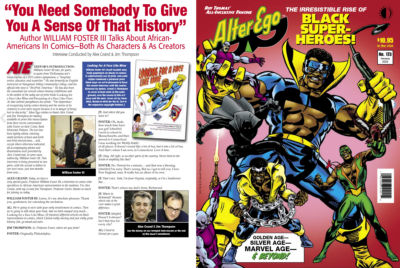
Transcript for the first half of this interview published in Alter Ego 173:
The second half of this interview transcript published in Alter Ego 174:
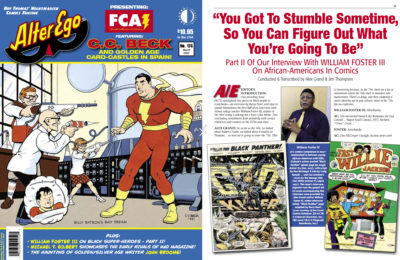
Interview Conducted by Alex Grand & Jim Thompson
ALEX GRAND: Today, we have a very special guest, Professor William Foster III. A historian in comics who specializes in African-American representation in comics. I’m Alex Grand, with my co-host Jim Thompson. Professor Foster, thanks so much for joining us today.
WILLIAM FOSTER III: Listen, it’s my absolute pleasure. Thank you, gentlemen, for extending the invitation.
AG: We’re going to start with your early involvement in comics. Then we’re going to talk about your book, that we both enjoyed very much… Looking for a Face like Mine. [It features] different articles of black representation in comics, which I found really moving and just really great history. Jim, go ahead and start.
JIM THOMPSON: So, Professor Foster, where are you from?
FOSTER: Originally, Philadelphia.
JT: And where did you move to?
FOSTER: Oh, dude, how much time have you got? [chuckles] I went to school in Massachusetts, and then moved to Connecticut. I was working for Weekly Reader, of all places. It doesn’t sound like a lot of fun, but it was a lot of fun. And that’s where I am now, in Connecticut. Love it here.
JT: Okay. All right, so no other parts of the country. Never lived in the South or anything like that?
FOSTER: No. Detroit for a minute… and that was a blessing. [chuckles] I’m sorry. That’s wrong. But no, I got to tell you, I love New England, man. It really has an allure of its own.
JT: That’s nice. Yeah, I’m from Virginia, originally, so I’m a Southerner. But…
FOSTER: That’s where my dad’s from. Richmond.
JT: Where in Richmond? Because which side of the river makes a great difference.
FOSTER: [laughs] Doesn’t it always? Isn’t that true for every city?
AG: I lived in Detroit for a year, but I was in Boston for a year, and you’re right. There is something about that New England vibe. I do love it, too. It’s multicultural, it’s really interesting.
FOSTER: I’m telling you, and it’s part of that New England… that Northeastern brain trust that goes on in our country. I love that.
JT: So, let’s talk about your entry to comics. When did you start reading? What books or lines were you interested in?
FOSTER: I started when I was about 11, reading comics. But I was a voracious reader. I read… you know that old insult that you’d give somebody, “Eh, go read the encyclopedia.” That was me. I was the, “Eh, read me the encyclopedia”… I couldn’t get enough.
And comic books were just great. I mean, they told a story vividly, and in bright colors. Superman and Batman were my two favorite characters. For the comics I could afford. And I was lucky I had a couple of buddies who are twin brothers, and their parents were a little higher financial scale, so they bought them all the new comics, as soon as they came out. And I would come over and they’d let me read them. I’d say, “Hey, you guys are all right. I don’t care about what anybody else says about you.”
JT: What era of Superman and Batman are you reading? Because I don’t know your age.
FOSTER: Silver Age. It was like the early ‘60s, and Curt Swan is my favorite Superman artist.
AG: So, what’s the year of your birth then?
FOSTER: 1953.
AG: Yeah, okay. This kind of the approximate year of birth of a lot of our guests, it seems. Early ’50s, yeah.
FOSTER: It was free, and cheap, entertainment. Everybody told us we were going to die and go to hell if we read comics. It was a great time. Actually, it got better after people said that, because that way, now we really wanted to read them. [chuckles]
JT: So, you were reading Curt Swan-drawn Superman, and you were around during the “New Look” Batman around the time of the shows, so Infantino’s new look.
FOSTER: Absolutely, but you know the Batman Annuals were reprinting stories from the ’50s before I was old enough to read them. Man, I ate those up, because Batman was just more dynamic. I mean, you couldn’t cross a roof without having a giant toothbrush or a razor, or something… It was great.
MT: So now, did you just limit yourself to those two characters at that point? Or did you step into Justice League, and The Flash, and all those other characters?
FOSTER: Every Superman title I pretty much read, including Lois Lane and Jimmy Olsen. World’s Finest, of course, was obviously combining my two heroes; I loved that one. But my parents cleverly got me into Classics Illustrated. And then my cousins read all the Harvey Comics books—Hot Stuff, Spooky—and my sisters loved the Archie… yeah, my sisters, it wasn’t me… never me… [chuckles]
I had a really wide range of comics I was looking at. Even some Charlton Comics occasionally would drop by off my way. Some old EC… my dad brought home a box of those, one time. It had a real heavy mildew smell. Like I cared… I just went through those, man.
JT: So, which ones, the horror books, or the science-fiction?
FOSTER: All of them. Had a nice selection. I used to love the fact that… This is something that the critics of comics books never got… Something bad would happen to you, only if you weren’t a good person. If you were an evil person or you had an evil plan, if you kill somebody for their money or you kill somebody’s husband so you could go out with their wife, you know what’s coming for you. And that’s the part, us kids, were looking for.
JT: Oh, yeah. EC was really good about that, too. That if you were cheating on your girlfriend, you were probably going to end up with your head taken off and used as a bowling ball.
FOSTER: Yeah, or served up to somebody with the eyeballs still in it. [chuckles]
JT: Yeah, don’t sell tainted meat because you’re going to get it.
AG: [chuckles] Tainted meat, that’s so true.
JT: All right. So, it’s interesting, you haven’t mentioned Marvel yet. Did…
FOSTER: When Marvel came out, I was hooked. But before that, I was a big DC fan, or a lot of different publishers. But when they brought out Spider-Man, Fantastic Four… those are two I kind of read. “Doctor Strange” I loved.
And then, as they moved into more titles… “Captain America” was okay, I liked him. “Thor,” not so much. “Iron Man,” okay. But Spider-Man primarily. Because, first of all, as history tells us, he was the first teenage superhero, if you don’t count Superboy and Robin. They were sidekicks. Spider-Man was on his own right, and he had a real complex life.
JT: What was your thinking about… Now, with the EC Comics, they actually dealt with race, especially in Shock SuspenStories and things. But in others too, they actually acknowledged that there were other people. Not so much with the comics that you’re talking about.
FOSTER: It’s true. Now, that’s funny… in DC Comics, as I got older, and I started looking at the images, over and over again, I had noticed that the only time they have a black person in a DC comic was when they were at the UN. And then they weren’t African-Americans, they were Africans.
JT: Yeah, Had the whole… All the iconographic images of it.
FOSTER: Yeah, but ironically, they used to do a bunch of public service announcements in the books. And there, you could see people of color. Of course, they’re in poor countries, being served food, and building schools and stuff like that… but that was pretty much it for the longest time.
AG: Yeah, Jack Schiff was putting out a lot of those ads in DC comics.
FOSTER: I did a piece on those on at the Popular Culture Association in Nashville Convention, and I just had the time of my life, because I had all these examples. And people who had never seen them didn’t know what I was talking about, but they had some good advice: Be a good citizen. Be open to other cultures. That was good, but that was the only time you saw it.
In fact, I read a Superboy comic where Superboy goes to Africa and every stereotype’s in play, but in the first two pages of the book, they had this ad talking about “We’re all brothers.” I say, “Hmm… Yeah… I see that. Right now, I see the brothers thing.” [chuckles]
JT: Some of the genres, even in the DC comics and in the Marvel comics, allowed for black representation. I’m thinking of Gabe Jones and the Howling Commandos, and Sgt. Rock. There was one black soldier and…
FOSTER: Sure… Gravedigger
JT: Yeah… Well, there was Gravedigger too. So, you had some of that stuff. Did you seek those books out? Were you happy or pleased to see black representation or did it matter?
FOSTER: I noticed that it was missing but it didn’t actually detract from the story. But, it’s funny you should mention that because… the non-super-hero characters I saw that were people of color were in Marvel. Peter Parker’s high school had a black kid in it. Peter Parker had walked through …
JT: Yeah, and Robbie Robertson. I mean, he had a real job.
FOSTER: They had a black cop. You know, like you’d see them at any point in time, and it wasn’t like, “Well, you have to wait till some Negroes come along so you can go arrest them.” I mean, he was doing his job. And that was what stuck out in Marvel.
AG: Yeah. It seemed like Stan Lee was more progressive than Carmine Infantino when it came to stuff like that.
FOSTER: I met Neal Adams at a show. I brought my entire collection of comic books, and different stuff, too, in New York. And I didn’t know who he was, but he introduced himself to me and his son. And he said he was standing in one of the editor’s office, and it was like they were asking for a new Green Lantern. And they were talking about him doing another blond guy. And he said, “I’m like, I’m sick of this, so I said, ‘Listen, do me a favor, come with me, over to the window. We’re in New York City. Look out there, what do you see?… You see people with every ethnicity. Why are we only representing one?’ I said, ‘Look man, you got to have help us out. You know we have to represent what the reality is. That’s what comic books have the opportunity of doing.’” And he said that’s how he got Stewart as a black Green Lantern.
AG: Yeah, John Stewart. Yeah. He’s a great character.
FOSTER: Oh man, still to this day.
JT: That run, for me, changed, probably growing up as a Southerner, I was 11 or 12 when that first, “Green Lantern/Green Arrow” with the “You done a heap for the ‘orange skins’ and the ‘purple skins’…” That was a defining moment for me. I always list that as one of the things that changed my life, in terms of, it woke me up—in a real way.
FOSTER: I like the cover, where they show John Stewart without a Green Lantern mask. And how Jordan asked him, “Well, why aren’t you wearing a mask or why aren’t wearing a mask?” He said, “Look at me dude, you think nobody’s going to know I’m black [chuckle] when put a mask on? No, I’m not doing that, get out of here.” He had some bite to him. He had some flavor. Because let’s face it, Howard Jordan was kind of like a tight ass. [chuckles]
JT: Oh, totally. And they got that. Denny O’Neil understood that, and that’s what he did with the character. In The Avengers, when Professor Bill Foster actually appears in the comics…
FOSTER: 1967. Never forget it.
JT: Were you there? So, you read that? Because that was a stand-out character too… a scientist. And it wasn’t like just a one issue appearance. He became, not a significant part of the Marvel Universe until later when he gained powers, but he was a recurring character.
FOSTER: Actually, people kind of hit me to that, because I didn’t really notice that until later. And I started looking back when he became Black Goliath. That’s when I kind of got it, because he had the introduction at the top of the page; in the first page of every book, on all the five issues. And I just went back in time to see who he was and where he was. And it turned out that he’s the guy that Henry Pym asked, “How can I get this. I’m having difficulty with controlling my size thing.” I said, “Whoa, that’s just outrageous. That’s sweet.”
JT: They introduce him and then they bring in the Sons of the Serpents. Marvel’s doing stuff that’s very different from any of the other companies.
FOSTER: And then you got Black Panther coming out in 1966, which is like “Whoa!”… Where were we in America in 1966?
JT: Were you reading that in real time? Or is that something that you discovered after?
FOSTER: Oh, dude… They introduced them in The Fantastic Four… how was I not going to read them? It was great. And it’s funny that, even then, there were people who had never picked up a comic book who were actually convinced Stan Lee was naming him after the Black Panthers Political Party. It’s close, if you look at the timelines for both, but no, there was no way that was a crossover.
AG: Yeah. Timewise, [Black Panther may have appeared] three months before the political group. I think it was a coincidence, because there’s a delay in printing by the time it got out anyway.
JT: But I think there was a reference to the party, in a newspaper or a magazine that may predate it. I’ve argued with Arlen Schumer about this before, and that was fun.
FOSTER: Oh, man. [laughs] But it’s funny… I clued you guys on the geek boys. They don’t like coincidences. They don’t.
It’s amazing. When they took the Fantastic Four to Wakanda, and they’re super scientific and the spear that’s not a spear, it’s a ray gun. They have rituals and a fine tradition. I was just like, “What a time, they couldn’t have timed it better.”
JT: Back to your history, because we can get lost in the comics, and we’re going to for the next hour or so… Educationally speaking, so you’re reading comics. Do you put them aside and move on science-fiction or some other thing? Or do you stay in comics and continue reading that? And what happens in terms of: Do you decide you want to be a professor? Do you decide you want to write? Did you ever want to work in comics? Tell us about that next stage, now that you’re like a little bit older.
FOSTER: I was a voracious reader, like I said, and science-fiction was a major genre. I mean, I went through my school’s library like a wildfire. [Robert] Heinlein was one of my favorites… Norris, Norton, Samuel Delaney… I read all of those guys. I love their work.
Comic books were taking me the same way. It’s given me a world of fantasy, but… it helped me in science class, if you can believe it or not. Junior high school science class, one day, my science instructor says, “Okay, I’m going to give you guys a property of a metal, you tell me what metal it is.” I was the only guy in class, thanks to reading Metal Men, who knew every metal. I got the answers right.
But at the same token, I had people… not my parents… people… I was from a big church-going family, so you’re always going to have somebody with an opinion and didn’t know how to shut up… they were telling me that that kind of books are going to rot my brain. “It’s a waste of time. Don’t read those funny books.” And I just said nothing. But I say a bunch now, because I’m still thinking, “Yeah, you were right. They’re not going to take me anywhere, except to Germany, China, Australia, Britain… Yeah, I didn’t go nowhere. I should put those comic books down. I wasted my life.” [chuckles]
But yeah, I was a simultaneous reader. Like I said, I couldn’t not read. Once I’ve picked that stuff up, and found out that opening up a book, I can go into another world, that was it for me. I even tried reading novels from other eras, and novels not necessarily written for boys. I was a big Nancy Drew fan: See if I can figure out the mystery before anybody else in the room. Then I come to find out the books I was reading were like, what… they were 20 years old, and they’re still producing Nancy Drew.
JT: Were there any genres that you just thought, “I just can’t handle this because it’s just too damn white? There’s no reference to my…
FOSTER: [laughs] There was a lot of them.
JT: I’m thinking of fantasy especially. I mean, Tolkien is awfully white.
FOSTER: True.
JT: In all of that—and I love it—but there is no space… Whereas, with science-fiction, even if it’s by metaphor, it slips in all the time. And I don’t think it does in fantasy, nearly as much.
FOSTER: No. No, it didn’t. It’s interesting. My awareness of people who look like me in books was kind of like… It was kind of dulled for a long time. But you asked me what genres I read. This was about the time—late ‘60s, early ‘70s—when Zap Comics came out. And they didn’t care who you were, everybody’s made fun of. Drugs, sex, and rock ‘n’ roll… I got to tell you, I just said, “Whoa.”
I read a book that featured Richard “Grasshopper” Green, and I said, “This guy must be black because he’s just too damn funny.” The people were afraid to talk race, and he talked about it up front.
JT: So, when you’re reading and you would see these images from people like Robert Crumb… you were good with that?
FOSTER: I know some people, like if you said “Good morning,” they would’ve said, “What do you mean by that?” That wasn’t me. The idea is, I had a sense that he understood. He ironically grew up in Philadelphia, or just outside. I’m looking at somebody, and I just got a sense when somebody is trying to be hurtful in what they’re saying or not. And I’ve never felt like that. He was being funny. And I can’t stop laughing till I start choking. And then I get, “Oh, hey, that’s offensive.” “No, it wasn’t.” But I’ve met some people who are just like, everything is offensive. Then I can’t help you, because that’s not how I roll.
AG: That’s something you mentioned in the book… because there’s some younger people that look at [Crumb] as a bad person. You analyzed him in your book, “Well, he offended everybody equally, “and that it was because of that that you appreciated kind of where he was coming from in that sense. And you don’t feel like he should be canceled in some way, over the stuff he’s done. Is that right?
FOSTER: Yeah, I think that’s a bit much. I think that we had people who were censoring comic books. We had people who were having comic book burnings. Gad, that was an awful image. What country did that take us back to? And I didn’t feel that was necessary at all.
There were all kinds of comic books. There were religious comic books, and I read those because I came from a very religious family. I love the books that were written about the lives of Jesus or the great prophets.
So, I had a full rounded education, in terms of things that I could reach for. It wasn’t like comic books were evil and death. Besides the fact that comic books of the ‘60s, and the ‘50s were kind of mild. The idea is that you never really saw anybody kill anybody, unless it was an imaginary story. Lex Luthor was a bad guy, but he only killed Superman, an imaginary—nowadays, who knows what could happen? That’s why the Comics Code was in place. But no, I never came after guys… Particularly since I’ve met guys later on, and I’m very fortunate, like Larry Fuller, and Richard “Grass” Green again. I’ve met them in person. And they’re talking about what they did those days, they’d just laugh.
JT: I want to get you into college. Tell us about your education, like what did you want to do as a career? And how did you go about it?
FOSTER: It’s funny. I started writing very young. I didn’t start writing well till I got through college. I started writing for the school newspaper, for the literary magazine, I wrote for the news service, editorial… it was an explosion for me. I’d been writing stories since I was young because I was inspired by the books I was reading.
So, when I got to college, mass communication-journalism was a straight forward run for me, I knew exactly. I had friends that didn’t know what the heck they would do in college. [For] my parents, college was serious. If you’re going to go to college, you better have something there to do. So, I took it very seriously. And I’d met all kinds of people there as well. In fact, one of the guys who became the founder of the Teenage Mutant Ninja Turtles went to UMass at the same time I was there.
JT: Which one?
FOSTER: The fat guy with the glasses. [chuckles]
AG: Oh, that’s probably [Peter] Laired.
FOSTER: The one that married the really attractive woman, and if I say, “What the hell happened there?” [chuckles]
AG: Yeah. And then Kevin Eastman married Julia Strain. I know that. Yeah.
FOSTER: Life is full of mysteries. And you think about Connecticut. Something that I didn’t realize when I moved here is that a lot of cartoonists and comic writers live here. Once they’d make it big, out of New York they came… right up the road to Connecticut… and just took the commuter train down there. So that worked out really well for me to meeting people.
JT: When did you first do something related to comics, on a professional level?
FOSTER: I think I must’ve started writing about them in college, because I had this interest. Okay, I got to tell you a story that you’ve heard more than one time: My parents threw all my comic books out after I moved out.
JT: Oh, yeah…
FOSTER: I’ve forgiven them now, thanks to the therapy. But I had to start my collection all over again, so, I’m starting in a brand-new era. And I had… No, please don’t get me started on what I had. I’ll just tell you what I went from there, because that would be a long story by itself.
But no, I had started reading everything again, and like you said, there’s the new flavor in comics. DC was trying to get with it, Marvel was just going, you know… They had women super-heroes, and they had…
AG: Now you’re talking in the 1970s, right?
FOSTER: Absolutely, bro. I graduated in ’75.
JT: So was that good or grimacing, when you would read, “I Am Curious (Black)!” or you would see Little Harlem… or Little Africa in Metropolis…
FOSTER: I’m sorry. It was just funny, bro. Come on… “Little Africa,” give me a frigging break. [chuckles] Okay, Lois Lane turns black for 24 hours. Man, that should do it… 24 hours is long enough! And how fortunate for her, her boyfriend, who happens to be Superman, can change her from white to black. And the interesting thing was, that wasn’t the only place that story was taking place. I have a copy of True Confessions magazine from that same era. And on the front, they have a white woman, blonde hair, blue eyes, you know, attractive. And she says, “I turned black!” And there’s another picture where… “Who would be fooled that you were a black person?” [chuckles] They just darkened the skin and put a wig in her. I said, “That’s just funny.”
And It’s just like a training on stereotypes… that black people, of course, would be speaking in very stereotypical language. They wouldn’t talk to her, like they didn’t talk to Lois Lane. But once they think she’s black, it’s all, everything is cool. That just makes you ignorant. But I also appreciate it because, we go through stages. We go through tokenism. We go through patronism. We try different images, and the freedom we try that, I think is what we should be.
Just look at what they did for women. I mean, women were… How many years, Sue Storm, when she was like just cute and posing and… let’s face it, kind of dumb? As time goes on, she’s become like the leader, more than one time.
JT: Oh, yeah. But those early days, The Thing would take her over his knees and spank her. I mean [chuckles] they’re horrible.
AG: Yeah, because Stan and Jack were kind of doing romance comic stuff in that Fantastic Four.
FOSTER: That reminded me of something… Marvel Girl, when she first joined The X-Men, it was the same thing. And two, somebody just made me realize that in one of his thought balloons, Professor Xavier is saying, he’s in love with her.
JT: Yeah, that’s creepy.
AG: That confused me many years later. I was like, “What?”
FOSTER: Creepy. [chuckles] And not just a little bit… Whoa, Professor… Whoa!
JT: Now, Marvel’s got like a bunch of those creepy things, whether it’s Clea sleeping with Ben Franklin, or it’s the Ms. Marvel thought-rape.
AG: Yeah, that’s the kind of freedom they had a little more freedom to do whatever.
FOSTER: When you first introduce the characters, you’re trying to figure what’s going to work out. But I had kind of a clear sense of what’s important and what’s not, because I was working on those same issues. That someone doesn’t look like me—does that mean that they deserve to be treated less than me? Well, I had been treated less than… And I didn’t like it. So, I’m not going to do the same thing to somebody else. I got to do better. And when the comic books show that that was great,..
JT: But at some point, did you decide: Nobody has written about African-American comic characters in the way that they should because… We interviewed Trina Robbins, a couple of times, and…
FOSTER: Oh, big fan of hers.
JT: And Trina said nobody was writing about the subject and so… it wasn’t that she set out to be a writer, but she said, “Nobody else was doing it, so I had to.” Did you feel that way?
FOSTER: Yeah. I had to kind of bring attention to it because no one else was. The best thing where I am right now, where I sit right now in comics, is that I’d be able to find all kinds of writers. People who like had gone off into obscurity and I’ve pulled them back. Young people I see at shows. I immediately go to the table, “This is who I am. Please send me copies of your work.” So, I become the lodge stone, and that’s a role that doesn’t upset me at all. But back in the day, not so much, my brother. Really not.
AG: Yeah. I had an epiphany as well. There’s a whole, another side to comic history. I had that in Trina’s Women in Comics book, and your Looking for a Face Like Mine. No one else is looking at it in that way. You’ve run museum exhibits on this. You’ve been in a couple of documentaries, Superheroes: A Never-Ending Battle, and then Comic Book Superheroes Unmasked, both nationally aired. This particular area is a specialty of yours. Let’s go through kind of a timeline, starting with the Yellow Kid, and moving to the present a little bit.
The Yellow Kid 1895, Hogan’s Alley… Now, a lot of the early comics strips like the 1890s—I’m talking about before everything was nationally syndicated and homogenized and kind of whitewashed in a way—in the 1890s, they were showing like local New York life in the Yellow Kid, and you were mentioning that there’s like a gang of kids and the Yellow Kid was one of them, and there’s some African-American kids. Tell us about that scenery, and then move us forward through time like with Krazy Kat and stuff like that.
FOSTER: Oh, no problem, brother… Krazy Kat… how much time you got? [chuckles] The Yellow Kid… basically, if you look at the neighborhood photographs, it’s like… you can’t tell somebody’s Irish by looking, unless he’s got one of those little white pipes in his mouth… or the Jewish kid has a yarmulke, and the black kid, obviously a little more obvious for him, you can tell. Sometimes you couldn’t even tell if the girls were girls because they’d be wearing pants like the boys. But it was sort of like the art gang kind of theory, the idea is that these are just kids. And they’re coming from different places, they’re speaking differently, but they’re getting along. Now, the adults can’t do it but the kids can do it. In fact, Our Gang made that main town center team. It’s kind of an American team.
And you’re right, because in the city… I used to kid with my students of my communication class that, if you’re living next door to somebody, you live in one to an apartment next door to somebody, you know exactly what’s going on there. You know when there’s a funeral. You know when there’s a wedding. You know when there’s an argument. The walls are paper-thin.
And here you understood that everybody was the same. All those—blah, blah, blah—They always fight… Yeah, you were doing the same thing last night. So, you get the chance to have the sense of how our experiences are pretty much the same. We’re going through the same thing. Nobody was really rich, but then nobody was really poor. And if you ask me, I’d tell you my family wasn’t poor, but if you look at, compare us to somebody else or contrast somebody else, that was true. So, they started with that.
Now, you’re moving to the 1920s, 1930s, and comic books have taken on a place of their own. I think I mentioned that when everybody was in bootlegging and making all kinds of illegal money, and then the IRS came by. Suddenly, comics became a place where they could hide those profits. No one said that about DC, no one says about… that suddenly, they had all this cash. In fact… can you guys see this?… I don’t know.
The Red Mask. First black hero in a comic book. A year before Negro Hero, All-Negro Comics came out. No one knows who wrote it . No one knows who drew it. And when people found out he was a black super-hero, they tried to put out another one where he turned white. And that just disappeared off the face of the Earth.
AG: Yeah, I noticed that the coloring was inconsistent. After a couple of issues, I’m like, “What is this?” Now, George Herriman, there is some discussion that he had some African-American heritage. He did stuff also before Krazy Kat kind of became his thing. But there is one, I think it was called Musical Mose or something like that.
FOSTER: Lil Mose?
AG: Yeah. It was about a black character who was trying to pass himself as white, in a white society. And there were some physical bloopers that had happened. Do you feel he’s expressing something? And what’s your take on that form of comedy back then?
FOSTER: Well, here’s the interesting thing: Herriman came out of Louisiana, I think probably really near New Orleans. Of all the places in this country, that place is where race-fixing was taking place on a regular level. But if you were white, it didn’t matter what you were. So, people said, he was trying to act like he wasn’t black. I suppose he kept his hair cut short, and he always wore a hat. But then, you had people who would say, “Well, you’re crazy. He took off whenever he felt like it.” He was a dark-skinned guy.
But it talks about the kind of… what’s the word I want?… the kind of sickness about race that we have in this country, about you can’t be too dark or people passing. I had to explain to my students what “passing” is. They have no idea… they have seen it, but they didn’t know it was called that. Okay. I had to explain to them what the paper bag test was. They didn’t know what that was, either. In Louisiana, believe me, that went on all the time. Some of my favorite novels are about those days where it would be like…
I love Krazy Kat. Of course, my introduction to it was, when I was a young kid, the animated Krazy Kat. It was made by the same people who made Popeye. So, you know, you just move from one to the other. But no, I don’t feel anything like getting kind of skullduggery was going on, that he was trying to hide who he was. Unless… I think his kids said the same thing. And the South… I don’t even want to put on the South. In America, if you’re having kids, and suddenly, one of the kids was dark, a couple of things could’ve happened. But what do people think of the first thing? They think of the worse possible scenario. And men never got blamed; women always got blamed. And that’s kind of like the legacy of slavery and racism, as well as, against women.
So I just think it’s just people kind of caught up with that. I don’t know if anybody ever took it seriously. I don’t know if he ever lost any jobs; he was just too damn good.
JT: When you first heard his name, when you first saw pages of Krazy Kat, did you know at that time that he was black or mixed race? Or was it something you found out later on?
FOSTER: Actually, something that people were discussing later… Like I said, I go to the Popular Culture Association Conferences… and there’s always somebody doing the extreme, long, and not necessarily interesting paper on that as the major theme. I’m like, “Uhmm, I guess that’s an interesting point…” But in the end, I had to make the same decision I made about Superman and Batman: love their books, just notice that there were no black people there. That doesn’t mean that I didn’t love their books.
JT: Once you found out, did you read Krazy Kat, the characters, as black?
FOSTER: No. I did read to see, but maybe I had missed something because I longed for that possibility. That maybe, something was being said, or he was saying some message… But no, I didn’t get any… I didn’t, and I’ve read some stuff where the subtext was a lot less subtle, and I said, “Whoa, somebody here has a problem.”
One of my students wrote his own comic book. And the title of the book is called Whigger, effectively, white n****. I thought it was brilliant. Because, first of all, nobody around would even say that word, because they’re so afraid of being brushed with the tar brush. But he was a good writer. He told the story very well. He said he gets tired of being the white guy surrounded by black guys, but he makes that really cool, so the only thing that people are complaining is the white people or black people who didn’t know him. His buddies would just look at him and laugh.
So, the idea is, how do we get along? Which is that ultimate message on what we read and what we promote? It’s got to be the most important thing a story is telling us.
Nowadays, you can be as nihilistic as you want to be in the telling of a comic book story or a graphic novel story. But I was raised in the age where, if we’re not saying something that’s going to promote us, then what are we doing?
I understand the apocalyptic is an interesting reading, but in the end, maybe there ought to be some stories that kind of balance that off. Okay. And that’s what I’m looking for, is the balance.
AG: Yeah… I like you have a positive attitude about a lot of this stuff.
JT: But in terms of, you look at Krazy Kat, and you look at Little Nemo, and they both are two masterworks of that era, and… Do you hit a point where you say, “I like Little Nemo but it’s hard to get past the racist aspect of it”? The African kid that’s along with it that’s got the bone in the nose, or… certainly looks like that even if it doesn’t actually have the bone.
AG: In the ‘90s cartoons, they replaced him with a squirrel or something like that.
JT: Squirrels are good.
FOSTER: It’s interesting. I think one of the reasons I read a bunch of old cartoon strips is because I was interested in what lifestyle was like back in that period of time. My parents talked about it. My grandparents talked about it. I didn’t know anything about it. But the race thing, yeah, you kind of notice that.
Who are the major characters? And when you show a black character, what do you show him as? Do you show him as speaking slow and Pidgin English, and not being clever? But then, I did a piece for Hogan’s Alley magazine where I talked about Henry, the kid who never talked, never had a mouth… never had a conversation balloon. In a surprising number of his strips, he’s got black friends, or black kids in the neighborhood. In fact, he even had one place where he sees the black man with four kids going into the ice cream parlor, Henry stops next door to the shoe shine parlor, comes back out, he’s a black kid. He used shoe polish on himself because he wanted free ice cream… You see, that’s funny.
Now, here’s one that I don’t know if anybody have ever mentioned. Little Lulu, when she was appearing in ads in Saturday Evening Post, a lot of anti-black in “Little Lulu.” Only once or twice in her animated cartoons did you get a chance to see it. But I was stunned by that. Saturday Evening Post, whoa… what the heck?
AG: Let’s talk a little bit about Jackie Ormes, 1937 going to 1940, and then there’s a later run. The Torchy Brown strip. So that’s just kind of amazing that we have a female African-American cartoonist doing newspaper comics strips, and they’re syndicated. Is it mainly by black newspapers? Is that what was going on?
FOSTER: Yeah. That’s exactly right.
AG: And how amazing is this that she was doing this in 1937?
FOSTER: Yeah, I am telling you, it was an interesting period of time, and she was very prolific in that. And how she portrayed the character… an environmentalist, a nurse… went back down South and came back. I can tell you, from my family, when they left the South, there was nothing that would get them back. But she had an appreciation, there was a call, and a calling, and that’s what she did. So, she’s a character much to be truly admired. And then, Jackie Ormes as a female cartoonist… you’re right, dude, that was a speck amazing.
AG: Yeah. She just had the artistic storytelling drive, which is amazing that that had happened. Let’s talk a little bit about Will Eisner’s Ebony character. [chuckles] You said there were five categories of black representation in films. You apply that to comics as well. Ebony represents one of these five categories that you had laid out in your book.
There is also a 1973 “conversation” with Ebony White by Will Eisner that you applauded in your book. What’s your take on the Ebony character? The movement that some of the younger people are saying, that we should get his name removed off the comic industry awards… First, what’s your take on Ebony? What was your impression on his 1973 conversation? Tell us about that.
FOSTER: I’ll tell you what, I’ll start off my conversation with Will Eisner. I don’t know how I got lucky enough to do this. At San Diego Con, he was always swamped, and so I decided I’d come back later. I came back and like, literally, there was no one… It had to be lunch time. Nobody was around his booth. So I said, “Mr. Eisner, I’m a big fan of your work…” and I talked to him about… I said, “What do you think about how people felt about Ebony?”
He kind of paused for a second, because it’s obvious that’s the first time he’s been asked. And he said, “Well, depends on when you ask me.” He said, “Sometimes, people have said that it was a great idea to be inclusive, and other people said how dare you have a despicable image of us.” And he said he got awards from NAACP at one point, and he said, “In another point, they completely condemned it.”
That’s interesting to me. He also had a black police officer who was in more than one strip, in more than one comic. And he had one where Ebony, because a black girl turns him down, decides he’s going to go back to school to get rid of his Southern accent. He said he doesn’t want to be recognized as a minstrel. You have black soldiers. So, if I was drawing characters, I would be real careful about who I painted. But at the same token, I don’t know if you guys remember the creator of Dennis the Menace…
JT: Hank Ketcham.
FOSTER: Yup. Hank Ketcham came out with a black character, [Jackson] about a year, maybe two, after Charles Schulz introduced the black character, Franklin. And he did not get the same reaction as Charles Schultz had got. People came after him with almost guns and knives. He was in Europe at the time, and he got a wire saying, “Get back over here.” They’re crashing in the offices, destroying property. His goal… his response was this, he said, “Wait a minute, every cartoon character is a caricature of somebody. Find somebody who looks like Mr. Wilson with his big ass.” [chuckles] “Or Dennis’ father, who has a nose like a nose cone. Or Dennis himself who looks like a tramp with a load in his pants. That’s what I’m doing.” Your critics are big, but the idea is, as I said, I can’t make anybody less sensitive than they are, when they see an image that they think is really negative.
So, Ebony, I didn’t feel insulted because, on top of everything else… I got a question for you guys, like I used to do for my students. You remember the old TV show I Spy?
BOTH: Yeah.
FOSTER: Robert Culp, Bill Cosby. Okay, here we go. I want you to think about a typical episode. They’re getting into a car, who’s driving? Is it Cosby or is it Culp? If it’s Cosby, is he the servant? If it’s Culp, it’s because he’s the master. Or does it not make a difference?
AG: Right… because sometimes people will get their own impression of something.
FOSTER: And so, I think that’s the same. And we’re going to see it continuously, until somebody comes out with a character that’s just so stereotypical that they’re just going to be done for that point, okay? Because there’s got to be artistic freedom on one side, and you got to be telling the story on the other side. And we all think that every point has to be… You have to hit these numbers on every story you do. When does has that ever been true? Because that’s been changing dramatically.
Think about a character like Spawn, who was a black guy when he was alive—but now, the skin’s burned off. But people still think of him as a black super-hero. I have a friend who says, “No, I don’t want no dead guy as a super-hero.” So, it’s such a yin and yang. But for me… when was the last time I was offended by a character?
Oh, okay… I collect all kinds of comic books. So I collected one that was put out by the American Nazi Party. And so, you’re going to have a kind of appreciation on what kind of characters they showed on there… that I just screamed. You know, you wasn’t trying to be nice to nobody. You’re trying to make a real important statement about what you think about other races and other religions. And the more cruel and violent you were to those members of those races and those religions, the more you thought you were making your point. Got you. Not lost at all.
JT: But you don’t really have to go all the way back to the Nazis to be offended by…
FOSTER: Oh, no…
JT: I mean, like there’s American comics that I’m sure…
FOSTER: Oh, God, yeah. They never had an important role, they were only shown for surface… protection, like on the cover, never seen inside the book. There weren’t any black super-heroes. There were not black heroines. And yeah, so the absence, and then people who did appear, were they something to be admired? Nope, not for the longest time. You’re absolutely right.
AG: Yeah. I noticed you had kind of two perspectives, kind of happening at the same time, and they’re valid, and they’re both true. It’s there’s that one aspect of “we should be represented better,” but then there’s another aspect of, and you said this in your book, that “It’s better than nothing and I love the comics for its form and I love the history of it.” And that you appreciate it for where it was. It’s kind of interesting that you have both of those happening at the same time.
FOSTER: The world’s a big place, and what’s one of the biggest problems we have right this minute, this time in history, is that if you don’t think the exact same was as I do, not only must you be punished, but you must be punished severely. I think that’s horrible. But here’s the thing… I’ve seen enough of people of color creating their own comic books, and that’s the excitement for me, and it never ends. And then I see them move into mainstream comics and do their own books. So, we’re at the point where you had nothing on the screen, to the point now you have, on any number of points of view, and that’s the only way it can be. No one black person can represent the entire race. No one woman can represent the entire gender. And yet, somebody will always say, “Well, we got one.” Now, that’s called tokenism, and that’s not a good idea.
AG: Yeah. Right. True. Now, in talking about African-Americans making their own comics… as a segue into it, you mentioned that, in 1945, World’s Finest Comics #17, there’s actually a tribute to African-Americans serving in World War II called “Johnny Everyman.” That was pretty cool. Then a couple of years after that, you mentioned it earlier, All-Negro Comics. It was by Orrin Evans. You had an excitement in the way you wrote about it… African-Americans having control over their own imagery. And you had mentioned that that was something that was especially meaningful. Tell us about the significance of All-Negro Comics.
FOSTER: Orrin Evans was a reporter, and he was more than just a reporter. He was actually the guy who created the Negro journalism organization. He was not afraid to get into a cop’s face, which even then, at that point in time, would have been horrendously dangerous. But he said, “He’s either going to be straight, or they’re going to be—“ He got tired of seeing comic strips that didn’t have people like him. So, when the paper he was working for went out of business, he— We’re pretty certain that all the guys he got were all black. But he got a bunch of guys who he knew could do the job, and they put out their book. He was told and pressed that he couldn’t sell this book. He sold this for 15 cents while almost every other comic book was selling for 10… which was a major thing to do. In full color, he did the book. Not only the color but the inside. He did a great African king, he did a black detective, he did black fairies… he took the story to wherever he could. I think that was amazing.
It only lasted one issue. I happen to have one copy, because I happen to be at the right place at the right time. That’s how it gets done. And then, you get other people to sign it, maybe we ought to try this. So, you get Negro Heroes. Who was that? I think it was Dell.
And then you have in 1965…
AG: Yeah, Lobo?
FOSTER: Yep. First comic book that features a black character as a main character. Now, I met both the guys who put that book together. I got lucky. I happened to be doing an exhibit on Long Island, and this guy walks up and he said, “Hey, that’s my work.” [chuckles] “I thought you guys were dead!”
And then I met the other one, because I did a couple of shows when I was teaching at my college, and the guy shows up. He lived not very far from where we’re doing it, and I couldn’t believe it. There’s a big black comic book convention out in Philadelphia every May. I had him come down, and they gave him a Founders Award. He’s a white guy, but he was the guy who said he read a book called The Black Cowboys, and he said, “We need to do something.”
AG: Yeah, because that’s a real thing in history, that should be told.
JT: And there were black Westerns all the time. I mean, that was very common… African-Americans Westerns during the [movie] serial period.
FOSTER: But sadly, they were only shown in black theatres, and only one night a week. But yeah, it was like a specialty film. It took me years to figure this out, because by the time I was going to the theatre, you’d go anywhere. But to be only allowed to go on the “crow’s nest” and only on certain days of the week… and they would cut certain scenes out of the movies so it didn’t look like the black folks and white folks are getting along. I thought, “Geez, people before me had to go through all those!” Through a lot of troubles, a lot of mistreatment.
And I never understood that. Because it wasn’t my experience. It’s like riding at the back of the bus, if I could put that point in. It’s that, when I was a kid, back of the bus is where the fun was. That’s where somebody was playing cards, that’s where somebody had a guitar, or somebody was passing around a bottle of something. But before us, it was never like that. And you need somebody to kind of give you a sense of that history.
AG: Before we jump too deep in the ‘60s, because ‘60s and ‘70s are their own pretty amazing story in this, but in the ‘50s, there are a couple of notes. One, you mentioned Batman #57: Batman and Robin, stand up for sportsmanship. Probably Jack Schiff’s statement that racial fighting weakens our country. So, that was an interesting thing. It’s cool that you found all these, and that you put them in your book like that.
Then you also mentioned, and Jim will find this interesting because it’s 1964-ish, you have the war comics. You have Our Army at War, Star Spangled War Stories, Sgt. Fury. And you mentioned in the book that you weren’t sure why, but war stories tend to be a fertile ground for a racial discussion. Why is that? First, what’s your impression? And then maybe Jim can weigh in on what he thinks it is.
FOSTER: Oh, no problem. In fact, real early in the run of Sgt. Fury and His Howling Commandos, they had a guy who joined their commando unit. They had an Englishman, they had an Italian-American, they had a Jewish guy, they had a black guy, and they had a Southern guy. And they had Sgt. Fury, who is from New York, like from Hell’s Kitchen.
And this new guy, when they bring them in to the barracks, They say, “Here, you’ll be sleeping next to this guy.” “I’m not sleeping next to a black guy.” “Get that Jewish guy…” [chuckles] And they call him on it. They said, “You’re a bigot. We work as a team. If we don’t, we all die.” And sure enough, this guy, because he wants to be a hero and he’s like struggling to fight when they’re right in front of the Germans, and it’s like they’re all going to get killed… he gets the message, but it’s not so obvious. “Oh, gee, fellas, that’s great… it’s a small world… “
That’s not what happened. The idea is that, he gets it but he can’t admit it to them. That I liked about the story. Now, on the other side of that, in terms of realistic, there was never an integrated unit in the United States Army, ever [during WWII]. Least of all the Commandos. But despite that, I loved the fiction. I ate it up. They had all separate skills. They worked together. They looked out for each other. Come on, who wouldn’t want to be part of that gang?
AG: Yeah, that’s true. Jim, what’s your take on the war genre and racial discussion?
JT: Well, I think in comics, it was really clear. Because, I think of Blackhawk and Chop Chop, and the Young Allies, where Kirby does a horrible black kid. Whereas when they bring in Sgt. Fury, Gabe is as competent as anybody, and one of the cooler characters. It’s a little silly with the trumpet but…
FOSTER: The trumpet, yeah.
JT: But it’s OK. Later, they use him, in terms of music, and that story that takes place in France and the treatment of black men. That’s kind of brilliant. So, they were good on that. The story that the professor is talking about, doesn’t that end with Gabe actually giving blood to the racist? It’s a little heavy-handed in terms of the last comments, the final panel, but it’s good. And I think, in film, you don’t get a lot of that until probably after Fury and Rock and those stories. I think comics are leading the charge, so to speak.
FOSTER: Absolutely. Well, I think it’s also that… you guys were talking about Marvel earlier, that they felt that they could do it. DC, maybe not so much, and that Marvel ran with it. Maybe they could make a change about something. All of a sudden, Sgt. Rock’s… I mean, Sgt. Fury is like black, one day. But the idea is that he encourages his men to have an appreciation for each other. And I don’t know if DC was, at that point in time, I don’t know… was open to that kind of storytelling.
JT: But none of it compares to that EC story where the white guy is being celebrated and he finds out that his fellow black soldier is buried somewhere else and is not honored. And he calls them all out on race. That’s ahead of its time like nothing else.
FOSTER: Love that story. I love it because you had to read it carefully, and you had to keep up where he was going with the story.
AG: Speaking of EC, did you like that “Judgment Day” story? Where the astronaut… This is 1953 now… comes to the robot planet and there’s one color robot versus another. There is this kind of bigotry going on, and then the astronaut says, “You guys aren’t quite ready yet.” And he takes off his helmet, he’s an African-American man. And then there’s some weird thing with Bill Gaines, and the Comics Code was saying, “Well, you can’t have sweaty beads on an African-American’s head, it’s too sexual.” And they gave him all this hell and they wouldn’t distribute the comic over it. Or not that they wouldn’t distribute, but the Comics Code won’t approve it, so the newsstands wouldn’t distribute it, until he complained enough. What’s your take on that story? And is that still a powerful story?
FOSTER: That reminded me… I couldn’t tell who inspired it, but I’m guessing that they later inspired the Twilight Zone for the same thing, where Rod Serling told stories about racial inequity, all of the damn time. It must have made the censors crazy.
But yeah, the idea that… it’s like you don’t want to tell the story but you got to tell the story. No one censoring you: “Well, we’re not prejudiced, but we’re not talking about it.” Then you’re prejudiced. Shut up. Okay. [chuckles]
They just couldn’t get it. So, I love that story, and it’s surprising to me how well-known that story has become. I have a friend I just sent a copy of the comics page. In the next issue, where people wrote letters about what they thought of the story. It was interesting that it was kind of an even mix on what people thought they liked and what they didn’t like. And one guy says, “Well, if you like n***s so much, why don’t you go live with them?” Whoa! How do you find a pen? And then, somebody else said, “Thank you for telling the story like you told it.” They took the chance. If they hadn’t, nobody would have said anything, but I think the world would have been poor for not having heard it.
JT: Since you brought up The Twilight Zone, can we just for a second and go off and talk about “The Big Tall Wish”?
FOSTER: Go for it.
JT: The boxer that becomes a…
FOSTER: Ahh… was that Ivan Dixon?
JT: Yeah, with the little boy and dreaming and things. That’s just an example of what Serling was doing, but it’s just amazing.
FOSTER: It’s just so sad that the main voice of the story is his hand or his feel for the story. It took years for somebody to come back to get with that same feel. Because the one that they did back in the ‘80s was like… ah oi, not good.
JT: Well, there were a couple of good episodes, and there’s a few I really like. But no, it’s not the same. Neither was the [Jordan] Peele one that was on CBS. It’s hard to put that back. I was as big a Twilight Zone fan as you probably are. In fact, my son’s name is Willoughby.
FOSTER: [chuckles] You are a big fan.
AG: So, as far as the ‘60s, we talked about Robert Crumb, we talked about Franklin in Peanuts, so now we’re going to enter the ‘70s. This is interesting because in the ‘70s, there’s a lot of movements where the ‘60s start to manifest into mainstream. There’s a delay, and then suddenly it starts showing up in pop culture, more in the ‘70s, like an explosion.
FOSTER: Absolutely.
AG: You mentioned Inner City Romance by Guy Colwell… Super Soul Comics 1972, Richard “Grass” Green.
FOSTER: Absolutely.
AG: Don McGregor’s Jungle Action series with Black Panther, Luke Cage. Tell us, as you were reading these in real time, what did you feel was going on?
FOSTER: Oh, man, it wasn’t easy. It’s that the counter-culture was taking over. When you see a major trend come in or a major wave is coming through, it’s making money and you want to make money, too. So you try things out. When you start seeing a lot more women manifest themselves in the comic book world, and not just as super-heroes but as policemen, or police chiefs in some cases, heads of government agencies, and politicians. It becomes easy for them. Like now, we have a template.
The first ones were, like we said, there’s that kind of humor, “Oh, I got to go to the Senate and pass a bill, but first, I got to get my nails fixed.” But I’m remembering plainly, I had friends telling me they were told, “I don’t care how many degrees you have, every woman here, starts in the typing pool.” Or, “You are not going to be able to get this job. Why should I hire you when you’ll just get pregnant, and go get married to someone, and I got to train somebody else?” Right to their faces, with no shame whatsoever. What I’m saying, and that’s horrible, is I’m coming in to the age where women are trying to get a fair shake, and fair shake is for everybody.
So, the ’70s is that. The language changes… Or ask anybody you know about Luke Cage. And that’s the last time you had a black guy say, “Sweet Christmas!” [chuckles]
JT: Well, it would have been on the Netflix show, two years ago.
FOSTER: I was talking to one of the guys who did the Milestone Comics, and he was cracking me up with that. He said, “Yeah, me and the brother are sitting around, and I heard somebody say, ‘Sweet Christmas!” [chuckles] I said, “Please, you’re killing me.”
But, also, there was another phase where every black super-hero had to have “Black” in front of his name. And that kind of got to be a joke. Even now, it’s still kind of a joke. But I understand what that was: Being black was important to say. And if this is the only way you can say it, that’s fine.
JT: Did you see the Harvey Birdman episode with Black Vulcan. Have you gotten to that one yet. Alex?
AG: Yeah. Yeah. I’ve finished the Harvey Birdmans, they are funny.
JT: Black Vulcan is on the stand, and he doesn’t want to be called Black Vulcan. And he says, “I said to Aquaman, ‘Why don’t you call yourself White Fish?’” [chuckles]
AG: Ha, that’s a good one. And then the recent Harvey Birdman Special, Black Vulcan became President of the United States, actually.
FOSTER: You’re kidding.
AG: You should check that out. It’s fun… like 2019, or recent. Yeah. Now, Black Vulcan is Black Lightning, right?
FOSTER: Yeah.
AG: Just so everyone knows this.
FOSTER: And I can’t understand what happened, but I’m sure it was something legal.
AG: Yeah. It was a legal thing with the name, yeah.
FOSTER: Who did you have? Apache Chief?
JT: Yeah. The episode is “Apache Chief Episode,” where he goes to a Starbucks and burns himself on a hot cup of coffee… and he can’t grow after that.
AG: Yeah. The pain was too much. [chuckles] Now, when you read the Don McGregor Jungle Action run, did you enjoy that run? What was your impression of it?
FOSTER: Okay, now I’m going to put some grain in my eyes, because I’ve known Don for a long time. The title gives some people pause, but he was always trying to treat people as human beings. And that’s what happened with “Black Panther” for a long time. People didn’t know how to deal with him, so he was kind of a background character. Is he a monarch of a country? Is he a super-hero? How is he a person? At one point, I think he has a job as a teacher in a high school.
So, they couldn’t really decide what they wanted to do with him as a character. And even up to not very long before the movie came out. I was reading the book on a regular basis. But I couldn’t read any more because I couldn’t tell where it was going. They were… very confusing.
AG: You mentioned Storm… the creation of Storm in 1975… Len Wein, Dave Cockrum. She became a strong female black leader. What was your impression of Storm? You mentioned, “Yeah, she has blue eyes, but still, it’s an African princess.” Tell us your impression of Storm, and why is that important?
FOSTER: I think it’s important because you never had anyone like her before. It’s interesting that when they did the Amalgamation comics where they combine the Marvel and DC heroes… who does she combine with? She combines with Wonder Woman. And becomes Amazon, which tells you how powerful an image that she had, that that was a natural fit. They didn’t have to explain that to anybody.
As they tell her story, that changes over time. She has an African mother, and an African-American father. She has been a thief in Cairo, as a young kid.
AG: Yeah, because her parents were killed in an explosion.
FOSTER: So, they’re adding elements to the story, and then she becomes Kitty’s kind of like godmother. While she was a teenage girl, trying to make her way through… and Rogue, at the same time. So, she has a lot of different hats, she wears…
AG: Yeah. She’s very developed. I like her character as a person. Because I’ve read so much of it.
FOSTER: I was surprised to see how much she called the Professor on ethical issues. And I thought that was important, to have somebody like that, because if you’re an all-powerful person, what’s going to stop you? As we saw in Jean Grey’s character, where there’s no governor, what happens?
AG: She’s sexual. She has a sexual aspect to her. A lot of the time, black characters, even going back to then, are often neutered to some degree.
FOSTER: Absolutely.
JT: And you would have her taking showers naked… having rain on her… and she didn’t really like to wear clothes, and didn’t fully understand it. That was highly unusual at the time, where the black characters tended to have a stick up their ass. I mean, they didn’t have that because people didn’t want to see that to some degree.
FOSTER: Oh, hell no… You know, well, they did want to see, but not in the crowd. Now, you guys know that Wonder Woman had a black sister, right? Nubia, who is like another person they didn’t know what to do with as a character. So, I guess I’m thinking that’s because we have these unresolved issues of race. We’re going to always be dealing with that kind of thing in this country. Where the idea is that, “Well, she’s black, so she can’t be this, but she can be that. If somebody says she white, she’d be that, but she can’t be this.” We’re going to be working with that for a little while, I suspect.
But it’s something that comic books can’t… Well, they can ignore it, but at their peril, I think. I’ve dabbled in writing stories, and I’ve just began to appreciate that as it’s not as easy as it looks. Even if you go to the tropes that have been in place for decades.
AG: Right. So now, later ‘70s, and this is an interesting thing you mentioned because you had an interview with [Grass] Green. I don’t know if this is still a thing or if it was really a thing back then, but he said that when he was younger, being both black and an artist in the black community, they would think he was maybe…
FOSTER: Gay.
AG: Gay or something.
FOSTER: Or creepy.
AG: Or creepy or some different thing.
FOSTER: Or creepy gay.
AG: Not that those two words are synonymous with each other. But just that that was what it was looked at as being. Was that a thing, first of all? And is that still a thing?
FOSTER: It was a thing, and to certain people it’s still a thing. Okay… because I can hear the voice in my head. Just when you were saying that out loud, someone was saying, “What kind of man wants to be an artist?” Really. The kind of man who’s making more money than you’ll ever make in your lifetime, okay? [chuckles] The same people who tried to dissuade me from being involved with comic books because they couldn’t see a place where we’d make any sense. We had to be serious, we have to march to a certain drum. You have to get a job that has this kind of… Really. And if I don’t do that, then I’m a failure? I’ll tell you what, why don’t I define failure for myself? That’s not the only way you can make a living.
And I have young people now who I’d like to think I’ve influenced to follow their heart and did not make a dime, and they don’t care. And they’re doing fine. But there will always be people who would say that this is not a wholesome lifestyle, if you want to be an artist.
AG: I see. Not wholesome. That’s the bottom line, I guess.
There are a couple of things that happened in 1978, comic-wise, in this aspect that we’re examining here today. In ’78, and Jim’s a fan of this as well, is Sabre by Don McGregor, which was basically one of the earlier modern graphic novels… strong black adventure. But then at the same time, same year, you had Bill Mantlo’s 1978 story… It’s a “Spider-Man” story, the Hypno-Hustler. [Foster laughs] Just let the audience know because, maybe it doesn’t know. What’s your impression of Sabre versus something like the Hypno-Hustler? And why is one, maybe more successful than the other?
FOSTER: Okay. Sabre was basically—if you look at him, he’s basically inspired by Jimi Hendrix; there’s no question. And he spoke lyrically. He didn’t give a straight-forward line, and it’s obviously post-Apocalyptic, wherever the hell that is. I don’t think it’s Earth. He uses his instinct, his natural ability, which we’ve always thought that was kind of a ’60s thing. He has a gun, but it’s not the first thing he reaches for. He knows how to use a sword. The people who are after him, there’s no question that they have a hierarchy that they respect more than they respect anything else. They think of him as an animal, so he’s an outsider. But he’s an outsider that you admire because he’s moving as naturally as he can.
Hypno-Hustler was voted the worst super-villain in all of Marvel history. I don’t know who voted that, but my vote would’ve counted on that, too. Once again, somebody trying to take advantage of a trend, the disco era. And he’s introduced in the Spider-Man comic, and literally, the outfit he’s wearing—only somebody who had no money, and you found some pieces somewhere and you put them all on, that would be him. [chuckles]
But that’s okay. You got to stumble sometimes, so you can figure out what you’re going to be. I’m surprised you knew about that. That just kills me, man.
JT: It says something though, about how far Marvel goes down in some ways. In terms of the major characters. Like they’re doing great stuff on the side. The Steve Gerber stuff and those things, and McGregor with Billy Graham, because we should mention Billy Graham, in terms of that, too.
FOSTER: Absolutely.
JT: But besides that, what’s actually going on with the Spider-Man books, and with The Fantastic Four, and after Kirby leaves. They go down pretty bad, because if you go to earlier Spider-Man… and I just want to say, The Prowler… Hobie Brown… that is a character that’s treated with respect. He’s a great Spider-Man, complicated character. And then, you skip five, ten years, and you got that guy on the skateboard…
FOSTER: [laughs] the Rocket Racer.
JT: Oh, yeah. And they’re just awful.
FOSTER: They’re fishing really hard to find somebody, you know… kind of crazy characters. [chuckles] Who was the guy in the giant wheel of death or murder…?
JT: Yeah, the Big Wheel?
FOSTER: The name is enough to warn everybody. The big wheel guy.
JT: They’re terrible.
AG: [chuckles] I wanted to mention Bertram Fitzgerald. His Golden Legacy series, his Fast Willie Jackson 1976, with the Archie-type art by Gus Lemoine. You actually chatted with him as well… so tell us, what was he trying to do with Fast Willie Jackson? It didn’t go for a long time. Tell us what led to ceasing the publication of that comic.
FOSTER: No problem. He started Golden Legacy for the same reason that brother Evans started All-Negro Comics. He said he got tired of not seeing black people in comics. So he would dedicate an entire series to that. And he said he was told by both black people and white people, “It will never sell.”
No one would sell him a subscription list, so he couldn’t sell at newsstands where comic books were sold. But he acted clever, and he got inventive. He went to grocery stores and got advertising from different groups… like Pepsi and Coke… and sold them there, and he started doing very well. He also submitted to the Urban League and got support. And those books were amazing.
By the way, it’s important to say, unfortunately, he’s no longer with us. He passed last year. Crushed my heart. He had to go to and find his own printer, and a guy was stealing his designs and selling them off the books. He had to take that guy to court. While he was at the courtroom, he had a heart attack. Went to the hospital, came back out, and still won the case. So, what he was looking for in Fast Willie Jackson was something for young people. He said, “How can I tell if they’re reading this?” So they used a contest in the “Letters to the Editor” page and said, “If you can come up with a good ending for this story, we’ll use your story.”
He said they got an amazing amount of letters coming back to them. He said it was an important thing for him to try out. And it was so different from Golden Legacy. And he particularly said, “You got to set it to the Archie art, which everybody recognized.” Those are becoming increasingly hard to find now, sadly.
AG: Yeah. I managed to find one issue on eBay. The only affordable one I could find, yes.
FOSTER: I’ll tell you what, talk to me, I’ll hook you up later… I know a guy.
AG: [chuckles] So now, in the ‘80s, there’s a few things you mentioned like Daddy Cool in 1984. But it seems like it’s not as much as in the ‘70s and the ‘90s. It’s almost like there’s less of these in some way.
FOSTER: Absolutely. I think it had to do with the economic conditions of the country at that time. And also, the political feeling on what was happening, too, because the Reagan years… [chuckles] It was interesting.
Daddy Cool was deep, in that it was printed by the same people who did Player magazine… which was, how should we say it, adult entertainment? It was a large-sized format, and they reduced it later on into a paperback size. But the person who reduced it wasn’t paying attention; the page count was all off. It’s like reading a Japanese novel at a train station.
But it was an amazing story, and for people who had never read Daddy Cool, he wrote a lot of novels. He was very popular. If you can gauge the popularity of somebody who’s writing pretty much for the underground. But it was an amazing book, and I got my copy years ago because I saw it someplace and I said, “I got to do better.” And I picked it up, and it wasn’t back in print for like 20 years. So if you see one of the little paperback copies, let it go. Trust me. You need to do better.
AG: But the ‘90s is a really interesting time…
FOSTER: It comes back strong.
AG: Yeah, it comes back really strong. Also, it’s not just comics… you also mentioned cards, right? And there was a big thing in the early ‘90s. Even Marvel hopped on the bandwagon with their Marvel Comics Cards. There’s a huge card industry… even, I think, Revlon, that bought Marvel, also bought a card company. There’s this big thing for cards.
And you mentioned that there was 1990 Miss Black America Trading Cards, the 1992 Civil Rights Movement Cards, 1993 African-Americans History Cards. So, tell us about the card market with this topic. And did you know about it at the time, or was this more of a later thing?
FOSTER: I found out about it at the time, because I taught a summer program at college. If kids took the summer course, they would get a leg up for when they decided if they wanted to go to this college or this school. It was a nice idea. It was great. And my students told me about these trading cards. I was surprised.
I was a comic book guy, but before the summer was out, I had 3,000 cards. And the majority of them were mostly super-hero, but other things as well. I was stunned to find that set of Miss Black America Trading Cards. But it was a promotional device for a lot of places. So that’s what they got into. Even in Milestone…
AG: Milestone Comics, that’s a whole other thing. Yes. Dwayne McDuffie and those guys, yeah.
FOSTER: I was going to say… a story about Dwayne McDuffie, when he initially went to Marvel… just a passing story. He said, “Give me control of your worst-selling book, and I bet you I’ll turn it around.” It’s exactly what he did. The worst-selling book was one about, after all the fights with super-heroes and gods, and warriors, and demons and stuff, there’s always a mess in the city. Who is the company that came through for cleaning?
AG: Damage Control.
FOSTER: That was the book he took. And I said, “I’ve never heard that…” But once he told me, I said, “Now, I got to read it now, because of you…”
AG: Yeah. I never thought about looking at it that way. I’m going to go back and look at those again.
FOSTER: [chuckles] I was stunned. And Milestone has such an interesting story. Here’s the thing that some people got caught up in and they kind of got smacked hard… some people would tell the plot of their characters on the cards, and no comic book. So how did you get the card—you couldn’t buy a set! You had to buy them five or six at a time.
So, the idea was, we’ll get all of this money, and then they’ll find out what the story is like. But then, you throw away a bunch of cards, you get a lot of copies, so no, that didn’t work out too well for some folks. But other people said, “We’ll do both. We’ll tell the story that’s in the book, or we’ll start a brand-new story, so you can keep up with it, and then, who was it… Shadow Hawk. Had the cards, all nine of them, formed a picture. And that’s how the cards went into the books. They were smart. But I love getting my favorite characters. I got Wonder Woman, I got Superman, I got Batman, and the more I got them… Oh, I’m sorry, I got to mention Storm, and God knows, do you ever get enough Storm trading cards?
But I can say, that’s probably how I got my 3,000 cards. I loved that. Let’s face it, for a young fan, they make a perfect gift. It’s not like I’m giving them a book, where the parents can say, “Well, we have to check this out.” You can see plainly on either side, what’s on the story, and it’s not going to be a problem. So, for a person like me who likes to encourage young people and not look creepy, that was exactly what those turned out to be… a perfect way of reading a little piece about the character.
AG: Yeah. That’s right. Did Milestone achieve what they wanted to achieve?
FOSTER: Ooh, interesting question. Yes… And no. It’s funny you should ask. It’s that they’ve got the presence, and the one area that was a difficulty, and still is difficult, for all African-American comic book publishers: distribution. If you don’t have any distribution, you’re pretty much going to [fail]… even if you’re online. It’s not the same.
So, DC said, “We’ll cover that for you.” But then, as you should have suspected… You know who Daddy Warbucks is, right?
BOTH: Yeah.
FOSTER: Little Orphan Annie. Okay. Daddy Warbucks may look like a sympathetic old guy but he never was going to let go of the reins. He don’t care what you think. So DC was always… “Well, no, you can’t put that stuff in.” “Wait a minute, our contract clearly says that… “ “Now, well, we say no.” So, it becomes that.
One story, I don’t know if I’d wrote about it… Dwayne McDuffie wrote it, the lightning character…
AG: Static Shock.
FOSTER: …has a girlfriend, and they’ve decided they want to have sex, so that’s the story. Okay? Now here’s the thing: DC didn’t want them to show a condom, and McDuffie said, “Wait a minute… if I have had an image of her, and I said put her butt in a prominent image on the front cover, you all would double the copies. You would’ve made twice as many copies.” [chuckles]
And it was subtly done. It wasn’t like they were brandishing while putting them on, they were on the side table. But DC… And [McDuffie] said, the first time he found out about that is when the cover came out. He said no one talked about it before it came out, and they had an extra cover on top of it, and then you open up and then you saw it. But you couldn’t do it on the store. And he said, that was pretty much it for him. They wanted editorial control over something that they really— That should’ve been made clear to everybody. I get the feeling it wasn’t. But then, how often does that come true with a partner? You think we understand each other, but somebody would go, “Oh, I’ll get away with what I want it.” That’s always going to be a nightmare.
JT: I want to talk about the success for a minute. My perspective a little bit in that, when I was teaching. I had Michael Davis come to the class. He’s something. He came. He’s one of the creators of Static. And I had a class of Duke students, and it was mostly white, and I had two black students. When he came in and I introduced him in connection with Static, none of the white kids had any idea who that was.
One of the two black kids, the guy in the class, it was like introducing him to Elvis. He thought, Static… I mean, he explained to me after, he said, “You have no idea how important that character is to me.” So, every year, I would ask my black students, “What about Static?” Because I would talk about super-heroes. And that character’s enormously important to kids of an age that they were watching the TV show. It was huge.
AG: Yeah, he had a cartoon for three years or something, right?
JT: Yeah, and it was big, with the black community.
FOSTER: Didn’t they win a Peabody?
JT: Yeah, I think it did.
FOSTER: If I can say this, and nobody gets offended, he was like the black Spider-Man.
JT: Before there was a black Spider-Man.
AG: That’s a good comparison actually. Now, there’s some other ‘90s milestones. We talked about the Dwyane McDuffie stuff. Barry Crockett Motown Man 1999… then there’s also this book that I actually found, though it was difficult to find… A Cartoon History of African-Americans. It chronicles the history of blacks and Americans starting in 1619. And it’s like a visual or cartoon history of that. You mentioned that in your book. That came out in 1997. What was the energy of the ‘90s to suddenly bring out such an awareness, and such a curiosity about this?
FOSTER: Oh, my brother, I got two words: Personal Computers.
AG: There you go… Internet.
FOSTER: Yup, absolutely. And you could write, you can have a program that could draw, and if you had the Internet, you could distribute. And you don’t have to wait in line … Remember back when there were basically five comic companies, and you knew they took what they wanted, and they didn’t what they didn’t. And they hired guys to write what they wanted them to write.
So, any kid who wanted to write a comic book before computers… you’re doing it on the back of the paper that comes with your mom’s nylons, and you’re rolling them off on a roller-press. But now, when I got involved with the IBCBP, the group of independent black comic book producers, that was just amazing. And it has become an important network, and in fact, it mirrors a network that was in place when the Black Pullman and black press kind of cooperated. Certain towns wouldn’t take black newspapers, and the Pullman would grab a bunch and throw them off when they knew somebody would pick them up. So, they kind of defeated that kind of thing, where you’re not going to get the news in many places.
That was the same thing. When people realized they could cooperate with somebody other than the big guys and still get the job done, and be creative… That was what the ‘90s was about.
AG: Wow, that’s cool. Yeah, because that’s what happened to TV channels as well, right? There were like three networks, and then suddenly, the Internet just changes everything… where they don’t have all the control… and knocked the whole filter on everything.
FOSTER: Absolutely. Interesting that that happened to them, because that’s what movies had, until TV came in.
AG: Exactly. And actually, comics almost kind of had that before TV even.
Now, in 2003, a couple of things happened that you mentioned. There was, basically, a black Captain America, and it was a commentary on the government experimenting on African-Americans. Also, in the same year, Thunder is created… Black Lightning’s daughter. It seems like these things are happening in clusters. But tell us about those two characters. Why are they important going into the 21st century?
FOSTER: Second-generation super-hero, been kicked around a little bit but not really done. But then, you find that they do it, and it’s an African-American family. And then, of course, now we had it as a TV show. Just amazing. Because they could have done any number of ways with that, because the characters have been around for a little bit.
The first one that you asked me about, I’m sorry, go back for a second.
AG: Oh yeah… Isaiah Bradley is the black Captain America, and the commentary on government experimenting on African-Americans. Tell us about your impression of that character.
FOSTER: The Tuskegee Experiment, which a lot of people still don’t know about, where black prisoners were told they were given a cure for syphilis and gonorrhea, and in fact, they were not. They were given nothing, not even Penicillin. The goal of the experiment was to see what would happen; the results would be that syphilis would be in the human body for 30 years. And they all died horribly.
So, someone said, what happens if the super-soldier serum given to Captain America… you really think that was given to him without trying it out on black people first? And that was what it was about. That Captain America is the benefit of having abused some black guys… to see how it’s going to work.
And the fact that they made it a part of the continuity of Captain America’s origin for all time stuns me beyond words. I think that’s amazing, because I’m a DC kid, and how many years did I have to put up with imaginary stories, or stories that could’ve happened? It just seemed like a cop-out, but that’s what they did. They said, “Nope, this is how we’re always going to play it.”
AG: Yeah, this is the canon. This made it in. Yeah.
FOSTER: I’m not saying that everybody else was a coward, but somebody took a chance. It does not always have to be pretty and in the light. Sometimes it’s in the dark and we can still do some good stuff with it.
AG: Sure. So, Jim probably has some final questions as well. But tell us about your exhibit, “The Changing Image of African-Americans in Comic Books.” And tell us about that experience for people that haven’t seen it.
FOSTER: It has grown exponentially from when I first started. I didn’t have a lot of images in the beginning, and now… I used to have to take the physical pieces out. I stopped that. Then I used to do it on slides; now I can do it on PowerPoint, which is great because I can include as many slides as I want to, I can import them if I need to, and nothing is imperiled.
But the idea of, if you don’t see it, you don’t know it. Like he was saying, his students have never seen Static, and they didn’t know who the hell he was. Thank you for TV, thank you for movies now, you can’t say you haven’t seen him. Think about a media darling, a media phenomenon like The Black Panther. Around the world, billions of dollars are made… Sequel coming, couple of sequels coming. We know it’s coming.
Changes in nature on how these characters exist in literature and in media, and in legend. Superman has been around, what?… since 1938? You don’t even need to speak in English to recognize his symbol. So, the same thing is happening for black characters, and them being not just uniquely associated with United States, they have black super-heroes from every part of the world. You got to love it. And not just black… you have Israeli super-heroes, we have Italian super-heroes, we have Irish super-heroes. Thank you Marvel for that.
And then also, when they made the international X-Men in 1975, they have… Who’s the guy that uses his voice in The X-Men?
AG: Banshee.
FOSTER: Yeah, from Ireland. You got Kurt [Wagner] from Germany…
AG: Yeah, I love that whole era of X-Men.
JT: There was a Native-American for two issues.
AG: Yeah, Thunderbird. He kind of gotten taken out quick, though.
FOSTER: I thought his brother took over.
AG: Well, his brother came in later, like in the late ‘80s… in New Mutants. He’s still around. I think he’s actually, like, three times stronger than his older brother. James Proudstar…. And then you have Forge, who I thought was actually pretty cool. He and Storm had a thing going on for a while there.
FOSTER: Who was the young girl in the Native American outfit—she did something with the spirit or something?
AG: Oh, maybe Alpha Flight… Talisman? And they had her dad, Shaman, right? He had the bag of leather, and then a demon head would pop out and he would be like, “Whoa, well, let’s put that back in.” Yeah. [chuckles]
FOSTER: If we don’t have a sense of humor, this would all be wasted. But yeah, it’s interesting… I used to love the Legion of Super-Heroes… Young Mutants, never so much. I did a comic book with a friend of mine, and he’s Native American. It’s the first, as far as we know, African-American-Native American super-hero team. And it was just fun to do. We’re thinking about bringing it someplace else, and we’ll see what happens.
But that’s a good trend for some people. That’s too much for some folks, I got that. I will use this, in the best possible way. If you’re used to white bread, then rye or wheat probably makes you crazy.
AG: [chuckles] What about you, Jim? Are you a wheat bread kind of guy or what?
JT: No, I’m rye all the way.
FOSTER: See, I would have called you for a pumpernickel guy. [chuckles] But I think the biggest thing is that, when I take my exhibit out, everybody shows up. I have a part of it that I do, basically, just for people who are from a older generation, and talk about Krazy Kat, and talk about Woodie Woodpecker, because I said, “You guys remember these characters?” Man, they’re jumping on it. It’s like you’d think I was in a room with 15-year-olds. That’s exactly why I do it, because you think that you don’t have anything in common with another generation, but you absolutely do.
Oh, by the way, you talked about the public service ads… I just recently did some pieces about Joe Palooka… Frank Sinatra. They went pretty far. A few had made sure that there were people that would listen. This is an important message…
AG: Yeah. Now, coming into the present time, do you feel that this is an interesting and exciting new era? How do you feel about characters now, where they have representation? Do you feel like it’s been well done? Do you feel like it’s driven by some sort of like, “Okay, well we need to make a race-based character, and we’ll do this.” Do you feel like it’s artificial? Do you feel like it’s genuine? What’s your impression? Since you experienced the whole gamut of seeing how this whole thing’s evolved.
FOSTER: Sure enough. Something to think about. Something, too, is that we have a former U.S. President who is represented as a super-hero in any number of comic books. And that’s like amazing. All he said was that he was a fan of comics, and that’s all comic book makers had to hear. And now, he’s represented as Superman in several different dimensions.
JT: And the Spider-Man cover with him, his head on this… I’ve got that on the wall.
FOSTER: I think it’s an important time. I think there’s always a chance of somebody’s doing something for money as opposed to for a better reason. And that’s just the chance you take. And something may be done badly, even when you’re striving for good intentions, absolutely. But I’ll take a shot. I’ll take a shot.
My goddaughter and I, we never miss an opening of a super-hero movie, and we’re having the time of our lives, literally. She’s a lot younger than I, but it’s like we’re both kids. And we go to matinees so nobody else is there so we could be as loud as we want. I love that. Because that’s what I did when I was a kid. The movie, and the people you saw in the screen… this was not the time to be quiet… it’s a time to be exuberant. And that’s part of what youth is about. I think, if comics ever capture that or keep that, we’ll be okay.
JT: I’ve got five kind of random questions now…
First one, which is brand new, and it’s only because you brought up the Legion of Super-Heroes: What was it about, in the ‘70s, putting all the black people on one island? Because in terms of Tyroc, and on Krypton they had the Vathlo Island, the black scientist’s home… When you were reading that, did you say, “All right, I’m happy to see something but this is [chuckles] crazy!”
FOSTER: No… No. That was Kryptonian segregation, and I’m going to call it just what it was.
JT: Yeah, it wasn’t good. And they never knew what to do with Tyroc, either. I mean, he comes, and “Hey, there’s a black Legionnaire!”—and then it’s like, nope, he’s gone.
FOSTER: Yeah, get him a new tailor would’ve been the first thing they needed to do. That outfit was patooey! weak, get out of here. [laughter] Don’t walk in my neighborhood wearing that towel! Okay. What’s gets me is that the first map of Krypton shows the island of the blacks, and they all got these monstrous Afros. It’s like the mid-‘60s.
JT: Yeah, I was just talking about that just recently. Because nobody remembers that.
FOSTER: I do.
JT: I have the map, and an issue or two earlier, there were those characters. And they’re shown on like a television screen, checking in with them, with the scientists. They’re all kept on an island.
All right, second question, but along the same time period: I have talked to a number of black artists that respected Jack Kirby for not drawing white people when he’s drawing black people, and trying to actually make them look different. I wanted to ask you about… They just recently published his Soul Love romance comic book.
FOSTER: Get out of here! No, they did not!
JT: Yeah… No, it’s available. And I wondered what you thought of that, and what you thought of “Flippa-Dippa” and The Black Racer. Kirby attempting to do this is great and I love him. But what’s your thought on his DC stuff there?
FOSTER: I think about it this way. Sometimes, you go to the dog pound and you want to bring home a big, big boxer or a German Shepherd, and you bring home a poodle. [chuckles] Because nobody knows. It’s the most vicious poodle in the room, but nobody knows. Okay. So sometimes, you just hope against hope.
But, no, thank you for telling me about that Soul Love. I’m going to do my best to find that, because I saw the Kirby magazine that showed some of the pages from that. I had never seen that! I said, “You mean they were planning to do a black love story?”
AG: Yeah. It’s like 1971. The cool thing you’ll like about it, because I have it, TwoMorrows published it—the people who make The Jack Kirby Collector, they published this Soul Love. And they have Jack Kirby’s pencils, but painted by Alex Ross. It’s actually really nicely done, so you’ll really like it.
FOSTER: I’m sure I will. Thank you, gentlemen. Now, my birthday wishes have come true.
JT: All right. I notice in our conversation that we talk more about black characters and black comics than we do about black creators. Trina Robbins did one on women super-heroes. And then most of the rest of her work was on women creators. Do you have other work in mind? Are you going to do more on African-American comic creators at some point?
FOSTER: I would love to. It’s one of the banes of my existence… it’s just hard to get to people. I got a big list of people. In fact, I’m going through my research piles now. And then… and this is not a shot to anybody, but it’s hard to get the rights to publish people. Because I understand how it is when you are like, underfunded; you think everybody’s trying to rip you off. I am not. But that surely sounds like what everybody says. But there’s a bunch of them, and I’ve been in touch with them since late ‘90s. And I’m keeping track of as many people as I can. The opportunity I’m reasonably certain will make itself present. And I’m going to chase it down.
JT: And along those lines, I want to segue into the names of a couple of people that I have a special affection for. And the first one is somebody I know Alex wrote about. I’m interested in it because I’m interested on “Chalk Talk” during that certain period, especially in terms of religion. Elton Fax. Do you know of his work?
FOSTER: No.
JT: He was an African-American comic artist that did a lot of WPA stuff…
AG: And he did some Western pulp art and stuff, too, and a little bit in comics. I’ll tag you and add you on Facebook.
FOSTER: Thank you.
JT: Yeah. And he used to do “Chalk Talks,” too… so look him up, because that’s interesting. He’s fascinating, in terms of his history.
Let’s talk just briefly about Matt Baker and his contributions, because he seems like somebody that ought to be covered in far more depth than he has been.
FOSTER: Well, actually, you know that somebody put out a book about him.
JT: Yeah… but you didn’t!
FOSTER: No and somehow, I’ll bear the shame. [chuckles] But no, because I want to find out more about him myself. Somebody just had done some thorough research. Also, with who you mentioned, the creator of Torchy Brown, there’s a book about her out, which I was surprised to see.
AG: Yeah, Jackie Ormes. The Matt Baker book is good. I just finished that. Evidently, I don’t know if his family knew, but he had these two best friends. I think one was an Italian artist. He had a lot of friends that were Caucasian, in the art field, and a lot of them were Italians. And they were all buddies. Al Feldstein really liked him a lot, and they all worked in the same studio.
It was interesting. His closest friend, who was an Italian guy and who was a comic artist, says that Matt Baker was actually gay, which I didn’t know, because he drew women so perfectly.
FOSTER: No fooling.
AG: But also, that he generally wouldn’t really talk too much about race, when he’d hang out with a lot of his friends. He was just very excited, and enjoyed the culture of the moment a lot. But evidently, his Italian friend wanted him to be his best man at his wedding, but [Baker] didn’t want to put them in that position, or something like that. It’s actually kind of sad, because even the Italian friend and his wife were both [sad]… It was like a depressing theme that hovered over their wedding, that he opted out of being their best man because of stuff like that. It’s really interesting stuff.
FOSTER: He didn’t want it to turn into “the thing” of the wedding. I got it. I’m feeling it. Listen, for both of you guys… A.C. Hollingsworth.
JT: Oh, yeah.
FOSTER: I love his work. And the fact that he turned into a fine artist, starting as a cartoon artist when he was 15… just an amazing story. I own some of the original pieces of his work… only because I was paying attention when some other people were not.
JT: Oh, wow. That’s great.
FOSTER: It’s very hard to find.
JT: I want to get your feeling about the era we currently live in, of tremendous archival republication, just putting things back and making them accessible, like they haven’t been in a long time. The subject that I want to ask about is the one that didn’t happen, which is Captain Marvel and the Monster Society. It didn’t happen because of worries about the black representation, of the one character. And when we’re doing this historic art stuff, how do you feel about it—should the character be altered, cleaned up? Those pages somehow are too central to the storyline to limit it so… should they just all be out there? I would normally say “all out there,” but when you get to something that’s so obviously going to have a children’s market… I’m just curious what your feelings are.
FOSTER: They made several for-TV movies about The Spirit. Several. And interestingly enough, the Ebony character was much more palatable, and he was sharp, and there was nothing that anybody could complain about. So, to modernize the character, I got that. To try to bring it back in the old days in this day won’t work. It doesn’t work now. They tried that with Amos ‘n’ Andy on the radio. Two white guys imitating black people… who knew? But when it came into the TV show, this is the biggest conversation I had with my students about this. Their parents would say, “Look at all the black professionals being shown on Amos ‘n’ Andy: lawyers, doctors, judges, okay. But look at the parody of who we are overall. So, which would you rather have?
I feel confident and confident enough to speak that for myself, but not for anybody else.
JT: Amos ‘n’ Andy’s horrid. Because my wife is a TV professor. She shows it in class, some aspects of it, and you’re both horrified, but the Kingfish is funny. I mean the lines are funny, and it’s very tricky, especially when you’re doing it in front of students, and the mix of how the reactions are. It’s a tricky business for sure.
FOSTER: It is. I taught diversity as a diversity counselor and consultant for years, and the thing that we would ask somebody was, is would it be funny if you changed the race of the people who were saying it? That kind of helped.
JT: That’s exactly right. My penultimate question: Comics are an interesting vessel for telling black history. And that’s been especially noticeable in the last decade. And the two books I want to talk about would be the Hip Hop History Family Tree and March.
FOSTER: I interviewed one of the authors of March. We got on the phone and truly, we must’ve hit a common chord, because we must have talked two and a half hours. And Hip Hop, I was on the Eisner Awards, I think, when that won an award. So I was very impressed with that. The work was amazing. And it wasn’t like anybody else could have done it that same way. Which means, if somebody else wants to do it in a different way, they most certainly can.
And like most Hip Hop artists, they have their own take on it, when they were introduced to it, what influences they had. I think that’s real important. And comic books suggest an excellent way to introduce somebody. I mean, Hip Hop is an international media thing now. There’s hardly anybody who can’t get with it.
JT: And it’s an amazing time when both in terms of comics and TV documentary, you can do so much with black history, from different voices in ways that really, really weren’t available for a wide distribution in earlier days.
Along with that, in terms of fiction, I wondered if you’re up to date on certain black creative teams, and books, and specifically, what’s going on in something like Bitter Root right now.
FOSTER: Oh God, yeah. Big fan.
JT: I was hoping you were going to say that. Can you talk about that a little bit, because I’d like listeners who don’t know that comic, and a lot of them don’t, and maybe in the same way that my students didn’t know Static—I think there are people that don’t gravitate to that, and it’s a fantastic book.
FOSTER: It’s interesting because I see different generations represented. First of all, I love what they do with the color foil and the paging, and how they put it together. I just liked it. I think somebody gave themselves a chance to do what you would do if you had a book report due… run over to the local bookstore and flip through the pages, see-look before you buy it. But you’ll want to keep reading. So I’m going to treat books that way.
JT: The writer, Walker, did work on Shaft and some other books, and Sanford Greene was the artist on Power Man and Iron Fist, the recent version. So it’s an all-black creative team, which doesn’t really come along all that often. And it’s some great work. And it got an Eisner recognition this year. Yeah.
FOSTER: Yes. See, and that speaks to… Because I’ve been on that [Eisners] committee and… you know… it’s no poop butt. We were working really hard… and sometimes it’s not an easy choice, but in this case, I think they made the right one.
JT: When did you do it? Which year?
FOSTER: Oh my God, ‘14? 2014, I think? They usually pick out a really diverse team of people who come in, man… and it’s kind of intense, but it’s okay. And you’ll understand once you’ve been through, and you’ll understand exactly how serious it is.
AG: I really enjoyed this, because when I read your book, I had already seen you in those two documentaries before, so I knew who you were. And you’ve commented in our group, and every time you did, even if it was a questionable character, you would chime in. And you always had something positive to say. Everything you write, there’s a positive side to what you’re putting. I always found that really fascinating, and I’d always study your comments. I’d be like, “Wow, that’s a great perspective.”
So, it was exciting for me to read the book and to also meet with you today. Thanks so much for joining us today. Jim and I had a great time.
FOSTER: Well, listen, gentlemen, I had a great time as well. Oh, by the way, just to let you know, I’m negotiating for a third collection of essays, coming up. I’ll keep you guys posted.
AG: Yeah, absolutely. What’s the second one called?
FOSTER: Dreaming of a Face Like Ours..
AG: I’ll read that one next.
FOSTER: Thank you. Okay, now, you may have to go through me to get that one, too. But don’t worry, like I said, I’ll hook you up. [chuckles]
🎬 Originated, Edited & Produced by Alex Grand. Thumbnail Artwork, CBH Podcast ©2021 Comic Book Historians.
Images used in artwork ©Their Respective Copyright holders. Music ©Lost European, William H. Foster Interview by Alex Grand & Jim Thompson
📜 Video chapters
00:00:00 Glimpse
00:00:26 Prof. William H. Foster
00:00:51 Looking For A Face Like Mine
00:01:11 Early days
00:02:40 Entry to comics
00:06:44 Marvel & DC Comics
00:09:18 Black representation in comics
00:10:33 Meeting Neal Adams | John Stewart as Green Lantern
00:12:23 Dr. Bill Foster, Black Goliath, Black Panther
00:15:28 Reading Science Fiction and other genres
00:18:33 Richard Eugene-The Grasshopper
00:19:10 Reaction to Robert Crumb images
00:21:26 Started writing
00:23:06 I am Curious (Black), Lois Lane
00:25:14 Freedom on Women characters in Marvel
00:27:06 Writing African-American comic characters
00:28:22 Yellow Kid, Krazy Kat | First Black Hero
00:32:02 George Herriman, Krazy Kat | Race
00:35:54 My student’s comic book Wigger
00:37:09 Little Nemo, Little Lulu
00:39:17 Jackie Ormes, Black woman cartoonist
00:40:35 Will Eisner, Ebony White Spirit
00:42:46 Hank Ketcham
00:43:03 I Spy, Bill Cosby | Spawn
00:46:23 Your two perspectives
00:47:49 Orrin Evans, All Negro Comics | Lobo, World’s Finest
00:52:08 Sgt. Fury | War Genre & racial discussion
00:56:47 DC Comics, Judgement Day Story 1953
00:58:56 Twilight Zone – 1970s
01:00:21 Counterculture | Luke Cage, Black Lightning
01:03:29 Harvey Birdman’s Black Vulcan
01:04:50 Don McGregor’s Jungle Action
01:05:44 Storm of the X-Men
01:09:19 Richard Grass Green
01:11:07 Sabre, Hypno Hustler, Prowler
01:14:55 Bertram Fitzgerald, Fast Willie Jackson
01:17:35 1980s Daddy Cool – 1990s
01:19:08 The Card Market
01:20:40 Milestone Comics | Dwayne McDuffie
01:23:09 Milestone Comics achieve what they wanted?
01:25:36 Michael Davis | Static comics
01:27:22 Power of the Internet – 21st Century
01:30:01 Black Captain America, Thunder
01:32:49 Museum Exhibit
01:38:04 Present-day comic books, movies
01:40:49 Random questions Legion of Superheroes
01:42:21 Jack Kirby-Soul Love, Black Racer
01:44:16 African-American Comic Creators
01:45:31 Elton Fax, Matt Baker, Alvin C. Hollingsworth
01:48:49 Black representation
01:51:49 Hip Hop Family Tree, March – Books
01:53:28 Big Fan Cartoons and Comics
01:54:38 Shaft, Book by David Walker
01:55:40 Dreaming of a Face Like Ours | Wrapping up
#LukeCage #BlackPanther #ComicBookHistorians #YellowKid #KrazyKat #WorldsFinest #ComicHistorian #CBHInterviews #CBHPodcast #CBH
Alex: All right. Today, we have a very special guest, Professor William Foster III. A historian in comics that specializes African-American representation in comics. I’m Alex Grand, with my co-host Jim Thompson… Jim.
Jim: Hi, everybody.
Alex: Professor Foster, thanks so much for joining us today.
Professor Foster: Listen, it’s my absolute pleasure. Thank you, gentlemen, for extending the invitation.
Alex: We’re going to start with kind of like your early involvement in comics. Jim is going to start off with that. Then we’re going to talk about your book, that I really enjoyed very much… We both enjoyed very much. Looking for a Face Like Mine, which is… Different articles of black representation in comics, which I found really moving and just really great history. Jim, go ahead and start with it.
Jim: Okay. So, Professor Foster, where are you from?
Professor Foster: Originally, Philadelphia.
Jim: Ah, and where did you move to.
Professor Foster: Oh, dude, how much time have you got?
I went to school in Massachusetts, and then moved to Connecticut. I was working for Weekly Reader of all places. It doesn’t sound like a lot of fun but it was a lot of fun. And that’s where I am now, in Connecticut. Love it here.
Jim: Okay. All right, so no other parts of the country… Never lived in the South or anything like that?
Professor Foster: No. Detroit for a minute… And that was a blessing.
I’m sorry. That’s wrong. But no, I got to tell you, I love New England, man. It really has an allure of its own
Jim: That’s nice. Yeah, I’m from Virginia, originally, so I’m a southerner. But…
Professor Foster: That’s where my dad’s from.
Jim: Oh, how about that. Where in Richmond?
Professor Foster: Richmond?…
That’s the only family story I got.
Jim: Okay… No, because which side of the river makes a great difference.
Professor Foster: [laughs] Doesn’t it always. Isn’t that true for every city.
Alex: I lived in Detroit for a year, but I was in Boston for a year, and you’re right. There is something about that New England vibe. I do love it too. It’s multicultural, it’s really interesting.
Professor Foster: I’m telling you, and it’s part of that New England… That northeastern brain trust that goes on in our country. I love that.
Jim: So, let’s talk about your entry to comics. When did you start reading? What books or lines were you interested in? That kind of information.
Professor Foster: No problem at all. I started when I was about 11, reading comics. But I was a voracious reader. I read… You know that old insult that you’d give somebody, “Eh, go read the encyclopedia.” That was me. I was the, “Eh, read me the encyclopedia” I couldn’t get enough.
And comic books were just great. I mean, they told a story vividly, and in bright colors. Superman and Batman were my two favorite characters… For the comics I could afford, I… And I was lucky I had a couple of buddies who are twin brothers, and their parents were a little higher, financial scale, so they bought them all the new comics, as soon as they came out. And I would come over and they’d let me read them. I’d say, “Hey, you guys are all right. I don’t care about what anybody else says about you.”
Jim: What era of Superman and Batman are you reading? Because I don’t know your age.
Professor Foster: Silver age. It was like the early ‘60s, and Curt Swan is my favorite Superman artist.
Alex: So, what’s the year of your birth then?
Professor Foster: 1953.
Alex: Yeah, okay. This kind of the approximate year of birth of a lot of our guests, it seems. It’s early ‘50s, yeah.
Professor Foster: It was free, and cheap entertainment. And before you got to the Arrow, everybody told us we were going to die and go to hell if we read comics. It was a great time. Actually, it got better after people said that because that way, now we really wanted to read them.
Jim: So, you were reading Curt Swan drawn Superman, and probably, you were around during the “New Look” Batman around the time of the shows, so Infantino’s new look.
Professor Foster: Absolutely, but you know the Batman annuals were reprinting stories from the ’50s before I was old enough to read them. Man, I ate those up, because Batman was just more dynamic. I mean, you couldn’t cross a roof without having a giant toothbrush or a razor, or something… It was great.
Jim: Yeah… I love those giant annuals, on all of that.
Professor Foster: Oh, man…
Jim: So now, did you just limit yourself to those two characters at that point? Or did you step into Justice League, and The Flash and all those other characters?
[00:05:01]
Professor Foster: Every Superman title, I pretty much read, including Lois Lane and Jimmy Olsen. World’s Finest, of course, was obviously, combining my two heroes, I love that one. But my parents cleverly got me into Classics Illustrated. And then my cousins read all the Harvey Comic books – Hot Stuff, Spooky. And my sisters love the Archie… Yeah, my sisters, it wasn’t me… Never me…
I had a really wide range of comics I was looking at. Even some Charlton Comics, occasionally would drop by off my way. Some old EC, my dad brought home a box of those, one time. It had a real heavy mildew smell… Like I cared…
Jim: Oh, that’s great.
Professor Foster: I just went through those, man.
Jim: So, which ones, the horror books, or the science fiction?
Professor Foster: Yeah… All of them.
Jim: All of them?
Professor Foster: Yeah. Had a nice selection. I used to love the fact that… This is something that the critics of comics books never got… Something bad would happen to you, only if you weren’t a good person. If you were an evil person or you had an evil plan, if you kill somebody for their money or you kill somebody’s husband so you could go out with their wife, you know what’s coming for you. And that’s the part, us kids, were looking for.
Jim: Oh, yeah. EC was really good about that too. That if you were cheating on your girlfriend, you were probably going to end up with your head taken off and used as a bowling ball.
Professor Foster: Yeah, or served up to somebody with the eyeballs still in it. [chuckle]
Jim: Yeah, don’t sell tainted meat because you’re going to get it. [chuckle]
Alex: [chuckle] Tainted meat, that’s so true.
Jim: All right. So, it’s interesting, you haven’t mentioned Marvel yet. Did…
Professor Foster: When Marvel came out, I was hooked. But before that, I was a big DC fan, or a lot of different publishers. But when they brought out Spider-Man, Fantastic Four, those are two I kind of read. Doctor Strange, I loved.
Jim: Oh, yeah.
Professor Foster: And then, as they moved into more titles… Captain America was okay, I liked him. Thor, not so much. Ironman, okay. But Spider-Man, primarily. Because, first of all, as history tells us, he was the first teenage superhero, if you don’t count Superboy and Robin. They were sidekicks. Spider-Man was on his own right, and he had a real complex life.
Jim: What was your thinking about… Now, with the EC Comics, they actually dealt with race, especially in the Shock SuspenStories and things. But in others too, they actually acknowledged that there were other people. Not so much with the comics that you’re talking about.
Professor Foster: It’s true. Now, that’s funny, in DC Comics, as I got older, and I started looking at the images, over and over again, I had noticed that the only time they have a black person in a DC Comics was when they were at the UN. And then they weren’t African-Americans, they were Africans.
Alex: Yes.
Jim: Yeah, Had the whole… All the iconographic images of it.
Alex: Yeah, the outfit. Yeah.
Professor Foster: Yeah, but ironically, they used to do a bunch of public service announcements in the books. And there, you could see people of color. Of course, they’re in poor countries, being served food, and building schools and stuff like that… But the was pretty much it for the longest time.
Alex: Yeah, Jack Schiff was putting out a lot of those ads in DC Comics.
Professor Foster: I did a piece on those on at the Popular Culture Association in Nashville Convention, and I just had the time of my life because I had all these examples. And people who had never seen them, didn’t know pretty much what I was talking about but they had some good advice… Be a good citizen. Be open to other cultures. That was good, but that was the only time you saw it.
In fact, I read a Superboy comic where Superboy goes to Africa and every stereotype’s in play, but in the first two pages of the book, they had this ad talking about “We’re all brothers.” I say, “Hmm… Yeah… I see that. Right now, I see the brothers thing.”
Jim: When there were… I mean, some of the genres, even in the DC Comics and in the Marvel Comics, allowed for black representation. I’m thinking of Gabe Jones and the Howling Commandos, and Sgt. Rock. There was one black soldier and…
Professor Foster: Sure… Gravedigger
Jim: In each…
Professor Foster: Yeah. Gravedigger.
Jim: Yeah… Well there was Gravedigger too… So, you had some of that stuff… Did you seek those books out? Were you happy or pleased to see black representation or did it matter?
Professor Foster: I noticed that it was missing but it didn’t actually detract from the story. But, it’s funny you should mention that because… The non-superhero characters, I saw, that were people of color were in Marvel.
[00:10:05]
Peter Parker’s high school had a black kid in it. Peter Parker had walked through …
Jim: Yeah, and Robbie Robertson.
Professor Foster: Yup… Then they had…
Jim: I mean, he had a real job.
Professor Foster: Had a black cop. You know, like you’d see them at any point in time, and it wasn’t like, “Well, you have to wait till some Negros come along so you can go arrest him.” I mean, he was doing his job. And that was what stuck out in Marvel.
Alex: Yeah. It seemed like Stan Lee was more progressive than Carmine Infantino when it came to stuff like that.
Professor Foster: I met Neal Adams at a show. I brought my entire collection of comic books and different stuff too, in New York. And I didn’t know who he was but he introduced himself to me and his son. And he said, he was standing in one of the editor’s office, and it was like they were asking for a new Green Lantern. And they were talking about him doing another blond guy. And he said, “I’m like, I’m sick of this,”
So, I said, “Listen, do me a favor, come with me, over to the window. We’re in New York City. Look out there, what do you see?… You see people with every ethnicity. Why are we only representing one?” I said, “Look man, you got to have help us out. You know we have to represent what the reality is. That’s what comic books have the opportunity of doing.”
And he said that’s how he got Stewart as a black Green Lantern.
Alex: Yeah, John Stewart. Yeah. He’s a great character.
Professor Foster: Oh man, still to this day.
Jim: That run, for me, changed, probably growing up as southerner, I was 11 or 12 when that first, Green Lantern – Green Arrow… With the, you done a heap for the “orange skins” and the “purple skins”… That was a defining moment for me. I always list that as one of the things that changed my life, in terms of, it woke me up – in a real way.
Professor Foster: I like the cover, where they show John Stewart, without a Green Lantern mask. And how Jordan asked him, “Well, why aren’t you wearing a mask or why aren’t wearing a mask?” He said, “Look at me dude, you think nobody’s going to know I’m black [chuckle] when put a mask on? No, I’m not doing that, get out of here.” He had some bite to him. He had some flavor. Because let’s face it, Howard Jordan was kind of like a tight ass.
Jim: Oh, totally. And they got that. Denny O’Neil understood that and that’s what he did with the character. I mean, Green Arrow would say, “You’re a tight ass”, basically.
In the Avengers, when Professor Bill Foster actually appears in the comics…
Professor Foster: 1967… Never forget it.
Jim: Were you there? So, you read that?… Because I remember that issue… Because that was a stand-out character too, that that’s a scientist. And it wasn’t like just a one issue appearance. He became, not a significant part of the Marvel Universe until later when he gained powers, but he was a character, and a recurring character.
Professor Foster: Yeah. I was at… More people… Actually, people kind of hit me to that because I didn’t really notice that until later. And I started looking back when he became Black Goliath. That’s when I kind of got it, because he had the introduction at the top of the page; in the first page of every book, on all the five issues. And I just went back in time to see who he was and where he was. And it turned out that he’s the guy that Henry Pym asked about, “How can I get this. I’m having difficulty with controlling my size thing.”
I said, “Whoa. That’s just outrageous. That’s sweet.”
Jim: And they introduce him and then they bring in the Sons of the Serpents. It really is… Marvel’s doing stuff that’s very different from any of the other companies.
Professor Foster: And then you got Black Panther coming out in 1966, which is like “Whoa!”… Where were we in America in 1966?
Jim: Were you reading that in real time? Or is that something that you discovered after?
Professor Foster: Oh, dude… They introduced them in the Fantastic Four, how was I not going to read them? It was great.
Jim: Okay. All right… So, that must have been really something.
Professor Foster: And it’s was funny, is that even then, there were people who had never picked up a comic book were actually convinced that Stan Lee was naming him after the Black Panther’s Political Party. It’s close, if you look at the timelines for both, but no, here was no way that was a crossover.
Jim: No.
Alex: Yeah, I think technically, timewise, he may have done that three months before the political group.
Professor Foster: Yep.
Alex: I think it was almost a coincidence because there’s a delay in printing, by the time it got out anyway.
Jim But I think there was a reference to the party, in a newspaper or a magazine, that may predate it. I’ve argued with Arlen Schumer about this before, and that was fun.
Professor Foster: Oh, man. [laugh] But it’s funny, being… It’s that you know how… I clued you guys on the geek boys. They don’t like coincidences. They don’t.
Jim: Yeah.
[00:15:00]
Professor Foster: So, that’s okay…. But no, I don’t think so, but it was like amazing. When they took the Fantastic Four to Wakanda, and they’re super scientific and the spear that’s not a spear, it’s a ray gun. They have rituals and a fine tradition. I was just like, “What a time, they couldn’t have timed it better.”
Alex: Yeah.
Jim: Back to your history, because we can get lost in the comics, and we’re going to for the next hour or so…
Professor Foster: No problem.
Jim: But let’s talk about… Educationally speaking, so you’re reading comics, do you put it aside and move on science fiction or some other thing? Or do you stay in comics and continue reading that? And what happens, in terms of, do you decide you want to be a professor? Do you decide you want to write? Did you ever want to work in comics? Tell us about that next stage, now that you’re like a little bit older.
Professor Foster: No problem. I was a voracious reader like I said, and science fiction was a major genre. I mean, I went through my school’s library like a wildfire. (Robert) Heinlein was one of my favorites, Norris, Norton, Samuel Delaney; I read all of those guys. I love their work.
Comic books were taking me the same way, it’s given me a world of fantasy but… It helped me in science class, if you can believe it or not… Junior high school science class, one day, my science instructor says, “Okay, I’m going to give you guys a property of a metal, you tell me what metal it is.” I was the only guy in class, thanks to reading Metal Men, I knew every metal. I got the answers right.
But at the same token, I had people… Not my parents… People… I was from a big church going family, so you’re always going to have somebody with an opinion, and didn’t know how to shut up… They were telling me that that kind of books are going to rot my brain. “It’s a waste of time… Don’t read those funny books.” And I just said nothing. But I say a bunch now, because I’m still thinking, “Yeah, you were right. They’re not going to take me anywhere, except to Germany, China, Australia, Britain… Yeah, I didn’t go nowhere. I should put those comic books down. I wasted my life.”
But yeah, I was a simultaneous reader. Like I said, I couldn’t not read. Once I’ve picked that stuff up, and found out that opening up a book, I can go into another world, that was it for me. I even tried reading novels from other eras, and novels not necessarily written for boys. I was a big Nancy Drew fan… See if I can figure out the mystery before anybody else in the room.
Alex: Nice.
Professor Foster: Then I come to find out the books I was reading was like, what… They were 20 years old, and they’re still producing Nancy Drew.
Jim: Were there any genres that you just thought, “I just can’t handle this because it’s just too damn white. There’s no reference to my…
Professor Foster: [laughs] There was a lot of them.
Jim: I’m thinking of fantasy especially. I mean, Tolkien is awfully white.
Professor Foster: True.
Jim: In all of that, and I love it. But there is no space… Whereas with science fiction, even if it’s by metaphor, it slips in all the time. And I don’t think it does in fantasy, nearly as much.
Professor Foster: No. No, it didn’t. It’s interesting. I don’t… My awareness of people who look like me in books was kind of like… It was kind of dulled for a long time. I think, maybe towards my last part… Oh! I know what actually… You asked me what genres I read… This was about the time, late ‘60s, early ‘70s when Zap Comics came out.
Jim: Yeah.
Professor Foster: And they didn’t care who you were, everybody’s made fun of. Drugs, sex, and rock ‘n roll… I got to tell you, I just said, “Whoa.”
I read a book that featured Richard “Grasshopper” Green, and I said, “This guy must be black because he’s just too damn funny.” The people were afraid to talk race, and he talked about it upfront.
Jim: So, when you’re reading and you would see these images from people like Robert Crumb… You were good with that.
Professor Foster: I know some people like if you said, “Good morning”, they would’ve said, “What do you mean by that?” That wasn’t me. The idea is, I had a sense that he understood. He ironically grew up in Philadelphia, or just outside. I’m looking at somebody, and I just got a sense when somebody is trying to be hurtful in what they’re saying or not. And I’ve never felt like that. He was being funny. And I can’t stop laughing till I start choking. And then I get, “Oh, hey, that’s offensive.” “No, it wasn’t.” But I’ve met some people who are just like everything is offensive. Then I can’t help you because that’s not how I roll.
Alex: And that’s something you mentioned in the book, is that… Because there’s some of the younger people that look at him as a bad person.
[00:20:00]
You analyzed him in your book as saying, “Well, he offended everybody equally and that it was because of that that you appreciated kind of where he was coming from in that sense.” And you don’t feel like he should be cancelled in some way, over the stuff he’s done. Is that right?
Professor Foster: Yeah. I think that’s a bit much. I think that we had people we were censoring comics books. We had people who were having comic book burnings. Gad, that was an awful image, wouldn’t it, what country did that take us back to? And I didn’t feel that was necessary at all. You don’t like…
There were all kinds of comic books. There were religious comic books, and I read those because I came from a very religious family. I love the books that were written about the lives of Jesus or the great prophets.
So, I had a full rounded education, in terms of things that I could reach for. It wasn’t like comic books were evil and death. Besides the fact that comic books of the ‘60s, and the ‘50s were kind of mild. The idea is that you never really saw anybody kill anybody, unless it was an imaginary story.
Alex: Right.
Professor Foster: Lex Luthor was a bad guy but he only killed Superman, an imaginary… Nowadays, who knows what could happen… That’s why the Comic Book Code was in place. But no, I never came after guys… Particularly since I’ve met guys later on, and I’m very fortunate, like Larry Fuller, and Richard “Grass” Green again. I’ve met them in person. And they’re talking about what they did those days, they’d just laugh.
Alex: Yeah. Yeah. That’s cool.
Jim: I want to get you into college. Tell us about your education, like what did you want to do as a career? And how did you go about it?
Professor Foster: It’s funny. I started writing very young. I didn’t start writing well, till I got through college. I started writing for the school newspaper, for the literary magazine, I wrote for the news service, editorial… I just, it was an explosion for me. I’d been writing stories since I was young because I was inspired by the books I was reading.
So, when I got to college, mass communication-journalism was a straight forward run for me, I knew exactly. I’d friends that didn’t know what the heck they would do in college… My parents, college was serious. If you’re going to go to college, you better have something there to do. So, I took it very seriously.
And I’d met all kinds of people there as well. If you wonder… In fact, one of the guys who became the founder of the Teenage Mutant Ninja Turtles went to UMass at the same time I was there.
Alex: Oh, yeah?
Professor Foster: Oh, man…
Jim: Which one?
Professor Foster: The fat guy with the glasses.
Alex: Oh, that’s probably (Peter) Laired.
Professor Foster: The one that married the really attractive woman, and if I say, “What the hell happened there?” [chuckle]
Alex: Yeah. And then Kevin Eastman married Julia Strain. I know that. Yeah.
Professor Foster: Oi, they do… Life is full of mysteries.
Alex: [chuckle]
Professor Foster: And you think about Connecticut, here’s something I didn’t mention that I didn’t realize when I moved here is that, a lot of cartoonist and comic writers live here. Once they’d make it big, out of New York they came… Right up the road to Connecticut, and just took the commuter train down there. So that worked out really well for me to meeting people.
Jim: When did you do something related to comics, on a professional level?
Professor Foster: Oh, interesting. I think it must have started writing about them in college, because I had this interest. I didn’t have… Okay, I got to tell you a story that you’ve heard more than one time… My parents threw all my comic books out after I moved out.
Jim: Oh, yeah…
Alex: [chuckle]
Professor Foster: I’ve forgiven them now, thanks to the therapy. But I had to start my collection all over again, so, I’m starting in a brand-new era. And I had… No, please don’t get me started on what I had. I’ll just tell you what I went from there, because that would be a long story by itself.
But no, I had started reading everything again, and like you said, there’s the new flavor in comics. DC was trying to get with it, Marvel was just going, you know… They had women superheroes, and they had…
Alex: Now you’re talking in the 1970s, right?
Professor Foster: Absolutely, bro.
Alex: Yeah.
Professor Foster: I graduated in ’75.
Jim: So, was that good or grimacing, when you would read, I Am Curious (Black)!, or you would see Little Harlem… Or Little Africa in Metropolis…
Professor Foster: I’m sorry… It was just funny, bro. Come on… Little Africa, give me a frigging break.
Okay, Lois Lane turns black for 24 hours. Man, that should do it, 24 hours is long enough. And how fortunate for her, her boyfriend, who happens to be Superman, can change her, from white to black. And the interesting thing was, that wasn’t the only place that story was taking place. I have a copy of True Confessions Magazine from that same era. And on the front, they have a white woman, blond hair, blue eyes, you know, attractive. And she says, “I turned black.” And there’s another picture where… “Who would be fooled that you were a black person?”
They just darkened the skin, and put a wig in her. I said, “That’s just funny.” And It’s just like a training on stereotypes.
[00:25:02]
That black people, of course, would be speaking in very stereotypical language. They wouldn’t talk to her, like they didn’t talk to Lois Lane. But once they think she’s black, it’s all, everything is cool… That just makes you ignorant. But I also appreciate it because, we go through stages. We go through tokenism. We go through patronism… We try different images, and the freedom we try that, I think is what we should be.
Anybody… Just look at what they did for women. I mean, women were… How many years, Sue Storm, when she first thought that she was like just cute and posing and… Let’s face it, kind of dumb. As time goes on, she’s become like the leader, more than one time.
Alex: Yeah.
Jim: Oh, yeah. But those early days, The Thing would take her over his knees and spank her. I mean [chuckle] they’re horrible.
Alex: Yeah, I mean, because Stan and Jack were kind of doing romance comic stuff in that Fantastic Four.
Professor Foster: And also, they… That reminded me of something… Oh, Marvel Girl, when she first joined the X-Men, it was the same thing. And two, somebody just made me realize that in one of his thought balloons, Professor Xavier is saying, he’s in love with her.
Jim: Oh, yeah.
Alex: I remember that. Yeah.
Jim: Yeah, that’s creepy.
Alex: That confused me many years later. I was like, “What?”
Professor Foster: Creepy [chuckle]… And not just a little bit…
Alex: [chuckle]
Professor Foster: [chuckle] Whoa, Professor… Whoa.
Jim: Now, Marvel’s got like a bunch of those creepy things, whether it’s Clea sleeping with Ben Franklin, or it’s the Ms. Marvel thought-rape.
Alex: Yeah, that’s the kind of freedom they had a little more freedom to do whatever. Yeah.
Professor Foster: When you first introduce the characters, you’re trying to figure what’s going to work out. But yeah, no, I had a kind of a clear sense of what’s important and what’s not because I was working on those same issues. That someone doesn’t look like me, does that mean that they deserve to be treated less than me?
Well, I had been treated less than… And I didn’t like it. So, I’m not going to do the same thing to somebody else. I got to do better. And when the comic books show that that was great,..
Jim: So, and then I’m going to turn it over to… But at some point, did you decide, nobody has written about African-American comic characters in the way that they should because… We interviewed Trina Robbins, a couple of times, and…
Professor Foster: Oh, big fan of hers.
Jim: And Trina said, nobody was writing about the subject and so… it wasn’t that she set out to be a writer but she said, “Nobody else was doing it, so I had to.” Did you feel that way?
Professor Foster: Yeah. I had to kind of bring attention to it because no one else was. The best thing where I am right now, where I sit right now in comics, is that I’d be able to find all kinds of writers. People who like had gone off into obscurity and I’ve pulled them back. Young people I see at shows. I immediately go to the table, “This is who I am, please send me copies of your work.” So, I become the lodge stone and that’s a role that doesn’t upset me at all. But back in the day, not so much, my brother. Really not.
Alex: Yeah. I had an epiphany as well. There’s a whole, another side to comic history. I had that in Trina’s Women in Comics book, but I had that same, with yours on Looking for a Face Like Mine. No one else is looking at it in that way. And what I want to do with the audience, and us to talk about, and this is your specialty, you’ve run museum exhibits on this. You’ve been in a couple of documentaries, Superheroes: A Never-Ending Battle, and then Comic Book Superheroes Unmasked; both nationally aired.
So, you’ve been on TV talking about these stuffs, this particular area is a specialty of yours. Let’s go through kind of a timeline, starting with the Yellow Kid, and moving to the present a little bit. There’s quite a bit there but…
You had mentioned… I’ve watched one of your interviews, and then I also read your book as well; the Yellow Kid 1895, Hogan’s Alley… Now, a lot of the early comics strips like the 1890s, I’m talking about before everything was nationally syndicated and homogenized, and kind of whitewashed in a way… In the 1890’s, they were showing like local New York life in the Yellow Kid, and you were mentioning that there’s like a gang of kids and the yellow kid was one of them, there’s some African-American kids. Tell us about that scenery and then move us forward through time like with Krazy Kat and stuff like that.
Professor Foster: Oh, no problem, brother… Krazy Kat, how much time, you got?
The Yellow Kid, basically, if you look at the neighborhood photographs, it’s like… And you can’t tell somebody’s Irish by looking, unless he’s got one of those little white pipes in his mouth… Or the Jewish kid has a yarmulke, and the black kid, obviously a little more obvious for him, you can tell. Sometimes, you couldn’t even tell if the girls were girls because they’d be wearing pants like the boys.
But it was sort of like the art gang kind of theory, the idea is that these are just kids.
[00:30:00]
And they’re coming from different places, they’re speaking differently, but they’re getting along. Now, the adults can’t do it but the kids can do it. In fact, our gang made that main town center team. It’s kind of an American team.
And you’re right, because in the city… I used to kid with my students of my communication class about that, is that if you’re living next door to somebody, you live in one to an apartment next door to somebody, you know exactly what’s going on there. You know when there’s a funeral. You know when there’s a wedding. You know when there’s an argument. The walls are paper thin.
And here you understood that everybody was the same. All those – blah, blah, blah… They always fight… Yeah, you were doing the same thing last night. So, you get the chance to have the sense of how… Our experiences are pretty much the same. We’re going through the same thing. Nobody was really rich but then nobody was really poor. And if you ask me, I’d tell you, my family wasn’t poor but if you look at, compare us to somebody else or contrast somebody else, that was true. So, they started with that.
Now, you’re moving to the 1920s, 1930s and comic books have taken on a place of their own. I think I mentioned that when everybody was in bootlegging and making all kinds of illegal money, get down the place’s stow away when the IRS came by. Suddenly, comics became a place where they could hide those profits. No one said that about DC, no one says about… The best kind of what took place, that suddenly, they had all these cash. In fact… can you guys see this?… I don’t know.
Alex: Yeah, best comics?
Professor Foster: Yeah.
Jim: Yeah.
Professor Foster: Okay.
Alex: Oh, yeah! I know that character. Yes.
Professor Foster: The Red Mask.
Alex: The Red Mask.
Professor Foster: First black hero in a comic book. A year before Negro Hero, All-Negro Comics came out. No one knows who wrote it. No one know who drew it. And when the people found out that he was a black superhero, they tried to put out another one where he turned white. And that just disappeared off the face of the Earth.
Alex: Yeah, I noticed that the coloring was inconsistent. After a couple of issues, I’m like, “What is this?” Now, George Herriman, there is some discussion in his lineage that he had some African-American heritage. He did stuff also besides Krazy Kat like before Krazy Kat kind of became his thing. But there is one, I think it was called Musical Mose, or something like that.
Professor Foster: Lil Mose?
Alex: Yeah. And it was about a black character that was trying to pass himself as white, in a white society. And there were some physical bloopers that had happened. Do you feel he’s expressing something? And what’s your take on that form of comedy back then?
Professor Foster: Well, here’s the interesting thing, Herriman came out of Louisiana, I think probably really near New Orleans. Of all the places in this country, that place is where race-fixing was taking place on a regular level. But if you were white, it didn’t matter what you were. So, people said, he was trying to act like he wasn’t black. I suppose he kept his hair cut short, and he always wore a hat. But then, you had people who would say, “Well, you’re crazy. He took off whenever he felt like it.” He was a dark-skinned guy.
But it talks about the kind of… What’s the word I want?… The kind of sickness about race that we have in this country, about you can’t be too dark or people passing… I had to explain to my students what passing is. They have no idea, that they have seen it but they didn’t know it was called that. Okay. I had to explain to them what the paper bag test was. They didn’t know what that was either. In Louisiana, believe me, that went on all the time. Some of my favorite novels are about those days where it would be like…
I love Krazy Kat. Of course, my introduction to it was, when I was a young kid, the animated Krazy Kat. It was made by the same people who made Popeye. So, you know, you just move from one to the other.
But no, I don’t feel anything like getting kind of skullduggery was going on, that he was trying to hide who he was. Unless… I think his kids said the same thing. And the South… I don’t even want to put on the South. In America, if you’re having kids, and suddenly, one of the kids were dark, a couple of things could’ve happened. But what do people think of the first thing? They think of the worse possible scenario. And men never got blamed, women always got blamed. And that’s kind of like the legacy of slavery and racism, as well as, against women.
So, I just think it’s just people kind of caught up with that. I don’t know if anybody ever took it seriously. I don’t know if he ever lost any jobs, he was just too damn good.
Jim: When you first heard his name, when you first saw pages of Krazy Kat, did you know at that time that he was black or mix race? Or was it something you found out later on?
Professor Foster: Actually, something that people were discussing later… Like I said, I go to the Popular Culture Association Conferences.
[00:35:00]
And there’s always somebody doing the extreme, long, and not necessarily interesting paper on that as the major theme. I’m like, “Uhmm, I guess that’s an interesting point…” But in the end, I had to make the same decision I made about Superman and Batman, love their books, just notice that there were no black people there. That doesn’t mean that I didn’t love their books.
Alex: Right, that’s cool.
Jim: Once you found out, did you read Krazy Kat, the characters, as black?
Professor Foster: No. I did read to see, but maybe I had missed something because I longed for that possibility. That maybe, something was being said, or he was saying some message… But no, I didn’t get any… I didn’t, and I’ve read some stuff where the subtext was a lot less subtle, and I said, “Whoa, somebody here has a problem.”
One of my students wrote a book. He wrote his own comic book. And the title of the book is called Whigger, effectively, white nigger. I thought it was brilliant. Because, first of all, nobody around would even say that word, because they’re so afraid of being brushed with the tar brush. But he was a good writer. He told the story very well. He said, he gets tired of being the white guy surrounded by black guys but he makes that really cool so the only thing that people are complaining is the white people or black people who didn’t know him. His buddies would just look at him and laugh… They didn’t…
So, the idea is that how do we get along, which is that ultimate message on what we read and what we promote. It’s got to be the most important thing a story is telling us.
Now, nowadays, you can be as nihilistic as you want to be in the telling of a comic book story or a graphic novel story. But I was raised in the age where, if we’re not saying something that’s going to promote us, then what are we doing?
I understand the apocalyptic is an interesting reading, but in the end, maybe there ought to be some stories that kind of balance that off. Okay. And that’s what I’m looking for, is the balance.
Alex: Yeah… I like you have a positive attitude about a lot of this stuff.
Jim: I’m curious on one thing though, and go back to Alex… But in terms of, you look a t Krazy Kat, and you look at Little Nemo and they both are two masterworks of that era, let’s say, and… Do you hit a point where you say, “I like Little Nemo but it’s hard to get past the racist aspect of it”? The African kid that’s along with it that’s got the bone in the nose, or… certainly looks like that even if it doesn’t actually have the bone.
Alex: In the ‘90s cartoons, they replaced him with a squirrel or something like that.
Jim: Squirrels are good.
Professor Foster: It’s funny, I… It’s interesting. I think, one of the reasons I read a bunch of old cartoon strips is because I was interested in what lifestyle was like back in that period of time. My parents talked about it. My grandparents talked about it. I didn’t know anything about it. but the race thing, yeah, you kind of notice that.
Who are the major characters? And when you show a black character, what do you show him as? Do you show him as speaking slow and Pidgin English, and not being clever? But then, I did a piece for Hogan’s Alley Magazine where I talked about Henry, the kid who never talked, never had a mouth… Never had a conversation balloon.
In a surprising number of his strips, he’s got black friends, or black kids in the neighborhood. In fact, he even had one place where he sees the black man with four kids going into the ice cream parlor, Henry stops next door to the shoe shine parlor, comes back out, he’s a black kid. He used shoe polish on himself because he wanted free ice cream… You see, that’s funny.
Jim: Ah, that’s interesting.
Professor Foster: Yeah… Now, here’s one that I don’t know if anybody have ever mentioned. Little Lulu, when she was appearing in ads in Saturday Evening Post, a lot of anti-black in Little Lulu. Never got to… Only once or twice in her animated cartoons. did you get a chance to see it. But I was stunned by that. Saturday Evening Post, whoa… What the heck?
Alex: Let’s talk a little bit about Jackie Ormes, 1937 going to 1940, and then there’s a later run. The Torchy Brown strip, so that’s just kind of amazing that we have a female African-American cartoonist doing newspaper comics strips and they’re syndicated… Is it, mainly by black newspapers? Is that what was going on?
Professor Foster: Yeah. That’s exactly right.
Alex: And how amazing is this that she was doing this in 1937?
Professor Foster: Yeah, I am telling you, it was an interesting period of time, and she was very prolific in that. And how she portrayed the character, an environmentalist, a nurse.
[00:40:01]
Went back down South and came back… I can tell you, from my family, when they left the South, there were nothing that would get them back. But she had an appreciation, there was a call, and a calling, and that’s what she did. So, she’s a character much to be truly admired. And then Jackie Ormes as a female cartoonist, you’re right, dude, that was a speck amazing.
Alex: Yeah. She just had the artistic storytelling drive, which is amazing that that had happened. Let’s talk a little bit about Will Eisner’s Ebony character.
You put him into a… You said there were five categories of black representation in films. You apply that to comics as well. Ebony represents one of these five categories that you had laid out in your book.
There is also a 1973 conversation with Ebony White by Will Eisner, that you applauded in your book as well. That you applauded it. What’s your take on the Ebony character? The movement that some of the younger people are saying, that we should get his name removed off of the comic industry awards… First, what’s your take on Ebony? What was your impression on his 1973 conversation? Tell us about that.
Professor Foster: I’ll tell you what, I’ll start of my conversation with Will Eisner. I don’t know how I got lucky enough to do this. But San Diego Con, and he was always swamped, and so, I decided I’d come back later. I came back and like literally, there was no one… It had to be lunch time. Nobody was around his booth. So, I had said, “Mr. Eisner, I’m a big fan of your work…” and I talked to him about… I said, “What do you think about how people felt about Ebony?”
He kind of paused for a second, because it’s obvious, that’s the first time he’s been asked. And he said, “Well, depends on when you ask me.” He said, “Sometimes, people have said that it was a great idea to be inclusive, and other people said how dare you have a despicable image of us.” And he said, he got awards from NAACP at one point, and he said, “In another point, they completely condemned it.”
That’s interesting to me, he also had a black police officer who was in more than one strip, in more than one comic. And he had one where Ebony, because a black girl turns him down, decides he’s going to go back to school to get rid of his southern accent. He said he doesn’t want to be recognized as a minstrel… You have black soldiers… So, if I was drawing characters, I would be real careful about who I painted. But at the same token, I don’t know if you guys remember the creator of Dennis the Menace.
Jim: Hank Ketcham.
Alex: Hank Ketcham. Yeah.
Professor Foster: Yup. Hank Ketcham came out with a black character about a year, maybe two, after Charles Schulz introduced the black character.
Alex: Franklin.
Professor Foster: Franklin. And he did not get the same reaction as Charles Schulz got. People came after him with almost guns and knives. He was in Europe at the time, and he got a wire saying, “Get back over here.” They’re crashing in the offices, destroying property… His goal… His response was this, he said, “Wait a minute, every cartoon character is a caricature of somebody. Find somebody who looks like Mr. Wilson with his big ass.”
“Or Dennis’ father who has a nose like a nose cone. Or Dennis himself who looks like a tramp with a load in his pants. That’s what I’m doing.” Your critics are big, but the idea is that people were, as I said, “I can’t make anybody less sensitive than they are, when they see an image that they think is really negative.
So, Ebony, I didn’t feel insulted because, on top of everything else… I got a question for you guys, like I used to do for my student… You remember the old TV show I Spy?
Jim: Yeah.
Alex: Yeah.
Professor Foster: Robert Culp, Bill Cosby. Okay, here we go. I want you to think about a typical episode. They’re getting into a car, who’s driving? Is it Cosby or is it Culp? If it’s Cosby, is he the servant? If it’s Culp, it’s because he’s the master. Or does it not make a difference.
Alex: Right. Yeah, because sometimes, people will get their own impression of something.
Professor Foster: And so, I think that’s the same … And we’re going to see it continuously, until somebody comes out with a character that’s just so stereotypical that they’re just going to… And/or to be done for that point, Okay? Because there got to be artistic freedom on one side, and you got to be telling the story on the other side. And we all think that every point has to be… You have to hit these numbers on every story you do. When does that’ve ever been true? Because that’s been changing dramatically.
Think about a character like Spawn, who was a black guy when he was alive but now, the skin’s burned off.
[00:45:02]
But people still think of him as a black superhero. I have a friend who says, “No, I don’t want no dead guy as a superhero.” So, it’s such a yin and yang. But for me, unless… When was the last time I was offended by a character?…
Oh, okay… I collect all kinds of comic books. So, I collected one that was put out by the American Nazi Party. And so, you’re going to have a kind of appreciation on what kind of characters they showed on there… That I just screamed. You know, you wasn’t trying to be nice to nobody. You’re trying to make a real important statement about what you think about other races and other religions. And the more cruel and violent you were to those members of those races and those religions, the more you thought you were making your point. Got you. Not lost at all.
Jim: But you don’t really have to go all the way back to the Nazis to be offended by…
Professor Foster: Oh, no…
Jim: I mean, like there’s American comics that I’m sure…
Professor Foster: Oh, god, yeah… They never had an important role, they were only shown for surface… protection, like on the cover, never seen inside the book. There weren’t any black superheroes. There were not black heroines… And yeah, so the absence, and then people who did appear, were they something to be admired? Nope, not for the longest time… You’re absolutely right.
Alex: Yeah. I noticed you had kind of two perspectives, kind of happening at the same time, and they’re valid, and they’re both true. It’s there’s that one aspect of, we should be represented better but then there’s another aspect of, and you said this in your book that, “It’s better than nothing and I love the comics for its form and I love the history of it.” And that you appreciate it for where it was. It’s kind of interesting that you have both of those happening at the same time.
Professor Foster: The world’s a big place, and what’s one of the biggest problems we have right this minute, this time in history, is that if you don’t think the exact same was as I do, not only must you be punished, but you must be punished severely.
Alex: Yeah.
Professor Foster: I think that’s horrible. But here’s the thing, I’ve seen enough, of people of color creating their own comic books, and that’s the excitement for me, and it never ends. And then I see them move into mainstream comics and do their own books. So, we’re at the point where you had nothing on the screen, to the point now you have, on any number of points of view and that’s the only way it can be. No one black person can represent the entire race. No one woman, can represent the entire gender. And yet, somebody will always say, “Well We got one.” Now, that’s called tokenism, and that’s not a good idea.
Alex: Yeah. Right. True. Now, in talking about African-Americans making their own comics…
Professor Foster: Oh yeah.
Alex: So, as a segue into it, you mentioned… This is kind of interesting. I like kind of throwing this in. But in 1945, World’s Finest Comics #17, there’s actually a tribute to African-Americans serving in World War II called Johnny Everyman. That was pretty cool. Then a couple of years after that, you’d mention it earlier, All-Negro Comics. And what was interesting was you put it… It was by Orrin Evans… You had an excitement in the way you wrote about it, in that African-Americans having control over their own imagery. And that you had mentioned that that was something that was especially meaningful. Tell us about the significance of All-Negro Comics.
Professor Foster: Orrin Evans was a reporter, and he was more than just a reporter. He was actually the guy who created the Negro journalism organization. He was not afraid to get into a cop’s face, which is even then, at that point in time would have been horrendously dangerous. But he said, “He’s either going to be straight, or they’re going to be…”
He said, he got tired of seeing comic strips that didn’t have people like him. So, when the paper he was working for went out of business, he… We just pretty certain that all the guys he got were all black. But he got a bunch of guys who he knew could do the job, and they put out their book. He was told and pressed that he couldn’t sell this book… He sold this for 15 cents while every other comic book was selling for 12… Which was a major thing to do. In full color, he did the book. Not only the color but the inside. He did, a great African king, he did a black detective, he did black fairies… He took the story to wherever he could. I think that was amazing.
It only lasted one issue. I happen to have one copy because I happen to be at the right place at the right time. That’s how it gets done. And then, you get other people to sign it, maybe we ought to try this. So, you get Negro Heroes… Who was that? Dell, or was that… I think it was Dell.
And then you have in 1965…
[00:50:04]
Alex: Yeah, Lobo?
Professor Foster: Yep. First comic book that features a black character as a main character. Now, I met both the guys who put that book together.…
Alex: Oh, yeah? That’s cool.
Professor Foster: Got lucky. I happen to be doing an exhibit on Long Island, and this guy walks up and he said, “Hey, that’s my work.” [chuckle] “I thought you guys were dead!”
And then I met the other one because I did a couple of shows when I was teaching at my college, and the guy shows up. He lived not very far from where we’re doing it, and I couldn’t believe it. I had him come down to the… There’s a big black comic book convention out in Philadelphia every May. I had him come down, and they gave him a Founders Award. He’s a white guy, but he was the guy who said, he read a book called the Black Cowboys, and he said, “We need to do something.”
Alex: Yeah, because that’s a real thing in history, that it should be told. That story needs to be told.
Jim: And there were black westerns all the time. I mean, that was very common, African-Americans westerns during the serial period.
Professor Foster: But sadly, they were only shown in black theaters, and only one night a week. But yeah, it was like a specialty film. It took me years to figure this out because by the time I was going to the theater, you’d go anywhere. But to be only allowed to go on the “crow’s nest” and only on certain days of the week… and they would cut certain scenes out of the movies so it didn’t look like the black folks and white folks are getting along. I thought, “Geez, people before me had to go through all those.” Through a lot of troubles, a lot of mistreatment.
Alex: Yeah, that’s right.
Professor Foster: And I never understood that. Because it wasn’t my experience. It’s like riding at the back of the bus, if I could put that point in. It’s that, when I was a kid, back of the bus is where the fun was… That’s where somebody was playing cards, that’s where somebody had a guitar, or somebody was passing around a bottle of something. But before us, it was never like that. And you need somebody to kind of give you a sense of that history.
Alex: Before we jump too deep in the ‘60s, because ‘60s and ‘70s are their own pretty amazing story in this, but in the ‘50s, there are a couple of notes. One, you mentioned, Batman #57, Batman and Robin, stand up for sportsmanship. Probably, Jack Schiff’s statement that racial fighting weakens our country. So, that was an interesting thing. It’s cool that you found all these, and that you put them in your book like that.
Then you also mentioned, and Jim will find this interesting, is 1964-ish, you have the War Comics. You have Our Army at War, Star Spangled War Stories, Sgt. Fury, Howling Commandos. And you had mentioned in the book when it came out that you weren’t sure why but war stories tend to be a fertile ground for a racial discussion. Why is that? First, what’s your impression? And then, maybe Jim can weigh in on what he thinks it is too.
Professor Foster: Oh, no problem. A particular story I read when they… In fact, real early in the run of Sgt. Fury and the Howling Commandos, they had a guy who joined their commando unit. They had an Englishman, they had an Italian-American, they had a Jewish guy, they had a black guy, and they had a southern guy. And they had Sgt. Fury, who is from New York, like from Hell’s Kitchen.
And this guy, when they bring them in to the barracks… They say, “Here, you’ll be sleeping next to this guy.” “I’m not sleeping next to a black guy.” “Get that Jewish guy…” [chuckle] And they call them on it. They said, “You’re a bigot… We work as a team. If we don’t, we all die.” And sure enough, this guy, because he wants to be a hero and he’s like struggling to fight when they’re right in front of the Germans, and it’s like they’re all going to get killed… He gets the message but it’s not so obvious. “Oh, gee fellas, that’s great… It’s a small world… “
That’s not what happened. The idea is that, he gets it but he can’t admit it to them. That, I liked about the story. Now, on the other side of that, in terms of realistic, there was never an integrated unit in the United States Army, ever. Least of all the commandos. But despite that, I loved the fiction. I ate it up. They had all separate skills. They worked together. They looked out for each other… Come on, who wouldn’t want to be part of that gang.
Alex: Yeah, that’s true. Jim, what’s you’re take on the war genre and racial discussion.
Jim: Well, I think in comics, it was really clear. Because, I think of Blackhawk’s, and Chop-Chop, and so many, or young allies… Where Kirby does a horrible black kid. Whereas when they bring in Sgt. Fury, Gabe is as competent as anybody, and one of the cooler characters. It’s a little silly with the trumpet but…
Professor Foster: The trumpet, yeah.
Jim: But it’s ok. Later, they use him, in terms of music, and that story that takes place in France and the treatment of black men.
[00:55:03]
That’s kind of brilliant. I really… So, they were good on that. The story that the professor is talking about, doesn’t that end with Gabe actually giving blood to the racist?… It’s a little heavy handed in terms of the last comments, the final panel but it’s good. And I think in film, you don’t get a lot of that, until probably after, Fury and Rock, and those stories. I think comics are leading the charge, so to speak.
Professor Foster: Absolutely. Well, I think it’s also that… When you guys were talking about Marvel earlier, that they felt that they could do it. DC, maybe not so much, and that Marvel ran with it. Maybe they could make a change about something. It was like they were… All of a sudden, Sgt. Rock’s… I mean, Sgt. Fury is like black, one day. But the idea that he encourages his men to have an appreciation for each other. And I don’t know if DC was, at that point in time, I don’t know… Was open to that kind of storytelling.
Jim: But none of it compares to that EC story, where the white guy goes, and he’s being celebrated and he finds out that his fellow black soldier is buried somewhere else and is not honored. And he calls them all out on race. That’s ahead of its time like nothing else.
Professor Foster: Love that story. I love it because you had to read it carefully, and you had to keep up where he was going with the story.
Alex: Speaking of EC, did you like that Judgment Day story? Where the astronaut… This is 1953 now. We’ll go back to the ‘60s right after that. But the astronaut talks about, it’s at the robot planet and there’s one color robot versus another. There is this kind of bigotry going on, and then the astronaut says, “You guys aren’t quite ready yet.” And he takes off his helmet, he’s an African-Americans man. And then there’s some weird thing with Bill Gaines, and the Comics Code was saying, “Well, you can’t have sweaty beads on an African-American’s head, it’s too sexual.” And they gave him all these…
Professor Foster: Oh, my god!
Alex: They gave him all this hell and they wouldn’t distribute the comic over it. Or not that they wouldn’t distribute, but the Comics Code won’t approve it so the newsstands wouldn’t distribute it, until he complained enough. What’s your take on that story? And is that still a powerful story?
Professor Foster: That reminded me, or maybe it was probably… I couldn’t tell who inspired it but I’m guessing, that they later inspired the Twilight Zone for the same thing, where Rod Serling told stories about racial inequity, all of the damn time. It must have made the censors crazy.
But yeah, the idea that… It’s like you don’t want to tell the story but you got to tell the story. No one censoring you… “Well, we’re not prejudice, but we’re not talking about it.” Then you’re prejudice. Shut up. Okay.
They just couldn’t get it… So, I love that story and it’s surprising to me how well known that story has become. I have a friend I just sent a copy of the comics page. In the next issue, where people wrote letters about what they thought of the story. It was interesting that it was kind of an even mix on what people thought they liked and what they didn’t like. And one guys says, “Well, if you like niggers so much, why don’t you go live with them.”… Whoa! How do you find a pen? And then, somebody else said, “Thank you. Thank you for telling the story like you told it.” They took the chance. If they hadn’t, nobody would have said anything, but I think the world would have been poor for not having heard it.
Alex: Yeah, that’s right.
Jim: Since you brought up the Twilight Zone, can we just for a second and go off and talk about The Big Tall Wish?
Professor Foster: Go for it.
Jim: You know that one?
Professor Foster: I believe I do.
Jim: The boxer that becomes a…
Professor Foster: Ahh… Was that Ivan Dixon?
Jim: Yeah. Yeah, with the little boy and dreaming and things. That’s just an example of what Serling was doing, but it’s just amazing.
Professor Foster: It’s just so sad that the main voice of the story is his hand or his feel for the story. It took years for somebody to come back to get with that same feel. Because the one that they did back in the ‘80s was like… Ah oi, not good.
Jim: Well, there were a couple of good episodes, and there’s a few I really like. But no, it’s not the same. Neither was the (Jordan) Peele one that was on CBS… It’s hard to put that back.
[01:00:04]
I as big as a Twilight Zone fan as you probably are. In fact, my son’s name is Willoughby.
Professor Foster: [chuckle] You are a big fan.
Jim: You can’t get more than that.
Professor Foster: No, you cannot, my brother.
Alex: [chuckle] So, as far as the ‘60s, we talked about Robert Crumb, we talked about Franklin in Peanuts, so now, we’re going to enter the ‘70s. This is interesting because the ‘70s, there’s like maybe a lot of movements of the ‘60s started to manifest. There’s a delay, and then suddenly it starts showing up in pop culture, more in the ‘70s, almost like an explosion almost.
Professor Foster: Absolutely.
Alex: Where you have, you mentioned Inner City Romance, by Guy Colwell, Super Soul Comics 1972, Richard “Grass” Green.
Professor Foster: Absolutely.
Alex: Don McGregor’s Jungle Action Series with Black Panther, Luke Cage. So, tell us about his movement. Tell us about, as you were reading these in real time, what did you feel was going on?
Professor Foster: Oh, man, it wasn’t easy. It’s that the counter-culture was taking over… Let’s get on the reel, people were like… When you see a major trend would come in or a major wave is coming through, it’s making money and you want to make money too. So, you try things out, that are making… When you start seeing a lot more women, manifest themselves in the comic book world, and not just as superheroes, but as policemen, or police chiefs in some cases, head of government agencies, and politicians. It’s easy for them… Like now, we have a template, now we can do something here now that…
The first ones were, like we said, they’re kind of like in humor, “Oh, I got to go to senate and pass a bill, but first, I got to get my nails fixed.” But I’m remembering plainly, the number of stories I read, where they were telling… I had friends telling me, they told them, “If you, don’t care how many degrees you have, every woman here, starts in the typing pool.” Or, “You are not going to be able to get this job. Why should I hire you when you’ll just get pregnant, and go get married to someone and I got to train somebody else?” Right to their faces, with no shame, whatsoever. What I’m saying, gad that’s horrible. Because I’m coming in to the age where women are trying to get a fair shake and fair shake is for everybody.
So, the ‘70s is that. The language changes… Or ask anybody you know about Luke Cage. And that’s the last time you had a black guy say, “Sweet Christmas.”
Jim: Well, it would have been on the Netflix show, two years ago.
Professor Foster: Oh, man… Who was I talking to?… I was talking to one of the guys who did the Milestone Comics, and he was cracking me up with that. He said, “Yeah, me and the brother are sitting around, and I heard somebody say, sweet Christmas” [chuckle] I said, “Please, you’re killing me.”
But, also, there was another phase too, was that every black superhero had to have black in front of his name. And that kind of got to be a joke. Even now, it’s still kind of a joke. But I understand what that was, being black was important to say. And if this is the only way you can say it, that’s fine. Okay.
Jim: Did you see the Harvey Birdman episode with Black Vulcan… Have you gotten to that one yet Alex?
Alex: Yeah. Yeah. I’ve finished the Harvey Birdmans, they are funny.
Jim: Black Vulcan is on the stand, and he doesn’t want to be called Black Vulcan. And he says, “I said that to Aquaman, why don’t you call yourself White Fish?
Alex: Ha, that’s a good one. And then the recent Harvey Birdman Special, Black Vulcan became President of the United States, actually.
Professor Foster: You’re kidding.
Alex: Yeah. Did you watch that?
Professor Foster: No!
Alex: You should check that out. It’s fun… Like 2019, or recent. Yeah.
Professor Foster: Oh, excellent. Thank you. I’ll be looking for that…
Alex: Now, Black Vulcan is Black Lightning, right?
Professor Foster: Yeah.
Alex: Just so everyone knows this. But just for the show.
Professor Foster: And I can’t understand what happened, but I’m sure it was something legal.
Alex: Yeah. It was a legal thing with the name, yeah.
Professor Foster: Who did you have? Apache Chief?
Jim: Yeah.
Alex: Right. Apache Chief.
Jim: The episode is Apache Chief Episode, where he goes to a Starbucks and burns himself on a hot cup of coffee… And he can’t grow after that.
Alex: Yeah. The pain was too much.
Now, when you read the Don McGregor Jungle Action run, did you enjoy that run? What was your impression of it?
Professor Foster: Okay, now I’m going to put some grain in my eyes, because I’ve known Don for a long time… The title gives some people pause, but he was always trying to treat people the character as a human being. And that’s what happened with Black Panther for a long time. People didn’t know how to deal with him, so he was kind of a background character. Is he a monarch of a country? Is he a superhero? How is he a person? At one point, I think he has a job as a teacher in a high school.
Jim: Yeah.
Alex: Yeah.
Professor Foster: So, they couldn’t really decide what they wanted to do with him as a character. And even to not very long before the movie came out… I was reading the book on a regular basis. But I couldn’t read any more because I couldn’t tell where it was going, they were… It’s very confusing.
Alex: You mentioned, Storm, the creation of Storm in 1975, Len Wein, Dave Cockrum. She became a strong female black leader. What was your impression of Storm? You mentioned, “Yeah, she has blue eyes, but still, it’s an African princess.” Tell us your impression of Storm, and why is that important?
Professor Foster: I think it’s important because you never had anyone like her before. It’s interesting that when they did the amalgamation comics where they combine the Marvel and DC heroes.
Jim: Yeah.
Alex: Uh-hmm.
Professor Foster: Who does she combine with? She combines with Wonder Woman. And becomes Amazon, which tells you how powerful an image that she had, that that was a natural fit. That they didn’t have to explain that to anybody.
As they tell her story, that changes over time. She has an African mother, and an African-American father.
Alex: That’s right.
Professor Foster: She has been a thief in Cairo, as a young kid.
Alex: Yeah, because her parents were killed in an explosion.
Professor Foster: So, they’re adding elements to the story and then she becomes Kitty’s kind of like godmother. While she was a teenage girl, trying to make her way through, and Rogue, at the same time. So, she has a lot of different hats, she wears…
Alex: Yeah. She’s very developed. I mean, I like her character as a person. Because I’ve read so much of it.
Professor Foster: I never knew that she… I was surprised to see how much she called the Professor on ethical issues. And I thought that was important to have somebody like that because it’s you’re all powerful person, what’s going to stop you? As we saw in Jean Grey’s character, where with no governor, what happens? And that’s [overlap talk]
Alex: And also, since he’s in love with Jean Grey too, evidently. So, that gets weird.
Jim: She’s sexual… She has a sexual aspect to her that a lot of time, black characters, even going back to then, are often neutered to some degree.
Professor Foster: Absolutely.
Jim: And you would have her taking showers naked… Having rain on her, and she didn’t really like to wear clothes, and didn’t fully understand it. That was highly unusual at the time, where the black character kind of tended to have a stick up their ass. I mean, they didn’t have that because people didn’t want to see that to some degree.
Professor Foster: Oh, hell no… You know, well they did want to see but not in the crowd.
Jim: Right.
Professor Foster: But yeah, so no, you’re right. Now, you guys know that Wonder Woman had a black sister, right?
Jim: Yeah. Absolutely.
Professor Foster: Nubia, which who is like another person they didn’t know what to do with as a character. So, it’s like, I’d like to think or I guess I’m thinking, is that, because we have these unresolved issues of race, we’re going to always be dealing with that kind of thing in this country. Where the idea is that, “Well, she’s black but she can’t be this but she can be that. If somebody says she white, she’d be that, but she can’t be this.” We’re going to be working with that for a little while, I suspect.
But, It’s something that comic books can’t… Well, you can’t ignore it, but at their peril I think. I’ve dabbled in writing stories, and I’ve just began to appreciate that as it’s not as easy as it looks. Even if you go to the tropes that have been in place for decades.
Alex: Right. So now, later ‘70s, and this is an interesting thing you mentioned because you had an interview with Green. I don’t know if this is still a thing or if it was really a thing back then, but he said that when he was younger, being both black and an artist in the black community, they would think he was maybe…
Professor Foster: Gay.
Alex: Gay or something.
Professor Foster: Or creepy.
Alex: Or creepy or some different thing.
Professor Foster: Or creepy gay.
Alex: Not that those two words are synonymous to each other.
Professor Foster: No.
Alex: But just that that was what it was looked at… Was that a thing, first of all? And is that still a thing?
Professor Foster: It was a thing, and to certain people it’s still a thing. Okay…
[01:10:00]
Because I can… Gad, I can hear the voice in my head. Just when you were saying that out loud, someone was saying, “What kind of man wants to be an artist?”… Really. The kind of man who’s making more money than you’ll ever make in your lifetime. Okay.
But nobody ever… The same people who tried to dissuade me from being involved with comic books because they couldn’t see a place where we’d make any sense. We had to be serious, we have to march to a certain drum. You have to get a job that has this kind of… Really. And if I don’t do that, then I’m a failure? I’ll tell you what, why don’t I define failure for myself. Not a disrespect for you… Oh, I’m sorry, disrespect for you… But no, that’s not the only way you can make a living.
And I have young people now, I have a number of young people who I’d like to think I’ve influenced to follow their heart did not make any dime, and they don’t care. And they’re doing fine. At least, as far as I can tell because, you know, how you doing?
But there will always be people who would say that this is not a wholesome lifestyle if you want to be an artist.
Alex: I see. Not wholesome. That’s the bottom line, I guess.
Professor Foster: Yeah.
Alex: There are a couple of things that happened in 1978, comic-wise, in this aspect that we’re examining here today. In ’78, and Jim’s a fan of this as well, is Saber by Don McGregor, which was basically one of the earlier modern graphic novels; strong black adventure. But then at the same time, same year, you had Bill Mantlo’s 1978 story… It’s a Spider-Man story, the Hypno-Hustler.
Professor Foster: [laugh]
Alex: Now, tell us what makes a… Just let the audience know because maybe the audience doesn’t know. What’s your impression of Saber versus something like the Hypno-Hustler? And why is one, maybe more successful than the other?
Professor Foster: Okay. Saber was basically, if you look at him, he’s basically inspired by Jimi Hendrix; there’s no question. And he spoke lyrically. He didn’t give a straight forward line, and it’s obviously post-apocalyptic wherever the hell that is. I don’t think it’s Earth. And he’s just… He uses his instinct, his natural ability, which we’ve always thought that was kind of a ’60s thing. We don’t always have to… He has a gun but it’s not the first thing he reaches for. He knows how to use a sword. The people who are after him, there’s no question that they have a hierarchy that they respect more than they respect anything else. They think of him as an animal, so he’s like an outsider. But he’s an outsider that you admire because he’s moving as naturally as he can.
Hypno-Hustler [overlap talk] voted the worst supervillain in all of Marvel history. I don’t know who voted that but my vote would’ve counted on that too. Once again, somebody trying to take advantage of a trend, the disco era. And he’s introduced in the Spider-Man Comic, and literally, the outfit he’s wearing, only somebody who like you had no money, and you found some pieces somewhere and you put them all on, that would be him.
But that’s okay. You got to stumble sometimes, so you can figure out what you’re going to be. I’m surprised you knew about that. That just kills me, man.
Jim: It says something though, about how far Marvel goes down in some ways. In terms of the major characters. Like they’re doing great stuff on the side. The Steve Gerber stuff and those things, and McGregor with Billy Graham, because we should mention Billy Graham, in terms of that too.
Professor Foster: Absolutely.
Jim: But besides that, what’s actually going on with the Spider-Man books, and with the Fantastic Four, and after Kirby leaves. They gunned down pretty bad because if you go to earlier Spider-Man… And I just want to say, the Prowler, that is a character that’s treated… Was that Hobie Brown?
Alex: Yeah
Professor Foster: Yeah.
Jim: That character is treated with respect.
Professor Foster: Oh, yeah.
Alex: I like that character.
Jim: He’s a great Spider-Man, complicated character. And then, you skip five, 10 years, and you got that guy on the skateboard, and you got the Hypno-Hustler…
Professor Foster: [laugh] Rocket Racer.
Jim: Oh, yeah. And they’re just awful.
Professor Foster: And It’s like they would really like… They’re fishing really hard to find somebody, you know… kind of crazy characters.
Who was the guy in the giant wheel of death or murder…?
Jim: Yeah, the Big Wheel?… Oh, he teams up with…
Professor Foster: The name is enough to warn everybody. The big wheel guy.
Jim: They’re terrible.
Alex: [chuckle] I wanted to mention Bertram Fitzgerald. His Golden Legacy series, his Fast Willie Jackson 1976, with the Archie-type art by Gus Lemoine. You actually chatted with him as well.
[01:15:10]
Professor Foster: Oh man, I got very lucky.
Alex: Yeah. So, tell us, what was he trying to do with Fast Willie Jackson? It didn’t go for a long time, tell us what led to its ceasing the publication of that comic.
Professor Foster: No, problem. He started Golden Legacy because… The same reason that brother Evans started All-Negro Comics. He said, he got tired of not seeing black people in comics. So, he would dedicate an entire series to that. And he said, he was told by both black people and white people, “It will never sell.”
No one would sell him a subscription list so he couldn’t sell at newsstands where comic books were sold. But he act clever, and he got inventive. He went to grocery stores and got advertising from different grocery… Like Pepsi and Coke, and sold them there, and he started doing very well. He also submitted to the Urban League and got support. And those books were amazing.
By the way, it’s important to say, so unfortunately, he’s no longer with us. He passed last year.
Alex: Right.
Professor Foster: Crushed my heart because he was like… He had to go to and find his own printer, and a guy was stealing his designs, and selling them off the books. So, he had to take the guy to court. While he was at the courtroom, he had a heart attack.
Alex: Oh, wow. Okay.
Professor Foster: Went to the hospital, came back out, and still won the case. So, what he was looking for in the Fast Willie Jackson was a book that he could kind of trace to see… Because he wanted something for young people. He said, “How can I chill out their reading this?” So, they used a contest in the Letter to the Editor page, and said, “If you can come up with a good ending for this story, we’ll use your story.
He said they got an amazing amount of letters coming back to them. He said it was an important thing for him to try out. And it was so different from Golden Legacy. And he particularly said, “You got to set the Archie art, which everybody recognized.” The Omaha… and those are becoming increasingly hard to find now, sadly.
Alex: Yeah. I managed to find one issue on eBay. The only affordable one I could find, yes.
Professor Foster: I’ll tell you what, talk to me, I’ll hook you up later… I know a guy.
Alex: [chuckle] So now, in the ‘80s, there’s a few things you mentioned like Daddy Cool in 1984. But it seems like it’s not as much, as the ‘70s and the ‘90s. It’s almost like there’s less of these in some way.
Professor Foster: Absolutely. I think it had to do with the economic conditions of the country at that time. And also, the political feeling on what was happening too because the Reagan years… [chuckle] It was interesting.
Daddy Cool was deep, that it was printed by the same people who did Player Magazine. Which was, how should we say it, adult entertainment?
Alex: Yeah. Oh, okay. Cool. I’ve heard of that.
Professor Foster: And they were the large sized…
It was a large sized format, and they reduced it later on, into a paperback size. But the person who reduced it wasn’t paying attention; the page count was all off. It’s like reading a Japanese novel at a train station.
But it was an amazing story, and for people who had never read Daddy Cool because he wrote a lot of novels. He was very popular. If you can gauge the popularity of somebody who’s writing like pretty much for the underground. But it was an amazing book, and I got my copy years ago because I saw it some place and I said, “I got to do better.” And I picked it up, and it wasn’t back in print for like 20 years.
Alex: Yeah, that’s cool.
Professor Foster: So, if you see one of the little paperback copies, let it go. Trust me. You need to do better.
Alex: [chuckle] But the ‘90s is a really interesting time…
Professor Foster: It comes back strong.
Alex: Yeah, it comes back really strong. And also, it’s not just comics, you also mentioned cards, right. And there was a big thing in the early ‘90s. where card… Even Marvel hopped on the bandwagon with their Marvel Comics Cards. There’s a huge card industry, even I think, Revlon that bough Marvel also bought a card company. Like there’s this big thing for cards.
And you mentioned that there was a 1990 Miss Black America Trading Cards, the 1992 Civil Rights Movement Cards, 1993 African-Americans History Cards. So, tell us about the card market with this topic. And did you know about it at the time or was this more of a later thing?
Professor Foster: I found out about it at the time, because I taught a summer program at college, for kids who want to…
[01:20:03]
If they took the summer course, they would get a leg up for when they decide if they want to go to this college or this school, it’s a nice idea. It was great. And my students told me about these trading cards. I was surprised.
I was a comic book guy, but before the summer was out, I had 3,000 cards. And majority of them were like, mostly superhero, but other things as well. I was stunned to find that set of Miss Black America Trading Cards. But it was a promotional device for a lot of places. So that’s what they got into. Even in… What’s wrong with me?… The Milestone.
Alex: Milestone Comics, that’s a whole other thing. Yes.
Professor Foster: Oh, god, the…
Alex: And Dwayne McDuffie and those guys, yeah.
Professor Foster: I was going to say, a story about Dwayne McDuffie, when he initially went to Marvel… Just a passing story…
Alex: Yeah.
Professor Foster: He said, “Give me control of your worse selling book, and I bet you, I’ll turn it around.” It’s exactly what he did. The worse selling book was one about, after all the fights with superheroes and gods, and warriors, and demons and stuff, there’s always a mess in the city. Who is the company that came through for cleaning?
Alex: Damage Control, yeah.
Professor Foster: That was the book he took. And I said, “I’ve never heard that…” But once he told me, that, I just said, “Now, I got to read it now, because you…”
Alex: Yeah. I never thought about looking at it that way. So, I’m going to go back and look at those again.
Professor Foster: [chuckle] But yeah… I was stunned. And Milestone has such an interesting story. Here’s the thing that some people got caught up in and they kind of got smacked hard, some people would tell the plot of their characters on the cards, and no comic book. So, the idea of, how did you get the card, you couldn’t buy a set. You had to buy them five or six at a time.
So, the idea was, we’ll get all of this money, and then they’ll find out what the story is like. But then, you throw away a bunch of cards, you get a lot of copies, so no, that didn’t work out too well for some folks. But other people said, “We’ll do both. We’ll tell the story that’s in the book, or we’ll start a brand-new story, so you can keep up with it, and then, who was it… Shadow Hawk.
Alex: Shadow Hawk.
Professor Foster: Had the cards, that every nine of them, formed a picture. And that’s how the cards went into the book. They were smart. But I love getting my favorite characters. I got Wonder Woman, I got Superman, I got Batman, and the more I got them… Oh, I’m sorry, I got to mention Storm, and god knows, do you ever get enough Storm trading cards.
But I can say, that’s probably how I got my 3,000 cards. But I loved that. Let’s face it, for a young fan, they make a perfect gift. It’s not like I’m giving them a book, where the parents can say, “Well, we have to check this out.” You can see plainly on either side, what’s on the story, and it’s not going to be a problem.
So, for a person like me who like to encourage young people and not look creepy, so that was exactly what those, you know, they turned out to be. They turned out to be a perfect way of reading a little piece about the character.
Alex: Yeah. That’s right… Did Milestone achieve what they wanted to achieve?
Professor Foster: Ooh, interesting question. Yes… And no. Because…
Alex: [chuckle] Let us know… Yeah, tell us about that.
Professor Foster: [chuckle] Okay. It’s funny you should ask. It’s that they’ve got the presence, and the one area that was a difficulty and still is difficult, for all African-Americans comic book publishers, distribution. If you don’t have any distribution, you pretty much going to… Even if you’re online. It’s not the same.
So, DC said, “We’ll cover that for you.” But then, as you should have suspected… You knew who Daddy Warbucks is, right?
Alex: Yeah.
Jim: Yeah.
Professor Foster: Little orphan Annie. Okay. Daddy Warbucks may look like a sympathetic old guy but he never was going to let go of the reigns. He don’t care what you think. So, DC was always… “Well, no, you can’t put that stuff in.” “Wait a minute.” Our contract clearly says that… “ “Now, well, we say no.” So, it becomes that.
One story, I don’t know if I’d wrote about it… Dwayne McDuffie wrote it, the lightning character…
Alex: Static Shock.
Professor Foster: Has a girlfriend and they’ve decided they want to have sex, so that’s the story. Okay?… Now here’s the thing, DC didn’t want them to show a condom, and McDuffie said, “Wait a minute, if I have had an image of her and I said put her butt in a prominent image on the front cover, you all would double the copies… You would’ve made twice as many copies.”
And it was subtly done. It wasn’t like they were brandishing while putting them on, they were on the side table. But DC… And he said, the first time he found out about that is when the cover came out.
[01:25:03]
He said, no one talked about it before it came out, and they had an extra cover on top of it, and then you open up and then you saw it. But you couldn’t do it on the store. And he said, that’s was pretty much it for him… They wanted editorial control over something that they really… That should’ve been made clear to everybody. I get the feeling it wasn’t. But then, how often does that come true with a partner. You think we understand each other, but somebody would get, “Oh, I’ll get away with what I want it…” That’s always going to be a nightmare.
Jim: I want to talk about the success for a minute. My perspective a little bit in that, when I was teaching, I had Michael Davis come to the class… He’s something. He came. He’s one of the creators of Static. And I had a class of Duke students, and it was mostly white and I had two black students. When he came in and I introduced him in connection with Static, none of the white kids had any idea who that was.
One of the two black kids, the guy in the class, it was like introducing him to Elvis. He thought, Static… I mean, he explained to me after, he said, “You have no idea how important that character is, to me.” And I’ve since talked to… So, every year, I would ask any of my black students. I’d say, “What about Static?” Because I would talk about superheroes. And that character’s enormously important to kids of an age that they were watching the TV show.
Alex: Right.
Professor Foster: Absolutely.
Jim: It was huge.
Alex: Yeah, he had a cartoon for three years or something, right?
Jim: Yeah, and it was big, with the black community.
Professor Foster: Didn’t they won a Peabody?
Jim: Yeah, I think it did.
Professor Foster: If I can say this, and nobody gets offended, he was like the black Spider-Man.
Jim: Yeah.
Alex: Right. That makes sense.
Jim: Before there was a Black Spider-Man.
Professor Foster: That’s true.
Alex: That’s true, yeah. That’s a good comparison actually. Yeah.
Now there’s some other ‘90s milestones which we talked about the Dwyane McDuffie stuff. Barry Crockett Motown Man 1999, then there’s also this book that I actually find, it’s difficult for me to find. I was trying to find it, A Cartoon History of African-Americans, chronicles history of blacks and Americans starting in 1619. And it’s like a visual or cartoon history of that. And you mentioned that in your book. That came out in 1997.
What was the energy of the ‘90s to suddenly bring out such an awareness, and such a curiosity about this?
Professor Foster: Oh, my brother, I got two words. Personal Computers.
Alex: There you go…
Professor Foster: Because now…
Alex: Internet.
Professor Foster: Yup, absolutely. And you could write, you can have a program that could draw, and if you had the internet, you could distribute. And you don’t have to wait in line because somebody… Remember back when, there were basically two, but there were maybe five comic companies, and you knew they took what they wanted, and they didn’t what they didn’t. And they hired guys to write what they wanted them to write.
So, any kid who wanted to write a comic book… You know, you’re doing it on the paper that comes with your mom’s nylons, and you’re rolling them off on that roller press thing. But now, your own hand. And then, from when I got involved, with the IBCBP the group of independent black comic book producers that was just amazing. And it has become an important network, and in fact, it mirrors a network that was in place when the Black Pullman, and black press kind of cooperated. Certain towns wouldn’t take black papers, and the Pullman would grab a bunch and throw them off when they knew somebody would pick them up. So, they kind of defeated that kind of thing, where you’re not going to get the news in many places.
That was the same thing. When people realized that I can cooperate with somebody else other somebody else, other than the big guys, and still get my job done, and be creative… That was what the ‘90s was about.
Alex: Wow, that’s cool. Yeah, because that’s what happened to TV channels as well, right? There was like three networks at some point, and then suddenly, the internet just changes everything, where they don’t have all the control and knocked the whole filter on everything anymore.
Professor Foster: Absolutely… Such is interesting that that happened to them because that’s what movies had, until TV came in.
Alex: Yeah, right. Exactly. And actually, yeah, and comics almost kind of had that before TV even.
[01:30:00]
Now, in 2003, a couple of things happened in 2003 that you mentioned. There was, basically, a Black Captain America, and it was a commentary on the government experimenting on African-Americans. Also, in the same year, Thunder is created, Black Lightning’s daughter. It seems like these things are happening in clusters or something. But tell us about those two characters. Why are they important going in to the twenty-first century?
Professor Foster: Second generation superhero, been kicked around a little bit but not really done. But then, you find that they do it and it’s an African-American family. And then, of course now we had it as a TV show… Just amazing. Because they could have done any number of ways with that because the characters have been around for a little bit.
The first one that you asked me about, I’m sorry, go back for a second.
Alex: Oh yeah, Isaiah Bradley is the Black Captain America, and the commentary on government experimenting on African-Americans. Tell us about your impression of that character.
Professor Foster: Sure enough.
Jim: The truth was the series, right? The [overlap talk] was the truth.
Professor Foster: The Kyle Baker…
Jim: Kyle Baker.
Professor Foster: Tuskegee Experiment, which a lot of people still don’t know about where black prisoners were told they were given a cure for syphilis and gonorrhea, and in fact, they were not. They were given nothing, not even a Penicillium. The idea was, the goal of the experiment was to see what would happen, the results would be the syphilis would be in the human body for 30 years. And they all died horribly.
So, someone said, what happens if the super soldier serum, given to Captain America… You really think that was given to him without trying it out on black people first. And that was the is about. That Captain America is the benefit of having abused some black guys… To see how it’s going to work.
And the fact that they made it a part of the continuity of the Captain America’s origin for all time, stuns me beyond words. I think that’s amazing, because I’m a DC kid, and how many years did I have to put up with imaginary stories, or stories that could’ve happened? It just seemed like a cop out but that’s what they did. They said, “Nope, this is how we’ll always going to play it.
Alex: Yeah, this is the canon. This made it in. Yeah.
Professor Foster: Because somebody had some… I’m not saying that everybody else was a coward, but somebody took a chance. It does not always have to be pretty and in the light. Sometimes, it’s in the dark and we can still do some good stuff with it.
Alex: Sure… So, Jim probably has some final questions as well. But tell us about your exhibit, The Changing Image of African-Americans in Comic Books. And tell us about that experience for people that have seen it.
Professor Foster: It has grown exponentially, from when I first started. I didn’t have a lot of images in the beginning, and now… I used to have to take the physical pieces out. I stopped that. Then I used to do it on slides, now, I can do it on PowerPoint, which is great because I can include as many slides that I want to, I can import them if I need to, and nothing is imperiled.
But the idea of, if you don’t see it, you don’t know it. How many of you have never… Like he was saying, he’s students have never seen Static, and they didn’t know who the hell he was. Thank you for TV, thank you for movies now, you can’t say you haven’t seen… Think about like a media darling, and like a media phenomenon like the Black Panther. Around the world, billions of dollars are made… Sequel coming, couple of sequels coming. We know it’s coming.
Changes in nature on how these characters exist in literature and in media, and in legend. Superman has been around what?… Since 1938?
Alex: Yeah.
Professor Foster: It’s like, you don’t even need to speak in English to recognize his symbol. So, the same thing is happening for black characters, and them being not just uniquely associated with United States, they have black superheroes from every part of the world. You got to love it. And not just black, you have Israeli superheroes, we have Italian super heroes, we have Irish superheroes… Thank you Marvel for that.
And then also, when they made the international X-Men in 1975, they have… Who’s the guy that uses his voice in the X-Men?
Alex: Oh, yeah, Banshee.
Professor Foster: Yeah, from Ireland. You got Kurt (Wagner) from Germany…
Alex: Yeah, I love that whole era of X-Men.
Jim: A Native-American for two issues.
Alex: Yeah, Thunderbird. He kind of gotten taken out quick though… Count Nefaria…
[01:35:02]
Professor Foster: I thought his brother took over.
Jim: He does, eventually his brother comes.
Alex: Well, his brother came in later, like in the late ‘80s. Right… In New Mutants.
Professor Foster: Okay… Oh, did they kill him too?… Sorry, that’s terrible.
Alex: No, he’s still doing… [chuckle] “Did they kill him…” No, he’s still around.
Professor Foster: That’s wrong. Excuse me… Forgive me…
Alex: Yeah, he was actually like, I think, three times stronger than his older brother. James Proudstar…
Professor Foster: Ooh!
Alex: Yeah.
Jim: Yeah, Forge, also.
Alex: And then you have Forge, who I thought was actually pretty cool. Him and Storm had a thing going on, for a while there. Yeah.
Jim: Yeah, he’s a good character.
Professor Foster: Who was the young girl, of the Native American outfit, she did something with the spirit or something?
Alex: [chuckle] What…? Is this the Legion of Superheroes character or…?
Professor Foster: I don’t know. I thought it was the X-Men. I’m not sure.
Alex: Oh, no, maybe Alpha Flight, Talisman?
Professor Foster: Yes. Thank you.
Alex: Yeah, and then they had her dad, Shaman, right?
Professor Foster: Yeah.
Jim: Yeah.
Alex: He had the bag of leather, and then a demon head would pop out and he would be like, “Whoa, well, let’s put that back in.” Yeah.
Professor Foster: If we don’t have a sense of humor, this would all be wasted… But yeah, it’s interesting, maybe by my influence because I used to love the Legions of Superheroes… Young Mutants, never so much. But the Mutants were pretty young, pretty much [overlap talk].
Alex: Right.
Professor Foster: I did a comic book with a friend of mine, and he’s Native Americans. It’s the first, as far as we know, African-American-Native American superhero team. And it was just fun to do… We’re thinking about bringing it someplace else, and we’ll see what happens.
But no, that’s a good trend for some people. That’s too much for some folks, I got that. I will use this, in the best possible way. If you’re used to white bread, then rye or wheat, probably makes you crazy.
Alex: [chuckle] What about you, Jim? Are you a wheat bread kind of guy or what?
Jim: No, I’m rye.
Jim: I’m rye all the way.
Professor Foster: See, I would have called you for a pumpernickel guy.
But I think the biggest thing is that, when I take my exhibit out, everybody shows up. I have a part of it that I do, basically, just for people who are from older generation, and talk about Krazy Kat, and talk about Woodie Woodpecker, because I said, “You guys remember these characters?” Man, they’re jumping on it. It’s like you’d think I was in a room with 15-year-olds.
Alex: That’s awesome.
Professor Foster: That’s exactly why I do it, because, you think that you don’t have anything in common with another generation, you absolutely do. Okay…. Oh, by the way, you talked about the public service ads…
Alex: Yeah.
Professor Foster: I just recently, did some pieces about, Joe Palooka doing one. Frank Sinatra doing one. They went pretty far. A few had made sure that there were people that would listen. This is an important message…
Alex: Yeah. Now, coming in to the present time, do you feel that this is an interesting and exciting new era? How do you feel about it when they have characters now, where they have representation? Do you feel like it’s been well done? Do you feel like it’s driven by some sort of like, “Okay, well we need to make a race based character, and we’ll do this.” Do you feel like it’s artificial? Do you feel like it’s genuine? What’s your impression? Since you have the whole gamut of seeing how this whole thing’s evolve.
Professor Foster: Sure enough. Something to think about something too is that we have a former US President who is represented as a superhero in any number of comic books.
Jim: Yeah.
Professor Foster: And that’s like amazing. All he said was he was a fan of comics, and that’s all comic book makers had to hear. And now, he’s represented as Superman in several different dimensions. I think that’s amazing.
Jim: And the Spider-Man cover with him, his head on this… I’ve got that on the wall.
Professor Foster: I think it’s an important time. I think there’s always a chance of somebody’s doing something for money as oppose to for a better reason. And that’s just the chance you take. And in case something be done badly, even when you’re striving for good intentions, absolutely. But I’ll take a shot. I’ll take a shot.
My goddaughter and I, we never miss an opening of a superhero movie, and we’re having the time of our lives, literally. She’s a lot younger than I but it’s like we’re both kids. And we go to matinees so nobody else is there so we could be as loud as we want. I love that. Because that’s what I did when I was a kid.
[01:40:00]
The movie, and the people you saw in the screen… This was not the time to be quiet, it’s a time to be exuberant. And that’s part of what youth is about. I think, if comics ever captured that or keep that, we’ll be okay. I think that one day, when a story has to be this way because a computer or a… What’s the thing that they use to predict behavior?… They’re doing it now in computers… Gad, I just saw a program on it… In fact, they used it in one of the Marvel movies, to figure out who they need to get rid of because based on how they’d acted, we could predict the future.
Jim: Oh, yeah! In Avengers, they figure out… Was it going back in time, when they were figuring out… It was something they did… I know what you’re talking about.
Hey, Alex, I got five questions, pretty random.
Alex: Go for it.
Jim: I would go with those now?
Alex: I think so.
Jim: First one, which is brand new and it’s only because you brought up the Legion of Superheroes. What was it about, in the ‘70s, putting all the people on one island? Because both, in terms of Tyroc, on Krypton they had the Vathlo Island where the black scientist’s home… When you were reading that, did you say, “All right, I’m happy to see something but this is [chuckle] crazy.”
Professor Foster: No… No. Kryptonian segregation and I’m going to call it just what it was.
Jim: Yeah, it wasn’t good. And they never knew what to do with Tyroc either. I mean, he comes, and “Hey, there’s a black Legionnaire”, and then it’s like, nope, he’s gone.
Professor Foster: Yeah, get him a new tailor would have been the first they needed to do. That outfit was “pffth” weak, get out of here.
Don’t walk in my neighborhood wearing that towel. Okay. What’s interesting that gets me is that the first map of Krypton, shows the island of the Blacks, and they all got these monstrous afros. It’s like the mid-‘60s.
Jim: Yeah. I was just talking about that just recently. Because nobody remembers that.
Professor Foster: I do.
Jim: I have the map, and an issue or two earlier, there were those characters. And they’re shown on like a television screen, checking in with them, with the scientists. They’re all kept on an island.
All right, second question, but along the same time period. I have talked to a number of black artists, that respected Jack Kirby, for not drawing white people when he’s drawing black people, and trying to actually make them look different. I wanted to ask you about… They just recently published his Soul Love, romance comic book.
Professor Foster: Get out of here! No, they did not!
Jim: Yeah… No, it’s available.
Professor Foster: Oh, man.
Jim: And I wondered what you thought of that, and what you thought of “Flipper Dipper” and the Black Racer. Kirby attempting to do this is great and I love him. But what’s your thought on his DC stuff there.
Professor Foster: I think about it this way. Sometimes, you go to the dog pound and you want to bring home a big, big boxer or a German Shepherd, and you bring home a poodle.
Because nobody knows. It’s the most vicious poodle in the room, but nobody knows. Okay. So sometimes, you just hope against hope.
But, no, thank you for telling me about that Soul Love. I’m going to do my best to find that, because I saw the Kirby magazine where it’s showing some of the pages from that, and I’ve never seen that. I said, “You mean they were planning to do a black love story?”
Alex: Yeah. It’s like ‘1971.
Professor Foster: Other than that, because if he wrote romance like that…
Jim: It’s amazing.
Professor Foster: In the early ‘50s, and that was the last time you saw that.
Alex: The cool thing you’ll like about it, because I have it, TwoMorrows published it. The people who make the Jack Kirby Collection, they published this Soul Love. And they have Jack Kirby’s pencils, but painted by Alex Ross. It’s actually really nicely done, so you’ll really like it.
Professor Foster: I’m sure I’ll do. Thank you, gentlemen. Now, my birthday wishes have come true.
Jim: All right. I notice in our conversation that we talk more about black characters and black comics, than we do about black creators… Trina Robbins did one on women superheroes. And then most of the rest of her work were on women creators. Do you have other work in mind? Are you going to do more on African-American comic creators at some point?
Professor Foster: I would love to. It’s… It’s one of the banes of my existence, it’s that it’s just hard to get to people. I got a big list of people. In fact, I’m going through my research piles now, but its…
[01:45:01]
And then… And this is not a shot to anybody, it’s hard to get to the rights to publish people. Because I understand how it is when you are like, underfunded; you think everybody’s trying to rip you off. I am not. But that surely sounds like what everybody says. But there’s a bunch of them, and I’ve been in touch with them since late ‘90s. And I’m keeping track of as many people as I can. The opportunity I’m reasonably certain will make itself present. And I’m going to chase it down.
Jim: And along those lines, I want to segue into a couple of names of people that I have a special affection for. And the first one, is somebody I know. Alex wrote about two. I’m interested in it because I’m interested on Chalk Talk during that certain period, especially in terms of religion.
Elton Fax. Do you know of his work?
Professor Foster: No.
Jim: He was an African-American comic artist that went and did a lot of WPA stuff, and LG…
Alex: An he did some western pulp art and stuff too, and a little bit in comics, I’ll tag you and add you on Facebook.
Professor Foster: Thank you.
Jim: Yeah. And he used to do Chalk Talks too… So, look up, him because that’s interesting. He’s fascinating, in terms of his history.
Let’s talk just briefly about Matt Baker and his contributions, because he seems like somebody that ought to be covered in far more depth than he has been
Professor Foster: Well, actually, you know that somebody put out a book about him.
Jim: Yeah… but you didn’t!
Professor Foster: I thought it was fascinating to that point… No. and somehow. I’ll bear the shame.
But no, because I want to find out more about him myself… Somebody just had done some thorough research. Also, with who you mentioned, the creator of Torchy Brown, there’s a book about her out, which I was surprised to see.
Alex: Yeah, Jackie Ormes… Yeah, the Matt Baker book is good. I just finished that. Evidently, I don’t know if he’s family knew but he had these two best friends. I think one was an Italian artist… He had a lot of friends that were Caucasian, in the art field and a lot of them were Italians. And they were all buddies. Al Feldstein really liked him a lot, and they all worked in the same studio.
It was interesting. His closest friend who was an Italian guy, and who was a comic artist, say that Matt Baker was actually gay, which I didn’t know, because he drew women so perfectly.
Professor Foster: No fooling.
Alex: But also, that he generally wouldn’t really talk too much about race, when he’d hang out with a lot of his friends. He was just very excited, and like enjoyed the culture of the moment a lot. But evidently, his Italian friend wanted him to be his best man at his wedding, but he didn’t want to put them in that position, or something like that. It’s actually kind of sad because even the Italian friend and his wife were both like… It was like a depressing theme that hovered over their wedding, that he opted out of being their best man because of stuff like that. It’s really interesting stuff.
Professor Foster: He didn’t want it to turn into “the thing” of the wedding. I got it. I’m feeling it.
Listen, for both of you guys, AC Hollingsworth.
Jim: Oh, yeah.
Professor Foster: I love his work. And the fact that he turned into a fine artist, starting as a cartoon artist when he was 15… Just an amazing story. I own some of the original pieces of his work but I… Only because I was paying attention when some other people were not.
Jim: Oh, wow. That’s great.
Professor Foster: It’s very hard to find.
Jim: All right. A couple of other…
Professor Foster: Go ahead.
Jim: I want to get your feeling about, the era we currently live in of tremendous archival republication just putting things back and make them accessible, that haven’t been in a long time… The subject that I want to ask about is the one that didn’t happen, which is Captain Marvel and the Monster Society. It didn’t happen because of worries about the black representation, of the one character. And when we’re doing this historic art stuff, how do you feel about, should the character be altered, cleaned up?… Those pages somehow… Central to the story line to limit it, or should it just be all out there.
I would normally say all out there but when you get to something that’s so obviously going to have a children’s market… I’m just curious what your feelings are.
[01:50:00]
Professor Foster: They made several for TV movies about the Spirit. Several. And interestingly enough, the Ebony character was much more palatable, and he was sharp, and there was nothing that anybody could complain about. So, to modernize the character, I got that. To try to bring it back in the old days in this day, won’t work then, it won’t then no, it doesn’t work now. They tried that with Amos ‘n’ Andy, on the radio. Two white guys imitating black people, who knew. But when it came into the TV show, this is the biggest conversation I had with my students about this. I said their parents would say, “Look at all the black professionals being shown on Amos ‘n’ Andy”, lawyers, doctors, judges, okay. But look at the parody of who we are overall. So, which would you rather have?
I feel confident and confident enough to speak that for myself, but not for anybody else.
Jim: Amos ‘n’ Andy’s horrid. Because my wife is a TV professor. She shows it in class, some aspects of it, and you’re both horrified and but the fish is funny. I mean the lines are funny, and it’s very tricky, specially you’re doing it in front of students. And the mix of how the reactions are, it’s a tricky business for sure.
Professor Foster: It is… I taught diversity as a diversity counselor and consultant for years, and the thing that we would ask somebody was, is would it be funny if you changed the race of the people who were saying it… That kind of helped.
Jim: No. That’s exactly right… My penultimate question, history… Comics are an interesting vessel for telling black history. And that’s been especially noticeable in the last decade. And the two books I want to talk about would be the Hip Hop History Family Tree, and March.
Professor Foster: I interviewed one of the authors of March. We got on the phone and truly, we must’ve hit a common chord because we must have talked two and a half hours. And Hip Hop, I was on the Eisner Awards I think, when that won an award. So, I was very impressed with that. The work was amazing. And it wasn’t like anybody else could have done it that same way. Which means, if somebody else want to do it in a different way, they most certainly can.
And like most hip hop artist, they have their own take on it, when they were introduced to it, what influences they had. I think that’s real important. And comic books suggest an excellent way to introduce somebody. I mean, Hip Hop is an international media thing now. There’s hardly anybody who can’t get with it.
Jim: And it’s an amazing time when both in terms of comics, and TV documentary, you can do so much, with black history, from different voices in ways that really, really weren’t available for a wide distribution in earlier days.
Along with that, in terms of fiction, I wondered if you have… If you’re up to date on certain black creative teams, and books, and specifically, what’s going on in something like, Bitter Root, right now.
Professor Foster: Oh god, yeah. Big fan.
Jim: I was hoping you were going to say that. Can you talk about that a little bit because I’d like listeners who don’t know that comic, and a lot of them don’t, and maybe in the same way that my students didn’t know Static. I think there are people that don’t gravitate to that, and it’s a fantastic book.
Professor Foster: I don’t… It’s interesting I get toured for so many different levels because I see different generations represented. First of all, I love what they was being done with the color foil and the paging, and how they put it together. I just liked it. It’s… you know. I think somebody else did themselves a chance… Do what you were doing if you had a book report due. Run over to the local bookstore, and flip through the pages, see-look before you buy it. But you’ll want to keep reading. So I’m going to treat books that way.
Jim: The writer, Walker, did work on Shaft and some other books, and Sanford Greene was the artist on Power Man and Iron Fist, the recent version. So, it’s an all-black creative team which doesn’t really come along all that often.
Professor Foster: Yup… But may…
Jim: And it’s some great work.
[01:55:00]
And got an Eisner recognition this year. Yeah.
Professor Foster: Yes… See, and that speaks to… Because I’ve been on that committee and it’s… you know… It’s no poop butt. We’re working really hard to make sure… And sometimes, it’s not an easy choice but in this case, I think they made the right one.
Jim: When did you do it? Which year?
Professor Foster: Oh my god, ‘14? 2014, I think?
Jim: Ahh, that’s interesting. We’re friends with Michael Dooley, who did it last year.
Professor Foster: Ah! They usually pick out a really diverse team of people who come in, man… And it’s kind of intense, but it’s okay. And you’ll understand once you’ve been through, and you’ll understand exactly how serious it is.
Alex: I really enjoyed this because when I read your book, I already saw you in those two documentaries before so I knew who you were. And you’ve commented in our group and every time you did, even if it was a questionable character, you would chime in. And you always had something positive to say about… Everything you write is actually like there’s a positive side to what you’re putting. I always found that really fascinating, and I’d always study your comments. I’d be like, “Wow, that’s a great perspective.”
So, it was exciting for me to read the book and to also meet with you today. Thanks so much for joining us today. Jim and I had a great time.
Jim: Yeah, it was great. Thanks.
Professor Foster: Well listen, gentlemen, I had a great time as well. Oh, by the way, just to let you know, I’m negotiating for a third collection of essays, coming up. I’ll keep you guys posted.
Jim: Yeah. Please
Alex: Yeah. Absolutely… Now, what’s the second one called?
Professor Foster: Dreaming of a Face Like Ours.
Alex: That’s what it was. Yes. And I haven’t read that one yet. I’ll read that one next.
Professor Foster: Thank you. Okay, now, you may have to go through me to get that one as well too. But don’t worry, like I said, I’ll hook you up. [chuckle]
Alex: Yeah, because the first one, I found on eBay, it was like 40 bucks or something. I’m like, all right, I’ll just get it. But the second one, I couldn’t find that one. So, all right, that’s cool. So, we’ll be in touch about that. That’s great.
Professor Foster: And gentlemen, thank you for working with me on the Zoom connection.
[01:57:07]
Join us for more discussion at our Facebook group
check out our CBH documentary videos on our CBH Youtube Channel
get some historic comic book shirts, pillows, etc at CBH Merchandise
check out our CBH Podcast available on Apple Podcasts, Google PlayerFM and Stitcher.
Use of images are not intended to infringe on copyright, but merely used for academic purpose.
Images used ©Their Respective Copyright Holders
Interview © 2021 Comic Book Historians