Neal Adams Interview, Balls of Steel by Alex Grand & Bill Field
· August 5, 2018 · by comicbookhistory · Interviews
Today’s episode features a very special interview with comic book writer, artist, and the legend Neal Adams. Co-Founder of Continuity Studios. Comic book lovers, don’t miss the interviews…Alex Grand and Bill Field interview the chief comic book illustrator himself, Neal Adams. We discuss his life and times starting when he graduated from the School of
Industrial Art in 1959, his news strip and advertising work in the early 60s, his late 60s Superhero books, through the 70s with Jerry Siegel and Joe Shuster and Superman Muhammad Ali, through his Continuity era during the 1980s and beyond. Who was Green Lantern and Green Arrow based on? Was Christopher Reeve his favorite Superman? How did Neal get his start?
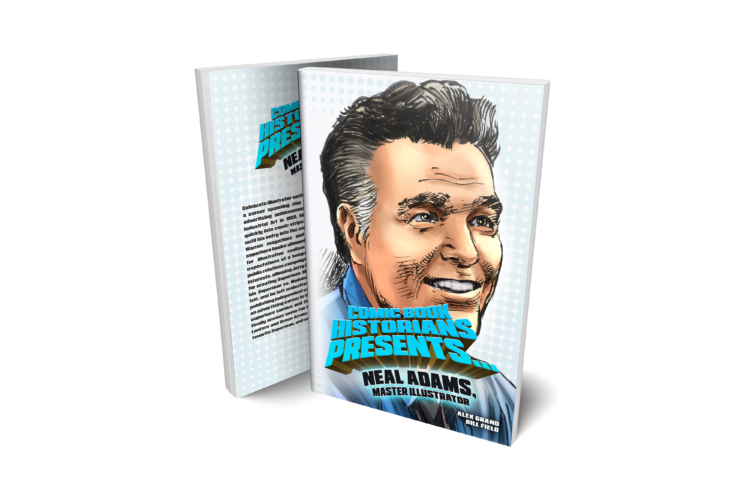
Transcript published in Comic Book Historians Presents… Neal Adams, Master Illustrator:
#NealAdams #ComicBookHistorians #BatManComics #DCComics #Marvel #StanLee #Superman #ChristopherReeve #GreenLantern #GreenArrow #Continuity
Robot Coupe – Lost European – Standard
License.
Adams worked on Chip Martin. He also worked on the College Reporter Ads which were drawn for the Bell Phone Company when he worked at Johnstone & Cushing in 1962.
Take On the World
Alex Grand: Neal, I want to first ask you about when you got out of the School of Industrial Arts. Is that where you graduated from?
Neal Adams: Very good. You’ve done your research.
Alex Grand: Yes. I think one of the rumors out there is that the first panel of yours that was published, was the Adventures of the Fly 4, in 1960.
There was a transformative box of Tommy which was turning into the fly. Was that yours?
Neal Adams: Not originally. It was drawn originally by Jack Kirby. But they liked mine better as a sample. So they cut it out of my page with a razor and then glued it over Jack Kirby’s page… Jack Kirby’s panel. They then paid me for a third of a page which was about $12.50.
Alex Grand: So you did get paid for that panel then?
Neal Adams: Oh, yeah, straight up. Those guys at Archie paid me.
Alex Grand: So after that, did you assist Howard Nostrand[1], with the Bat Masterson strip?
Neal Adams: Bat Masterson… based on the television series. Yeah I did.
Alex Grand: How was working with Howard Nostrand like?
Neal Adams: Howard Nostrand used to work for a studio called Alexander Chaite Studios[2] which then, was an advertising studio. They had people like Bob Peak[3] and a lot of other people who were in there. Then, they sort of discovered that the people who ran the agency, were taking maybe a little bit more money than they should. Anyway, the artists’ kind of blew up and they all left; all at the same time. And Chaite Studio just went bye-bye!
All the artists split up and the question became: “Where are they going to go?” So four guys went to an apartment which was on I think 50th street. They rented this apartment and set up a studio there and they would all later be partners. So one of them was Howard Nostrand, one of them was Elmer Wexler[4], and then there were two other photo retouch guys.
Neal Adams (cont.): What was great about that, was I got to go into a studio with two retouch guys and Elmer Wexler, and Howard Nostrand; each of whom had different skills. So here I am just turning 18, and I was in a studio with four professional artists. With each one having different skills. So it was like the greatest thing in the world for me.
Alex Grand: And then after that, you did Ben Casey[5]. It was a syndicated TV show at the time right?
Neal Adams: Not right after that. I had about 14 decades between that and Ben Casey. It seemed like only a couple years, but it was … I learned a lot. I mean, first of all, I only did Bat Masterson for three and a half months. Even though it seemed like an eternity, ’cause I worked every day and very, very hard.
But Howard taught me a lot about commercial art and introduced me to people along the way that I could go to with my freelance portfolio and get work. I also got advice from Elmer Wexler who basically was an ex-marine, a very hard knuckled guy and didn’t take any shit from anybody; he was the opposite of Howard Nostrand. So Elmer taught me how to be a professional. The retouch guys taught me how to have a sense of humor because they had … they were Spanish. One guy was Spanish and he would walk around the studio singing the song Bésame Mucho. Except he sang it Bésame Culo.
Alex Grand: That’s great. That’s funny.
Neal Adams: So, I was thrown into a really great bunch of guys. From there I thought I would aim high and I would go to the place where Elmer Wexler worked. He did work for Johnstone and Cushing[6]. Johnstone and Cushing did advertisement art for Boys Life magazine, the newspapers and whatever. They also paid about four to six times as much as the comic book company.
So here I was, still 18 years old, going to Johnstone and Cushing, proving myself at Johnstone and Cushing, and now making more than any comic book artist in the world practically. Or certainly in America. So I would get $200 or $400 a page and they got 40 or $50 a page. I could support a family and I did have a family. But I was very competitive, and being competitive, I really got good and fast. I was competitive and because I was pretty smart, I knew how to lay things out. I knew how to structure things, I knew how to write and I know how to put words together. So they had me writing, designing, and drawing for everybody else. So I became, in effect, top dog.
Neal Adams (cont.): I did that for several years for Boys Life magazine, and went on to advertise Chip Martin and College Reporter[7] which was for the telephone company. I did one for a rifle company, called Savage Rifles. I did ads for syntax dye, air conditioners… just so much really. So much stuff that it was a career. I also did outside of Johnstone and Cushing; some illustration work for the newspapers and for color. I also met a guy that I did movie posters for. Here I am, 18 years old going on 19… doing movie posters and illustration work, and whatever came along that I got to do. I didn’t actually do comic books until I did the syndicated strip for three and a half years and then I fell backward into comic books.
Neal Adams (cont.): So my travel to doing comic books is a backward, back assed travel into a medium that I thought was, at that time, inferior to all other mediums.
Alex Grand: So you brought a lot of experience like, advertising, design, strips, and then your training.
Neal Adams: Right, and illustration too. A Painter too…I was a painter and illustrator, so that when I came to comic books, they thought that I fell from the sky. They had no idea… who was this guy… how can he do all this stuff. I also started off as a big foot guy. A big foot guy is a guy who, well, okay … we have in the business, a thing called big foot and little foot. Big foot is in cartooning, ’cause you have little characters with big feet and big hands. Little foot is superheroes. Those have big giant bodies and little tiny feet. Haven’t you noticed that?
Bill Field: I think Alex Toth mentioned that all the time. I always think of him as soon as I hear the words big foot, little foot.
Neal Adams: Remember Space Ghost with the little tiny feet?
Alex Grand: That’s true, it was especially popular in the 90’s. The feet in it got really small in the 90’s.
Neal Adams: Pretty damn small now. You look at Jim Lee and all those guys, it’s got some little tiny feet down there. Sometimes, you don’t even see those feet. They’re hidden in the mist.
Descent into Comic Books
Alex Grand: Okay, so after the Ben Casey strip and now it’s around 1967-ish or so, Carmine Infantino[8] … did he open the door for you to come in? Or were you already there? I know you were also talking to Murray Boltinoff[9] and Kanigher[10].
Neal Adams: Carmine Infantino didn’t have the doors to open. He worked at DC Comics as a freelancer. What he was trying to do at the time that I showed up was that he was trying to become an art director for either DC or Marvel. He was playing each one against each other. So when I came in, it had nothing to do with Carmine. He was just that guy sitting in the corner. The bald guy with the cigars who looked like… I don’t know, Edward G. Robinson[11]. Only he was big. I think he was his illegitimate son.
Alex Grand: Oh, okay, that’s interesting.
Neal Adams: He just looked like him. Anyway, so I first went to Bob Kanigher who did the war stories and that’s how I got into DC Comics. I went from being Creepy, Eerie, and Vampirella over at Warren, where I worked too hard when doing a story, to being with Bob Kanigher.
But Carmine Infantino saw the advantage of him taking the credits for discovering me.
Alex Grand: I see.
Neal Adams: Now, it was a little odd for him to use the word discover since I had already had a syndicated strip, I did advertising and I did all those other stuff.
Alex Grand: You had already done a lot of the classy stuff first it seems.
Neal Adams: If anything, I actually discovered DC Comics and to my chagrin, I did like it. I’m embarrassed to say that because even though I was just there temporarily, until I could solid myself up with a strip, or an illustration work, or even an advertising work, I intended to leave that place as soon as I could. I just sort of fell in love with it and comic books which to me, in a weird way, is the best medium of all. The rates were terrible. The attitudes were terrible. They didn’t have contracts. They were operating in the dark ages. They were total assholes, but the medium itself is just too good to not be appreciated and it’s just fantastic. It feeds all the computer games. It feeds all the television shows, and the movies too. We are the starting point of every bit of graphic that are out there across the world. Hundreds of millions and even billions of dollars are spent on comic book movies.
Neal Adams (cont.): I mean, you can go to a movie and you can say while you sit there that well, thank God it’s not based on a comic book. But you’ll discover later … it says it’s based on a graphic novel by so and so. It’s amazing. It’s like, how do you say it… a predigested story. A predigested concept, which is much better than somebody sitting and writing a script. It’s already been digested. People like it that way.
Alex Grand: So your involvement in the war stories is interesting because you did turn down the Green Beret[12] newspaper strip. That was offered to you, right?
Neal Adams: Well, it got offered to me in a weird way. Becuase Elliot Caplin[13] had the right to do it, and was looking for an artist; I was doing Ben Casey at the time, and so I couldn’t really do it. Not that I wanted to do it, but, I was able to recommend Joe Kubert[14] to do it. He did it for, I don’t know, three and a half, four years. It was a very happy time for Joe, because for every comic book artist, they want to have a syndicated strip. The fact that I got mine at so young an age made me a little bit spoiled, but Joe had waited for decades to get a strip and then he got the Green Beret.
Alex Grand: Some have thought that because DC had such tight control, and because there’s only a certain number [of comic artists], that when Joe went over there, it resulted an opening for you? Or would you have just gotten in anyway?
Neal Adams: DC Comics had neither control nor lack of it. They were just a bunch of guys walking around and banging into the walls. They had no idea what they were doing. It just suited Bob Kanigher to have another Joe Kubert walk in the door. This was because they had lost Joe Kubert, and Mort Drucker[15] had also gone to Mad Magazine. So who did he have left then? He had Russ Heath[16], Ross Andru[17] and Jack Abel[18], and some other people … you know, some very minor lights; maybe except for Russ Heath. Russ Heath is still fantastic. To have me walk in there and be able to give him something in imitation or like Joe Kubert did was a big deal for him. So that made my way in, but that soon ended. Julius Schwartz[19] got his hands on me after a while.
Alex Grand: And that’s essentially what a lot of people know. As far as your fans go, there seems to be questions around a lot of your DC and Marvel work from the late 60’s and beyond, into Muhammad Ali and Superman. I’m going to have Bill ask this section of questions.
Bill Field: We’re in somewhat of a golden era for you, because we’re coming into Batman. We’re coming into Deadman and we’re coming into Green …
Neal Adams: When you’re saying golden era, I think I was the one who created the golden era. There’s nothing about when I was on Batman or on those other things that made it golden, believe me. Theirs was a crappy business. They didn’t have contracts and they didn’t return the original art. The golden era came because of what I did. It didn’t come with it, or in any way out of it. What it was, was that Marvel Comics was doing much better stuff than DC Comics. DC Comics needed something to combat Marvel with and what they needed, they didn’t realize it. They needed to have new artists and needed to have new writers. Even though Carmine’s job was to get new artists and writers, he didn’t know how to do it, and neither did the editors. But I did. I found them out and after which, I hid them in a room. So I allowed them and later, I would feed them to the editors.
Neal Adams (cont.) : So I made more of a contribution there than engaging in drawing. Yes, the drawing there was new, different, and more illustrative. It also had better anatomy and all the rest of it, but those were really only part of it. We got guys like Wrightson[20], and guys like Len Wein[21], Marv Wolfman[22], Howard Chaykin[23]. We got all these guys who would basically hide out in my room or in the coffee room. I’d be able to introduce them to the editors and they would go, “Why am I looking at this guy’s stuff?”
Well, you got back up stories they will say to them. You’re doing the House of Mystery, so let’s stick a guy in there; somebody new. So they had to learn how to reintroduce new people. They hadn’t hired anybody new in 10 years. I was the first. The last guy that was hired, was working in production and his name was Mort Drucker, and he went over to Mad Magazine and he was so glad to get out of there, that he just stayed away. So it was a primitive kind of place.
Neal Adams(cont.): Even when I was doing Batman, they didn’t know what [was going on] … If I walked in and said, “You know, Batman’s supposed to be realistic, and a creature of the night, and jump out at guys and scare them.” When I said that, that was like a big surprise, they saw that as wrong.
But that’s not the way you [run things]… anybody knows that. Anybody … but it seemed like it was a surprise to them. I don’t know how.

Neal Adams illustrated many covers for DC Comics including this one from 1969.
And the Crowds Roar
Alex Grand: So, now, when you were doing Deadman in the late 60’s and Steranko[24] was doing Nick Fury Agent of S.H.I.E.L.D… You guys, I think, exploded the illustration potential of comic books. It would seem like comic books was somewhat subdued before you guys arrived. Did both of you feed off each other? Did you vibe off each other at all?
Neal Adams: No, no, no and no. And the joke is that there’s some kind of an implication that comes if Jim Steranko and I are alike, or that we somehow made the same kind of impact. I was an illustrator who could draw comic books and I had a syndicated strip. He was a magician who loved Jack Kirby. He was trying to idealize Jack Kirby and what he did, and he eventually did. He never presents himself as an artist. He usually presents himself as an entertainer. He does graphics, and he comes up with ideas and piles the ideas in, and then adds that Jack Kirby sensibility. You’ll never see him focus on anatomy or any other stuff that you need. His direction… it’s almost like he’s a different type of creature. He’s a chimp and I’m a baboon. You know. We’re very, very different.
Alex Grand: Yeah, but from a different angle.
Neal Adams: But at the same time, we both weren’t afraid to do the things that we wanted to do, and the door was open for us to go ahead and do it. But it wasn’t just us. I mean, there was Barry Smith[25], there was Bernie Wrightson, and there were other people doing it. Somehow, we were allied together. I don’t know how and I think it’s funny. I think Jim probably thinks it’s funny, he has no idea why it happened. But it happens. You can’t argue with fans. They’re fans. They are the controllers.
Time to Grow Comics Up
Bill Field: So you went into socially relevant stories with the Green Lantern and Green Arrow…
Neal Adams: Well, we made an impact with Batman and the decided impact was for us to bring reality to it.
Alex Grand: Yes.
Neal Adams: So, bringing reality to Batman inspired all the artists around me to do the same thing. It also inspired the writers to some extent. The editors were also inspired as well. One of the best artists at DC Comics was Gil Kane[26]. Gil Kane and I were friends, very good friends, and Gil had decided for whatever reason, to go and do a project which was outside of DC Comics. That meant that he no longer did Green Lantern.
Alex Grand: His Name is… Savage right?
Neal Adams: Yeah. Well I don’t know if it’s that one or the other one.
Alex Grand: Blackmark?
Neal Adams: Blackmark, I think. And he based it on Lee Marvin as the-
Alex Grand: On the cover?
Neal Adams: Yeah, that’s very interesting. Anyway, he went off and decided to do that and you have this problem about who’s going to do Green Lantern. Anybody that did Green Lantern after Gil, who was someone who knew a lot of anatomy, who could draw … Gil was really ahead of everybody at DC except for say, Joe Kubert.
So anybody that did Green Lantern really did not do a very good job. It’s not a criticism of a person as much as it is a reality. Gil was that good. So I asked Julie Schwartz if I could do Green Lantern for a couple of issues and Julie said to me, “No, we’re going to cancel the book.” I replied: “No, you shouldn’t cancel the book. It’s Green Lantern”. She told me: “Well, it’s not selling”. And I pushed and said to her” “Well, let me do a couple of issues”. So Julie had the big idea of jumping in on this “modernizing things a little bit,” and was always forward thinking. He also used to represent science fiction writers.
Alex Grand: With Mort Weisinger[27]?
Neal Adams: Yeah, with Mort. The partners: they were the teenage partners of Ray Bradbury and a bunch of other guys. Anyway, he was the one who came up with the idea of putting Green Lantern and Green Arrow together. We had already made a big hit with Green Arrow in Brave and Bold. And so he put Denny and I together and really came up with a new story line; it was to pit these characters against one another. So now the puzzle became, “What are we going to do with this?”.
Well, since Denny O’Neil[28] was a reporter, he was instead more interested in reality. If people say relevant comic books, that started the era of relevant comic books. Before Julie Schwartz, you know, nobody really was concerned about doing relevant comic books. We’re interested in doing real comic books, and interesting comic books, and adding other things to it. It’s the fact that because Denny O’Neil was a radical Irish liberal, it put him in a position to vent his spleen on Green Lantern and Green Arrow, and to also place these guys at opposite ends of the political spectrum. But they really weren’t. These characters were really on the same end; they were just slightly different, not unlike Denny O’Neil and myself. You could call me Green Lantern and you could call him Green Arrow.
Alex Grand: That’s great.
Neal Adams: In a way.
Bill Field: I’ve never thought about that. But it’s absolutely true.
Neal Adams: In many ways it is. I believe in all the proper institutions and everything else, and I prefer to work using these institutions. I’ll rather I make changes without marching the streets. Denny marches in the streets, yells, carries signs, and does other stuff like that. That doesn’t mean that I don’t agree with him.
It simply means, that I would prefer to make the change rather than yell about it. So, there’s the yellers and then there’s the doers. I’m the doer. It didn’t occur to us at the time that that was the case, but in retrospect it sort of was, and maybe that’s what made it good.
Then, everybody in the field said, “Oh, those guys are preaching. That’s all bullshit.” But as much as they said it out loud, in their hearts, that’s not how they truly felt. They could see the reality of what we were doing and that doing so was a good idea, one that moved us in a good direction too. And you can tell, that it’s basically colored everything in comic books since then. Things have gotten even more real.
Bill Field: How did the sales progress after you started doing that book?
Neal Adams: Well… if you’re doing a historical documentation on the sales, then you would actually have to know what sales are all about. You would also have to know what is wrong with the sales in the newsstand market, and most times, you often don’t. There’s no way for you to equate the sales of something that’s good with the actual selling and sales results, because something else was usually going on. That too led to the direct sales market. So there’s a very deep, solid core of misinformation that goes into understanding the sale of comic books. Because most good comic books often didn’t sell well.
Alex Grand: And also, what some of the fans might not know, is that back then a distributor could actually keep some of them and then claim that they weren’t sold, and go on to sell it on the side. So a lot of things like that were going on too I think.
Neal Adams: No. They didn’t keep them. They sold them to teenagers who would come with their father’s station wagons to pick up Penthouse magazine, Playboy magazine, Conan, Green Lantern, Green Arrow, Batman, and Swamp Thing. They would pick the best stuff because they were the fans.
Well, when you’re a fan, you understand more of what your audience will buy. So you too know what to buy from the local distributor. There were about 410 distributors back in those days, and they were all around the country. So that meant you had 410 opportunities for some guy in a town to go take his father’s station wagon, and buy this stuff off of the back of the distributor. The distributors and the publishers had instituted a concept called affidavit returns. Affidavit returns assumes the honesty of all parties involved, which is stupid.
Neal Adams (cont.): I mean; I can’t even imagine contemplating such an act. Before that, they would strip the titles off a comic book, wrap them in a rubber band, and then send them back to the publisher. Now, they were having the distributor sign a piece of paper that [promised that] he had destroyed so many comic books [so he wouldn’t have to return them]. What could be more stupid than that? So that made the publishers get lower and lower sales, as comic books were supposedly being destroyed. But in all of the country though, teenagers and young adults were actually buying comic books and selling them to their friends. They were not selling for 25 cents, but for a $1.50, $2, $5 and they were those who signaled the beginning of the direct sales market. All those guys who dress regular and act regular.. they’re all full of crap and they’re all basically a den of thieves. That’s how our business started and you know what? Lots of businesses started out with a den of thieves. It’s just the way it is.
Alex Grand: So how would you contrast Green Lantern, and Green Arrow, with Steve Ditko’s Hawk and Dove? It’s similar, but still different.
Neal Adams: Golly. I would never think of that as a contrast. Hawk was a war monger while Dove was a peacenik. Green Arrow for example, was not a peacenik. He was actually a radical liberal that also believed in non-violence. Green Lantern believed too in non-violence but achieved that through using authority. That’s the only difference. I lived through the Hawk and Dove period and it was a very different time.

Make Batman Cool Again
Bill Field: So now, fast forward to the early 70’s and Batman is taking a darker turn right after the Batman TV series. You actually grew Batman up quite a bit. Because he had been taken down a peg or two to juvenile camp kind of standards, but you brought it up and made it more cinematic, and that probably fostered in the way for movies. Don’t you think?
Neal Adams: No. The Batman television show was a satire. It was never intended to be anything but a satire. It was originally a comedy. We watched it to laugh and that’s what we did. We laughed and it was great. I for one had a great deal of fun. I mean, it’s sort of like going to Saturday Night Live and doing superheroes. It was a comedy, and anybody who might have thought for one minute that it was a battle between Batman and Robin, and not a satire of Batman and Robin, was out of their minds.
And that they indeed thought that may be the case at DC Comics, was an indication of how deluded they were by the success of the television show. They should instead have done a Batman and Robin satire book, and then have a regular Batman and Robin book, but they didn’t. They kind of drifted Batman towards the television show.
Neal Adams (cont.): So now, you have a guy in his underwear walking around in the daytime, and no kid is pointing at him shouting, “Mommy! Mommy! that kid’s wearing his long underwear.” It was all a stupid idea. So this character that I grew up with. This character that was drawn by Jerry Robinson and all these other guys was no longer in the books. So I asked, “Look, can I do Batman and Robin?” And Julie Schwartz answered, “No, get the hell out of my office.” So I presented my case in severally, that Julie actually went and changed the way they were doing Batman and Robin. It was relative to the licensing and everything else, such that it opened space for me to do some Batman stories, which were all successful because I worked with Denny O’Neil, and also because I was drawing a more realistic Batman.
The Batman I was drawing had real muscles. He had a cape that flowed out rather than look like a log out from behind him. And people would often say, “Neal, you changed Batman.” But I didn’t change Batman. I brought him back to what he was, what everybody wanted to see. That’s I suppose is what everybody loved about Batman.
Neal Adams (cont.): Yes. They loved the satire. You gotta give credit to the satirists. It’s funny as hell, and in so many ways. Even … Cesar Romero playing the Joker but still refusing to shave his mustache is almost hysterically funny too. It’s sort of like the latest Justice League movie where… what’s his name gets his face pasted over because he refuses to take off the mustache isn’t it? What the hell is wrong with you, buddy?
Alex Grand: That is a funny parallel and you’re totally right. Only in DC does this sort of thing happen.
Neal Adams: Idiotic. You add a scene at the beginning where they have somebody else’s face. If you want to hide it, then take out that scene. You know, why don’t you just say nothing?
Bill Field: I thought it was weird that they used Christopher Reeve’s face. No. I’m just joking.
Neal Adams: No.

Agony and Ecstasy
Alex Grand: So now, let’s go into the 70’s. You’ve made a huge impact on Superhero fans at this point and by ’75, you and Jerry Robinson[29] had gotten some roles in Siegel and Shuster[30] along with obtaining credit and a pension.
Neal Adams: No. It wasn’t me and Jerry Robinson. Jerry Robinson came in at the end and helped me with the National Cartoonist Society. It was a long drawn out … it was about three and a half months of battling with DC Comics, but again, it’s a long story. And if you start the story, you sure have to give the details and then, the details become long and involved in them, are conversations on the phone, and screaming and yelling, and all the rest of that.
It was generally a big fight. It’s similar to you talking to a boxer and you’re talking about a match. You know, I could talk about the match, and you may then question, “Well, where did you get the stamina to have the fight?” And I’m made for that. I’m made for that kind of fight. You couldn’t find a better person to do it, because I’m a calm person. I don’t get riled, I don’t get upset, and again I don’t lose. I’m not the type of person that ever loses.
Neal Adams (cont.): If you get into a fight with me, it pretty much is going to go to the end, and then you’re going to die. That’s just the way it’s going to be and I would not wish it on anybody else. I would not say, “Too bad you couldn’t do that.” No. It’s not too bad because, you’ll get high blood pressure, you’ll get all bloody and stuff, but not me. That’s not going to happen to me. Because I don’t fade that way. I’m the right person.
Bill Field: Now, your boxing analogy gives me the perfect segue to 1978 and the wonderful Superman vs. Muhammad Ali. A lot of people thought “What the hell?”, when they looked at the artwork. But honestly, to me, it’s some of your best work.
Neal Adams: I think there are people who think that it’s the best comic book ever done.
Bill Field: It was a shocker to me. I couldn’t wait to buy it, because it just blew me away. I was a fan of yours up to that point, but I became a real super fan of you after that. Some of the things you did with water, some of the things you did with shadow were just … it’s never been equaled.
Neal Adams: You have to remember that first of all, we lived in a bigoted country back then. Second of all, we were fighting people in Asia that we shouldn’t have been fighting and we were killing people. Third, we had a guy who was a world champion boxer who refused to go there; he refused to fight. He didn’t believe in it and there was no sufficient reason why he should believe in it. So, we lived in a country where that kind of stuff was going on. Lots of politics was going on. But if you had any understanding of the world, you knew that Ali was the champion of the world. Even though he wasn’t a champion in America.
So Julie Schwartz, who by the way, is your good old fashioned New York liberal Jew, was the first one to step up and say, “Hey, we’re going to do this.”
Neal Adams (cont.): So, it was his idea. It was his idea and he gave it to us to do. I also ended up writing most of it. In the end, I wrote it all the way to the end and drew it. Whilst doing it, I knew all the time that people were going to love it. All around the world, I knew it was going to really express DC Comics license throughout the world; because people would want to see this. A real live person with a comic book superhero. That’s just too irresistible, too wonderful. So I made sure to make it authentic. So if you read that book, you will find boxing moves that Ali did, his speeches and you’ll find all kinds of stuff that’s real, valid, and generally good stuff.
Bill Field: Did you talk to Muhammad Ali during this period or ever have any contact with him?
Neal Adams: No. He was busy. He had his own business. We didn’t talk until the end when it was done. When it came out, that is when the book came out, he had won the championship for the third time, and so he made a big [impact]. We did a news conference. I was there, Ali was there, and all the attention went on Ali because he’s the champ. They talked about the third win, and then they talked about the release of the comic book. So that helped the comic book sales move up like crazy. The legendary comic book. It was beyond me at that point. It was like, wow! That’s cool.
Alex Grand: That coincided too with the release of the Superman movie done with Christopher Reeve. Since you knew Superman better than a lot of people especially at the time, anatomy wise, do you feel that Christopher Reeve was a good Superman?
Neal Adams: He was a great Superman. As far as everybody’s concerned, he was the best Superman. I don’t repeat what other people don’t tell me, because I don’t really have any opinions myself. Everybody around will tell you that Christoper Reeve was the best Superman and that everything about him was wonderful.
Why Draw When You Can Publish?
Bill Field: Let’s fast forward a little bit longer into your Continuity[31] era. Can you explain a little bit about what that was all about, and why you went off and did it? I think we kind of know by some of the things you have said already.
Neal Adams: Well, I just decided then that I would do my own comic books. I mean, there’s nothing that I’ve done in my career that didn’t advance the medium. And I’m doing things now to advance the medium, but by publishing myself, it gave a certain credence to the question: “Why don’t you do this kind of thing?”.
Not a fan magazine, or just some kind of crappy publishing, but a number one Ace comic book similar to people doing their own comic books. Soon after that, or during that time, you got Image. So, you got a major force of people doing their own comic books.
Well I thought, that is the wave of the future. From that you got Hellboy and from that too, you get all kinds of independent projects. Still from that, some asked: “What’s going on with the English guy that he’s doing comic books with some of the best artists like Millar… however you pronounce it”. And that’s no surprise.
Neal Adams: That’s no surprise, because we did Continuity comic books. Before that, it was mainly minor artists, minor comic book people, or people who were unknown that just managed to make their way through. But the majors didn’t quite do it. It sort of started with-
Bill Field: Cerebus?
Neal Adams: -no, no, because he was not a major known artist. That was a fringe guy who just jumped in. Same thing with Elf Quest. But then, you got Sergio Aragonés Groo and what’s the name of the company?
Bill Field: Epic?
Neal Adams: No, no. Groo and Jack Kirby’s-
Bill Field: Pacific?
Neal Adams: Yes Pacific Comics[32]. They had a bunch of fans who could afford to pay their professionals, and the professionals themselves, couldn’t believe that they were actually being paid better than they were being paid by Marvel and DC. And could also have their own rights. Those fans too couldn’t believe that they were getting Jack Kirby[33], Sergio Aragonés[34], and Neal Adams. It was a big shock to them. I had to convince Sergio and Jack Kirby that this was a valid thing, because they too couldn’t believe it. I mean, it was just a …
So they’d call me and they’d say, “Neal, what the hell is this? These guys are saying I can keep my rights? That’s impossible!” I’ll tell them: “No, no, it’s not impossible. I guarantee you, it’s fine”.
So you have a new industry created. An industry where independents are creating their own product and profiting off them. That’s a big deal. That’s a big deal.

Missing in… Advertising!
Bill Field: Where are you now? What are you currently doing, and where are you taking the medium in future?
Neal Adams: I disappeared for three decades. You guys don’t know that. Think about it. The comic books that I did for other companies; the ones I did interior pages for, and those I did with Superman vs. Muhammad Ali. That was it. Then I disappeared. Yes, I came back as a publisher, but that was simply me as a publisher doing covers to support Continuity comics. So I wasn’t doing comic books. I was doing advertising instead and I supported my family. We had a studio in New York, where we billed $3 million a year on average and so I have the biggest studio for any comic book artist. We had more people working for us there on a regular basis, more reps going out there, except this time, it was for advertising. Nobody knew this because nobody communicates.
Neal Adams (cont.): So all these people in advertising knew Neal Adams but nobody in comic books … I mean everybody in comic books thought Neal Adams died.
Alex Grand: Went off the map…
Neal Adams: Yeah, I went off the map. So those guys doing all the advertising stuff, if they found out that I did comic books, they would freak out and go, “You do comic books? Really?”
And then some little guy in the back room would go, “Yeah, that’s Neal Adams!” The guys who were in charge in advertising often had no idea.
Alex Grand: I saw a commercial I think in ’79 or ’80 and it was like a-
Neal Adams: The Nasonex bee. Yeah.
Alex Grand: That was yours?
Neal Adams: And… we’re not supposed to say this, but it was also Antonio Banderas’ voice. That was mine and that’s what put a few million dollars in the bank too.
Alex Grand: That’s wonderful to hear. So that sounds like a whole other avenue of interest that people can explore. Your advertising career that is?
Neal Adams: But I encourage that too in artists. There’s no reason why artists shouldn’t work for Hollywood, or shouldn’t work for advertising agencies. They have a right to make a living just like everybody else. They have to think about business, about their own opportunities, and they have to think basically about what their bottom line is, without worrying about DC and Marvel. Who gives a crap about DC and Marvel when you come right down to it? If they own all this stuff and they’re not sharing, to the degree that they’re not sharing, we also don’t give a shit about them. To the degree that they share, then we also care. Okay? And they do share a little bit, and we care too but only to that extent. But if they don’t care more, basically the business is going to be all about independents and soon, DC and Marvel’s going to disappear. Both of them are making their own basket, or weaving their own basket, so they’re going to have to live with whatever water drains through.
Alex Grand: No, that’s wonderful. It seems that your confidence and your balls of steel, pushed and nudged other creators to grasp their own creator rights. Seems like you’re a huge force for that…
Neal Adams: Eh… maybe.
Bill Field: It works for me.
Neal Adams: I’m down with that.
Bill Field: Well listen. Thank you for giving us such a long interview. It’s been a true honor. Thank you so much.
Alex Grand: Thank you, Neal. It’s been a wonderful time.

Group photo of the CBH Neal Adams Interview July 21, 2018 from left to right: Neal Adams, Bill Field, Alex Grand, and top, Natalie Grand.
[1] Howard Nostrand was the premiere Horror artist for Harvey Comics under editor Sid Jacobson. He became useful for being able to mimic the EC Comics artists without swiping or plagiarizing their work. He put together the 1959-60 syndicated comic strip Bat Masterson with writer Ed Herron and assistant, Neal Adams.
[2] Both Marvel artist alumni & Buscema brothers, John and Sal also worked at the Alexander Chaite Advertising Studio in 1961.
[3] Bob Peak is a famous commercial illustrator who developed the design of the modern film poster starting on West Side Story, then including work for the first six Star Trek movies, Superman, Apocalypse Now and more.
[4] Elmer Wexler created the character Miss America in 1941 for Quality Comics and illustrated Vic Jordan, newspaper strip in the early 1940s. He illustrated record covers, books and magazines.
[5] Ben Casey was a Medical Drama series aired from 1961 to 1966 filmed at Desilu Studios and starring Vince Edwards. The daily strip ran from 1962 until 1966.
[6] Johnstone and Cushing was an advertising agency founded in 1936 that hired comic artists like Milton Caniff and Lou Fine to make comic style advertisements. The agency dissolved in 1962.
[7] Chip Martin, College Reporter were a series of comic ads for the Bell Telephone System that appeared in Boys Life Magazine.
[8] Carmine Infantino was a well known comic artist since the late 1930s, DC editorial director in 1967, and DC publisher from 1971 through 1976. His initial move upon his 1967 promotion was to bring new artists into DC Comics to visually elevate the line from the era of the Pulp editors that dominated the company since the 1940s.
[9] Murray Boltinoff wrote and edited comic books for DC Comics since the 1940s for roughly 40 years, and supervised both the Doom Patrol and Teen Titans.
[10] Robert Kanigher was an editor and writer for DC Comics starting in the 1940s. He took over writing Wonder Woman from her creator, Professor Marston. He also wrote what many consider to be the first Silver Age comic in Showcase 4, “Mystery of the Human Thunderbolt.”
[11] Edward G. Robinson was a Romainian American actor who played tough guy gangster roles in films like Little Caesar.
[12] Tales of the Green Beret was a newspaper comic strip depicting the Vietnam War written by Robin Moore and drawn by Joe Kubert from 1965 to 1968.
[13] Elliot A. Caplin was a writer for King Features Syndicate, and later editorial director of Parents magazine. He co-created strips like Big Ben Bolt and Peter Scratch and wrote for others like Little Orphan Annie. He is the brother of famous and infamous cartoonist, Al Capp.
[14] Joe Kubert is a very talented comic artist, mostly associated with DC Comics’ characters like Sgt. Rock, Hawkman, and Viking Prince to name a few. He was involved in making comics for six decades and is founder of The Kubert School.
[15] Mort Drucker initially worked on newspaper comic strips as an assistant, and later worked for DC Comics. He made a strong name for himself in the art of caricature in The Adventures of Bob Hope, JFK Coloring Book, and the satire comics of Mad.
[16] Russ Heath was a talented illustrator famous for his western & war stories at DC Comics and his comic art for Little Annie Fanny for Playboy Magazine.
[17] Ross Andru had a long career at both DC Comics and Marvel Comics working as an artist on Wonder Woman, Metal Men, Spider-Man and Punisher.
[18] Jack Abel was most famous for his inking decades of comic stories including Legion of Superheroes, Superman, Superboy, Iron Man, The Incredible Hulk, Master of Kung Fu and more.
[19] Julius Schwartz was a science fiction agent turned editor at DC Comics, helping to revitalize the comics industry by overseeing the creation of Barry Allen, Hal Jordan, Ray Palmer and other characters and pushing science fiction mixed with realism into the superhero genre.
[20] Bernie Wrightson was an accomplished illustrator, artist on House of Mystery, and co-creator of the Swamp Thing.
[21] Len Wein started at DC Comics in 1968 and also started working at Marvel in 1971. He alternated with both companies in a long extensive career, involved with books ranging from The House of Secrets to The Amazing Spider-Man.
[22] Marv Wolfman had a similar start as Len Wein joining DC Comics together. He went to Marvel in 1972 learning from Roy Thomas. His two most well known runs are Tomb of Dracula in the 1970s and Teen Titans in the 1980s. He worked as both writer and editor on a very long list of popular characters and teams in comics, novels and videogames.
[23] Howard Chaykin is an Inkpot Award winning writer-artist training under greats like Gil Kane, Wally Wood and Neal Adams. His approach to the adventure hero, utilizing illustration and satire is both unique and excellent. He worked at both DC & Marvel and his comic series American Flagg! set a tremendous tone followed by other similar works like Watchmen and Dark Knight Returns.
[24] Jim Steranko is considered the renaissance man of comics, writer, artist, publisher, magician, book cover illustrator, historian, and film conceptualist. His S.H.I.E.L.D. run definitively brought Nick Fury into the reader consciousness using cinematic techniques in comics still being used in multiple media including TV and movies today.
[25] Barry Windsor-Smith
[26] Gil Kane started in comics as an inker in the 1940s, eventually penciling a series of titles for both Marvel and DC Comics. His Silver Age Green Lantern run and Bronze Age Spider-Man run are fan favorites. Marvel utilized his dynamic approach to comic art for many of its covers in the 1970s, and many credit him for creating one of the first graphic novels.
[27] Mort Weisinger was editor of the Superman line of titles at DC Comics for roughly three decades. He was originally an agent with Julius Schwartz for science fiction writers, and an editor for Standard’s line of pulp magazines including Thrilling Wonder Stories and Captain Future.
[28] Denny O’Neil was a journalist in Missouri until finding his way into Marvel Comics under Stan Lee in the late 1960s eventually becoming an editor and writer at DC Comics in 1968 bringing in a realistic sensibility for readers. His work in comics spans close to four decades of titles including Batman, the Question, Power Man and Iron Fist, G.I. Joe: A Real American Hero, and many more.
[29] Jerry Robinson was a cartoonist who drew Batman comics, co-created the Joker, and president of the National Cartoonists Society in the later 1960s.
[30] Jerry Siegel and Joe Shuster created Superman, premiering in Action Comics 1, 1938. After leaving DC Comics in 1947, their lives got continually more difficult and impoverished.
[31] Continuity Associates is an illustration studio formed by Neal Adams and Dick Giordano in 1971. It was used as an art packager for comic book publishers. Continuity Comics was an independent comics line started by Neal in 1984 which lasted for 10 years.
[32] Pacific Comics, the publisher, started in 1981 and ceased publishing in 1984, founded by Bill Schanes and Steve Schanes.
[33] Jack Kirby is a founding father and co-creator of the Marvel Universe, as well as the King of Comic Book storytellers.
[34] Sergio Aragonés created the comic character, Groo the Wanderer and was a regular contributor to Mad magazine.
Like, comment, share and subscribe to our channel…
Don’t click this link: https://bit.ly/3iRIaxx
Video chapters
00:00 Neal Adams’s first comic art
00:51 Working with Howard Nostrand?
02:19 Bat Masterson to Ben Casey | Johnstone and Cushing
05:53 Advertising design, strips & illustration
07:00 Getting into DC comics | Carmine Infantino
10:05 Tales of the Green Beret by Kubert
11:54 The golden era came as a result of what I did
14:23 Green Lantern/Green Arrow | relevant comic books
19:03 Green Lantern/Green Arrow sales
21:57 Green Lantern/Green Arrow vs Steve Ditko’s Hawk and Dove
22:38 Restore Batman’s roots
25:59 Jim Steranko vs Neal Adams
27:50 Getting Siegel and Shuster credit
29:34 Superman vs. Muhammad Ali
32:29 Christopher Reeve as Superman
32:56 Continuity Comics, how it came to be?
35:57 Working in Advertising again
37:44 Artists need to diversify opportunities
39:12 Wrapping Up
Edited & Produced by Alex Grand, ©2021 Comic Book Historians
Podcast and Audio ©℗ 2019 Comic Book Historians
Join us for more discussion at our Facebook group
check out our CBH documentary videos on our CBH Youtube Channel
get some historic comic book shirts, pillows, etc at CBH Merchandise
check out our Comic Book Historians Podcast available on Apple Podcasts, Google PlayerFM and Stitcher.
Use of images are not intended to infringe on copyright, but merely used for academic purpose.
Interview © 2021 Comic Book Historians