Daredevil and Black Widow Fight Villains and Bittersweet Feelings By Anthony M. Caro
· March 18, 2024 · by Alex Grand · Articles
Why did Daredevil team with Black Widow in the early 1970s? Here’s a simple answer: to fight crime and increase sales. Whether the figures met Marvel’s expectations is lost to history. No matter. That partnership, which ran from Daredevil #81 to #124, blended experimentation, romance, and social commentary around one wildly convoluted arc starring the Blofeld-esque villain Mr. Kline, aka The Assassin.
Marvel Sales and Daredevil’s Lament
Marvel Comics and revisionist history seem inseparable. A commonly spun version of events suggests that immediately after Marvel debuted The Fantastic Four and Spider-Man in their respective books, the House of Ideas set the industry on fire and captured the market. In reality, Marvel Comics’ climb was far slower. Marvel achieved great success by the late 1960s, but the 1970s would turn rocky.
Equally revisionist is the notion that certain books didn’t do as well as they did. The idea that Daredevil languished in low circulation until Frank Miller’s legendary run is inaccurate. In 1968, Daredevil cracked the Top 40 in industry-wide comic book charts, reaching #23 on the charts and becoming Marvel Comics’ fourth best-selling title. By 1969, Horn-Head’s monthly circulation averaged 245,000, an impressive number, but still 100,000 less than Archie and Me. In 1973, Daredevil dropped to Marvel’s 11th best-selling title, with 168,000 issues on average per month – not a great number, but not so low that the figures couldn’t be turned around. [Please see the references at the end for more information about Marvel’s sales numbers.]
For Daredevil, Marvel adopted a team-up approach similar to Captain America, pairing him with a new recurring character in hopes of sustaining or boosting fan interest. Black Widow enjoyed a run in the Amazing Adventures anthology series. Appearances in eight issues didn’t instill enough confidence to give the character a monthly solo title, but feedback was apparently positive enough to believe the House of Ideas could do more with Black Widow.
Prelude to a Team-Up
Mr. Kline made a soft, behind-the-scenes debut in Daredevil #79 (August 1971), the same issue that introduced the Man-Bull. The Man-Bull was an engaging new villain who posed a massive physical challenge to Daredevil. Literally and symbolically, the hero appeared overwhelmed. He eventually defeated the Man-Bull in an exciting two-part story, but he had no idea that Mr. Kline would soon become far more important or what role he would play in the months ahead.
At the same time, a quieter, somewhat padded subplot unfolds as Karen Page and Matt Murdock’s relationship begins to fall apart. Matt even asks himself whether he truly loves Karen, wondering if he failed to meet her expectations.
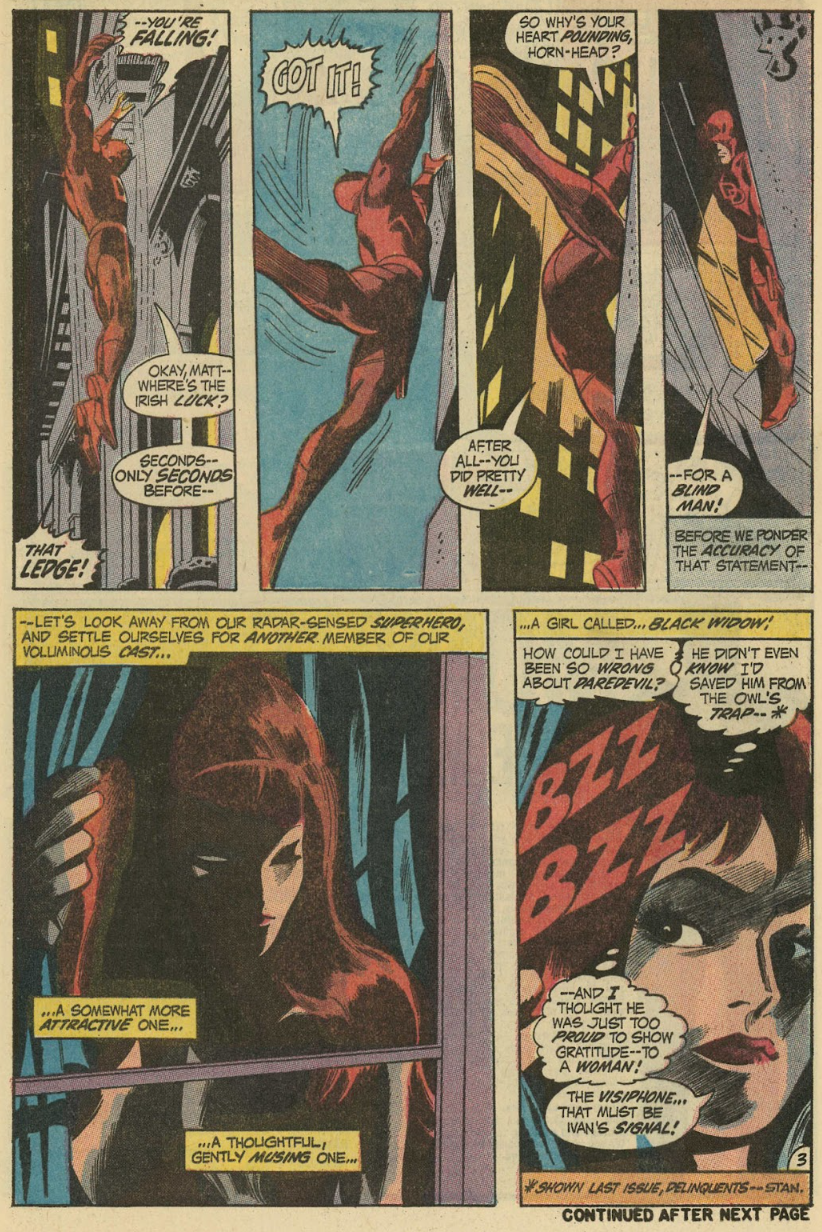
While Mr. Kline provided the conspiracy and danger, Karen’s eventual exit played an equally important role. Her departure, though a little clunky in execution, served a clear purpose: it cleared the emotional space in Daredevil’s heart. A wounded, lovelorn Matt Murdock became open to a new relationship with Black Widow. Pride might prevent him from asking for her help in battle, but his heartbreak made their growing connection feel natural.
Daredevil No Longer Swings Alone
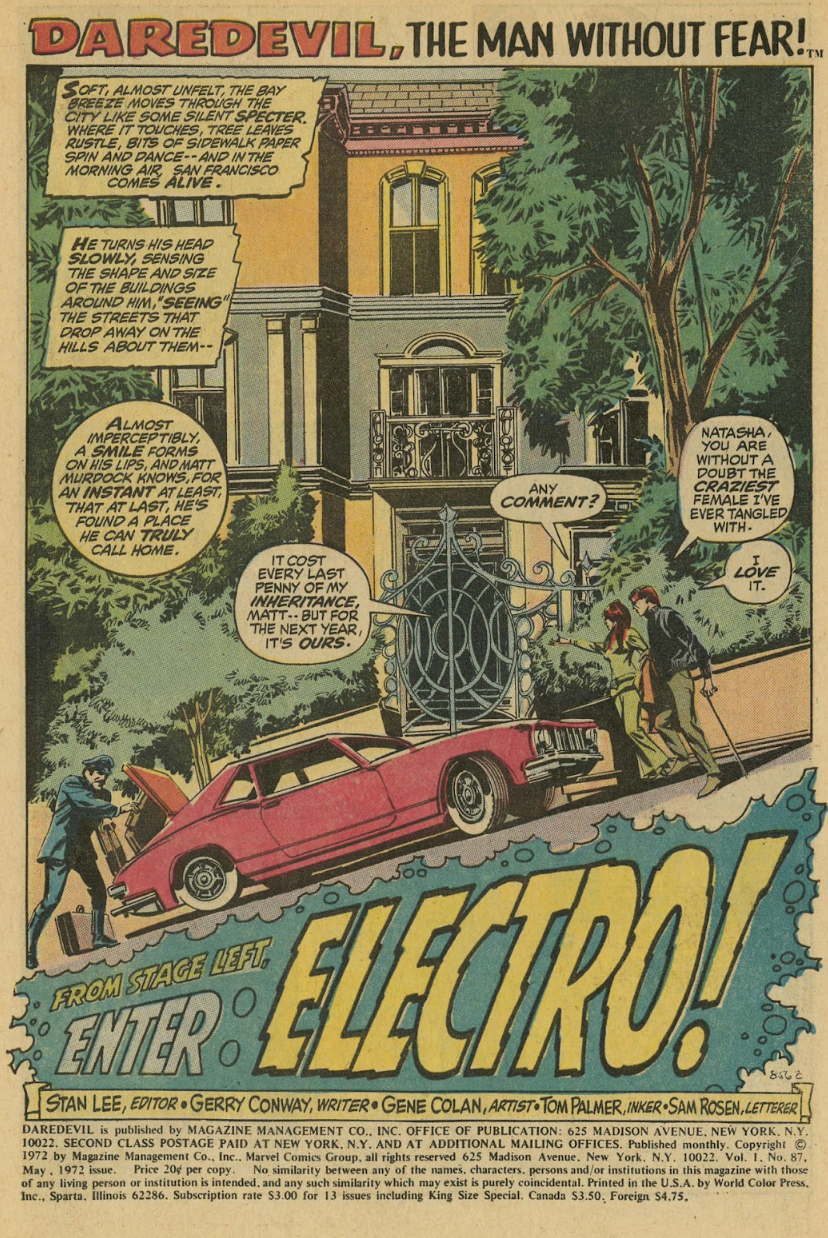
The Marvel Comics of the late 1960s and early 1970s sometimes dabbled in experimentation while remaining true to traditional superhero storytelling. Writer Gerry Conway took Daredevil further, pushing the experimental approach further by blending heroic battles and soap-operatic storytelling, along with Gene Colan’s lush, neo-dreamscape art. The approach worked well against the backdrop of the early 1970s’ social changes. Black Widow, a feminist hero, guided Daredevil in a new direction.
Why? The women’s empowerment subtext has company in the storytelling, but the secondary subtext isn’t concerned with liberation. To many (then predominantly male) readers, the strong, independent Black Widow possessed traits commonly associated with male heroes that they idolized.
Daredevil and other Marvel heroes of the era connected with readers because they possessed enviable superpowers and suffered from human problems readers understood. Like other Marvel heroes, Daredevil has superpowers that are far more attainable in real life. He’s a pugilistic, athletic acrobat in tune with his natural senses: skills and traits that a motivated human could mimic with a physical fitness routine.
Black Widow has skills similar to Daredevil’s but lacks his radar sense, making her a more grounded, realistic hero and a perfect complement to Daredevil’s readers. Black Widow also has personal issues, but she handles them better than Daredevil, giving her a levelheaded quality that exceeds her partner, one of the most levelheaded superheroes in Marvel comics.
And she represents something else: the girlfriend the older male readers clamored for, an exaggerated depiction of an idealized paramour. While that might not fit into the liberation element, it is a description not far removed from how some (then) readers saw her, since the book borrowed elements from romance comics. Weaving heavy love story themes into a superhero book will turn the title into a part-romance monthly.
Daredevil Gets a Lifeline
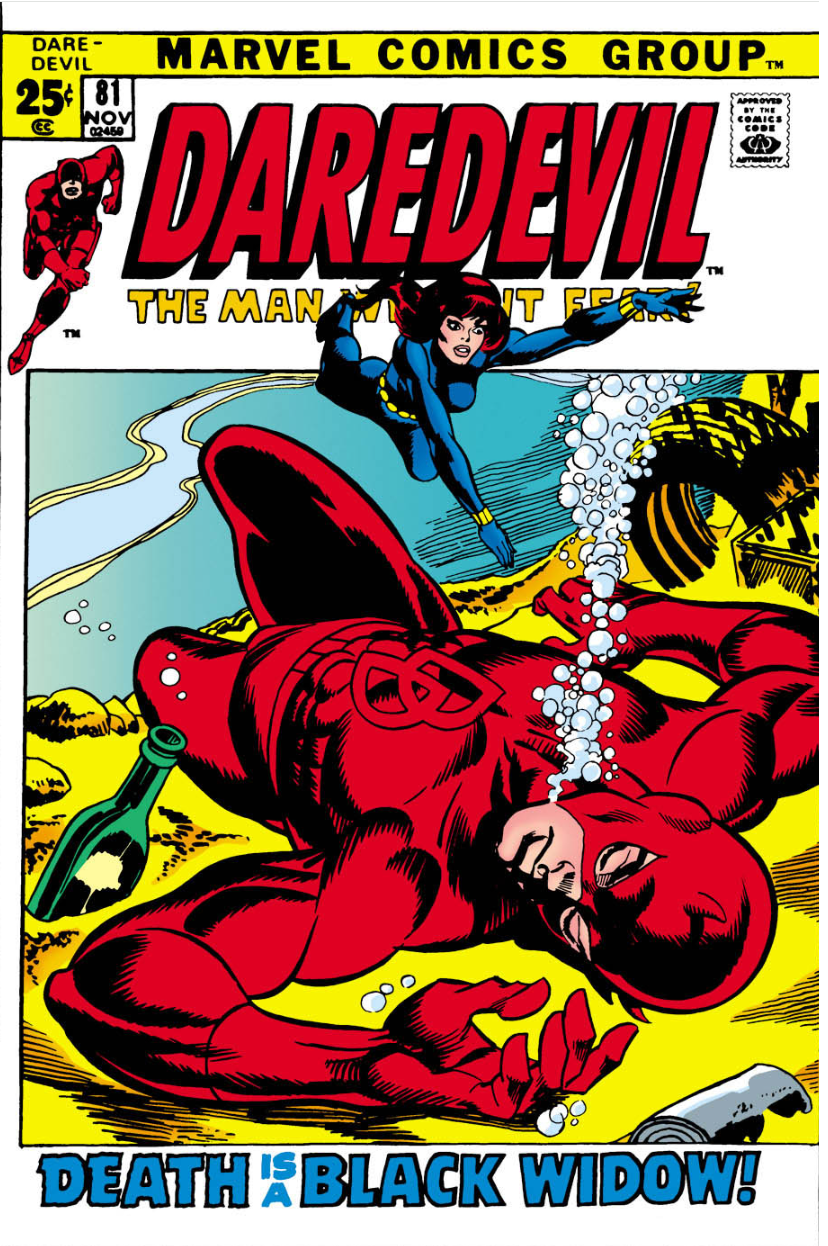
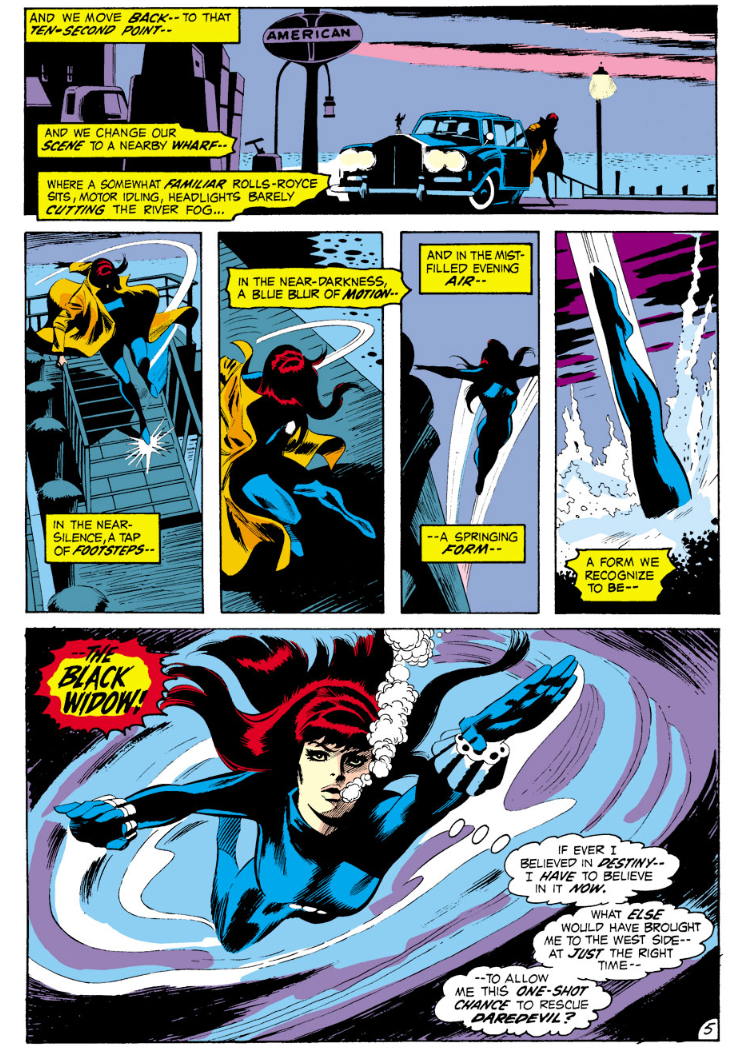
Daredevil #81 (November 1971) carries the misleading title, “And Death is a Woman Called Widow.” The title is obliquely ironic. The issue begins with Daredevil unconscious at the bottom of New York Harbor, thanks to arch-nemesis The Owl. Black Widow dives into the water to pull him out.
Once the hero regains consciousness after his time at the bottom of the Hudson River, Black Widow surmises, “Daredevil must be ashamed…ashamed to owe his life to a woman.”
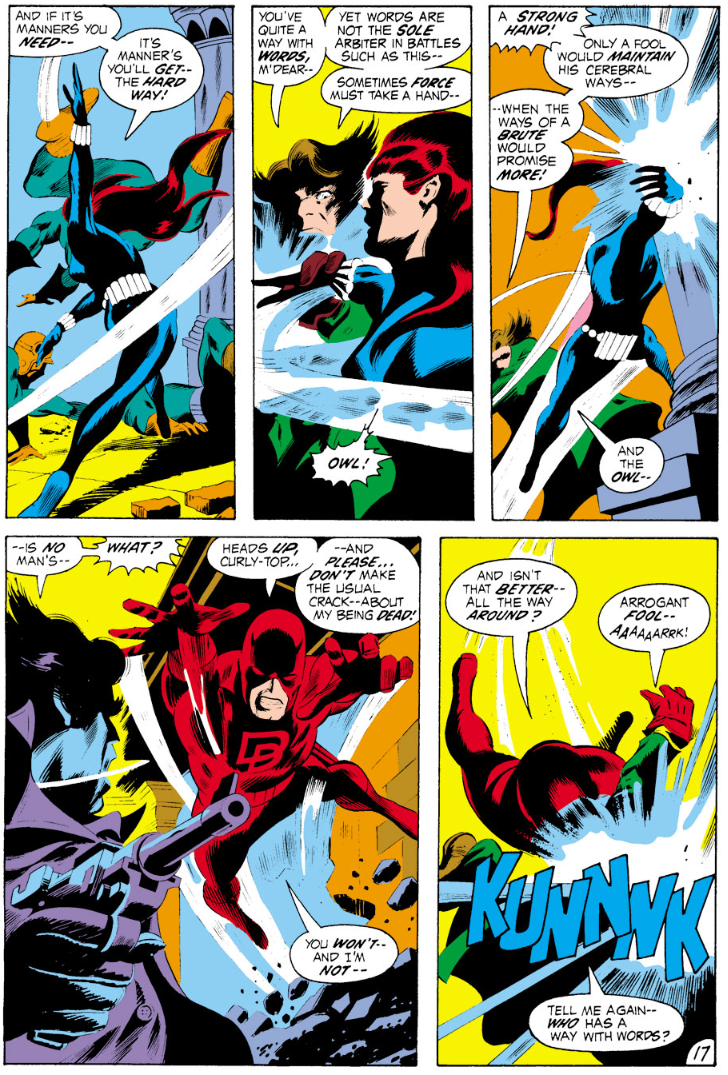
That’s a historically intriguing choice of words. Pop culture forever remains linked to the time of its creation. Comic books can’t swing their way out of that fact. Daredevil #81 hit spinner racks during the days of the emerging feminist movement, one that would profoundly alter women’s places in American society. In 1971, Black Widow found herself in a patriarchal world catering to a virtually all-male audience. As Daredevil’s savior, she’s set apart from the submissive sidekick role.
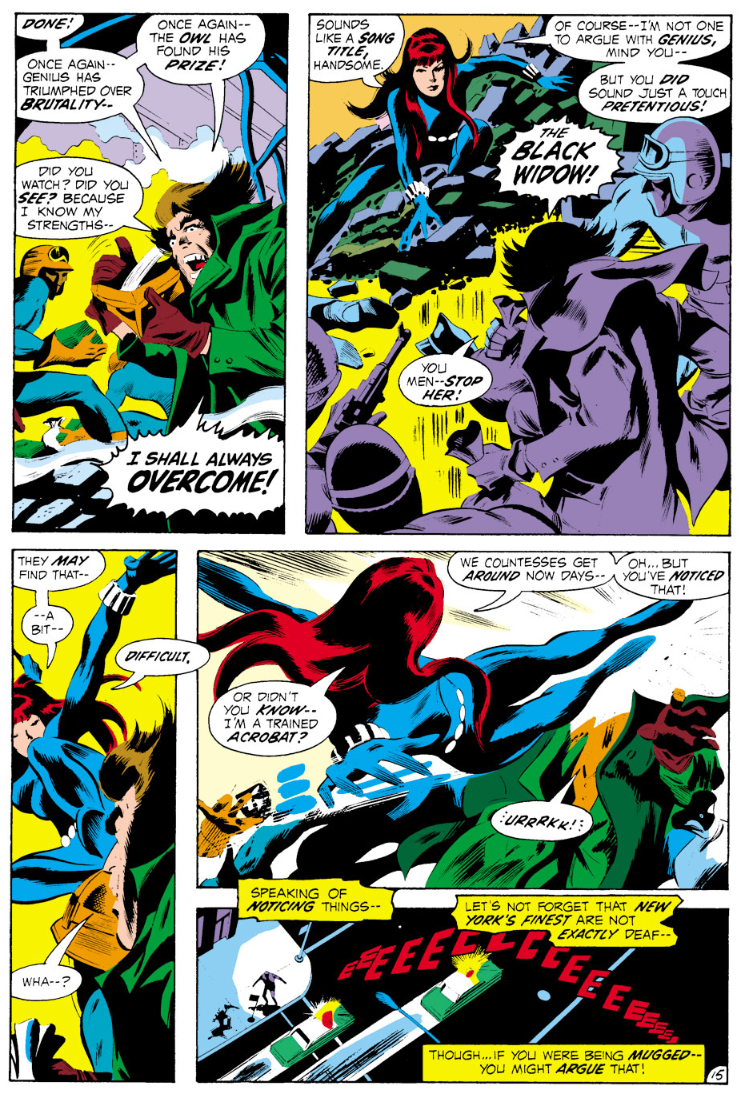
Overall, the mix of bringing back a classic villain, establishing a new villain, giving the hero a new partner, and introducing amorous tension amid topical cultural and sociological themes leads readers to wonder, in an engaging way, “Where are these events headed?”
The reader not only wonders about how the twisting and turning extended narrative will conclude, but they also wonder if the Daredevil/Black Widow relationship will conclude or grow.
You have to keep reading to find out.
Guest Appearances from the Villain Rolodex
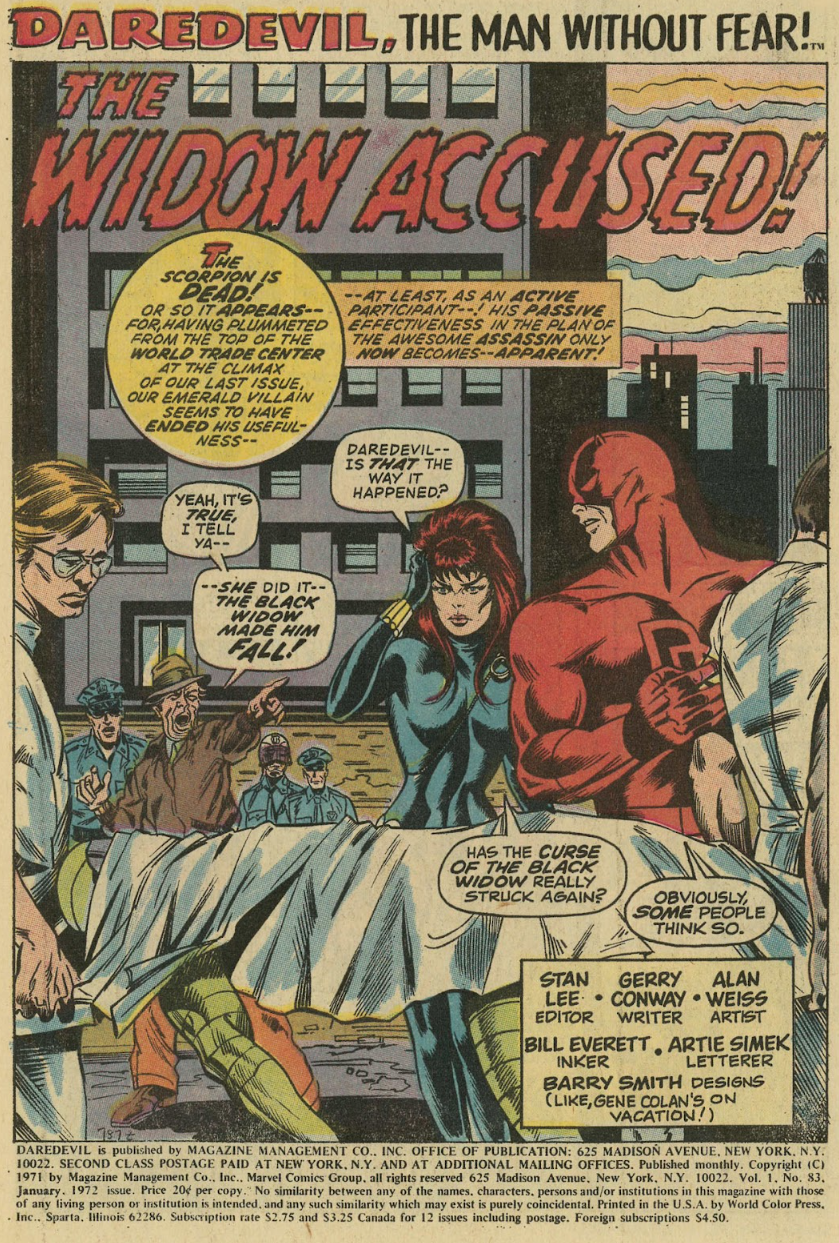
Anyone who thinks comic books are all about aesthetics and creative artistry might be too focused on writers and artists rather than on publishers or distributors. “Now Send….The Scorpion,” the tale presented in Daredevil #82 (December 1971), provides more than an intriguing matchup for the hero. The Scorpion helps draw in Spider-Man readers, as he’s one of the web-slinger’s top foes. (The Scorpion previously provided guest-villain duties in February 1970’s Captain America #122.) The main villain, Mr. Kline/The Assassin, is not well-known enough to get his image on the cover, but the Scorpion had a higher profile. The villain also provides a reliable way to further the Mr. Kline storyline and help build the relationship between Black Widow and Daredevil. The story ends with Black Widow accused of murdering the Scorpion, and her presence shifts further into a major focus of the book.
A Soap Operatic Battle Royale
Daredevil #83 (January 1972) sees the relationship take a turn toward melodrama, a shift that did not always earn appreciation. Skimming the “Let’s Level with Daredevil” letters-to-the-editor section reveals growing reader frustration with the melodrama. One letter suggested, “…you either get your superheroes and their girls together or ship ‘em all off to Peyton Place.” Another noted, “…too many of your superheroes have too many hang-ups. Get rid of some of them, please.”
The bullpen’s response to the reader’s edict jokingly wondered if the reader meant for Marvel to get rid of the hang-ups or the superheroes.
Let’s level here: they go together. If Marvel fails to reverse negative reader attitudes toward its books, the publishing house would have to cancel the superhero titles.
Wonder what fans thought upon reading issue #83, where Mr. Kline blackmails Foggy to ignore exculpatory evidence and prosecute the Black Widow for the Scorpion’s murder. This event occurs after the Widow and Daredevil have a falling-out that turns into fisticuffs.
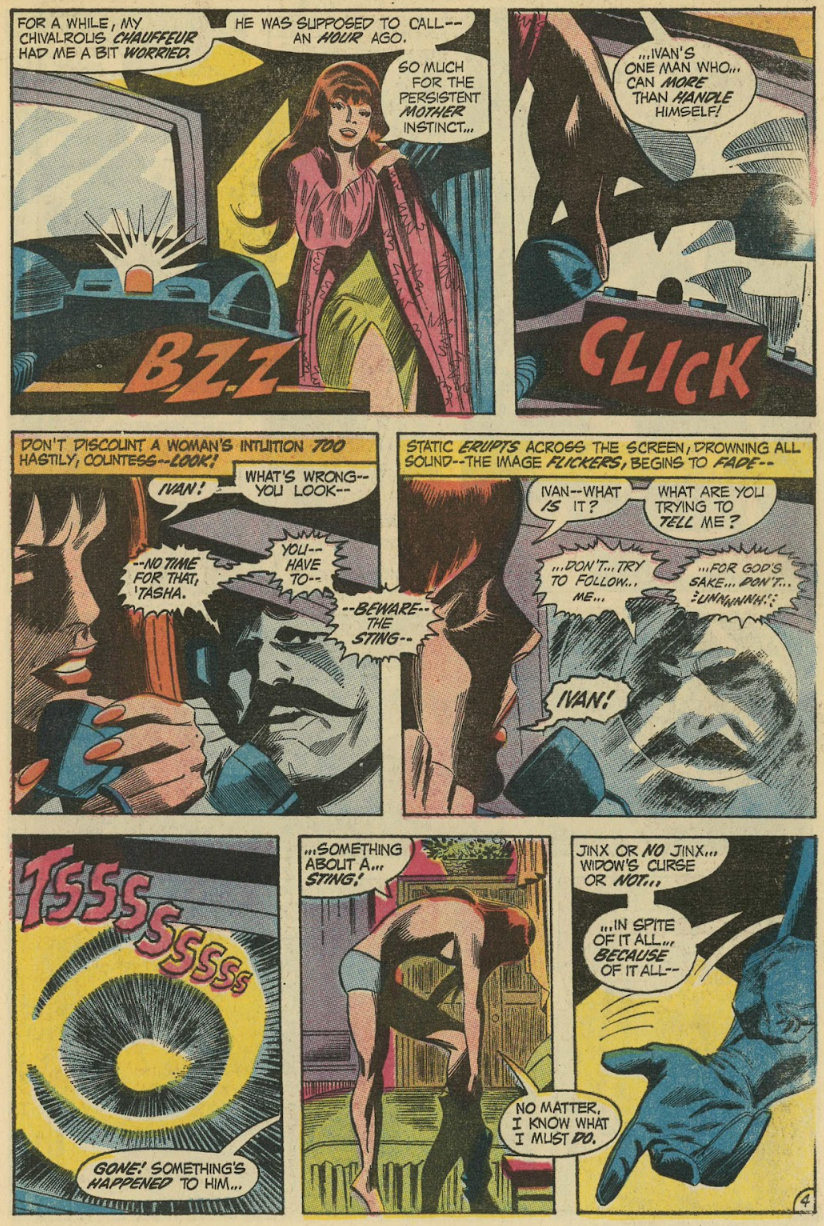
Still, Daredevil believes he can save Black Widow from prison after a hunch suggests there’s more to the Scorpion’s behavior and subsequent demise than what appears. The hero heads to the morgue to view the Scorpion’s body, but all Daredevil finds is old nemesis Mr. Hyde, ready to pounce since it is too early for a Mr. Kline/Daredevil confrontation.
This issue has a lot going on, and melodrama helps drive it. Daredevil’s motivations are emerging conflicted feelings toward Black Widow. Drama and a somewhat scattered narrative serve a purpose: they create ties that bind Daredevil and the Black Widow together. Without the underlying motivation, the team would seem thrown together. Connecting them through personal laments adds the valuable drama necessary to make a series compelling.
Yes, subtle romance-comic elements are making their way into the title.
A Story Arc Closes, a New Beginning Launches
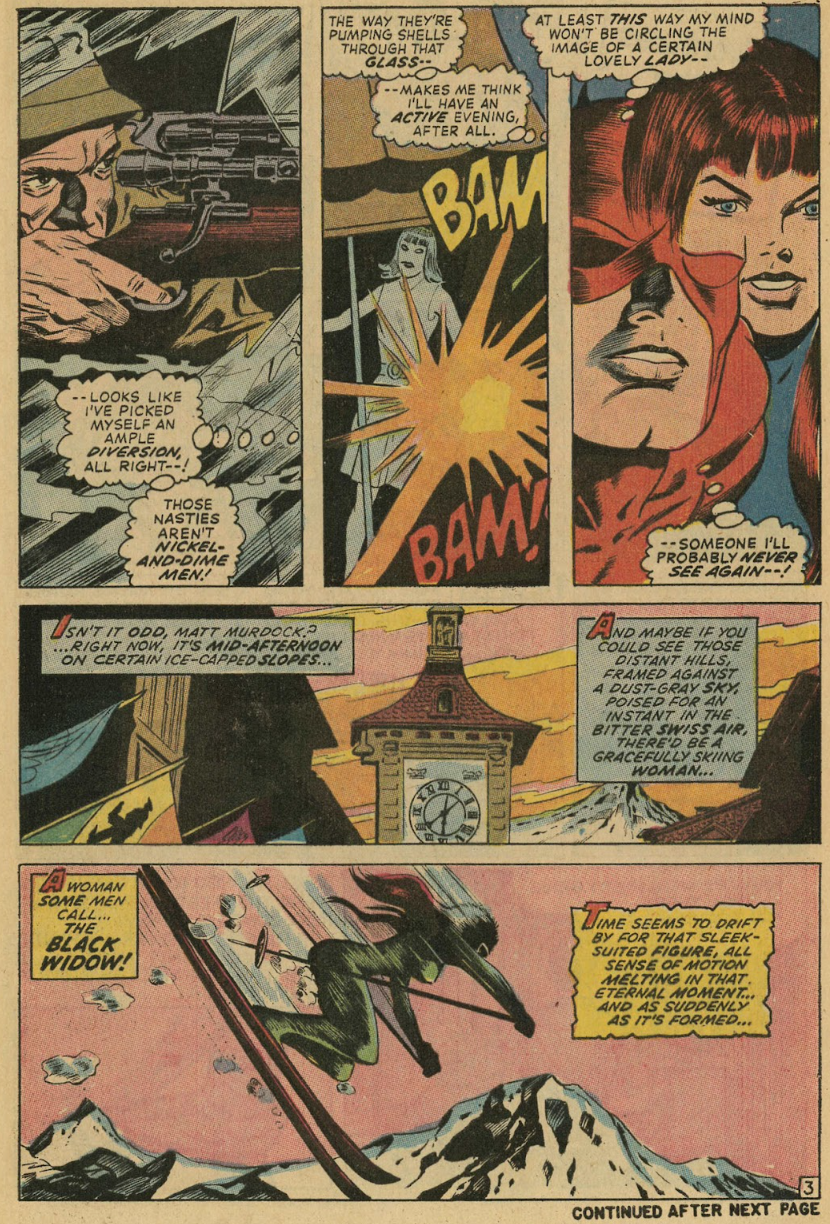
In Daredevil #84 (February 1972), Black Widow escapes her troubles in New York by heading to Switzerland, where she learns a mysterious Doctor Borgdsky may have discovered a cure for blindness. A phone call to New York has her former courtroom defender, Matt Murdock, on his way for treatment.
As the alter ego travels across the Atlantic, the superhero team-up partnership between Daredevil and Black Widow grows stronger.
Passion can lead to personal entanglements. For Daredevil, discovering and falling for a prototypical Avengers member means dealing with Avengers-style villains. While Black Widow doesn’t join The Avengers for another year and a half until Avengers #111 (May 1973), that doesn’t mean an Avengers-esque villain won’t appear earlier.
In a weird swerve, “Mr. Kline” abruptly reveals he’s a robot with a dastardly plan to alter history so his futuristic puppetmaster, Baal, won’t be the last remaining being alive on Earth thousands of years from now.
The Assassin spews dialogue reaffirming Baal’s plans before himself, relegated to forgotten Bronze Age villains who never amounted to much. The not-typical-for-Daredevil villain’s boastings of his nefarious plan prompt Daredevil to ask, “Who writes your dialogue? Doctor Doom?”
All this lands out of nowhere, yet Black Widow’s return at the conclusion to rescue Daredevil from the Assassin feels inevitable. The Deus ex machina ending with the Executioners (last seen in Sub-Mariner #42) helps stop the Assassin’s time-altering plans. Daredevil and Black Widow receive prophetic well-wishing with the words, “Accept your entwined fates, my friends, live and enjoy the life that has been returned to you!”
In the arc’s climax, Black Widow learns that Daredevil and Matt Murdock are the same person. Soon, they would move to San Francisco, pulling the hero away from his New York backdrop and hinting at the brooding, solitary Daredevil to come.
But that chapter is still in the future. For now, when Daredevil appreciates an opportunity to tackle some street-level thugs because his “mind won’t be circling the image of a certain lovely lady,” you know the story between them is far, far from over.
Marvel Comics’ Sales Figure References
“Comic Book Sales Figures of the 1960’s.” CollectedEdition.Com, Tapatalk, 8 Apr. 2007, www.tapatalk.com/groups/marvelmasterworksfansite/comic-book-sales-figures-of-the-1960-s-t2904.html.
“Comic Book Sales Figures for 1969.” Comichron, John Jackson Miller, www.comichron.com/yearlycomicssales/postaldata/1969.html. (Data reflects circulation figures reported to the United States Postal Service.)
Hoknes. “Best Selling Marvel Comics of 1973 – 40 Years Later !” Trending Pop Culture, Trending Pop Culture & InvestComics , 2014, trendingpopculture.com/best-selling-marvel-comics-of-1973-40-years-later/.
Kirksey, Ryan. “GoCollect Blog: Silver Age Best Sellers: Marvel’s Rise to Dominance.” GoCollect Blog, GoCollect, 20 Apr. 2020, gocollect.com/blog/silver-age-best-sellers-marvels-rise-to-dominance/.
Anthony M. Caro recently published the acclaimed work Tragedy Man: A Horror Anthology. He also penned the essay collection Universal Monsters and Neurotics: Children of the Night and their Hang-Ups and the sci-fi novelette Why Is Cal Drawing Stick Figures at 3 AM in the 22nd Century? He writes about all things pop culture and contributed to HorrorNews.Net, PopMatters, Mad Scientist, and Jiu-Jitsu Times. Besides working as a professional writer, he handled production duties in radio, TV, film, and theater.
essay ©2024 Anthony Caro
Join us for more discussion at our Facebook group
check out our CBH documentary videos on our CBH Youtube Channel
get some historic comic book shirts, pillows, etc at CBH Merchandise
check out our CBH Podcast available on Apple Podcasts, Google PlayerFM and Stitcher.
Use of images are not intended to infringe on copyright, but merely used for academic purpose.
Images used ©Their Respective Copyright Holders