David Anthony Kraft Interview, Rock N Roll Journalist, Writer, Publisher by Alex Grand & Jim Thompson
· December 14, 2019 · by Alex Grand · Interviews
Read Alex Grand’s Understanding Superhero Comic Books published by McFarland Books in 2023 with Foreword by Jim Steranko with editorial reviews by comic book professionals, Jim Shooter, Tom Palmer, Tom DeFalco, Danny Fingeroth, Alex Segura, Carl Potts, Guy Dorian Sr. and more.
In the meantime enjoy the show:
Alex Grand and co-host Jim Thompson interview David Anthony Kraft from his humble beginnings in the late 1960s becoming the agent of the Otis Adelbert Kline, Publisher of Fictioneer Science Fiction Books. His early 1970s Marvel work with Roy Thomas, his work at Atlas Comics in 1975 with Chip and Martin Goodman, Giant-Size Dracula with Marvel newcomer John Byrne, working under Gerry Conway at DC Comics, his editing run on FOOM under Sol Brodsky, his Marvel Defenders run under Stan Lee, working with Keith Giffen and Carmine Infantino, his character-defining run on She-Hulk in her first series, his Music references like Blue Oyster Cult, his Beatles, Marvel Super Specials, his Children Books with Marvel Special Projects under Sol Brodsky, why he left Marvel and DC Comics in 1983, publishing his Comics Interview Magazine from 1983-1995, publishing sci-fi books by authors like Don McGregor, his work in animation for shows like GI Joe Extreme, his recent work Yi Soon Shin, and a discussion of his 3 mentors, Leigh Brackett, Stan Lee and E. Hoffman Price.
David Anthony Kraft was an American comic book writer, publisher, and critic. He was primarily known for his long-running journal of interviews and criticism, Comics Interview, as well as for work for Marvel Comics in the late 1970s and early 1980s. David Passed away on 19 May 2021.
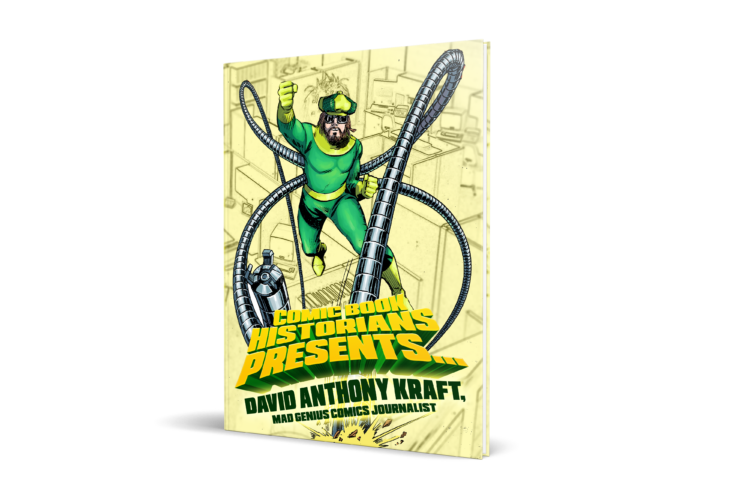
Transcript published in Comic Book Historians Presents… David Anthony Kraft, Mad Genius Comics Journalist:
Alex: David Anthony Kraft, thanks for joining us today.
Kraft: Hey, my pleasure.
Jim: Let’s go back to your very beginnings: you were born in May 31, 1952, in Devil’s Lake, North Dakota and then moved to Georgia?
Kraft: Oh my god, you’re opening a whole topic. Here’s the problem I have with that. And you’re like, “How could you have a problem with that?” Well, people always assume where you were born or where you’re “from” somehow defines you. Here’s how I put it. You know when an airport is jammed up and the planes are circling, waiting for permission to land? If there was such a thing as re-birth, which I’m just using as a metaphor, I was circling waiting to land in the South. And, “I got fucked at the drive through,” as Pesci used to say.
Alex: Ha!
Kraft: I got dropped at the fucking Canadian border! So no, that’s not where I’m from. I ran away from there when I was five. My picture was in the front pages of the paper when I was 14, missing in action, trying to get to the South. It doesn’t really define me.
Jim: But even if you simply say, “I’m not from New York City,” that gives us something that we don’t get with any other interview that we’ve had since the beginning.
Alex: Because most of the comic people we’ve interviewed are from the northeast.
Kraft: I am not a city kind of guy. Like Conan, I was born on the battlefield, in 40 or 50-degree below weather, and all that sort of stuff. I spent my youth trying to get out of there. If I were a city person, it would be Manhattan. That is the best.
Jim: And that’s where you arrived, at some point, on a motorcycle? Is that right?
Kraft: Yes. [chuckle] Here, I’ll give you a little behind the scene. When I was in high school, you know, when you’re at a certain age, you don’t know your own boundaries. You have no idea what you don’t know, which is kind of like everything. You think you know it all. I decided to apply for every kind of editorial job there was. Including, The New Yorker magazine. Well, what would a guy, from where I was from, know about The New Yorker? First of all, I loved the Edgar Rice Burroughs[1] books, and his closest competitor was Otis Adelbert Kline.[2]
Alex: For whom you are a literary agent for the estate.
Kraft: Yeah. Since I was 16 because I didn’t know my own boundaries. I talked to Kline’s daughter, then asked if he had an agent because he had died years before, and if there was somebody representing his work. And she said, “No.” And I said, “Well, That’s me then.” I said, “What have you got to lose?” If I don’t sell anything, you’re exactly the same. And if I do, voilà!” So, I became Kline’s agent in high school.
Alex: What year was that, roughly?
Kraft: This was in the ‘60s.
Alex: Late ‘60s, okay.
Kraft: Anyhow, that’s how I got to Marvel because he’s kind of been my guiding light. When DC got the rights to do Edgar Rice Burroughs’ Tarzan and John Carter, and so on, there was a bidding war behind the scenes between Marvel and DC, and DC won. Since I was Kline’s agent, Roy Thomas,[3] who was Editor-in-Chief at that time, contacted me. Because having not gotten Burroughs, they wanted to get Kline. That would have all gone swimmingly, and it was meant to be. Later on, in Creatures on the Loose, they had Gulliver Jones of Mars, which is based on the old book by Edwin Lester Arnold.[4] They tried to get Kline, and at the time, there were some hard cover books, and the publisher had a stake in it. If there were any subsidiary rights sold, then he would participate. He was so greedy; he queered the deal. I used the chance to go, “Hey, Roy, can I write for Marvel?” And Roy said, “Sure, but we don’t have enough work for our existing writers. But go ahead and submit something.” Being practical, I didn’t submit anything because I thought, well, if they don’t have work for the existing writers, they’re not going to have work for me.” There’s the very long story leading to this. Later on, when I got to the South, I was editing a metaphysical magazine. I knew I was going to Marvel. There was no doubt about that. I thought I would have to go there, sort of camp on the doorstep, and somehow, you know, get in there.
Jim: And this is because you were a big Marvel fan early on, right?
Kraft: Oh yeah. Yeah, absolutely. I quit DC Comics when I was seven or eight. Me and my best friend decided they were just totally stupid. I would not have had a so-called comic career if it weren’t for Stan[5] and Jack[6] because comics used to be dumb. When I got into Marvel, I was like, “This is what I want to do.”
Alex: Right. So, basically Fantastic Four? Was that your main comic?
Kraft: No, I bought the original Hulk stuff when I was in grade school before it was Marvel. When you’re that age, you don’t follow it. It’s not like today where you know that these are all part of some continuity. Later on, I saw Jim Warren[7] magazines had a publication called Screen Thrills Illustrated, and they wrote an article about the Republic Movie Serial, Captain America. And don’t ask me, I wasn’t alive in those days, but I always was interested in stuff like that, and they had a picture of The Avengers #4. The cover was Cap coming back. That cover, Kirby’s art, I had to have it. I haunted the newsstands until the book came out. I was always into The Avengers. You know, Cap, and Thor, and Hulk, and not as much, Spider-Man. I didn’t get around to The Amazing Spider-Man till issue #19.
Jim: You were a letter writer too, right?
Kraft: Oh, yeah. All of us were. I mean, if you think about it. Everybody who later ended up there.
Jim: Were you published much or just that one Hulk issue?
Kraft: A couple. Here and there. I think they may have both been Hulk, I’m not sure. Because I was a big Hulk guy. I didn’t bother to submit. And then, a few years later I was editing a metaphysical magazine in Northeast Georgia, which is where I am right now. I got a letter from Roy. He needed an Associate Editor, and he thought of me.
Kraft: You never know when you throw a rock in the pool where the ripples will lead, so I kind of owe it to Kline.
Jim: Was this in ’74 when you started doing work for the Marvel black and white magazines?
Kraft: Yeah, he contacted me in early ’74. Well, the thing is, in the meanwhile, of course, I had sold some tech-science fiction to Amazing Stories and some comics stories to Skywald. With that characteristic, not knowing your limitations thing, I had cold-called Sol Brodsky at Skywald with all the confidence of somebody who’s in high school. I was like, “I need to write for you.” Thanks to him, he agreed, and I did a few stories for those magazines.
Jim: Were those your first published comics, the Skywald stuff?
Kraft: Yeah, that was before Marvel.
Jim: And then Atlas? I just want to get the trajectory right. Tell us about you going over to Atlas/Seaboard.
Kraft: Okay, let me segue neatly into that.
Jim: Okay.
Kraft: Roy hired me at Marvel, and that was great. I had about a year at Marvel.
Alex: Because yeah, you contributed to Tales of the Zombie 8.
Kraft: Oh yeah, it’s actually the first magazine. I say this, I was proud then with the sense of irony and I’m still feeling that way today. My first credit, as an editor was on co-editing with Don McGregor[1] on Tales of the Zombie. It was funny because I used to love reading The New Yorker magazine, which is perceived as miles away from Tales of the Zombie. I would read The New Yorker, and then I would proudly go to my job as Editor of Tales of the Zombie. I got a lot of stuff out of The New Yorker, including Hellcat’s speech pattern. You know, like cheese and crackers, your sources are where you find them. I was at Marvel for a year, and what happened is, and it’s not intentional, and it still happens today but because I had already written horror stuff for Skywald, I was a horror writer.
Alex: Yeah because you did the Giant-Size Dracula 5, the first John Byrne[2] art/story from Marvel.
Kraft: Yeah, here’s the thing, I was happy to have that and happy to be at Marvel but I didn’t want to write horror. I wanted to write the actual Marvel superheroes.
Jim: And you got that, by force almost, with Man-Wolf, didn’t you? Because that was for a horror book, and you turned it into a superhero book.
Kraft: Yeah. Well, the thing about Man-Wolf is they already had Werewolf by Night, which is basically kind of a rip off Wolf-Man, the Universal movie werewolf. Why did they need a third rate one? And really, what they’d done with him was he ran around and growled and menaced people when the moon was out. I saw no future for me or the book. I didn’t want to write something that stereotypical. I’d written a novel when I was in high school, and I went to Roy and said, “I want to just kind of adapt it to Man-Wolf and make him into a Stargod and take him to space.” I thought Roy would say no but he was like, “Great!” One thing really wonderful about Roy, he did not micromanage. If you messed up, he or Stan would call you on the carpet. I just made it a policy never to mess up, so I never got called on the carpet. Once he said that, I was off and running.
Jim: How did George Pérez[3] get on that book?
Kraft: Me. What happened was George Tuska[4] was drawing it. They had some other assignment for him, which kept him busy. He didn’t have time to do that issue of Creatures on the Loose with Man-Wolf. We were talking, sort of off microphone, about how people help each other out behind the scenes. George Pérez had been helping Rich Buckler,[5] ghosting some of his work. The only thing in color that George had been published in was a Deathlok thing that featured Rich and Doug Moench.[6] He got his shot on the first Man-Wolf issue of Creatures on the Loose that I wrote. I liked it so much, he was supposed to just be a fill-in. I pulled the mom and dad trick on John Romita[7] and Roy Thomas. I went to Roy and I said, “Because George had … If you look at those issues, the movement, the action, the excitement, everything that’s Marvel is there.” And I wanted that. I went to Roy and I said, “Can George just be the regular guy on Man-Wolf?” And Roy was like, “It’s okay with me if it’s okay with John Romita” who was the art director. I went to John Romita. We used to play softball on Friday afternoons in Central Park. I went to John Romita, and I said, “Roy says it’s okay if I have George Pérez on the book. Do you have any objections?” And he was like, “Well, if Roy says it’s okay.“ So, that’s how I got George on there as the regular guy.
Alex: That’s awesome!
Kraft: I always liked working with George. We worked together on Logan’s Run. I was packaging The Beatles book for Marvel, and I hired him for that. It’s always fun working with him. After a year at Marvel, Stan’s brother, Larry Lieber[8] got hired at Atlas as Editor. He called me and offered me the job as his Associate Editor. Well, I was pretty young. I did not have the experience to know or to think, “I wonder if Atlas will last.” I was flattered, of course, and also, they were doubling my salary that I was getting at Marvel, on staff as an editor.
Alex: Yeah, that’s important.
Kraft: Who can resist that, right? I went to Atlas as Larry’s Associate Editor. That’s where Rich and I did Demon Hunter. I thought I had it made. And the thing about Larry is, Larry is a hard worker. He didn’t really delegate much to me so I went to the publisher, which was Chip Goodman[9] and I said, “I’m not a clock watcher, I like to do things, and I just need to do stuff. I love the salary but, you know, give me some damn work.” Chip said, “Well, we’ll divide the line between you and Larry.” And I said, “No, no, no. Larry hired me, I’m not going to stab him in the back by having half the line. That’s not what I’m talking about. I just want him to delegate some stuff to me.” When I had complained to Chip about not having enough work, at that point, Larry let me start writing the cover copy and some other stuff like that. I got to have some fun with that.
Jim: Was Jeff Rovin[10] gone at this point?
Kraft: Yeah, there’s a lot of stuff that I overheard about Rovin but best left off any recorded thing. They were pretty unhappy with him at the point that I got there.
Alex: How was Chip Goodman and Martin Goodman? You met both of them? How were their personalities?
Kraft: Yeah, have you ever seen the movie The Man With X-Ray Eyes starring Ray Milland?[11] Well, my one and only meeting with Martin Goodman, that’s who he was. He came out of the elevator, and he was very short. He looked just like a Jack Kirby drawing with the hat and the suit, and everything. You know, from the early Marvel books? Or even before, the monster stuff. And everywhere he looked there were X-ray beams that destroyed people and things.
Alex: Ha!
Kraft: He was tremendously angry and I never put it together why. It turns out, I guess, Atlas was losing money hand over fist. I didn’t know that. Chip, on the other hand, had a great office because he also published Swank magazine. There were always these hot girls coming and going, which was cool. I did not know then but I have heard since then, that apparently Chip was gay. I did not know that.
Alex: I didn’t know that either.
Kraft: Well, I’ve heard that. Like I said, I was all about work. I was kind of oblivious to things. Yeah, there were always cute girls coming and going and stuff. It was a small office. It had an open production department that was Alan Kupperberg[12] and Shelly Leferman.[13] Alan Kupperberg designed that stylized Atlas “A” and Shelly lettered stuff including Demon Hunter. Chip’s office was right beside my office, which was Larry’s office. We had adjoining desks. After one particularly hard day, Chip showed up at the door with martinis, and he was like, “I heard what you guys went through today. You deserve a drink.” I was like, “This is the kind of publisher to have.”
Alex: Wow, so, he was actually a pretty cool guy?
Kraft: Yeah, at least as far as my experience. Anyway, we’re jumping around because we’ll have to come back to Demon Hunter.
Jim: Oh, we’re coming back to Demon Hunter.
Kraft: After I was there for a while, I got assignments to write three books on a regular basis. One of them was Demon Hunter, and there were a couple of others.
Jim: Do you remember what the others were?
Kraft: One was one that I had pitched to them but never made it. I think the other one might have been …
Jim: Was that the beast one? I mean there was the spin-off of from Demon Hunter. Was that it?
Kraft: No. No. It wasn’t that. I think it was called Blood Hawk. And then one of the other books, which, it’ll occur to me in a minute, because if I chase it, it’ll keep being elusive. I basically had three books to write. I was going to pull a Steve Englehart.[14] At that point, I went freelance. I was going to move to the West Coast because now I had all these books to write. So, I hopped on my motorcycle, and I went to the West Coast, secure in the knowledge that I was the new Steve Englehart. When I got to the West Coast, Atlas had gone defunct, and I had no work.
Alex: I’ve heard that story before. That by the time you got there, the party was over.
Kraft: Yeah, I was on top of the world, and then there wasn’t a world. I spent the summer on the West Coast, and I realized, I did not belong among mere mortals. Because at the Marvel bullpen and at Atlas, a lot of the same people crossing back and forth could go out to a movie, then sit around afterwards and talk about why we liked or didn’t like it. We could discuss what the technique was, how this worked and what they had done there to make that work, my kind of stuff. Out in the regular world, people just go, “Yeah, it’s a pretty good movie.” Well, that didn’t really work for me. I called Jim Salicrup,[15] a good friend of mine from the early days, and I said I wanted to come back, and Roger Slifer did that, too. Roger and I started on the same day at Marvel. They had just fired 13 people. What Marvel used to do is … we all knew it at the staff level, for some reason management didn’t seem to know it. What would happen is, there was a big lag between when a book was published and when Marvel got the actual sell-through on it. Obviously, the book sold better in the summer, and worse in the winter because of accessibility and so on. Every summer, they would get the winter sales figures and they would fire people. Every winter, they’d get the summer sales figures, and they would hire people.
Alex: Yeah, because it was off cycle.
Kraft: We used to say, why don’t they just notice this and average it out or something. Well, anyway, they had just fired 13 people when I wanted to go back, because it was the summer, they’ve gotten the winter sales figures. Roger was like, “I don’t know if you have much of a chance, they’ve just been firing people left and right.” And Salicrup was like, “Yeah, but you always do okay. You’ll be fine.” And you know, thank God for Salicrup. Anyway, I went back and things were fine. The first thing that happened was, when I went by the bullpen, I came in the front door, where the receptionist was, and then you’d come in and there was an office on your right that had Irv Watanabe[16] the letterer, and various people. And then when you turn the corner, there was Larry Lieber’s office. He was back at Marvel, after Atlas and doing the British books. I was on my way to him because I knew he would give me work. Britain used to divide one of the short Marvel comics into three parts, believe it or not, for publication in England, and they needed new splash pages. They would divide them mechanically, which could be in the middle of a conversation like we’re having and it’ll be like, “to be continued.” And then you have to come up with a splash page. Crazy stuff but I worked intermediary splashes for all the Marvel stuff basically. Anyway, that was later, I came in, I rounded the corner and standing in Larry’s doorway was Rich Buckler. We had a reunion. And we decided then and there that we should do Devil-Slayer. Rich was working on what became Marvel Spotlight #33, 1977.
Jim: Was this the Deathlok tie in?
Kraft: Yeah. It was originally scheduled to go into Astonishing Tales or something, but he didn’t have a plot. When I bumped into him, I was like, “Hey dude, how you doing? We should do this character called Devil-Slayer,” because Atlas was defunct. Jim: Let me ask you a question on that. Let’s go to Demon Hunter, Devil-Slayer, all of that. Did you consider yourself co-creator of that in the beginning or was it his baby?
Kraft: Well, it was his baby, except it wasn’t.
Jim: That’s what I’d like to explore a little bit. Is the character a co-creation?
Kraft: Rich was a great guy, and I loved talking Rock with him because he was plugged in to all the Rock stuff. Here’s the advantage that artists have, and that’s why they should all be bitch slapped. They can work and listen to TV or movies, or music. As a writer, because of the word thing, there’s no way to be writing words and listening to other words. They have this unfair advantage. But anyway, Rich was always into music and stuff. We used to talk about it at Marvel before and then at Atlas, then back at Marvel. They all say don’t speak ill, and I’m not really speaking ill, I’m just speaking reality. Rich would overcommit. Then, he would skate by with really kind of weak stuff. If you look at that first Demon Hunter he turned in, I wish I still had the xeroxes. There’s a point at which there’s a yacht, and I wrote off of the arc, I mean in Marvel style. And the artist, who actually finished the work, or worked it off of what Rich turned in … Well, there’s a whole page, and there’s a big shot of a yacht, and Rich put a little circle going, “Yacht goes here.” There wasn’t even anything to ink. When you look at it, it looks kind of unfinished. It’s unfinished because they did the best they could with nothing much there.
Alex: The inker put the yacht there. That’s funny.
Kraft: Yeah, Rich was enormously talented, but he spread himself way too thin. What happened was, I was meant to dialog Demon Hunter, but in the end I ended up co-creating the damn thing because it was so thinly done. There wasn’t anything there. There’d be pages that were inexplicable, and I would just puzzle over them, I’d be like, “What in the hell is supposed to be going on here?” So, I just made stuff up and, viola!
Alex: So, out of necessity, you are the co-creator of the character.
Kraft: Yes. [laughter] I signed on to dialog, and I ended up kind of inventing it with him. He had the original concept and sold it to Chip. Whatever the hell he was thinking was not on the page.
Alex: When you were doing the “Marvel UK” [Marvel Comics International] stuff in ’76, you did some DC titles too, right? Like Richard Dragon, Kamandi, and Swamp Thing.
Kraft: Yeah, when I went away and then suddenly discovered I had no work, and came back. What happens is, it’s not strict but it works like this, you kind of work your way up. See, you start at really, really low rates and you start doing horror stories or whatever, and then you keep going, and work comes your way. Eventually the goal of everybody in those days was to go freelance when you didn’t have to work on staff, and you had enough writing, or art to support yourself. When I went away, I reset to start. I went from having three books at Atlas to having nothing anywhere. For some reason, Gerry Conway[1] always liked my work, and that was nice. He was an editor at DC.
Alex: He had just jumped over to DC around that time then.
Kraft: Yeah, and I didn’t approach him. He approached me, which was great because I’ve never been that good at selling my stuff. I’m usually better when you give me an impossible assignment because then I will rise to it, and awe you and stun you, but if you ask me to pitch something, God help me. Gerry came and said, “You should come over to DC,” and I’m like, “Okay.” He offered me a pretty good rate. And that’s how I ended up doing that spell at DC.
Alex: Yeah, on Richard Dragon, Kamandi, and Swamp Thing. How was working on those books? Was that pretty easy for you? Or did you have to get background on those characters since they weren’t like the Marvel stuff that you had read while you were younger?
Kraft: Well, I researched everything, even the Marvel stuff. Like when I did Man-Wolf and wrote J. Jonah Jameson when Len Wein[2] was editor. He called me in and said that when I had Jonah calling Spider-Man, the wall crawling weasel, Len said, “He would never say that.” Well, I’m a research guy, so I pulled out the Stan Lee books with all the Jonah, and I’m like, “Right here, he calls him a wall crawling weasel.”
Alex: Ha!
Kraft: I try to keep the characters in character. Those days seem like they’re gone but Stan had a voice for every character. You could not, as Steve Gerber[3] used to say, “You could take a DC book and here’s Wonder Woman, Batman, and Superman, and whatever they’re saying is basically plot. It’s in service of the plot. They’re not real characters.” You could change the tails of the balloons; it would make no difference. Marvel was never like that, which is why I like Marvel. It was all character-driven. You could not take a balloon from the Thing and put it to Spider-Man. It’s impossible. I always would research the back issues to see the speech patterns, and the behaviors. Basically, to try to keep everybody in character. I did that also at DC but God, there’s so many stories. Like on Swamp Thing, I wrote the last issue of the first period.
Alex: Yeah, issue 24.
Kraft: Yeah. I also wrote 25 and 26 [chuckle] but they were not published. Well, 25 was drawn, and 26 was not drawn, it’s just scripted. I always liked Swamp Thing. If you think about it, and if you look at the different companies, it wasn’t just an implosion. First there was, when the code loosened up, and they were like, “We can do all these things. We can do zombies.” Suddenly, there were all these kinds of monster books. Then the monster thing kind of collapsed. I mean, it’s easier to see in hindsight than it is when you’re living in the moment. Pretty much all the monster books got cancelled. Man-Wolf, Swamp Thing, all of them, with the exception of The Tomb of Dracula, thank God, because that was a good book.
Jim: That was a good book.
Kraft: Yeah, really, it was. I used to always try to get it to edit in the office. Don McGregor and I would fight over the good books. Verpoorten[4] would bring in that day’s books, “These are in and we need them by four. [grumble]”
Jim: Gerber’s Man-Thing. That was another good one!
Kraft: Yeah, Man-Thing was damn great. I would try to grab all the good stuff. And Don McGregor would try to grab it but I would generally win. [chuckle]
Alex: Oh, that’s funny.
Kraft: We had desks side by side while we were editing, under Roy. This is what’s weird, there was Roy, Don, and me doing the entire color comics for Marvel. I mean, that was it. It wasn’t like today where there’s 4,802 editors. When they would bring those books in, there were books that weren’t so exciting, and there were books that I loved, like Starlin’s[5] work, or The Tomb of Dracula. Marv Wolfman[6] was on staff doing the black and white books but he was also writing The Tomb of Dracula. I always tried to grab the better stuff … And I liked Doug Moench’s Master of Kung Fu, too.
Jim: I loved that era. How about when Jim Shooter[7] came on?
Kraft: Don’t get me started on that. Shooter’s a good guy but his influence on Marvel was to turn it in to a DC kind of thing, with the editors and assistant editors of the books. From what Gerry had said, and what Roy had said, things were different before my period. It’s like when you’re born. You’re born, and the world seems normal from the time you’re born. You have no knowledge of before that. Well, when I came into Marvel, Roy was so busy writing books and editing, he spent his attention on the big things. “Here’s a new character. Here’s the top books. Let’s make sure the villains don’t repeat.” Once or twice a year, you’d go in with a book like Creatures on the Loose, or Amazing Adventures, or Black Panther, and you’d say, “I plan to do this.” He’d go, “Okay.” And then really, unless you really fucked up, or you tried to push boundaries, which Don was always doing, you’re pretty much left alone. Because we were on staff, there wasn’t anybody over us. There was no editor of those books. We were the de facto editors of our own books. They would go to press, and Roy and Stan would see them after they were printed. Those were cool days.
Jim: Were they a lot looser than DC?
Kraft: Oh, there’s no comparison. During my period at DC, and part of me smiles at this, and part of me is like, “Yeah, yeah, you were just being stupid.” DC was so regimented. And Marvel became this, later with Shooter. DC had these offices with glass fronts, and it was like a menagerie or zoo. Each one had an editor in it. You know what I mean? You can walk along and look at them wearing their suits and ties. They had no clue about how to do real comics, in my opinion, of course.
Jim: Was it true that Stan Lee is the one that took you out and bought you a suit?
Kraft: No but if you want, I’ll tell you that. He gave me a lot of advice though when I asked him. Anyway, when I was at DC, you know how you react against things? Well, I was hippie-esque anyway, had long hair. I think I had three hairs back in those days, and they were long. I was so non-DC because everything there was so plot driven and so anal. I tried to make a point so I spent a summer going around barefoot with my knees hanging out my jeans. And it would delight me to go to DC because it was so obvious how much they hated me.
Alex: Right because they were basically ‘suits,’ and you were the hippie walking in the room.
Kraft: Yeah, and I really did not belong there. I just couldn’t help myself. Anyway, when Gerry went back to Marvel, I followed him back to Marvel where I belonged because that was my sensibility. When I went back to Marvel, I realized it was kind of a dichotomy because I was a hippie but I was also a motorcyclist, and instead of being a motorcycle guy or a hippie, I was a hippie-motorcyclist guy. I always looked like that, too. I never got hassled on the streets. In those days, Manhattan was a rough place. I never had any trouble because I looked like the guy who would be causing it. So that was cool. In regard to the suit question, I was in meetings with Stan because Steve Gerber had done the Kiss book and then moved to Las Vegas. He even borrowed three hundred bucks from me to do that. In his favor, he actually paid me back.
Alex: How cool.
Kraft: Who does that, right? I was left in charge of the Rock ’n Roll books. We had a meeting; Stan and Jim Galton[8] who was CEO, and me. I was pitching The Beatles book and Galton would say, “They were sort of like The Monkees, weren’t they?” Really clued it in, I got to tell you. I would say, “No, they’re a whole thing on to themselves. All of Rock music from them onwards is influenced by them.” I would say that but Galton would not look at me. He would look at Stan and go, “Oh, so this and this and this.” And then Stan would look to me, and then I would answer, and then … You know, I just didn’t exist in that room to Galton. I decided at that point, I was wearing an inappropriate superhero costume, and I decided that I would change overnight into suits and stuff. Stan really did have an open-door policy. I mean I talked to him about all kinds of things but looking back on it, never once about comics. I’d go in and go, “I want to change. I don’t want to tell anybody but over the weekend, I’m going to totally change. Cut my hair, get a suit. Do this, do that.” Stan said, “I’m really glad you said that. I would never have told you to do it.” He said, “Here’s the thing, at one point, that hairstyle and that dress, meant something. When you hang on to it, you become an ‘anachronism.’” He’s like, “I’m so glad you’re going to change.” He gave me places to go to buy stuff.
Alex: Oh, that’s cool. And this is in 1978, when that happened, right? When you did Marvel Super Special 4, The Beatles, and the Marvel Super Special 7, the Sgt. Pepper’s book.
Kraft: Yeah, he was a great source of information. He talked to me about stockbrokers, all kinds of things, just never comics. Probably a good thing because from what I understand, he was really hands on, but in my day, he had bigger goals, so he was looking in a different direction. The end of that story is, after that I had meetings with Galton without Stan because he could actually see me, which was my experiment.
Alex: Wow, what a social experiment!
Kraft: I had a bad effect on the bullpen. Marie Severin[9] loved the way I dressed. She actually followed me around the halls going, “This is great. I love this.” Before that, everybody dressed like helter-skelter. After that, people, including Shooter, who was new at the time, started wearing suit coats and ties, and all the rest of them.
Jim: You were responsible for that?
Kraft: Yeah, don’t blame me though. Here’s what happened. Because of the response to me, other people saw that, and they were like, “We should dress up, too.” The difference was this, since I was freelance, I could go home and dress any way I wanted, including coming to the office any way I wanted. But because they were on staff, once they started that, they couldn’t go back. Not to blame Shooter entirely because there’s some blame attaching to me. But eventually, it became DC. You had all these editors with ties and coats, in little glass offices. You know, the very thing I hate, which was at the moment that I failed, left comics, and went back to publishing.
Jim: It seemed like at DC, you were kind of closing out, maybe not intentionally but you were doing the end of the line stuff for various comics and one of those, they weren’t the last two issues but they almost were, on Blackhawk. Was that a weird comic for you to be doing?
Kraft: It wasn’t like I was really familiar with Blackhawk but somewhere in my youth, I had come across some of those early Blackhawk issues, and I really liked them.
Jim: The Reed Crandall[10] stuff?
Kraft: Yeah, the good stuff. That was cool. But there’s a great unpublished Blackhawk story. When Gerry was editing that, and he’s like, “Here, do these.” We stopped near Times Square, at a Dunkin’ Donuts. We were sitting there, plotting together, “What should we do?” And Gerry was like, “We should kill Blackhawk, and we should do this, and we should do that.” His ideas were really cool. I thought he was serious. I nearly made a fatal error, by going, “Yes! I should go home and do it.” And then he went, “Just kidding. We can’t do any of that. We have to stick with the way the company did that stuff.” Gerry was much more creative. There’s nothing wrong with his work but he couldn’t bring all of it to his work because he was aware of what was acceptable and what wasn’t. I did what was acceptable, but I would’ve loved to have done more. Gerber went through a period where he hung out a lot with Gerry. He used to say, “That guy really knows a lot. He’s not like you would think from his work, and blah, blah, blah.” He was always conscious of what market, and what editor, and what company he was working for. He went on to a long TV career, story editing and writing.
Alex: Let’s talk a little bit about FOOM. That was a fan Marvel magazine that was started by Jim Steranko[1] in ’73. You edited issues 15 through 22 from 1976 to 1978. How did you get that gig and that first issue 15 was the Steve Gerber—Howard the Duck issue, right?
Kraft: Yeah, I was coming back from my big days as Steve Englehart when I arrived on the West Coast with no work. Then I returned. It was during that period where I was getting work and trying to re-establish myself. I always liked Sol Brodsky. I didn’t know him when he bought my stuff at Skywald. When I met him at Marvel, Sol used to intimidate me and a lot of people. When people were messing around because Marvel was not DC, so people would be squirting each other with squirt guns, or throwing paper airplanes, or doing whatever. Dueling on desktops. He would walk by the door to the editorial room, and he would just stop and stare, he wouldn’t say anything. That stare was like Gorgon. It could turn you to stone. [laughter] And I was usually working, not actually messing around. Nonetheless, I turned to stone, too. When I came back, after my hiatus, high on acid I must say. I was telling Salicrup how I always found Sol intimidating. He said, “You should just go talk to him. You’d find, he’s a nice guy.” So, here’s me, all hopped up, [laughter] I knock on Sol’s door, and I go in, and I’m a big one for confronting things. If there’s going to be things, let’s just confront them. I went in and I said, “You know, you’ve always intimidated me, and I don’t really know why but you’d stop at the door and stare.” And he said, “I never once was staring at you.” He said, “There was no point at which you were not doing your stuff.” And he said, “You know, it’s comics but we have deadlines and you have to get books out. It’s my job as Vice President to make sure people actually sober up and do their shit.” After that, we became swell pals and I would go to him for advice.
Jim: Did you ever tell him you were on acid when you were having that conversation?
Kraft: [chuckle] Yeah, well, I was on acid for 30 days at that period. [laughter] Here’s why and how. I don’t know how to find drugs, I never have. If they cross my path, I’m exaggerating for effect, but if Keith Richards[2] said, “Let’s do heroin on our eyeballs.” I’d be like, “Well, it’s Keith Richards and he has heroin, why not.” I wouldn’t go, I need to shoot heroin in my eyes but if it happened, I’d probably be there for it.
Alex: That’s the Pac-Man Philosophy, right? If it’s in front of you…
[laughter]
Kraft: Yes, well, I had that Norton Commando 750 motorcycle that I put in the Man-Wolf books. At that point, I was living in Queens, and there was this guy, George. He wasn’t a true humpback but kind of. He stopped to admire my bike, and we were just chatting. It turned out that he was like a drug guy. He had stuff and he’s like, “I’ve got acid.” He pulls out this baggie with these tabs. My thinking, being very practical, is that I’ll probably never see acid again. [chuckle] I didn’t know how to find it. Here’s the thing, I thought, there’s a whole bag of it, why don’t I just buy all of it, [chuckle] because I’ll never see any of it again.
Alex: That’s hilarious.
Kraft: That’s what happened. I was like, “I’ll just take all of them.” And so, I took acid every single day for 30 days till it ran out, and I never did it again.
[laughter]
Jim: If we go back and read your comics of this period, can we spot, “Oh, this is during the 30-days of acid?”
Kraft: [chuckle] No because here’s the weird thing, fans are always going … And I’ll say this about Stan and Ditko,[3] and everybody. They’ll go like, “Oh, they must’ve had good stuff here.” Stan and Ditko were the straightest guys on the planet Earth. They were never on anything. Whenever I wrote, I was never on anything. I mean, I only did it when I wasn’t. When I’m writing, I have to be a 100%, or at the worst 99%. I have to be really on it. I can’t be drunk or stoned, or this or that. No matter how stoned the thing reads, I wasn’t. Yeah, you wouldn’t spot it, but the influence of it. What it did for me was, I made a lot of mental connections, pattern sensing, and seeing the world in a different way, and stuff like that. I think for me it was very beneficial. I never felt the urge to do it again or anything. It wasn’t because I had a bad experience. I would say they were all pretty good. I’ve been there, done that, whatever.
Alex: Right. You don’t have that addictive personality.
Kraft: What I do is, whether it’s coffee or alcohol, or even food, I take time out. I’ve taken a year or two off alcohol or coffee. Just this year, I didn’t eat a single bite of food for 28 days. I’m not even addicted to food.
Alex: Now, when you were doing those FOOM issues did you look back at the Steranko issues, or did you say, “I’m going to do kind of my own take on FOOM?”
Kraft: What happened was because I was looking for work, as soon as I talked to Rich, the next door on the right was Sol, so I went in there looking for work. He was the champion of no budget. I learned a lot from Sol later when I was publishing. I’m like, “Here’s my page rate: a half of a cent.” The budget for FOOM, the entire magazine, all the art, all the writing, was 750 bucks. Produce a magazine for that, I dare you. [chuckle] My job was how can I do this, and still actually make anything at the end of it. I had met this legal secretary named Donna Coe, who is credited in FOOM as “diligent doer.” She could transcribe faster than you could talk. What I did was, I did the “Infoomation” section where I would talk to each of the different editors and writers, and then I would give it to her to transcribe, and then I would edit it into something resembling English that you could read. That’s how I got that done and got it done with not a lot of money. I wrote a lot of it, and so on. Mainly, I just had a lot of fun with it. I got to interact with Kirby a lot.
Alex: What’s your take on the Lee vs. Kirby vs. Ditko argument?
Kraft: This is a whole other topic. People who weren’t there, and don’t know anything about it, are absolutely certain they know everything. They haven’t dealt with Ditko. They haven’t dealt with Kirby or Stan. They really don’t have a clue. They know what they think is reality, which is not even close. I love Kirby’s work. I even wrote him a letter about the Captain America Bicentennial and stuff that I have on my Facebook page. The reason why he was such a good collaborator with Stan is, Stan was the man of words, and Jack was the man of art. Jack wasn’t so good with words, which I think you could tell if you read anything that he actually wrote. I was trying to actually publicize his books when he came back to Marvel. Okay, there’s a book added to the schedule called Devil Dinosaur. Here’s me because I’m trying to boost this in FOOM. I’m like, “Tell me about it. What’s the origin of Devil Dinosaur?” Jack pauses for a while and he goes, “He’s red. Yeah, yeah, he’s red.” [chuckle] That’s what I had to work with. I did the best I could under those circumstances.
Alex: He’s more about action, right? He’s expressing himself in the visual sense.
Kraft: Yeah, his ideas tripped over themselves; somebody like Stan kept him on course. He may not have thought so but if you think about it, here’s the Silver Surfer, in the next issue, it’d be something else. It’s always something else. Look at that DC stuff. It’s one thing after another, and nothing has any continuity to it. Stan would be the guy, “Let’s not lose the Surfer. Let’s bring him back. Let’s do this. Let’s not jump so fast.” I mean, there was a reason why their collaboration worked well. Stan may not have been the best with ideas but he knew his stuff. Stan was a sharp guy. Kirby was brilliant, and him and Stan together; I’m sure Kirby was like, “He used to sharpen my pencils, why do I have to listen to him?” Really, that was their best work.
Alex: That’s interesting. What you’re saying is that Kirby was brilliant, Stan had a very sharp wit, and together, that made for a really powerful thing.
Kraft: Yeah, because if you let Kirby write it, he could have a good idea and not even know it. Just throw the baby out with the bath water, on to the next idea. It’s like hold on a minute, take some readers along, build some stuff up. I think, why he always thought he was the writer is because he was kind of the plotter, and he thought that was writing. I don’t think he ever could comprehend that his writing, and Stan’s writing were worlds apart. Stan brought this whole, two or three other levels to it. Jack would just be like, “It’s a giant rat.” It’s like, “Well, your art is great but your writing, not so much.”
Alex: When you were doing The Defenders, you really showed a knack for writing personalities into your characters. One of the celebrated parts was the 1977 Scorpio story arc. You really gave each character their voice. Was that inspired by Stan’s writing, and you felt like you wanted to do something similar, or did you actually feel like you were channeling the characters, or expressing different parts of yourself? How did that kind of work out with The Defenders?
Kraft: I would say it was the latter part. Keith Giffen[1] was fun to work with, and Keith is a man of ideas. Over the years, I’ve collaborated with all kinds of people. He’s one of my favorites. I come up with something that I think is cool, and I give it to them, and they think, “That’s cool but watch this.” And they up it right back at you to write, and you’re like, “Holy shit.” Then you have to up it back. That’s the best kind of creation. Keith and various other artists were like that; George Pérez or Ed Hannigan.[2] And then there’s people like Carmine Infantino.[3] You give them something, and they give you back one tenth of what you gave them in your plot because they’re lazy, and they want the money. There, I’ve said it. I’m sure there’ll be people pissed off about it but that’s a fact. What you don’t see in The Defenders, the ones that were drawn by Carmine, is nine tenth of my plot. I’m looking at the Hulk punching this monster, which apparently has hands, because in one panel he has hands but for the rest of the book, he does nothing. The Hulk just punches him, and the Hulk is in the classic Superman “I’m going to fly off,” one knee up pose. He doesn’t even swap the image. I’m looking at it and going, “The entire story is missing.” I better pull a theme out of my ass in a hurry. Those are the collaborations I don’t like working with because of lazy hacks.
Alex: I see, and you’re talking about Carmine after he left DC Comics in the late 1970s?
Kraft: I’m talking about Carmine when he did The Defenders in the late 1970s. It’s funny because, as fate had it, he was publisher of DC when I was doing my stint there. There’s a couple of reasons that the monster crash was good for me personally. We were in an elevator, Gerry, Carmine and I, at DC. Carmine turned to us and said, “From now on, I want Hawkman and Swamp Thing in the same book.” I thought he meant, the Marvel stuff, like Tales to Astonish stuff where they had two 10-paged stories or whatever. And he goes, “No, in the same story. Every issue, from now on.” I’m thinking, Swamp Thing and Hawkman have zero in common. What the hell, right? The unpublished Swamp Thing, which was #25, was a battle between Hawkman and Swamp Thing. After that, he asked if the book had lasted, I didn’t know when he said that it wouldn’t. I was racking my brain, I’m like, “What the hell can I do?” I said, “Well, I guess I’ll take Swamp Thing to Thanagar, or something.” I mean, when the publisher talks, you listen. He had been the boss over there, and thank God they cancelled Swamp Thing before that and Man-Wolf because when I left Marvel to go to Atlas, I had not finished the Man-Wolf saga, the Stargod arc. To me it was a set-up because I saw him as a real Marvel character that had legs. I hadn’t finished it. When Shooter came to Marvel they offered him Man-Wolfbecause I had left. We had lunch, when I was at Atlas. I explained to him basically what’s on that text page. You know, that says, “Here’s what was in store for Man-Wolf.” Where I tried at least to give the readers a kind of a closure. Shooter’s eyes just glazed over like he just didn’t really get it. Fortunately for me, they cancelled the book. And then, when I got back to Marvel, I was able to actually do the end of that particular sequence.
Jim: Those two more Marvel Premiere issues.
Kraft: Yeah, I mean, in both of these cases, the Swamp Thing, which I think would have been horrible if Swamp Thing and Hawkman had to be together in the same story every issue. I was like, “Yeesh, I got out of that one.” The cancellation happened at the right time for me.
Jim: It’s so funny that Alan Moore[4] actually takes him to Thanagar.
Kraft: Yeah, here’s what’s also funny. I haven’t read those. I hear they’re good but I just never seem to have time. I want to go see what he did to it.
Jim: They’re very good.
Alex: Also, some concepts that you introduced in The Defenders; some have noted themes of the cold war, nuclear power, sibling rivalry, temptation, and interestingly, growing old alone. These are interesting anxieties that I think a lot of people had at the time. Was that conscious? Were you putting some of your own anxieties into the book?
Kraft: Well, I’ll jump back to Scorpio because I didn’t get to say I had the Scorpio concept. I knew how it was going to start and end. The book ends, I think, with suicide but the battle I left with Keith. Keith did some great stuff in the battle. You can’t have everything all dark all of the time. I mean, contrary to how comics have been for a while. I tried to lighten the stuff with some of the banter when the fight was going on with Zodiac. Well, Keith was beginning, too, and if you look back at those Scorpio issues, and compare them to later on, like the age of The Defenders when Sal was doing the art. Sal managed to put all of those characters, 30 maybe, all in. Unlike Carmine, who was cheating the whole way, Keith managed to put everything in my plot into the story, and still leave room for dialog. I mean, he was remarkable as a storyteller. If you look at Keith’s stuff, and I loved working with Keith Giffen, but if you look back, he was so new. He didn’t know to leave room when you change the scene; leave some room in the upper left so you can actually establish that you’ve changed scenes.
Alex: For a caption box, yeah.
Kraft: Yeah, and when you’re fighting there has to be some dialog someplace. You can’t fill the whole panel. That was challenging to write because I’d be like, “I can put one balloon under an arm here, and I can put a double dash on each side of one word. And I can put that over there.” [chuckle] I would rather go through that with somebody who’s creative than do some boring stuff. The Scorpio thing was probably my lowest point ever. I was massively depressed. I think that in art, I mean, who wants to be depressed all the time. People are like “McCartney’s[5] too happy.” Well, what should he do, suffer for his art? I think that particular story was because that’s where I was at that time. In some of the other stories I was very upbeat at the time. Mainly, it was the deadline. Always the deadline. Pressure for me is a great way to work but now comics have become, “Oh, you need to have your art planned in advance, blah, blah, blah.” God help us. There would’ve never been Howard the Duck, and there would’ve never been anything I did because I had no fucking idea what I was doing. You know what I mean? That Scorpio that I did; I knew what the story was over three issues. By and large, you had 8.2 seconds to come up with a plot, and three more seconds to actually script the pages, and you need to bring readers back, so you had cliffhangers. Gerber was good at the cliffhangers and terrible at recovering. [chuckle] Which is why, all of us, at various times, would go out to dinner with him because he’d be like, “Back against the wall, I’ve got to have a plot tomorrow, and I have no idea where I’m going with this.” We would go out and kick ideas around and stuff. It was fun times but it was also the deadlines. A lot of what you were asking me about the stories was, “Well, you need something tomorrow!” and it’s like, “Oh, shit.”
Alex: So emotionally, you’re putting into your stories what you’re thinking and experiencing at the time.
Kraft: Yeah, yeah, exactly. Your own experiences are the best thing you can come up with. The Defenders was pretty much the way I would do it but if I could go back to She-Hulk, then I would cut about half of the dialog. You know but you’re doing the best that you can in the limited time you have. We were all beginners if you think about it. I mean not all of us, certainly Sal wasn’t and so on. The rest of us were learning in front of an audience. It’s like, “Go on stage, act, and you better be good.” That casual approach was what made Marvel great at that time, and also made a lot of those books not so great. You know what I mean? It’s like, “Well, somebody came up with something lame.” Or this or that but I like that method where there is anarchy instead of the structured thing.
Jim: I want to ask a couple of questions about The Defenders, which relates to the Steve Gerber stuff that preceded you. What was it like coming on a book like his?
Kraft: He was a really good friend. Salicrup and I started this separate studio from Marvel called Mad Genius Associates. Some of the places have this totally wrong. They have Steve being a part of it, he wasn’t. It was Salicrup and me. We were at 750 8th Avenue. In the same building as the guy who wrote Network; Paddy Chayefsky.[6] I used to ride the elevator with him. Those were golden times. Steve needed a place, so he sublet from us. He was in the offices, and we all, being freelancers, kept crazy hours. A good time to work might be 4:00pm to 8:00 in the morning, and then you slept or whatever. We hung out a lot. We kicked ideas back and forth a lot, stuff like that. I really loved his Man-Thing, and a lot of The Defenders he didwas amazing because he never knew what he was doing. That’s the point. [chuckle] When Roger Slifer and I took over The Defenders, there was that dangling bit, Elf with a Gun thing. Steve had no clue what he’s going to do with that. There he was, no help at all. [chuckle] He’s like, “I don’t know. Seemed like a good idea at the time.” We had him hit by a truck, which seemed like a very kind of Dada conclusion. You know what I mean? This happens, and not everything needs a neat answer. I hated that later on; they tried to answer that. It’s like you don’t have to explain everything in life. Some things just happen. Anyway, he was like, “That’s the best ending outside of anything I might’ve come up with. And I have no idea what I might’ve come up with.” He might’ve come up with something with me, or Roger, or Salicrup, or somebody else helping him come up with it in a last-minute dinner. That’s what made this stuff so crazy. That’s how Howard the Duck could come to exist.
Jim: When you came on The Defenders, was there pressure to make it more commercial or to normalize it in any way at all?
Kraft: I never had any pressure of any kind. That’s what was so great about those days. Here’s what was bad, you got your page rate, and that’s what you got.
Alex: Archie Goodwin[7] was Editor-in-Chief at the time?
Kraft: Yeah, I mean it was a revolving chair. There was Len Wein. Then there was Marv. Then there was Gerry for, I don’t know, three weeks. Then there was Archie. Then there was Shooter. In those days, nobody tried to edit you. When you had a book, as the writer, you were basically in charge of that book. Now, on the top books, there was more attention paid, you to know what I mean? It’s like, “Don’t use this villain too much, or this or that.” Basically, we were kids, we just had free reign.
Jim: During your run on The Defenders, regarding the return of Devil-Slayer; Buckler wasn’t part of this. Was this the first time the character had been used without him?
Kraft: Actually, if you think about it, the first time was in the book that I did with him, which was started as Astonishing Tales but it ended up published in a Marvel Spotlight. If you look at that, Rich disappeared halfway through it. And you’ve got Arvell Jones,[8] and other people pitching in to finish the thing up. It’s like what I was saying earlier that Rich would overcommit to things, and then he’d have to have a lot of ghosts. Arvell started as his ghost for years, and so did George, and so on and so on. And they got careers out of it because like I say, Rich was good. If you look at some of the early Deathlok stuff, my God it’s great but the busier he got, the less he would put into something, and then sometimes nothing at all. Half of that Marvel Spotlight didn’t have Rich. [chuckle] I don’t know what he was doing but it wasn’t that. Since I thought of it as my character, it was kind of natural to put him in The Defenders.
Jim: Did you talk to him about it, or did you just go ahead and do it?
Kraft: No, I just went ahead and did it. I mean, mileage varies, I’m sure there were so many people doing books. Sometimes, you talk to people about stuff but a lot of the time, there wasn’t any time to talk to people about stuff. “Where’s the plot, Kraft?” Verpoorten would say. I would go home and pull one out of my ass. [chuckle] It wasn’t as studied as things are maybe today.
Jim: And then he took the character back somewhat in his own?
Kraft: Yeah, he did something with it, and he didn’t talk to me either. Tit for tat, right? You know, I chided him about that, by the way. [chuckle] I was like, “Oh, you forgot me, have you?”
Jim: I wondered about that because that was his sole creation at that point.
Kraft: Yeah, but that also happens. I mean if you look around, there’s people saying, “I did this.” You know, where’s the other people there? But I don’t think it was intentional. I just think he didn’t think about it.
Jim: And what else in terms of your run on The Defenders? You really made Hellcat into your own, too, right?
Kraft: Actually, she was my favorite. I think it shows. We had the Comics Code, and today, all my jokes aside about shooting heroin into your eyeballs, in Batman somebody can put a needle in somebody’s eyeball, it’s totally fine. Not so much in my day. When I returned to DC Comics later, I was writing World’s Finest and did a long story leading up to issue 300. And then there was a little epilogue, a five or six-page story that David Mazzucchelli drew. I had Superman and Batman at a bar afterwards. Remember, these were the characters as they were then. I had Superman order milk and had Batman order a shot of Jack. Dick Giordano stopped that “Batman cannot drink whiskey.”
Alex: Oh, really?
Kraft: Today, Batman can stab you in the eyeball. Those were different times. With the Code there and everything, we had to be circumspect about stuff. So, I had Hellcat being promiscuous in a fun way. There’s the real doleful official way of looking at it, like, “People who are promiscuous are bad.” I was like, “No, not always. You can have fun in your life. It’s okay.” I had her like that but I had to have it go under the Code’s radar. I always had her flirting with everybody, and coming on to everybody, and things like that. That’s why she was the happy-go-lucky Hellcat.
Jim: Were you doing The Savage She-Hulk at the same time? Because She-Hulk was a long-running book for you. You pretty much defined her.
Kraft: Well, I did about as many issues of The Defenders as The Savage She-Hulk. I did 25 or 26 issues.
Jim: Yeah, those were your two long-running books, weren’t they?
Kraft: Yeah, She-Hulk came after. There and again, I give Jo Duffy[1] credit, mainly not because we ever talked about it but because she didn’t blow the whistle and turn me in. I pushed it even further with the She-Hulk. I had her having two different boyfriends. It was knowingly because she was conscious of what she did as either self. When she was Jen the attorney, she had a steady boyfriend, Richard Rory who I always liked from Steve’s stuff, so I brought him back. Then she had Zapper, which was really, if you flip it, is like a guy who has the young girlfriend. She had the young boy toy. And she did that knowingly. That, as far as I know, hadn’t been done. They could have made a stink about it but the Code was so busy looking at like, “Are her breasts too big? Is there too much thigh showing?” They were too stupid to notice the actual theme and stuff. [chuckle] I liken it to this, when I was on staff editing, and Starlin’s books would come in, there were things I knew would make all hell break loose. And then all hell broke loose. I knew all hell would break loose if that Warlock story saw print. The one that he did that had the anagrams for everybody’s name like John Romita, and Len Wein, and so on. There was this competition to see who could build the highest piles of shit. It was his metaphor for Marvel and DC. I knew if I said anything around the office there would be hell flying. Instead, I just rubber-stamped it and sent it to the printer. Nobody saw it; Len, John, or anybody, until after it was printed. Then, all hell broke loose. [chuckle]
Jim: But you knew going in. That’s great!
Kraft: Well, that’s the kind of control we had if you think about it, and in a weird way, Don and I were the gatekeepers. If we let a thing through, it went through unless the Code objected to it. Then later, they’d call people on the carpet and stuff. The same thing with the She-Hulk and why I give Jo Duffy credit is she didn’t blow the whistle on me. She didn’t make any stinker at the office. She just let my stuff go. I like that. That established the She-Hulk. You know what I mean? It was like she embraced her sensuous side instead of the usual puritanical type; the imperial morals.
Alex: Right, which is still a lasting trait of She-Hulk.
Kraft: Yeah.
Jim: It just occurred to me, and I hadn’t thought of it before, that in Dan Slott’s[2] run he had She-Hulk engaged to John Jameson.
Kraft: I haven’t read it but I like it because it makes sense. I put Man-Wolf into She-Hulk, and I put Hellcat in the same issue because hey, I like them. They’re my characters. It makes perfect sense for that to happen down the line. I really hated one time when Defalco and Gruenwald ordered me to do that Peter Parker, The Spectacular Spider-Man annual where Man-Wolf returns to the status quo where he’s just a beast. I didn’t like that and here’s what they said to me, “This is what we’re going to do whether you like it or not. Out of courtesy, we’re offering you the chance to do it.” Well, if somebody has to do it, I guess I’ll do it because I was associated with the character. I thought it was a lack of vision. They did not see the potential in that character. Why don’t we just make it a stupid limited character again. You know, it’s like, “Uhm!” [chuckle] My name is on it but I that wasn’t my story.
Jim: Anything else you want to say about She-Hulk?
Kraft: For mere mortals, a lot of time has gone by, when I reckon it in mortal years [chuckle] it’s like, how long has she been around now, 30 years or more? To me, I am gifted with an extraordinary memory, so everything is current to me. It’s in real-time, she’s as fresh to me as when I did those. It’s weird to think in those terms but that character sure did last a long time. I did an introduction to Marvel Masterworks: The Savage She-Hulk when they did a couple of volumes. I pointed out that there were two things that I was trying to do there. I hated the idea of She-Hulk because Stan always said we’re not like DC. They have Super Monkey and Supercat. You know, etcetera, etcetera, and we don’t do that. Well, then it became necessary to do that, and Stan did that first issue, almost overnight.
Alex: Didn’t he do that to kind of match the TV show or to pre-do it before the TV show or something like that?
Kraft: There was a feeling that Universal was going to do an end-run and try to have a female Hulk. And so very rapidly, Stan had to do that to protect Marvel’s interest in the trademark.
Alex: Right, so it’s more just to create the character before someone else did.
Kraft: Yeah, to protect the thing. If you look at Stan’s issue, she’s an attorney and she turns into the Hulk, that’s all there is. Everything else about it fell to me. Why I requested it? I went to Shooter and I said, “I hated the idea but here’s why I hate it even more.” I always loved the Hulk but all I could see was that a lot of people are very derivative, and so what they would do is a female version of the Hulk. I thought that would just be horrible. I went in and said, “I don’t like the idea of this at all but I have to do this book so it’s not like the Hulk.” [chuckle] And that was my sales pitch for that. I gave her a libido. I gave her a couple of boyfriends. They’ve done all the stuff with the Hulk since where he’s intelligent and stuff but I had her drinking martinis and driving around in a pink Cadillac. It was as far from the Hulk as you could possibly get. My last issue, if I have any regrets is that I waited too long. My idea about the She-Hulk was this, I tried to treat it like an original Marvel character. When they were starting, those stories were pretty primitive if you go back and look at it. There was always a robot, etcetera. That’s why, in the early She-Hulk there’s a robot. Well, I was trying to start it like Marvel from those primitive times, and then advance it to Marvel at the current time. I think I took too long. They cancelled it with issue 25, and I was almost where I wanted to be. I got Salicrup, who was editing Marvel Two-in-One, to let me do a She-Hulk and Thing story. That’s the one where she’s driving around in the Cadillac and drinking. And at the end of it, and I got this past the Code where she’s hitting on the Thing all through the story, at the end they’re quarantined together for three days. I’ll leave it to your imagination but the Code being the Code, they didn’t catch that.
Alex: That was very clever.
Kraft: I felt I finally got where I wanted to go. Then they gave it to John Byrne. [chuckle] He was like, “Look what I’m doing with the She-Hulk.”
Jim: Please discuss why you used the Blue Öyster Cult music in The Defenders and how your early fondness of music ties into your comics.
Kraft: Before I ever got to Marvel, I mean those were the days of music when I was a kid and The Beatles were on Ed Sullivan[3] and from there on, I was sold. In fact, I actually was into Elvis[4] before The Beatles but I think at that point I was an actual musical fetus. That was my kind of thing so Rich, who was always into Rock, and I hit it off. We put Blue Öyster Cult into the Demon Hunter over at Atlas. It made sense because that was the soundtrack to the character. That’s why I did it when I brought him over to Marvel. Interestingly enough, I invited Eric Bloom[5] up to the bullpen, and he came up. I’ve got some snapshots, and I don’t know why Stern-o [Roger Stern] pushed himself into the picture. Stern-o and Shooter are in the picture, too. It’s like Shooter thought he was a drummer and stuff. I mean he was so out of anything Rock. Whenever I could, I would try to tie stuff in. I put Rush’s music in. Usually, the band were kind of chuffed for that to happen, and it got a lot of press in the Rock media. When I was writing The Defenders with Roger, that was a tight deadline because Gerry had jumped ship again. Suddenly, an issue of The Defenders needed to be scripted, which was drawn but there was no written plot. There were no notes on the side from Keith. We couldn’t get ahold of Gerry or Keith because it was a holiday weekend. We just had to come up with the entire rationale for a four-part story based on nothing and do it over the weekend. We were at Roger’s apartment, and we split up scenes and stuff. I took Hellcat from the start. I’m like, “Give me her.” I put Rush lyrics into there because they sort of seem to fit the story. That was the 2112 album. Roger wasn’t familiar with it but when I introduced him to it, he liked it. Because we put Rush in there, they invited us backstage to a show, and so Roger got to meet them, too. I was backstage a couple of times for Blue Öyster Cult, and there’s a shot in FOOM that I don’t think the printer returned so I don’t have the actual photo. I only have the printed version of it. There’s a shot of me with them, and they were so short. They were not short on talent but physically, they were so short. If you look at that FOOM picture, Eric is standing on his tiptoes trying desperately to be as tall as me. [chuckle] Over time, they were very popular, and when Kiss was up-and-coming, they would open for Blue Öyster Cult. And then, when Kiss got very popular it switched, and Blue Öyster Cult would open for Kiss. I was in Toronto once for a stadium concert and Kiss was the main headliner and the Cult were opening. Backstage, it was so funny because I’m not a tall guy. I’m 5’9 but all the Cult guys were shorter than me. Then you had the Kiss guys who, without their boots were all 6’8,″ 10, 12 feet tall. And then with their boots on, I’m talking into Gene Simmons’ navel, hoping it gets up to the top of the tower somehow. And then there’s these little, tiny Cult guys. [chuckle] Anyway, that’s the behind-the-scenes stuff. I always tried to work that stuff in. Here’s what’s funny, I have only found out in recent years, something I never would have thought. I thought they were pretty you know … They were big and they were well-established. I guess they looked at Marvel and thought, “Hey, they’re big, and they’re well established but I have had many, many people tell me that they came to Rush or BÖC because of the comics I wrote. I never thought that would happen. I’m like, “What? Really?” That’s amazing!
Alex: Then you also expressed your love for music and The Beatles in those two Marvel Super Specials you mentioned earlier, and that was in ’78. Then shortly after, you also then got into children’s Marvel books for Children’s Press, Marvel books in Simon & Schuster. Can you tell us about the children’s books?
Kraft: Yeah, here’s the other thing, I don’t know if Jim Shooter has a bad memory or if he just pitches his stories to whoever’s listening, I have no way of knowing which. I always got along well with Shooter but he’ll do strange things like that. He’ll tell the same story six different ways. Why do I bring this up? Well, because he has many times said Sol Brodsky did nothing at Marvel. Weird.
Alex: Which is interesting because he wrote the obituary for Sol saying he did a lot. So that’s interesting that he would say that later.
Kraft: I’ve seen interviews with Shooter where he’s like, “Sol changed light bulbs. There was nothing for him to do.” That’s not how it was at all. Sol did so much stuff, and that’s why I bring this up. I don’t know, I think Shooter probably believes whatever he says, when he says it. I don’t know. When we were out drinking after work, we always got along but sometimes I can’t figure it out. At one point, in his blog, he accused me of plagiarism for doing the Rock stuff. I’m like, “Plagiarism my ass! Marvel sent out press releases in the Rock press. Don’t be accusing me of plagiarism.” Which gracefully, he apologized for. The thing with all this stuff is Sol was doing plenty of things. He was the Vice President years before Shooter was Vice President. He had his own whole department.
Alex: He was VP of …
Kraft: Of Marvel Special Projects. And there were billions of special projects all the time. I see lists that people have compiled like, “Here’s what Jack did.” They’re not even a third of what I did. That stuff that Sol packaged doesn’t make most of those lists. It would be pop-up books for South America with Marie Severin, and John Romita, and me. Things like that, and I don’t see those on any lists anymore. Well, all that stuff was coming out of Sol’s department. That was his department doing industrials, as he called them. I used to do a lot of work for Sol, and when they decided to do … I think Galton made the decision, when they decided to move into children’s books and do the Marvel Books imprint, they needed an editor. Sol turned to me because, hey, I’m great, right? [chuckle] You can take it from me. Anyway, it was kind of interesting because when Marvel moved from 575 Madison Avenue down to 387 Park Avenue South, there was an edict posted, that no freelancers, artists, or writers would be allowed anymore to work in the bullpen. I said to Sol, “How am I supposed to edit Marvel books? What, I’m going to have people come to my apartment? That seems pretty unprofessional.” Sol was like, “Don’t worry about it. I’ll take care of it.” So, I had no idea. When we moved to 387 Park Avenue South, to my great surprise and I think to Shooter’s chagrin, I had an office exactly diagonally opposite his. [chuckle] And I wasn’t on staff. So that was kind of weird but funny. I think Sol had a sense of humor but he also had power. He did not change light bulbs. Yeah, and he was very good-natured. I call him my Jewish father because I have a southern father etcetera, etcetera. I was the Editor of those books. What happened was, on the main floor at Marvel, the editorial floor, they were like, “We want the Marvel library down here.” It was up on the business floor. It was put in my office, and I was moved around the corner from Jim Galton on the executive floor. [chuckle] It was great because I was freelance. I could come in when I wanted, do whatever I wanted.
Alex: That’s really cool.
Kraft: Yeah, it was. Anyway, that was my editing the Marvel books stage. Here’s where Sol came through for me. I had bought a house, the very one I’m in now on Screamer Mountain. It was like being with the mob where I had a first mortgage, a second mortgage, I had a note for furniture, and everything else. And then the fourth week, I had utilities and insurance. I had to run as fast as I could. Sol gave me a contract with Marvel that guaranteed me enough work to cover all that stuff. It was one of those contracts that a lot of those guys there had but if they didn’t give me enough work they had to pay me anyway. I was kind of covered for stuff, which was great on his part, and then I had to do it all. That’s how I ended up doing that until I went back … I’d been publishing before I went to Marvel, and I kind of went back to publishing.
Alex: You mentioned by 1983 after Shooter’s changes, it became really regimented and organized like DC, more of a conservative sort of environment.
Jim: Then you left and you worked on World’s Finest Comics at DC. Then in terms of writing comics, that was sort of a change in your career, is that right?
Kraft: Sort of. I went to do World’s Finest Comics because my friend Roger Slifer was editing, and he had some issue, no pun intended, with an issue. I pitched in, and did a fill-in. He liked it so much, he was like, “You should just do World’s Finest Comics.” We al ways worked together really well. There were periods of time where I was his editor, and times where he was mine. The weird thing is we made each other work really hard. You’d think that wouldn’t be a good thing but if somebody points out a flaw in a story, and they’re right, how do you let it go? It’s like, “Well, the story would be improved if you did this, and this” and, “Godammit, now I have to rewrite it because it would be improved.” [chuckle] We were good for each other but we made each other work really hard. That’s how I ended up on World’s Finest Comics, and when Roger left, I left too.
Alex: I see.
Kraft: I’m not even getting into all the DC things. DC is the most fucked up place I ever worked: tried to fuck you on the rates, and blame you for shit you didn’t do. My final issue on that we were trying to create new villains for World’s Finest Comics. I was doing a Swordfish and Barracuda story and Pat Bastienne[1] called me and said, “You don’t have this in! We’re taking you off the book.” And I’m like, “Have you looked in the drawer?” He’s like, “No.” I said, “Well, look in the drawer.” “Oh! The script is here.” Duh! [chuckle] Anyway, so I’m like, “You’re not having someone else write it”. They said, “Oh, yes, we gave it to somebody else to do over the weekend because you didn’t have it in.” I replied, “Well, I did have it in because you’re holding it. It was in the drawer.” Boo! DC Comics. [chuckle]
Jim: You worked at DC when Infantino was still Publisher, and then you went back when it was Jenette Kahn[2] and those guys were running it.
Kraft: And Paul Levitz,[3] yeah.
Jim: But you found it frustrating both times?
Kraft: Yes.
Jim: Was there any difference, any improvement? What was it like between the two experiences?
Kraft: Uniformly horrible. [chuckle] I mean DC, the first time I went there, Gerry hired me. He approached me. I didn’t approach him. And he said, “I will give you this rate to write these books for me.” DC stalled on paying me so long that I was six books in. Then when Gerry left, they slashed the rate that I had agreed to work for because it was offered to me. They thought I was going to put up with that, which I wasn’t.
Jim: Roger Slifer was there. There’s always a person there that you knew.
Kraft: Yeah, when he left, they were like… And I’m not the only one. I mean everybody thinks of Batman: The Dark Knight Returns but I remember talking to Frank Miller.[4] I don’t remember which issue of the original #3 or #4. I think it was #3. They did the same thing. They called him and said, “We’re having somebody else color it because the coloring isn’t here.” And he was like, “The coloring is on your fucking desk, goddammit.” They’re like, “Oh! Here it is.” Jesus Christ, that place. [chuckle]
Jim: They were going to have someone else color that issue of Batman: The Dark Knight Returns?
Kraft: Yeah, and he was adamant and pissed off. And here’s the thing, it was just like my fucking script. It was already there, and they were going to do this. Oh, I could just go on. [chuckle] I’ll try not to rant but wouldn’t you think if you were mistaken, and I said, “Look, the script is there.” Look, and you pull it out, and it’s in your hand. Don’t you think you owe me an apology?
Alex: Yes.
Kraft: I’m off the book. My script wasn’t there. Someone else wrote it, and you’re holding it. Proper implications to follow.
Alex: At this point, you had left both Marvel and DC in 1983. And just from what I had read about you, back in ‘74 when you were establishing a lot of the connections in comics, you had founded your own specialty sci-fi publishing company, Fictioneer Books. You published books by Kline as well as other science-fiction people as A.E. van Vogt,[5] Robert E. Howard,[6] Jack London,[7] and even Don McGregor. Then in 1983, as an imprint of Fictioneer publications, you then published the Comics Interview magazine, which was a very successful Eisner nominated comic creator magazine where you were interviewing various creators from ‘83 to ’95. Am I understanding all that correctly?
Kraft: Yeah, you have definitely done your homework. The only thing is I was publishing before I started at Marvel. I think it was ’73.
Alex: Because you were publishing material all this time, and then you decide to do this magazine when you left comics, right?
Kraft: Actually, some of my publishing and production knowledge became useful. It surprised me because the old guard at Marvel, Sol, John, and Verpoorten, and so on, they were accomplished, and they had been around the block more than once. When we did that Beatles book, I found a photographer in Canada John Roan who had taken pictures of The Beatles on tour, and those pictures had never been published. It was a scoop. I could have unpublished pictures of The Beatles early on tour. When we got the paper, it was a pulpy paper that the book was printed on. I think it was called Baxter. What happened was, it soaked up the ink, like an ink blotter. They were taken at concerts in days before anything was as advanced as it is today in terms of photography. There were black backgrounds, and spotlights, and The Beatles in the foreground. When it hit that paper, it blotted like an ink blotter. Everything got really, really dark, and hard to see. That was a catastrophe because you could see the pictures but you just couldn’t see them once they were on that. When we got the printer’s peripheral, it was like, “Holy shit!” Sol called me and he’s like, “We got a catastrophe here.” And this was so cool. I loved this because I knew something that they didn’t there. I’m like, “I can fix that.” And they were like, “What? How?” And I said, “What you do is, you leave the black plate off when they when they print it. You just use the red, blue, and yellow plates and it will lighten up.” It didn’t lighten up as much as the actual original pictures but you could actually see the pictures at that point. That came from before my Marvel days. The publishing stuff, Don’s book, they came after. There was a period where Don was banished from Marvel. For lack of a better word, he was being persecuted. And Don and I, from when we were editing together and on, we were friends and stuff. Well, when I was really bummed out, I let him dialogue some of The Defenders pages here and there, which helped him, and it helped me. What’s funny about it is it wasn’t the pages anybody would think. Like all those really depressing Scorpio pages are 100% me. They read like they’re Don, but they’re not. Don’s stuff is some of the light stuff. [chuckle] It doesn’t read like Don because it’s light stuff. He was not supposed to be credited, and I still put his name on there because it’s my goddamn book, and I’ll credit him if I want to. And it got through, and then people complained, of course. That’s when I published a couple of Don’s books like Dragonflame & Other Bedtime Nightmares, and The Variable Syndrome, which we edited and worked on many a night at the Green Kitchen, which still is on the corner of East 77th Street and 2nd Avenue. Keith and I used to plot there, too. Don’s name was in good standing because his books were loved so I knew that there should be a market for that. Phil Seuling[8] was still around, and was a mover and shaker in those days, came to me to buy enough of them to guarantee a second printing, which was cool.
Alex: Oh, that is cool.
Kraft: Yeah, so that was that. And then it got less fun. Here’s what happened at Marvel from my point. It became so much of a bureaucracy with all the different Editors, and all the different chain of commands, and this family, and that family, and you can’t use this film that it became two jobs. It became a full-time job to get work, which of course didn’t leave any time for a full-time job of doing the work. And then there were various edicts that I tried to obey. Like on The Savage She-Hulk, it’s not my nature to do single issue stories, unless I actually have a legitimate single-issue story. At that time, Jim Shooter was asking for, or demanding, whatever you want to say, single issue stories. I thought well he’s the Editor-in-Chief of Marvel, it’s within his prerogative to do that. I tried to accommodate but I don’t think it led to my best work. My best work is, “Just leave me the hell alone.” I don’t know what I’ll do until I do it but when I’ve done it, it’ll be okay. [chuckle] This other thing of knowing the whole story in advance, it’s like, “Holy Jesus Christ! I have no idea!” I mean it would be like telling Jazz improvisation people to submit sheet music in advance. It’s like, “I don’t know how to do that.” I come from the old school of anarchy; you know. As far as the comic stuff goes, when Jim Salicrup was at Topps, I did an adaptation of the Dragonheart movie for him with Ron Lim.
Jim: I remember that.
Kraft: I think it was Paramount but whoever was the production company sent me a really nice letter that I did a great job on it. That was nice. Then after that I worked in animation for a while with Roger. Then I thought I needed a year off. I stopped Comics Interview at issue 150, which matters to no one except me but I hate sloppy things. And I felt like the bottom was dropping out and it did. Marvel went bankrupt within a year.
Alex: That was in 1995 when it ended. 150 is solid number.
Kraft: Yeah, and you don’t know that. You know what I mean? It’s like many times, it had looked like the bottom dropped out and it recovered. I just had this feeling, and I thought I’d rather stop with Comics Interview 150. That way it looks like I actually know what I’m doing rather than stop with 156. “Screech … crash,” which is kind of what happened to Amazing Heroes; I think 202 or something. It’s like, “Oh, Jeez.” Anyhow, who cares, right? I kind of do. So, yeah, I’m like, “Wouldn’t it have been better to stop with issue 200? I mean, come on.”
Alex: Was it because of the Internet? Was that a part of it?
Kraft: No, the early to mid ‘90s was really a comic book glut, and most of those books were not very good. That was the early days of Image and all the fancy-schmancy different covers and this and that. The industry had better sales than had ever been seen until it all collapsed. That’s really what went on. I mean, it just imploded, the whole direct sales market. Fortunately, I got out just ahead of that. In my editorial, I said, “It’s better to leave the party early instead to be forcibly ejected later.” I also thought I needed a year off because I’ve been running on deadlines for so many years, and it turned into ten years off. [chuckle] It doesn’t mean I wasn’t doing anything I was terrascaping mountainside, and building gazebos, and things like that. I was totally off deadline and stuff. Then I was feeling all charged up, I’m like, when you’re all dressed up and you have no place to go? I was all recharged. I was talking to Jim Salicrup, and I said, “God, I’m just bursting to do something, and I have nowhere to do it.” He put me in touch with Onrie Kompan, and we have been doing the Yi Soon Shin comics now for 10 years.
Alex: Okay, and that’s what you’re doing now?
Kraft: Yeah, Stan wrote the introduction to the first graphic novel, which collects the first arc. They are not available in comics shops, or direct sales market at all, period. We have now broken well over 100,000 in sales. Because you can’t sell anything in the direct sales market anymore. They have these ideas about what will sell. Their idea is that will not sell, except outside of that it sells like hell. Inside of it, Diamond sold. Don’t fall and hit your head. Diamond says they’re the International Comics Distributors. The International Comics Distributors, we did a test with them, in one month they sold less than 500 copies. Onrie sells 500 copies in a single day at a convention. That’s not a comic book distributor. We’re just off on our own. We have licensing deals. It’s cool.
Alex: A quick aside in 1995, at the end of Comics Interview, you worked as a story editor and scripter for the cartoon G.I. Joe Extreme, is that right?
Kraft: Yeah, and Street Fighter, that year, too.
Alex: And Street Fighter? What got you into the cartoon business?
Kraft: Oh, you asked the question! Well, for years, I watched everybody, including Steve Gerber, get sucked into animation. I don’t know if you remember animation then. It was very poor. There would be a meteorite heading towards Earth that would destroy all life, and the characters would stand there in DC poses, straight up and they point. The voice acting in animation was always terrible. And the voice acting in The Simpsons was better than live-action. In adventure animation, it was just awful. I didn’t get into comics in order to make a quick buck. I got in comics because I love comics and wanted to do the best I could. I wasn’t after the fast buck. I didn’t want to hack shit out overnight. To me that’s always how animation was. I was like, “I will not get into animation and that’s the end of it.” You know, when you have a bathtub and you pull the plug. Eventually all the water drains down. Well, I felt like that was everybody I knew, and I was clinging on to the edge. [chuckle] Eventually, I got sucked down there, too. [chuckle] I can tell you how it happened. After I quit publishing and I thought, “Weesh, at long last, I have a moment to breathe.” Roger Slifer called because he was good about staying in touch. I don’t know if you know this but he was killed in a hit and run accident.
Alex: Oh, that’s terrible! Roger Slifer…
Kraft: Stepping off a curb in Santa Monica, and they never caught the person. Roger and I, since we started at Marvel the first day, we stayed good friends all those years. We always stayed in touch no matter what we were doing. He called, practically, every day. He called me up, and he said he had been in animation, and I was not going there. He called me and said, “It’s the new season, and there’s two shows, G.I. Joe Extreme and Street Fighter. They’re both looking for a producer. I’d been producing G.I. Joe Extreme, and I had all the credentials. I know what’s going to happen. If I apply for G.I. Joe Extreme, I won’t get it, and maybe I would have got Street Fighter. If I apply for Street Fighter and don’t get it, maybe I would have got G.I. Joe Extreme.” Well, being the wiseass I am, I said, “Apply for both of them, and when you don’t get either one your ego doesn’t have to be deflated.” [chuckle] Well, so he did, and he got both jobs. [chuckle] Then he called me back and he said, “You have to come here and help me. There’s no way I can do two shows in one season.” You know I mean, about two shows? And he said, “You will be my secret weapon.” You know how we started up talking about how people help each other. He was like. “I will not tell them you exist” but because we had worked together for so many years, we knew two things; you could count on us both for deadlines and quality. Who else would know that, right? He was like, “You need to come out here, you got me into this, blah, blah, blah.” I kept saying no, and the money kept getting better, and finally I was like, “Oh, the hell with it all, I’ll do it then.” I went out there, and that’s how I ended up working on those two shows. He was a man of his word, he said, “If they’re happy with the work, and they think I’m doing it, I will tell them it’s you, and I will get you credit.” Most people say that and then they conveniently forget later but he did not. I wrote a bunch of episodes of course, I’m on notice but I’m also credited as Story Editor. Technically, here’s what’s funny, I never signed a contract with those companies. I could be like, “Hey, you owe me.” I wouldn’t do that, of course.
Alex: But you got checks. You got paid for your work though?
Kraft: Oh, yeah, definitely. When he got me the screen credit, I’m credited as Story Editor. Technically, I never got paid. I did, through him. [chuckle] That’s kind of funny, I’m credited but I’m not on the payroll of that company.
Alex: That’s funny. I see what you’re saying because he was actually giving you the direct money himself. He got your name on the credits but you were not their employee.
Kraft: Yeah, after it was done, and they really loved what we did, he’s like, “I had this secret superpower here.” He actually got me the credit but you’re supposed to sign contracts with them and everything. [chuckle]
Alex: That’s almost like a ghostwriter arrangement, but you actually got credit for what you did.
Kraft: I got paid for the scripts by the company, and I got credited for those but being Story Editor and stuff, that was a different thing. I swore I would never do it, and then it was my big mouth. It was like, “Apply for both and you won’t get either one.” He got both of them. [chuckle] And he couldn’t let go because the money was good. It’s a good thing I did because I arrived there worn out after all those years of deadlines. When you’re publishing, there’s nobody to pass the buck to since every buck passes to you.
Alex: That’s right.
Kraft: It was day and night. One year, when I was publishing after ‘83, I published 52 books or magazines. That’s one a week. Me. I had 1.10% of the market, [chuckle] which I thought was quite an achievement for me but it ran me ragged. I was really needing a rest. That’s why I didn’t want to do it. I was like, “I’ll do it next year.” Well, thank God I did do it because next year the entire animation industry imploded.
Alex: So, you were able to leave things before they get really bad.
Kraft: Yeah, I put it like this, you know how squirrels store acorns through the winter? Thank God I did those shows because I stored up my acorns for subsequent years. Everybody I knew in animation was scrambling because there just wasn’t any work after that.
Alex: How crazy. Now, the last question I have before we close out is you’ve named three mentors, Leigh Brackett,[1] the female science-fiction writer, Stan Lee, and E. Hoffman Price.[2] Can you tell us stories about them?
Kraft: You got me. Really, dude, you do your research. [chuckle]
Alex: Can you tell us a story but about each one that basically put them in a role as a mentor for you?
Kraft: Okay, E. Hoffman Price, remember I told you how I liked Otis Adelbert Kline stuff because it was very Burroughs-like? I was in that phase and then I became the agent. Well Otis Adelbert Kline was E. Hoffman Price’s mentor. When Price was starting, he was kind of like an acolyte of Kline.
Alex: I see. Basically, you’re in that lineage with him.
Kraft: I contacted him in high school, like I said, I didn’t know any bounds. For some reason we carried on a correspondence for 25 years. I visited him, I don’t know, half a dozen times in Redwood City, California. It was interesting because he really bridged the gap. I don’t know why I’m interested in things like the pulp magazines. There’s no explanation for it but I’ve always been interested in the origins. The original Conan the Cimmerian stories, the original Edgar Rice Burroughs serialized stuff. Price was friends and collaborator with H.P. Lovecraft,[3] and friends with Robert E Howard so it was this kind of weird bridge. They, to him, were like Roger Slifer, and Jim Salicrup were to me. He didn’t mentor me in the sense of teaching me to write, rather wisely he wouldn’t do that. He would tell me things about writing but he didn’t want to get involved in any critical sort of stuff or anything. What I learned from him was to be specific when you’re writing. I was writing text then; this is before I wrote comics. I had a story that I had been submitting that was getting rejected. He was like, “Don’t just say it was a warm pleasant summer day, you know, it was the 4th of July, and people were pouring with sweat, etcetera. Get specific.” I rewrote this little story, specifically, which he hadn’t read. It sold the second time out to Amazing Stories. He was a sort of a mentor but he was friends with Leigh Brackett and Ed Hamilton[4] and wrote Captain Future and all kinds of the original science fiction all through the ‘20s to the ‘50s. Then he went into comics. Leigh Brackett was his wife. She wrote those Eric John Stark stories. They’ve been reprinted as books but they were originally pulp stuff. And then she wrote lots and lots of movies and things. I met them through E. Hoffman Price. She looked at my early work and she’s like, “Where’s the dialogue?” If you write a movie, or as it happened later, you write animation, there’s no captions, there’s no description. You’d better be able to tell the story in dialogue. Tell it well, so it doesn’t sound like exposition and things like that. I got that from her. Stan, I just grew up reading him. I think all of us did who were at Marvel, the second tier of us. I think that accounts for our verbosity because Stan really wrote a lot. Therefore, we wrote a lot. Well, sometimes that was good but sometimes, it was just overwriting. Today, I mean, let’s just tie them all with the same brush, shall we? Today, the underwriting is so bad it could use some actual writing in there. One extreme to the other. There’s a middle ground in there somewhere. This is a mass criticism, there’s always exceptions, of course, but people who are writing comics think they’re writing for TV or movies, and they’re dead wrong. They’re a different medium. I’ve written for both. Don’t think you’re writing for TV or movies when you’re writing comics. Write a damn comic and use the strengths of comics. Comics can have thought balloons; they can have sound effects. They have things that you can’t have elsewhere. When you watch a movie, like the X-Men movies, you can’t be in their heads, or Spider-Man. You know what I mean?
Alex: Right.
Kraft: He’s worried about Aunt May, he doesn’t mean to do this bad thing, you’re very sympathetic to them. They can’t do that in movies. You have strengths in comics so don’t fucking throw them away. Those idiots! [chuckle]
Alex: That’s interesting. After the Frank Miller era, many modern comics don’t have as many thought-balloons.
Kraft: Yeah, there were all the old clichés but now there’s all the new clichés. It’s like that Who song, “Meet the new boss, same as the old boss.”
[chuckles]
Alex: David, thanks so much for joining us today and sharing your insight into comics, the pulps, sci-fi writers, and the different people you’ve worked with. It was an absolute pleasure because you really offer this Rock ‘n Roll journalist/publisher/comic writer perspective that’s rare. I’m glad that people are able to learn that about you if they haven’t already.
🎬 Edited & Produced by Alex Grand, ©2021 Comic Book Historians, Sound FX – Standard License. Images used in artwork ©Their Respective Copyright holders. Images used for academic purposes only.
David Anthony Kraft Interview 2019 by Alex Grand & Jim Thompson
📜 Video chapters
00:00:00 Welcoming David Anthony Kraft
00:00:25 The place born doesn’t define me
00:02:03 Agent of the Otis Adelbert Kline
00:05:11 Always into Avengers, not Spider-man
00:06:30 Roy hired me for Marvel | Sol Brodsky at Skywald
00:07:35 Going over to Atlas Comics | Tales Of The Zombie
00:08:30 Write Marvel Superheroes, not Horror | Man-Wolf
00:10:00 George Perez on Man-Wolf? | John Romita
00:11:36 Atlas as Larry Lieber’s associate editor
00:12:57 Chip Goodman and Martin Goodman? | Demon Hunter
00:16:29 Marvel used to fire and hire people
00:19:06 Co-creator of Devil Slayer, Demon Hunter | Rich Buckler
00:21:23 Working for Marvel & DC same time in 1976 | Gerry Conway
00:22:41 How was working on Richard Dragon, Swamp Thing?
00:26:00 My period in Marvel
00:27:39 Stan Lee bought you a suit?
00:32:08 Working on Blackhawk, Gerry Conway
00:34:03 Working on FOOM, fan magazine of Marvel
00:38:41 Jim Steranko’s FOOM issues?
00:39:49 Stan the man of words & Jack the man of art
00:42:22 Channeling the characters of Defenders?
00:43:17 Keith Giffen and Carmine Infantino on Defenders
00:44:18 Unpublished Swamp Thing issue 25
00:46:40 Concepts in Defenders, talk about these
00:50:50 Steve Gerber’s Defenders run
00:52:35 Defenders, was there pressure to make it more commercial?
00:53:19 Return of Demon Hunter – Defenders, Rich Buckler
00:55:32 Defenders? | Hellcat
00:57:00 About She-Hulk Character
01:03:32 Blue Öyster Cult, Rockband
01:07:24 Marvel Special Projects under Sol Brodsky
01:11:49 Leaving World’s Finest Comics
01:13:54 What was the experience both times in DC?
01:15:41 Fictioneer Science Fiction Books
01:18:18 Don McGregor books, Dragonflame…
01:19:42 What happened at Marvel from my point of view is…
01:21:09 Stopped doing Comics Interview Magazine
01:22:50 International Comics Distributors
01:24:01 Cartoon business? | G.I.Joe Extreme, Street Fighter
01:29:12 3 mentors, E. Hoffmann Price
01:31:32 Leigh Brackett
01:32:08 Stan Lee
01:32:41 Movies don’t do what comics do
01:33:33 Wrapping up
#DavidAnthonyKraft #ComicsInterview #Defenders #SheHulk #MarvelComics #AtlasComics #ComicBookHistorians #CBHInterviews #ComicHistorianInterviews #CBHPodcast #CBH
Interview transcript found here:
David Anthony Kraft (aka DAK), working under his mentor, Stan Lee, is best known for his creative vision in shaping and defining The Savage She-Hulk after Lee’s issue #1, and for his run on The Defenders with Keith Giffen and Carmine Infantino. In this special edition from Comic Book Historians, you will find first-hand, behind-the-scenes stories related to his music references to bands like Rush and Blue Öyster Cult, his work on The Beatles’ Marvel Super Specials, and even learn about his little-known work on children’s books under Sol Brodsky for Marvel Special Projects.
Also in this edition, you will find a definitive biographical interview that covers Kraft’s vast contributions to comic history. You will experience, via David’s own words and the reminiscences of his close friends, his humble beginnings in the late 1960s as a teenager producing pulp fanzines, and learn why he left Marvel and DC Comics in 1983 to begin his own publishing company, which produced science-fiction books by Don McGregor, science-fiction comics and, of course, his oft-touted David Anthony Kraft’s Comics Interview magazine. Learn how a young man from the harsh, rural realities of North Dakota devoured tales of superheroes and superhumans and ignited in himself a passion to pursue a self-proclaimed, destined path to write comics. Discover a dauntless and determined young DAK who becomes the agent of the estate of Otis Adelbert Kline while still in high school who will ultimately garner mentorships with writing industry greats Leigh Brackett, Stan Lee, and E. Hoffman Price.
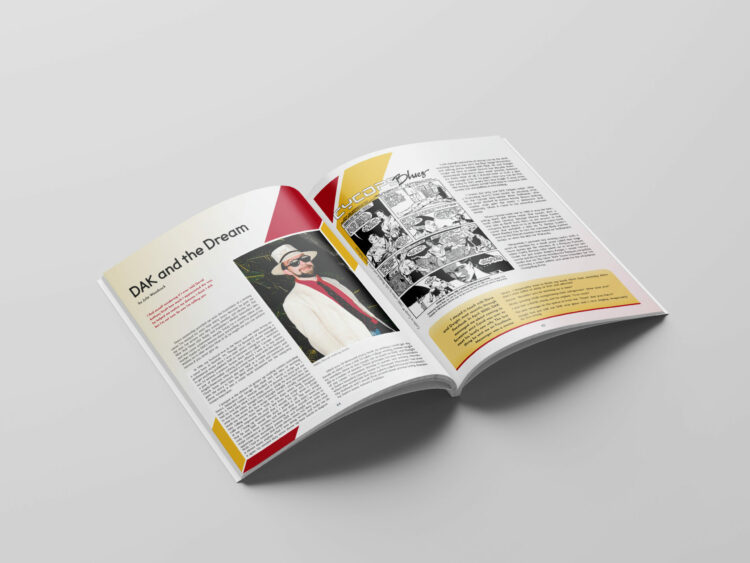
This ‘zine will take you through the brilliant and fascinating world of a widely-loved, bronze-age Marvel writer, from his early 1970s Marvel work with Roy Thomas, through his work at Atlas Comics in 1975 with Chip and Martin Goodman, and into his 1980s work in animation for the shows Gem and the Holograms and G.I. Joe Extreme. It will also dive into his character-defining run on She-Hulk in her first series, and his most recent work, the independently published comic, Yi Soon Shin. Exclusive to this ‘zine is a complete and previously unpublished giant sized Dracula comic story!
Celebrate the life of writer, editor, and publisher, David Anthony Kraft with this career-spanning-‘zine that includes memoirs from various friends and colleagues including: Roy Thomas, Jim Salicrup, Don McGregor, Brian Stelfreeze and more!
Join us for more discussion at our Facebook group
check out our CBH documentary videos on our CBH Youtube Channel
get some historic comic book shirts, pillows, etc at CBH Merchandise
check out our CBH Podcast available on Apple Podcasts, Google PlayerFM and Stitcher.
Photos and images ©Their Respective Copyright holders
Use of images are not intended to infringe on copyright, but merely used for academic purpose
Interview © 2021 Comic Book Historians