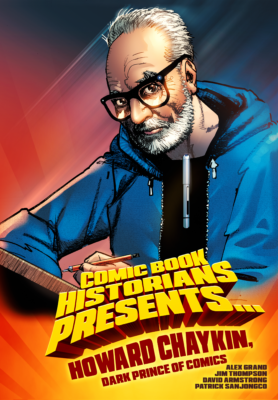
Howard Chaykin, the Dark Prince of Comics with Alex Grand & Jim Thompson
· May 9, 2019 · by Alex Grand · Interviews
Read Alex Grand’s Understanding Superhero Comic Books published by McFarland Books in 2023 with Foreword by Jim Steranko with editorial reviews by comic book professionals, Jim Shooter, Tom Palmer, Tom DeFalco, Danny Fingeroth, Alex Segura, Carl Potts, Guy Dorian Sr. and more.
In the meantime enjoy the show:
Alex Grand and co-host Jim Thompson interview Howard Chaykin, discussing his life from when he was born in 1950 through his childhood comic book reading of 1960s Marvel, his training under Gil Kane, Wally Wood and Neal Adams in the late 1960s through the 1970s. His early Marvel, DC, Atlas Seaboard Comics, Byron Preiss Graphic Novels, Heavy Metal and on into American Flagg for First Comics, The Shadow, Time Square, Blackhawk, Alan Moore, Frank Miller, Black Kiss, Cyberella with Don Cameron. His Television career including the 1990s Flash TV show, Legend with Russ Heath, Hawkgirl with Walt Simonson. His Marvel career in 2012, Black Kiss 2, the controversy surrounding the Divided States of Hysteria, and finally his ode to comic history, Hey Kids! Comics!
Howard Chaykin has done plenty of work at Marvel and DC but mostly likes to tell his own stories. He’s worked hard to establish creator-owned comics in his career.
Transcript published in Comic Book Historians Presents… Howard Chaykin, Dark Prince of Comics:
Chapter One
The Old Neighborhood
Alex Grand: Howard Chaykin is a writer, artist, and auteur, as well as a comic book historian who’s written and penciled for a variety of projects over decades. Howard, thanks so much for joining us today.
Jim Thompson: Let’s start on early background questions. There’s a lot of your background, your childhood, and growing up with comics in your work. Would you say that’s correct?
Howard Chaykin: I’d say that is true. I mean, all of us who do this for a living, all of us who makes shit up for a living, both apply what we’ve learned and experienced in our own lives but also bring wish-dreams to it. That dream is a wish your heart makes stuff, which is the way it should have been. It’s the way I’d like it to have been. That sort of thing. But yeah, I’d have to agree with that. Yes.
Jim Thompson: And at the same time, you’ve mentioned in interviews a certain, I won’t say distaste but a lack of love or enthusiasm for certain alternate comics; autobiographical tendencies that kind of dominate the field. The ones that are not independent comics but the alternate comics The Comics Journal really were advocates for.
Howard Chaykin: Oh, you mean the stuff that come out of the post Pekar,[1] post Spiegelman[2] universe.
Jim Thompson: Exactly.
Howard Chaykin: I see. I wouldn’t say so much disdain but uninterest. I don’t have a censorious sensibility. I have an aversion to the very idea of censorship, and the problem I have with these books is less their existence than their assumption of kind of a moral plane of superiority to anything else that exists in the same sort of medium and franchise.
Jim Thompson: And there’s certainly that notion in the way that Gary Groth[3] talked about it but also in the way that Spiegelman talks about it or just the embracement of something like Fun Home, all of which I like but that’s never been what you do when you bring your stuff. I almost said baggage and that’s wrong, but …
Howard Chaykin: I’m willing to go with baggage. I really am. Look, I’m a 68-year-old Jew product of Brooklyn and New York. If I haven’t got baggage, what’s the point of being neurotic? I was talking about this not 20 minutes ago in the context of … I live in a small town, and I was having brunch with a group of people at the beach. I mean, I live the antithetical life to what would assume that I was born to live through. And I explained to someone that when I was thirteen years old, I was very ill and I spent a week in bed, and I watched television all day. In those days in New York City, the W&W Affiliate owned the Warner Brothers product, and they showed a week’s worth of the gangster comedies. The second cycle of the gangster films at Warner Brothers in which the same cast and the same sets were used to tell comic stories of gangsters. City for Conquest, Brother Orchid, A Slight Case of Murder, that sort of thing. This is about 1938 to 1940, in that realm. And I realized that everybody in the movies, all these great Warner Brothers stock players, everybody in those movies who was supposed to be stupid sounded like me. I made it a concerted and discerning effort to cease to sound like one of The Bowery Boys or Leo Gorcey or Huntz Hall[4] because that’s what I sounded like when I was thirteen. By the time I was fifteen or sixteen, I had developed from smoking this voice that carried more authority than it deserves I might add.
Alex Grand: When you say this voice you mean your manner of speech right now?
Howard Chaykin: The way I sound now. I’ve always been this articulate. It’s gotten me into more trouble than you can possibly imagine. I mean that with all of my heart. And that aspect of my childhood growing up in Brooklyn in the 1950s. I was born in ’50 and raised in Brooklyn. I was raised a block and a half from and 25 years later than Gil Kane.[5] We went to the same grammar school I might add. And my experience as a little boy was to escape into comic books. Comic books, movies, and television were the means of escape because I am basically a coward. I don’t like confrontation of any kind, physically because I’m afraid of getting hurt and comics were a place to hide, and I loved comic books. I loved comic books unequivocally. I mean, uncritically everything about comic books. I love the language and from the minute I saw comic books I recognized that someone made these things, and I wanted to be one of those people.
Jim Thompson: So, what were you reading?
Alex Grand: DC and Timely or what?
Howard Chaykin: In ’55 I got a box of comics. I read all the DC stuff. I read the teenage stuff. I loved the Archie stuff, a lot of Looney Tunes, and a lot of Disney stuff. The one stuff I couldn’t accommodate was the horror stuff. For some reason the box of comics I got had no ECs in them but they had the EC imitators and a lot of injury to the eye motif comics.
Alex Grand: So, you weren’t getting the Kurtzman[6] stuff?
Howard Chaykin: No, no, no. I discovered EC, like many of my generation did, in the reprints that came up from Ballantine in the early ’60s. The MAD reprints were followed by a collection of the science fiction stuff and the horror stuff, and they were printed sideways in bad black and white print on Ballantine paper, and they were a revelation. I had no idea where they came from, and at that point I was a Golden Age collector because in those days Golden Age collecting was affordable. I was a serious Golden Age collector.
Jim Thompson: So, who were the Golden Age artists that you were drawn to or did it matter at that point?
Howard Chaykin: I was twelve years old, twelve and thirteen, and at that point I wasn’t aware of artists. I was aware of content like all kids. I mean, the brand for me in those days was the character, was the material. The maturing eye evolved past that and developed the sensibility to recognize the fact that the artist is the brand, the talent is the brand. But as a child we innately understand from our perspective that the character is the brand. And I loved Jack Burnley’s[7] Superman and years later I realized it was Jack Burnley. I mean, look, the fact is by the time the Marvel stuff comes along … I got turned on to Marvel at around this time. Okay, I knew Jack Kirby’s[8] work because I knew it from Boy Commandos. I knew it from Newsboy Legion. I knew it from the Challengers of the Unknown and from the Harvey stuff, and I was a huge fan of The Adventures of the Fly. The grotesqueness of the Fly really appealed to me, and I got turned on to the Marvel stuff while I was at summer camp. Once I came back from summer camp, the world was Marvel awash. So, I bought up all the Marvels that had come out at that point. I think Fantastic Four number three was just out. I became a complete Marvel junkie. I turned my back on DC Comics completely, and I’d been a Silver Age guy. Gil Kane was my guy and these guys were it. In the Golden Age stuff, had I known the Quality books and what Lou Fine[9] was doing, what Alex Kotzky[10] was up to, what Jack Cole[11] was doing, all of which was under the aegis of Will Eisner,[12] I would have been into those books as well but I wasn’t aware of it. And the Timely books in those days were really ugly. Marvel’s books back in the second world war were really just dreadful looking stuff. Kirby’s work in DC was vastly superior to the stuff he was doing with Simon[13] and Timely, I think. I came to know Maneely’s[14] stuff much later, and a lot of that came out of Archie Goodwin.[15] Archie was showing me that stuff. I mean, Archie was to a certain extent the linchpin of two aspects of my life. He showed me a lot of the ’40s and ’50s stuff that I’d never seen, and he also was the one that weaned me away from science fiction into crime fiction.
Jim Thompson: Were you an early reader?
Howard Chaykin: Yes. I entered kindergarten reading at the fourth-grade level because of comics.
Jim Thompson: Most of the people we’ve talked to talk about Archie Goodwin as somebody that was very important to their process or their development industry wise.
Howard Chaykin: I wouldn’t say that he was important in that sense. I wouldn’t go that far because he didn’t edit me much. We didn’t work together all that often but I respected his tastes enormously. He was also one of the funniest, wittiest men I’ve ever known in my life. He was capable of being friends with people that seemed complicated. I mean, he was very close friends with Gil Kane, who was a very difficult guy and was my first boss. Gil suffered no fools and the fact that that Gil was close friends with both Roy Thomas[16] and Archie Goodwin, it went beyond any friendships of opportunity but rather of simpatico and like-minded ideas. So, I have to say that Archie’s tastes influenced me more than his professional working.
Alex Grand: Around the age of nineteen or so how did you make your way to meeting Gil Kane and becoming his assistant? That was around 1969-ish.
Howard Chaykin: Yeah, I met Gil when I was thirteen at a used bookstore. He doesn’t remember this at all but it was like one of the critical moments of my childhood. He was looking for Will James’ books. Will James was a kid who reinvented himself as a cattle hand who wrote a series of children’s books about horses. And Gil’s drawing of horses has always been legendary and derived a lot from Will James’ depiction of horses. I was awestruck by him. He was just an Olympian figure. I don’t know what it’s like in fandom today. I really have no idea. The social networking has created an entirely different universe but in those days fans were in touch with each other all the time. We had coffee together. We drank together. And I heard through the grapevine that a guy who’d been his assistant had died in his sleep, a guy who was going to be a player, a serious talent. A guy named Tim Battersby,[17] who worked in a style similar to Woody’s.[18] He was one of the Woody guys, and he died at 21 of an undiagnosed heart ailment. Because of the callousness of youth, I called Gil and said, “Hi, I hear your guy died, do you need somebody?” So, I went to work for him, and I told him how my work was mediocre and he disabused me of this notion. He said basically this work is utter shit and there’s no value whatsoever. My feeling was hurt, and I had only one left, but ultimately, I learned from him, and I owe 95% of my career to the near year I spent working for Gil more than any of the hands-on work I did for Woody or Gray[19] or anyone else. I learned how to do what I do from watching Gil do it.
Alex Grand: Was he teaching you to tell stories and you absorbed it all? What kind of process was that?
Howard Chaykin: I couldn’t even put my finger on it. There was something about the way he lived his life, the way he approached his profession that struck me as logical and real, and I got it. I mean, right now I’m working on the second arc of Hey Kids! Comics! that addresses a post Silver Age area. It starts in 1950 and ends in 1980. And it talks about some of that relationship in the obscurest way, hopefully. I can’t really put my finger on what it was but, to this day, I hear Gil’s voice echoing in my head when I find myself being pontifical.
Howard Chaykin assisted Gil Kane on Blackmark, filling blacks, erasing pages and pasting up text.
Chapter Two
Standing on the Shoulders of Giants
Alex Grand: Did you work on Blackmark with Gil Kane?
Howard Chaykin: I did. I filled in blacks. I erased pages, and I pasted up text, and I was terrible. I was skill free. I had nothing going on. Now that I know more about Gil’s life, I realize that he was exactly me when he was that age because his work was terrible. He was awful until really, I’d say a good ten to twelve years into his career. He didn’t get any good. His work in the ’40s and early ’50s is dreadful and then all of a sudden, he develops his range by imitating Dan Barry[20] and Alex Toth[21] after spending all those years imitating Jack Kirby and finally finds his language. I think a lot of that language he found was being beaten up by Burne Hogarth.[22] He was a far better artist then but Hogarth beat him up so much, and Hogarth intimidated him so much. I mean, Hogarth intimidated Gil the way Gil first intimidated me. The difference is I got over being intimidated, and I think Gil died intimidated.
Alex Grand: Why did Hogarth intimidate Gil?
Howard Chaykin: Gil was an autodidact and resented that he never had an education that went beyond tenth grade. I said this in public more than once. One, I owe my career, I stand on the shoulders of Gil Kane, Gray Morrow, Wallace Wood, Neal Adams,[23] and Joe Orlando.[24] And the one thing that separates me from those men is none of them could write worth a shit, and I write well. Gil could write essays but he could never translate that essay skill onto a comic book page.
Alex Grand: Back then in DC during that time, they would take the original art and dispose of it and not give it to the artist. What was the story with Gil and original art? What exactly happened there?
Howard Chaykin: I don’t know exactly but I take very seriously the idea that he was a thief. I have no doubt in my mind that was the case. I’m not a witness. But I don’t doubt it for a minute.
Alex Grand: Did you like him? Was he like a second father to you in a way?
Howard Chaykin: Yes. He was the single most important male influence in my life. My father disappeared from my life when I was nine. My mother took me and my two brothers on the run because my father was a physical abuser. So, I was raised on welfare until I was a teenager and left … I was thrown out of the house when I was sixteen because I was a complete asshole.
Alex Grand: Was that your biological father that did that or was it the stepfather?
Howard Chaykin: No, no. I never knew my biological father.
Alex Grand: Okay. So, it was your stepdad that left.
Howard Chaykin: So yes, I am a bastard literally and figuratively. Thank you.
Jim Thompson: In terms of Batman: Legends of The Dark Knight and issues #24-26 of Batman: Flyer where you wrote it and Gil Kane illustrated it, what was that like to work with your mentor where you’re the writer, and he’s putting on paper what’s in your mind?
Howard Chaykin: Well, Gil was the one who came to me with a generalized concept. Okay look, Gil was a guy who had a nose like a toucan. As soon as he had it bobbed off and turned into a New Yorker cartoon, he saw anti-Semites under every rock and ironically, of course, he drank cocktails with those people on Friday night, every Friday night.
Alex Grand: That explains the pictures of his face being so different later in life compared to when he was young.
Howard Chaykin: Oh yeah, absolutely. I mean I address this issue with the second arc of Hey Kids! Comics! by the way because I’m willing to go out on a limb. The real irony is that he approached me on this one and around the same time he approached me with a second project, which was doing an adaptation of Gladiator. He was originally going to be the artist in that book that Russ Heath[25] ended up doing. I wrote the script, and my working process is I don’t draw anything or have anything drawn until the entire thing is written. So, Gil read the four issues of Gladiator. Why they called it The Legend, I have no fucking idea. I couldn’t tell you. He decided he couldn’t do it because it was too fucking difficult. That was the bottom line. It was too hard to do, which annoyed the hell out of me. It really did because I wrote it at him and it laid dormant for a little while, and then there were a number of people who are attached to it. I mean at that point Russ had been doing really nothing work for ten years, and then I happened to be in DC, and I saw this the second half of that Enemy Ace 1940s thing that he did, that he finished up with that French guy. Right, and it just kicked ass. It was astonishing. Russ Heath and I used to live in the same neighborhood. I ran into Russ at a restaurant. I said, you’ve been phoning it in for ten years, what the fuck? And he came on to The Legend and did an astonishing job but I still would have loved to seen Gil do it.
Jim Thompson: The last page of issue #25 of Batman: Flyer, you have the female characters saying, “I’m going to fulfill the destiny of bearing a child, your child. So, like it or not liebschien, I’d suggest you lie back and enjoy it.” In the right-hand bottom corner is a box that states “next issue, the climax.” And I just thought for a DC comic of that time that you’re putting in a level of sexual humor, do you remember at all if anybody was even aware of what you were doing?
Howard Chaykin: No. They never picked up on it at all. I mean, look if I had written “Think of England” would they have gotten that?
Alex Grand: Of course, you worked with Gil Kane but then you went over and worked with Wally Wood in his studio. Was that 1970 or ‘71 when that happened?
Howard Chaykin: I guess that was around 1970. Woody was living and working in Valley Stream, Long Island, and he had me pencil a vaguely salacious western strip. I was utterly unequipped to do this. I lasted for seven weeks. I sucked. My work was terrible. Gray Morrow introduced us, and what mostly came out of that was my understanding of how dreadful I was, and a lifelong friendship that evolved with Jack Abel[26] at that point. Jack was renting space alongside Syd Shores.[27] Both of them had studio space there and Woody planted me in the same room as them. And within a day or two, Jack Abel spent his entire day fucking with Syd Shores and mocking him. It went right over Syd’s head, and he realizes within a day or two that he had a henchman in me and then from that point on I was Jack’s bitch. We were horribly cruel to Syd, who never was aware of that at any time. He died having no clue what we were doing. That codified my place on the Jack Abel shit list. That was the first name on the list. It was a glorious list, I might add.
Alex Grand: What prompted you to leave Gil Kane and then work with Wally Wood?
Howard Chaykin: The work ended.
Alex Grand: The project was over. Gray introduced you to Wally, so how did you meet Gray?
Howard Chaykin: Gray was one of the kindest men I’ve ever known. Just an absolute prince, I got to know Gray when we met briefly through Alan Weiss who introduced us at one of the First Fridays at Jeff Jones’[28] place. I don’t recall. Gray was a real sport. He lived in Brooklyn. He had two apartments, one on top of the other, in a different Brooklyn than there is today I might add. He put me in touch with Woody, and that’s how it happened.
Alex Grand: How was working with Wally Wood?
Howard Chaykin: A real learning experience. As I’ve said more than once, I wanted my life to end up like Gil Kane but I had a terrified experience that it might end up like Wallace Wood. Woody was a miserably depressed, angry (by that point in his life) racist, and antisemitic drunk, and raver. He was just a terrifying presence.
Alex Grand: But he knew you were Jewish, and you guys were friends, right?
Howard Chaykin: I wouldn’t say we were friends. He was far friendlier with guys who preceded me like Ralph Reese,[29] Larry Hama,[30] and maybe Paul Kirchner.[31] I wasn’t there very long. You know Woody was just a miserable, bitter, unhappy man. I think a lot of it has to do with the fact that … Have you read Hey Kids! Comics! the first volume?
Alex Grand: Yes.
Howard Chaykin: Okay. Thematically speaking what that five-issue arc is really about underlying it all is that every one of those guys of that generation believed that they were in comics as a steppingstone to something else that was going to lead to some other aspect of their lives. I think Alex Toth always expected to become an illustrator of some serious importance. For them, I think a lot of it has to do with the newspaper strips. Then, of course, they come up against the glass ceiling effect of the newspaper comic strip world isn’t really open to Jews. It’s a Waspish business, at least it was then. And the truth is the difference between that generation in mind and this comes out in the second arc, and it’s stated explicitly that my generation does not come into this with any real bitterness in that sense. That’s because we came in knowing exactly what we were going to get and what we wanted. Jack Kirby’s alleged, “the comics will break your heart kid,” you know; that Warner Brothers melancholy melodrama bullshit. These guys were really disappointed by the lives they ended up living, and they did get ripped off. They did get burned.
Alex Grand: And you feel like Wally didn’t get what he was expecting.
Howard Chaykin: Yes, but Woody was also incredibly self-destructive. He drank at problems.
Alex Grand: Did you feel like his leaving MAD magazine was the beginning of that?
Howard Chaykin: Yeah, I do. Unequivocally but his relationship with Gaines[32] had deteriorated to the degree that I don’t think he could have stayed.
Alex Grand: Did you never meet Dan Adkins?[33]
Howard Chaykin: Nope, never met him and never knew him.
Howard Chaykin penciled a sequence of Shattuck for Wally Wood’s studio in 1972.
Chapter Three
Breaking into the Field
Alex Grand: What happened after Woody?
Howard Chaykin: My first professional job on my own name was a one pager for Murray Boltinoff.[34] Neal Adams you know, basically forced it down his throat, and it was terrible. I had no skill set, and I didn’t learn how to work until I was five years into the business. My work was terrible. I mean, it was. Gil was right, the work had no value whatsoever. It was complete shit. It wasn’t mediocre. It was dreadful. I mean, I am the least naturally skilled and talented member of my generation. I am nothing but a grind. It’s the truth. Everything I know is cerebrally based. I learned how to do everything I know and had to do. Believe me. You can’t know what it’s like to have that skill set limitation, walk into the room and have Bernie Wrightson[35] waiting for you. The difference really is that I was smart enough to recognize my own limitations and do something about it. And most of these guys, an enormous number of guys believed that their skill set granted them a free ride and that this is going to be it forever. You know, that endless summer sensibility. Those surfers that wake up at 55 years old and realize, “Oh my God, what did I fucking do with my life?” You know what I’m saying? I mean, I live in a town filled with those guys.
Alex Grand: So, what was the Overseas Weekly?
Howard Chaykin: The Overseas Weekly was a newspaper sold exclusively on PXs and military bases around the world. Woody had a deal with them to produce comic strips. He did Sally Forth and Cannon, which had nudity. They had no fucking but they had a lot of nudity, and the same thing is true of the thing I did, Shattuck. I ended up dropping it. Dave Cockrum[36] came in and took it over and did a much better job. Cockrum’s skill set was in place by that time. My skill set didn’t really emerge until the late seventies and a lot of it came out of shame. I was shamed by my public performance.
Alex Grand: Did Wally Wood pretty much ink over your work?
Howard Chaykin: Let me tell you about Woody. The way Sally Forth and Cannon were done was he had an assistant who would go through the work, which was double tier. Like a top half page of a full-sized newspaper. The assistant, whom I won’t name, would come in and go through the swipe file and trace other artists’ work, photographs, everything just to fill in the double tier with autograph tracings, okay, from everybody. From Caniff, from Toth, from Foster,[37] from illustrators, from photographs. Then Woody would come in with a brush and ink it and it would end up looking exactly like Wallace Wood. Years ago, one of my colleagues, who had ended up penciling for Woody, was going around using the page that he penciled for Woody as samples, which is completely inappropriate because his pencils were invisible underneath Woody’s inks. Woody’s inks made anybody look like Wood. His brushwork, his line was so indelibly his that it didn’t resemble anything that had been done. It became Woody, and I can’t think of anybody around today who fits that bill. I don’t think of anybody doing that but then again, I don’t pay much attention to the breakdown in penciling and inking these. For me, I never learned how to ink so I learned how to do drawings that could be reproduced in black and white. That’s as far as I got.
Jim Thompson: Did you draw horses for Shattuck at all or did you avoid that?
Howard Chaykin: They were terrible. I drew terrible horses. The thing that Gil always said, and this is not a joke, he said that one of the great separating elements of his generation is that my generation never learned how to draw animals. But he did Rex the Wonder Dog, you know, he did a bunch of horse comics. He did Hopalong Cassidy. All those guys learned how to draw animals. It was one of the things he would mock Carmine about all the time because he felt that Carmine’s animal drawing was just dreadful. They hated each other’s guts. I mean, I got a lot of blow-back from that relationship at DC Comics when it was Carmine in charge because I was associated with Gil and rightfully so.
Jim Thompson: You’ve previously stated that superheroes were never your thing really, that you’d rather do things about guys with guns or guys holding swords in their hands.
Howard Chaykin: When I started getting work, like I said, I wasn’t good enough to do that sort of stuff. I didn’t have the skill set required for it. The only guy in my generation who came in a little bit before I did who was ready for that was Buckler.[38] Rich Buckler arrived fully formed. He really did. He had his skill. He had a perfectly matched skill set to do superhero comic books. There were so many complex reasons as to why he did not become a demigod. That’s an entirely different conversation. Starlin[39] comes in a couple of years later but Buckler was there from the start, and he was the only one. I mean look at that. You look at Kaluta,[40] Wrightson, Brunner,[41] Weiss,[42] Simonson,[43] and me. None of us are really superhero people, and I was certainly the least skilled of that. So, I had to literally find other stuff to do that could match what little skill set I had.
Jim Thompson: Well, it seems like your mentors during those first two years were perfect for you. Kane was interested in doing things like His Name is … Savage and Blackmark, and Wally Wood in 1970 was doing sword and sorcery stuff and barbarians predating Conan. You went to the right people to not do superheroes.
Howard Chaykin: The stuff of Wood that I look at almost daily is the shock suspense stuff. The stuff that he did for the liberal hysteria comics that you see. That stuff is his depiction of the crumbling American city circa 1952 or 1953. It’s the archetype of my visualizing in my head of what my childhood looked like. When I read Jim Thompson[44] novels, it’s Wallace Wood’s imagery that comes to mind.
Alex Grand: Now around 1972 you left Wood, and you met Neal Adams. Tell us what had you leave the Wood’s studio, and then how you met Neal Adams?
Howard Chaykin: Well, I didn’t have the skill set that could sustain me for a while at Woody’s. I didn’t know how to do a long work. I get bored really easily. I get frustrated because my talent wasn’t there. Neal saw something in me, which I’ve never been able to understand, and he changed my life. He really did. He pushed me around. He yelled at me. He manipulated me. He forced me to get work, and he got me work, and for which, I will forever be grateful. You know, he’s a very difficult and controversial figure. I’m using the word controversial in this context but I know him personally so I’m saying it. He’s a difficult guy but I owe him that aspect of my career. I truly do.
Alex Grand: How’d you guys meet?
Howard Chaykin: I met him at DC Comics when he was working in the bullpen, opposite Murphy Anderson.[45] In those days, a lot of guys worked in the office. It’s a conceit that I’ve fictionalized in the Hey Kids! Comics! stuff but most of them didn’t but some did. That’s where I met Neal, and we started hanging out. I met him again at one of the First Fridays. Originally, the First Fridays were at Roy Thomas’, and then they moved to Jeff Jones’ place. It’s where I met Bernie. It’s where I met Michael and Alan and Frank and all of these guys. I also met Roy Krenkel[46] for Christ’s sake and Neal was there, and we started hanging out. We hung out as a group. In those days, the coffee room at DC Comics was the apex of DC on one arm and independent who’s who on the other. We hung around there. That’s how you got work. If someone needed something fast over the weekend, you got a job. You spent the day drinking coffee in there.
Alex Grand: And Neal introduced you to Boltinoff and Julius Schwartz[47] at DC Comics, is that correct?
Howard Chaykin: Yeah. Julie wouldn’t use me because see for Julie, the archetype of artists with Julie Schwartz was Murphy Anderson. Julie represented a sensibility in the science fiction world as literal minded a take on sci-fi as you could possibly imagine. If you look at science-fiction illustration, there’s a gap that exists that’s leaped between the work of guys like Jack Gaughan and Ed Emshwiller.[48] Then all of a sudden you see guys like Boris Vallejo[49] show up and even Bob Abbett’s[50] take with the John Carter of Mars covers and the Tarzan covers. Michael Whelan[51] comes along and his take on the Burroughs material particularly with the John Carter stuff is phenomenally literal minded, and Julie Schwartz really represented that literal minded nature. When Murphy died, his archetypal artist was Dave Cockrum in that there’s nothing challenging or threatening about that work. I mean Julie could never embrace Joe Kubert’s[52] kind of approach, whereas he loved Mike Grell’s[53] stuff because Grell, from Julie’s perspective, was simply another version of Neal Adams. When Roy couldn’t convince Bernie to come over to Marvel, he got Brunner and from Roy’s perspective, Brunner was a perfectly good substitute for Wrightson.
Alex Grand: So, you worked on romance gothic stuff …
Howard Chaykin: Terrible. Oh God, it’s horrible. If I had any shame left, I’d kill myself. I mean people laugh at me. They think I’m being falsely modest or overtly self-deprecatory but the truth of the matter is the work is dreadful. Then I got good but it took a long time to get good because they didn’t have anything natural going on from me. I mean, look right now I’m sitting in my guest bedroom, and I’m on the bed. To my right is a Bernie Fuchs[54] painting from 1962. Directly in my eye line is the original poster for The Outsiders by David Grove.[55] And my left is an Edwin Georgi[56] painting. To the right of that is an empty shell portrait of Johnny Hodges.[57] I am surrounded by the work of giants, and the work is here to intimidate and remind me of being humbled within my own insignificance.
Alex Grand: Those first DC works you did like Sword of Sorcery #s1-5 and Weird Worlds; you don’t like looking at those?
Howard Chaykin: I’m literally trying to learn something, and I’m getting there, but it’s like I’m a bottom-feeding-knuckle-dragging loser getting someplace. It’s nothing happening that has any real value, and I don’t want to take away from people who love the work there. You’re entitled to love whatever you fucking love. I really mean that. But the truth of the matter is, from my perspective, I didn’t get good until I was driven out of comics and was away for a couple of years developing a respect for craft and came back and did American Flagg!. The work I did in the 1970s, and I include the work I did for Byron Preiss,[58] is numbing and shows a lack of understanding of what I could bring to the table. By the time I got to do American Flagg!, I had actually discovered who I was and came to terms with who I was and was able to put it on paper both in text and visual. So that’s really what it’s about.
Sword of Sorcery #1 (1973) was one of Chaykin’s first DC Comics pencil works.
Chaykin demonstrated creation, plotting, and penciling in Weird Worlds #8 (1973).
Howard Chaykin completed the Neal Adams segment in Amazing Adventures #18 (1973).
Chapter Four
Moving to Marvel as Atlas Shrugs
Alex Grand: So, Killraven with Neal Adams and Amazing Adventures …
Howard Chaykin: It would be the first major mistake of my career because Neal took eight months to do twelve pages or twelve months to do eight pages, and I did the rest in a weekend. And no good deed ever goes unpunished.
Alex Grand: So, was it Neal that introduced you to Marvel also?
Howard Chaykin: No.
Alex Grand: Okay. How’d that work?
Howard Chaykin: Roy Thomas called me for some reason. I have no idea why.
Alex Grand: Okay because you guys were hanging out on the First Friday.
Howard Chaykin: I met Roy at a couple of places. Roy and Neal were all ten years my senior. I was born in 1950. Roy was born, again, in 1940. You know, there’s that mean generation of guys born between 1938 and 1940. Steranko,[59] Neal, Archie, Roy, and Skeates.[60] They’re all those guys born back then. And they’re a tiny generation, and then my guys come along where the oldest one is born in 1946. I think Simonson was born in ‘46 and Wrightson is born in ’48. I was born in 1950. I’m the youngest guy in that group, and I had the biggest mouth and nothing to back it up with.
Alex Grand: So, you were doing work for the Marvel black and white magazines, right?
Howard Chaykin: I did some stuff there, yeah. I worked for everybody back then. I worked at DC. I worked for Marvel. I worked for Warren.[61] You know, you worked because basically by that time, the shibboleth of working for two companies at the same time was gone. And all those guys, all those Silver Age guys who went to sneak over to work at Marvel under pseudonyms, like Gil Kane and Jack Abel, was irrelevant by that point. You could work for both companies. You work where you could get work.
Jim Thompson: So that includes Atlas.
Howard Chaykin: Atlas was fabulous. It was Martin Goodman[62] wanting to get his son a job and to piss in the face of Marvel. Every comic book company wants to be the next Marvel Comics but that’s like lightening in a bottle. It doesn’t happen. He started this company, and he had a lot of money. He spent a lot of money, and what Atlas really achieved, I can’t speak for anybody else, but it certainly achieved for me to double my rate at both Marvel and DC. They were right around the corner. Marvel was on Madison just between 57th and 58th Streets and Atlas was on 57th Street.
Alex Grand: Did you meet Jeff Rovin[63] and Larry Lieber[64] and Martin Goodman?
Howard Chaykin: I never met Goodman; I’ve never met Larry. I’ve certainly worked with Jeff. Jeff and I have had a checkered relationship for many, many years.
Alex Grand: Did you get your art back?
Howard Chaykin: I did.
Alex Grand: That was part of the agreement?
Howard Chaykin: Oh yeah, by that time we were getting artwork back, yes.
Jim Thompson: Some people say that was a fiction, and it didn’t happen.
Howard Chaykin: Oh no, we were getting art back by that point. Yes.
Alex Grand: What was your impression of Jeff Rovin?
Howard Chaykin: I won’t say; he’s too litigious. I’m not going to say anything.
Jim Thompson: One of the things that you did at Atlas with Scorpion, which had longer legs than one would expect because you left it, and they did something crazy with it but you took it back as Dominic Fortune, correct?
Howard Chaykin: Yeah, I basically walked around the corner. I said, “Fuck those guys. How would you like to do the Scorpion but with a different name?” And they said, “Sure.” You can’t understand how loose things were in those days. That was the entire pitch. Even though I had written this Scorpion stuff, they weren’t going to let me write it at Marvel. How I became a writer of my own stuff was that I realized that most of the people who were being accredited to write the material that I was drawing had failed as artists.
Jim Thompson: After you did the color comic, Dominic Fortune went on and became part of the magazine line and you were painting it, right?
Howard Chaykin: I was doing it in full color and marker, it was kind of a mess. Again, I was applying limited versions of the technique that I used in other places. It was a job of work. I didn’t want to do their stuff. I wanted to do my stuff. I was willing to strike the devil’s bargain of selling myself out from under but getting to do stuff I felt like doing. That was the bargain. You know, I hate reading that character written by other people, including by writers whom I rather like, because they don’t have the voice for it because I broke the character.
Jim Thompson: There was some bad use of that character at various points.
Howard Chaykin: Oh God, oh God.
Jim Thompson: But that’s true with all, you know? If they last long enough, they become ruined at some point.
Howard Chaykin: Of course, that’s the nature of the beast. As much as I have utter and complete disdain for mass market superhero comic books, I remained utterly awestruck at anyone who can find anything interesting or new to say about characters that have been around for between 50 and 80 years. I’m stunned by this. My entire relationship with this material is utterly based on nostalgia. My favorite Superman product of the past 25 years is Tom De Haven’s[65] novel, It’s Superman! I have no interest whatsoever in any of these things. As much as I dislike him intensely, Grant Morrison’s[66] All-Star Superman was just lovely. It’s beautiful! It really is. I mean it’s aided along by the fact that he and Frank did an astonishing job just together. There’s a great synergy between the two of them but the work really is moving, it really is, it’s astonishing. And again, this doesn’t in any way take away from fact that I loathe him. By the way, he loathes me, too. So, there’s a spoiler alert there. You know, he despises me as well.
Alex Grand: Is it true that George Lucas personally requested you for Star Wars?
Howard Chaykin: Yes. Yes, it is. He’d seen the Cody Starbuck stuff I did for Star Reach. Lucas was a half owner of a comic bookstore in New York City called Supersnipe. That’s what he was doing for money between the time of American Graffiti and Star Wars. He’d partnered up with a guy named Ed Summer who had been one of the other graduates of that class at USC film school. Lucas had seen my work. Han Solo was deeply inspired by Cody Starbuck. Anybody who knows comics knows that. But to say it publicly I just sound like a bitter old man, so I’m going keep my mouth shut. I saw the Star Wars movie two days before it opened nationwide, and I was stunned because had I known it was going to be this big of a deal, I’d like to think I could have done a better job. I’m not sure I could have. The material didn’t translate as well to comics as one would think. I did the breakdown of the script because one of the reasons that writers liked working with me in those days is that I could take that script and break it down into six issues, and they would know full well they could work with it. When I look at those pages, Roy is writing and writing and writing and writing and writing. There’s no faith in the reader to individually read narrative content and that seems to be the case today. That sensibility has won but the Star Wars stuff on the page and in the stills read like any number of cheapjack-soup-science-fiction movies you’d ever seen. There was nothing special in it. Anybody with any grounding in sci-fi could see every single place that Lucas borrowed from and that’s okay. It was a job of work. I was 24 years old living in New York City, and I had an apartment to support. I was married and I was working. I needed the work.
Alex Grand: Around 1978 when Wrightson, Kaluta, Jones, and Smith[67] had their studio, you had your own studio Upstart Associates with Starlin, Simonson, and Val Mayerik.[68] Tell me about that period.
Howard Chaykin: We were all living and working in the city, and we needed a place to work. We found a joint. Oddly enough I’ve never been to Wrightson’s, Jones’, Kaluta’s, and Smith’s studio. Those guys always had a kind of a legendary quality about them that I had no part of. I didn’t really have that kind of mindset at all. I’m a man among men and a worker among workers, and I felt that way about my life all this time, but we had a space, and it was a large square room. We each took a corner. The center was our common area, and it was a great working space. I was there every day because I lived closest. I was the only one who walked there. I lived on 29th Street between Seventh and Eighth Avenues, and it was on 25th Street and Second Avenue. In New York City, the only way to get there was on foot or cab because public transportation would go around to get there. So, I walked there every day, and I was on a kind of a mindset schedule that got me there at seven in the morning, and I’d show up with two bagels and four packs of cigarettes. By the end of the day, bagels were gone, and so were the cigarettes. I was a pretty heavy smoker at the time.
Alex Grand: Was there a sense that you, Starlin, Simonson, and Val Mayerik, that you guys were going to be the next generation of storytellers?
Howard Chaykin: No, not at all. We were there to work. There were a lot of laughs. There’s a great anecdote of Simonson sitting in a file cabinet but that’s another story. We had a great working space. It was really good to be there. I loved it. I loved being there. We had great parties there. We had a huge balcony out front that made for nice springtime parties. It was good.
Alex Grand: In 1979, you worked on World of Krypton about Superman’s origin. I loved that story!
Howard Chaykin: It’s because you were a child when you loved it. I have no memory of World of Krypton.
Alex Grand: I read it for the first time two years ago because I was one year old when it first came out.
Howard Chaykin: One, one, one! What “One” means to me is the song at the end of A Chorus Line.
Alex Grand: Yeah. The one thing I was staring at back then was my one penis, and that’s about it! [Chaykin laughs] You also worked on Alfred Bester’s[69] The Stars My Destination.
Howard Chaykin: The reason I did this World of Krypton was to support myself while I was doing the work for Byron mainly because Byron paid absolutely nothing so I had to support myself by doing hack work at other companies.
Alex Grand: You also did Sword of Heaven, Flowers from Hell with Michael Moorcock[70] for Heavy Metal. You did some design for Heavy Metal: The Movie as well.
Howard Chaykin: Well, it was my first real introduction to understanding the difference between the California and New York mindset. They’d spent six weeks and a lot of money trying to get designs for the last episode in Heavy Metal: The Movie, which by the way, was a piece of shit. They couldn’t get anything out of these guys, and they hired me to come out. I was there for ten days. It paid me per diem. They put me up in a hotel, and I was able to deliver the work that they needed from me and finish that work by noon every day. They showed up every day at four and by that time I was freelancing at the same time for A&M Records. I had a friend of mine who worked in the art department at A&M Records, and I picked up some work from them that I was working on there during those weeks. I made a great deal of money that week, relatively speaking.
Alex Grand: Right. That was The Legend of Jesse James album cover for Paul Kennerley?
Howard Chaykin: Yes, and also some stuff with The Police. It finally came clear to me that this is my version of that telegram that Herman Mankiewicz[71] sent to Ben Hecht[72] in 1927, which was, and this is a quote verbatim, “There’s a fortune to be made out here, and the competition are idiots. Don’t let this get around.” And it’s really terribly true because the California-bred talent were utterly unmotivated to make any real action. If you move to California with a sensibility that comes from a work ethic from Boston, New York, Philadelphia, Chicago, or New Jersey, you’re gonna kick serious ass out here. That’s been my experience, by basically working hard. Besides doing the work that I was hired to do for them, I also ended up designing a female character for the Harry Canyon piece from Heavy Metal: The Movie because he couldn’t see exactly what they were looking for. He kept coming back with a femme fatale, and I basically did a White girl version of someone singing “Santa Baby.” So, yeah, that was my first introduction to animation and one of the very few experiences I’ve had working in it.
Alex Grand: You mentioned Byron Preiss. During the Steranko interview, he had mentioned that Byron was on the search for the true sequential graphic novel. Tell us about your meeting Byron Preiss. Do you feel like he succeeded in achieving the final graphic novel?
Howard Chaykin: I don’t. I believe that Byron operated from the perspective of loving the idea of comics but having contempt for the language. His work consisted of trying to find a way to reconstruct, deconstruct, and reinvent something that had already been done just fine.
Alex Grand: That’s an amazing legacy.
Howard Chaykin: He also had his head shoved so far up Steranko’s ass that he could see through his nostrils.
Alex Grand: Was Steranko an influence on you?
Howard Chaykin: Not really. You know, I liked Jim personally quite a bit. I haven’t seen Jim in many years and the last time I saw Jim was in a convention in Ohio and we ended up shooting the shit for a couple of hours, and he turned me onto something I had no idea existed for which I am eternally grateful. This is totally outside of comics but it was the piano trios of André George Previn.[73] Jim has really good ears. He really does. Politically speaking, Jim and I exist on different planets. His politics and mine differ radically. But no, not really. But again, I like the guy.
Jim Thompson: Briefly back to Marvel just for a minute and your departure there. Talk about the For Your Eyes Only adaptation for a minute. That’s when you had a falling out with Jim Shooter,[74] right?
Howard Chaykin: Yeah, I did. For a while there, Shooter was telling me what a wonderful guy I was. Well Shooter hated me, and I’m not all that fond of him either. You know I represented the other side of comics to a guy like Shooter. Or even John Byrne.[75] Shooter started working in comics when he was what, three, six, something like that I think.
Jim Thompson: Thirteen I think but …
Howard Chaykin: Yeah, whatever. Like the guys of the previous generation, to a profound extent, he never really moved past that sensibility. I took on that assignment specifically so I could get the opportunity to do the cover. Getting inked by Vinnie Coletta[76] was not high on my list of desires for my future, okay? I wasn’t good enough to survive underneath Vinnie’s onslaught, okay? And he and I had words about a decision he’d made in the office on Good Friday. It put an end to my presence at Marvel, and it drove me out of the business for a while. I ended up doing paperbacks for a couple of years and happily so. Then when First Comics made me the offer on American Flagg!, I jumped on it because there was an opportunity to come back to comics, which I didn’t realize at the time, would turn out to be a clean slate.
Jim Thompson: So, we might owe American Flagg! to Shooter and For Your Eyes Only because if it hadn’t been for that you might’ve stayed at Marvel for a while.
Howard Chaykin: Quite likely, yes without question. I was doing okay financially, it was fine.
Alex Grand: So, did the Jim Shooter incident ban you from DC as well for a little while?
Howard Chaykin: No not at all. Frankly, if I came back to Marvel with my hat in my hand, I’m sure I could have gotten a job.
Jim Thompson: American Flagg! is obviously a big turning point in your career.
Howard Chaykin illustrated Alfred Bester’s The Stars My Destination in 1977.
Cody Starbuck original art by Howard Chaykin (1978), courtesy of David Armstrong.
Chaykin left Marvel over disagreements with Editor-in-Chief
Jim Shooter on the For Your Eyes Only adaptation (1981).
Chaykin put the comic storytelling world on notice with his pioneering series American Flagg! (1983).
Chapter Five
Waving the Flagg!
Alex Grand: Tell us about First Comics, the Indy comic book company. How did you end up there?
Howard Chaykin: By that time, I was in my early thirties and in crushing credit card debt, having worked for Byron Preiss for as long as I had. No one made any money working for Byron Preiss except for Byron Preiss. I knew Mike Gold[77] from DC. We shared enthusiasms both in and outside of comics, and he asked me if I had any interest in working for a new company that had real money. Not to sound puerile or to blow the fantasies of American comic book readers, but this is a job, and I was in serious debt, and I had an opportunity to get out of that debt, and with the money they offered to me, it was going to make that possible. So, I created this book; it was a kitchen sink comic book. It was based on a lot of material that I was thinking about and reading about in that era. I was a serious stoner, a serious drunk. I was operating from the respective of extremely blind rage of what I regarded the depredations of the Republican Party. I was pissed at Ronald Reagan, imagine now. At any rate, they bought it whole hog. That’s how it played. And significantly, the book had enormous impact; not on the audience but on the talent pool. Because the people who saw that book are the people who became professionals. Even at that point, the audience had been convinced that the material was the brand, and I was operating on the perspective that we were entering the realm of a star system, and the talent will be the brand. And to a great extent, it’s sort of middle of the road for me, and I’m never going to achieve that kind of attention with the audience because I don’t do material that flatters the audience. American Flagg! was not an easy book to read for people who had been accustomed to the X-Men and an audience that had been raised on the Marvel Age. This is material that was too complicated for that audience. They just weren’t interested in it. Comic book readers have a tendency to be very embarrassed by anything that goes beyond pinup and cheesecake. When they introduced the concept of actual human desire, they get very itchy. They’re not comfortable with this.
Jim Thompson: Do you think that you hit at the same time as Frank Miller[78] was really becoming something noticeable, and that Alan Moore[79] was doing what he was doing on Swamp Thing, and as Dave Sim[80] was on Cerebus? What you were doing was just as much as they were.
Howard Chaykin: I’m not familiar with Dave’s stuff. I knew Dave years ago but I have no familiarity with the Cerebus stuff at all. I knew Frank’s stuff and Frank’s first great gift from my perspective was synergizing Eisner, Ditko,[81] and Kane, and beautifully so. I read Alan Moore’s Swamp Thing after the fact. I read the first stuff of Alan’s, The Bojeffries Saga, which just killed me, and I was reading the Watchmen stuff in black and white as it came in. American Flagg! was in that early era but after the fact, Janette Kahn[82] literally grilled me for not bringing it to DC first. And I said to her, and I stand by this, that they would never have published the book as I had done it. The only reason American Flagg! existed the way it did was it was working at a company without baggage. There was no history there.
Alex Grand: And it was made for direct market not for the newsstands.
Howard Chaykin: Yes. There’s no way that book could have done it. I reached a tenth of the audience that anybody, that Alan and Frank reached on their books; a tenth because American Flagg! was at First Comics, a smaller company. You have no idea how many years I’ve spent explaining to the visually, narratively, and historically illiterate crew I frequently interview with, explaining that, no, I did not get that particular trope or that particular technique from that guy. He got it from me but you didn’t notice that because you were busy reading Superman comics. That’s really the way it was. We now live in a world that I don’t think is ever going to change. Where the writer is the Alpha in comics, which is irrelevant and pointless. And the problem with that is that it reduces the letterer to a delivery system for text when a letterer in comics is a narrative collaborator. I’m lucky enough to have worked with Ken Bruzenak[83] from the time that we were in our early thirties. We’ve known each other since our early twenties. Bruzenak and I, as I’ve said more than once, are twin sons from different mothers. We operate from an art director’s understanding of graphics and using the tropes of comics in ways that satisfy us. When I did the Divided States of Hysteria, when I gave Ken the script, I had no idea what to expect from him with my note that said, “internet chatter.” That was a phrase that was bandying around. It seems to have vanished but I expected something like along the lines of, you know, caption buttons or some shit. What I got was this absolute tour de force of insanity graphics that was fucking nuts that I just loved. The same is true in American Flagg! I always got more from him than I asked for. And bear in mind, just like me, he’s a phenomenal pain in the ass. We’re both very difficult men but we’re also deeply professional and with a great love of our own professions.
Jim Thompson: Why did you pull away from American Flagg! both in terms of art and then writing?
Howard Chaykin: I was bored. I was running out of interest.
Jim Thompson: Were you making money on American Flagg!?
Howard Chaykin: Yes. Relatively speaking I wasn’t doing great but I was doing okay. First Comics had great rates. They were paying good rates, and I was generating a bit of secondary income.
Jim Thompson: Dave Sim in The Comics Journal was critical about you leaving American Flagg! He said you left because you weren’t self-publishing and only self-publishers cared about what they created.
Howard Chaykin: I didn’t read that but that sounds like bullshit to me. I was tired of the material. I wanted to do something else. The fact that Jack Kirby could do fifty issues of Fantastic Four while he was doing other shit. My God, it’s beyond me.
Jim Thompson: And did you have Time (Squared) in mind at that point?
Howard Chaykin: Yes. I did the first Time (Squared) before I did the Shadow. I could be wrong; my timeline could be fucked up. The Shadow is the first California job I did. I was offered it at the San Diego convention in July, and I was drawing it in September of that year. I literally was drawing the cover, which became the poster as my belongings were being delivered a week late. I mean the first thing I had to do was I took my drawing table and assembled it and was working on that poster when they were moving shit into my house.
Alex Grand: Did you read The Shadow pulps as far as research, or had you already done that?
Howard Chaykin: I read a couple of them. I didn’t really care about them. I read the dossier to familiarize myself with the characters, and of course I antagonized the currently dead Harlan Ellison[84] by what I did with the material. I think that a lot of old time Shadow fans were very unhappy with them and fine, if you don’t like it do your own.
Alex Grand: I like what you did with it but I wasn’t attached to the older pulps.
Howard Chaykin: Right. Giordano[85] buttonholed me at that San Diego show and hired me to do the Shadow. I think he expected me to carry on with what Kaluta and O’Neil[86] were doing. I had no interest in doing that. I was more interested in playing with the idea of a 19th century/early 20th century man stuck in late 20th century America with all that ethos. One thing that Harlan was upset about is I portrayed him as a misogynist and a bit of a homophobe and racist, which frankly seemed to be the default position of many White men in the late 19th/20th century.
Alex Grand: Wait, you are saying the Shadow was that way?
Howard Chaykin: Yes. Come on! Contemporary chauvinism will occasionally oppose contemporary attitude on old material but it doesn’t make it any realer. A White member of the Anglo-Saxon Protestant ruling class in the United States in the time of Lamont Cranston aka the Shadow, for example, would have been an anti-Semite, a racist, certainly a misogynist, and a homophobe because that was all innate to White culture. Sorry, it just was.
Jim Thompson: Well as the series progressed, he got punished for it. Not by you but I remember Kyle Baker was doing it. He got decapitated and was carried around in a box for the last half of the series.
Howard Chaykin: That really delighted the original Shadow fans out there. Look, the reason the Shadow is identified as a 1930s pulp hero was because he was canceled in 1949. If Superman and Batman had been banished from the landscape in 1949, they, too, would have been regarded as nostalgia items. That material exists because of nostalgia, and I tend to stand back from nostalgia as good-stalgia. Do what you want to do with it. When I did the sequel to Midnight in Moscow, which is also a prequel to it, that last page Lamont Cranston deserts his companion, Margot Lane. The guy’s a twat.
Alex Grand: Whose idea was it to make the Shadow in contemporary times?
Howard Chaykin: Mine. I said it would be a waste of time if it was otherwise.
Jim Thompson: The two volumes of Time (Squared) …
Howard Chaykin: Soon to be three. The last twelve pages of black and white artwork have been delivered, and I’ve got the first 36 pages I did in color, which are done. The lettering has been done on the first 24. Ken is working on pages 25 through 36 right now. We are trying to figure out a publishing strategy as they say in the animated cartoons as to how exactly we’re going to bring it out, when and in what context format. There’s a number of bulbs in the air we’re talking about right now. It will be from Image Comics.
Jim Thompson: You don’t know yet if it’s going to be in the size as the original two?
Howard Chaykin: Probably not be because those days are gone. The size of the book will not but the thickness of the book will certainly be. There’s lots of stuff here. We’ve got lots of stuff. My editor seems happy. I don’t think anyone gives a flying fuck personally but that’s another story.
Jim Thompson: When Epiphany came out …
Howard Chaykin: You had no idea what I was talking about.
Jim Thompson: My first thought was it’s not American Flagg! Nobody’s having sex. It’s just a different book, and I didn’t understand it.
Howard Chaykin: Well, the idea of a comic book artist and writer not being a one trick pony confuses the fuck out of the comic book audience, doesn’t it? The comic book business is filled with people that have one idea and keep doing it over and over again. I’m not that guy. I like lots of different stuff, so I do lots of different stuff. I wish I had the sensibility to make a great deal of money doing one thing. I can barely make enough money doing a bunch. So, I do what I do. Time (Squared) was an opportunity to do a Fantasia about my boyhood, which is what it is to a certain extent, an attack on my family. A sword and sorcery book where people prefer crime fiction and an odd tribute to Fafhrd and the Gray Mouser by Fritz Leiber.[87] The third book completes the trilogy. It’s called Hallowed Ground Zero. It’s about the destruction of Time (Squared). It completes the trilogy.
Jim Thompson: Shouldn’t we talk about Jazz and music in relation to this, too?
Howard Chaykin: Yes, it reflected on my then newfound and obsessive interest in Jazz. I wanted to do a comic book that felt like a Bebop solo. I operate from the perspective that my audience and I are on the same page, which is always wrong. I’ve always assumed that my own interests echo my audience’s interests, which I am constantly being disabused of but I ignore it and carry on anyway. But I like doing different stuff, and if I’m really lucky my audience occasionally catches up with me.
Jim Thompson: Will you eventually release this in one hard cover?
Howard Chaykin: That will eventually happen, yes.
Jim Thompson: Will you include the American Flagg! issue?
Howard Chaykin: Yes. I’m pretty happy with it. I literally just finished the artwork and delivered the artwork to my letterer and my colorist Friday. Right now, I’m not even thinking about it because I’ve moved on, and I’m working on my script for Hey Kids! Comics! Volume II, which is called Prophets and Loss. Prophets meaning Old Testament prophets, not the other one. That’s why I’m emotionally and mentally engaged right now.
Jim Thompson: Is Time (Squared) the work you’re most proud of?
Howard Chaykin: Probably, yes although I’m pretty high on Hey Kids! Comics!
Howard Chaykin wrote, penciled, and inked Blackhawk for DC Comics in 1988.
Howard Chaykin original art of Blackhawk (1988), courtesy of David Armstrong.
Chapter Six
Revisiting the Classics
Alex Grand: So, your Blackhawk three issue mini-series for DC prestige format; you had previously done covers for earlier Blackhawk versions …
Howard Chaykin: I loved that book so much. Blackhawk, I’ve said more than once, is the first comic book I ever stole. I love everything about the Blackhawks. I still feel that the three greatest comic book cover arcs in the history of comics were Reed Crandall’s[88] Blackhawk and Military Comics covers, Harvey Kurtzman’s covers for Two-Fisted Tales and Frontline, and Dave Johnson’s[89] covers for anything. Dave is the third greatest comic book artist that ever worked.
Jim Thompson: Tim Sale[90] says the same thing about his covers. He thinks they’re the ones that nobody can top.
Howard Chaykin: I’ve never had someone drive me so close to the edge of grabbing food from my nostril. He cracks me up, he’s one of the funniest, wittiest men I’ve ever known, and I’m a tough audience.
Alex Grand: Now there isn’t a lot of flying in your Blackhawk, and the continuity stuck for a good while past your issues.
Howard Chaykin: I love what Marty and Rick did, I really did. But DC completely shit the bed with that awful New 52 version. Oh God, oh God! G.I. Joe done badly. I called Dan, and I said “I’d love to do this again, and I think I’ve found a way to do it as a contemporary book,” and he said “We’re waiting for a distinctive work over.” No, of course it’s not going to happen because Spielberg[91] had made a noise about wanting to do it; it’s never going to happen.
Jim Thompson: He’s been talking about that for like 20 years.
Howard Chaykin: Oh yes, actually going on close to over 30 because my first meeting with Hollywood executives was in regard to that work that I did on Blackhawk back in 1988. I think someone showed Spielberg a picture of the War Wheel and he was like “woooo.”
Alex Grand: So, Spielberg’s a comic book guy like Lucas.
Howard Chaykin: No, he’s not. He has no understanding of comics whatsoever unlike a lot of those guys from that generation that had a comic book idol. I think he knows he’s a movie guy and not a comic book guy in the way that Lucas is both a movie and comic book guy. I get the impression that Spielberg has no familiarity with comics.
Alex Grand: Oh, I see, that’s interesting because you did work in Hollywood.
Howard Chaykin: Anecdotally back in the day when Heavy Metal was doing 1941, I am told by reliable sources that his understanding of the process was suggested to the editor of the book. That she should memorize what she’s looking at in terms of the product and describe it to her artist. Whereas with Lucas,[92] I came home from the production unit with 400 stills all of which looked like IKEA.
Jim Thompson: That first Blackhawk issue that you did, you have an opening that reminds me of the start of Rio Bravo where there’s no sound. You have no word balloons. I always thought that was really exciting and unexpected. Any comments about that?
Howard Chaykin: Well, at that point, I had read The Hunters, which is a novel about Korean War air combat and also Keith Robinson’s work about the RAF and the RCF. I was really enthused with the idea of the nightmare of air combat. And that, combined with the images that came from Fred Cooper’s stock. Fredrick G. Cooper[93] was the guy who created the big head cartoon that Lou Beach[94] did for years that ended up being used in Monopoly. Monopoly pops up in this because he’s Majordomo.[95] But Cooper was a really good typographer and cartographer, and that’s where the lion and the eagle come from, in this case the Hawk. My dreams are almost always boiled down to my shouting and not being able to scream or be heard, and I really wanted to achieve that effect. I really wanted to do something that was different and interesting, and I felt the material deserved it. I do actually have a version of Blackhawk that takes place in a contemporary arena that I would love to do somewhere but it’s not going to happen.
Alex Grand: What’s the background story of the 1980s Marvel Wolverine/Nick Fury graphic novel written by Archie Goodwin?
Howard Chaykin: I penciled it in 1985 and inked it in 1989 because it took Archie four years to write it.
Alex Grand: Okay, tell us how it was to work with Archie on that?
Howard Chaykin: It was a gas. I loved doing that. I mean, again I was doing it Marvel style, which was something that I’m not happy with. I’m not fond of that. I prefer working from a full script. It’s one of the reasons why I left Hawkgirl with Simonson. Walter works Marvel style, and I didn’t like that anymore. I just really wanted a full script. But Archie was very sympatico. I had a great deal of room to play. Again, I’m very proud of the work I did, I mean in retrospect you look at work that you’ve done, and you can always tinker and play with it, and it was just recently reprinted in one of these new anthologies they’re doing. And there’s a lot of cringe worthy stuff in there. You know, you learn through your work, and you keep working. I mean look, I’m 48 years in for Christ’s sake!
Jim Thompson: Back to DC Comics; they’re really giving you beautiful books in terms of production values and everything, and then you have a falling out with DC over the labeling/rating system, right?
Howard Chaykin: Yes! There was collusion going on between Carmine and Stan[96] about creating a rating system. And you know collusion between the companies has always happened. It’s just a matter of what they get away with, and what they don’t. This is at the height of my alcoholism and just complete oblivion, and I had that self-righteous blind rage that informed so much of that sort of experience and hence Black Kiss.
Jim Thompson: And you, Alan Moore, Frank Miller, and the sellers of the time tried to put your weight down and go against the labeling / rating system but it wasn’t effective, was it?
Howard Chaykin: I don’t think anybody really cared what we thought. In the long run, fan favorites were not perceived as being anything really to do with sales at that point. I mean the assumption was back in those days, and it still is for a certain extent it remains true, that sales are not dependent on the main talent attached. We had books that sell really well because the guy’s doing it but in the long run, I think the assumption is for the companies that they can survive any fan favorite as long as they’ve got the material behind the audience.
Jim Thompson: The notion that sales went up on The Amazing Spider-Man after Ditko left.
Howard Chaykin: Right. By the way, they lost me. I’m a fan of Romita’s[97] work but in the same way that I stopped reading Fantastic Four after Jack left, I couldn’t look at The Amazing Spider-Man after Ditko left. There was just nothing there that interested me in the least.
Alex Grand: After moving from DC over censorship, you did Black Kiss for Vortex, and that was actually banned in some places, right?
Howard Chaykin: Well, it was banned. Hell, yes it was because it was disgusting. I mean it was also very funny but going back to what I said, comic book fans like cheesecake and titillation with an aversion to completion. And you know, I wanted to do a book that would literally be appalling, and I succeeded, I think.
Alex Grand: Well, it was interesting. A transgender vampire was completely unexpected and I’m referring to some specific panels but it blew everyone away. When I read it and I’m seeing Dagmar wiping stuff off her cheek, and I’m like “Wow! What kind of comic am I reading?” But I liked it. I was like “I’m finishing this today” because I wanted to know what happened next. Was that a profitable book for you?
Howard Chaykin: Yes, on a per-page basis. Two of the most profitable products I’ve ever done commercially were that original Black Kiss and the aforementioned Nick Fury/Wolverine graphic novel that I did with Archie Goodwin back in the late ‘80s.
Alex Grand: Yes, that’s a great one. I love that one.
Howard Chaykin: I took an enormous out-front page rate on Black Kiss because I assumed it wouldn’t sell, and it sold like crazy.
Alex Grand: Was the sequel as profitable as the first one?
Howard Chaykin: No. It did okay but it was no longer the outrage that it had been.
Alex Grand: Yes, I see. So, the character Dagmar, I remember watching The Bob Hope[98] Show, and there was a blonde lady named Dagmar; is it named after her?
Howard Chaykin: Yes, she would be the cast member of what was the first late night talk show called Jerry Lester’s Broadway Open House.[99] I’m actually too young to remember but I’m speaking history of television. The era of Steve Allen[100] and Jack Paar.[101] She was just this enormously busty crypto-Swede. I think she was from Wisconsin but pretended to be Swedish. I don’t think Dagmar was her real name but I loved the name so much that I stayed with it.
Alex Grand: Well, it really stands out. When I read that, I’d never heard that name but then I saw the Bob Hope thing. That character and how it was more of a character and that different people could still fulfill that role. I just think that was really smart and really interesting.
Howard Chaykin: Well thanks.
Chaykin’s Black Kiss hit audiences with never before seen hardboiled
erotic storytelling and content in 1988.
Chapter Seven
The Roaring Nineties
Jim Thompson: Howard, we’re going to kind of power through the 1990s a little bit so we get everything in. You returned to DC for another revisionist mini-series that was Twilight.
Howard Chaykin: With the fabulous José Luis García-López.[102] If comics were a meritocracy, if only, José Luis García-López would be regarded as the one true king.
Jim Thompson: He’s so underappreciated it’s kind of amazing. It’s fun listening to you talk about people like Buckler and him that are undervalued.
Howard Chaykin: Well Buckler is undervalued because Buckler was a wise guy who, given the opportunity, would never allow his skill set to actually work and was always looking for a quick buck. Whereas García-López is a man of great honor.
Jim Thompson: Buckler’s work on Jungle Action and Deathlok showed what he was capable of when he was trying. I mean he was innovative if he applied himself, which I guess is what you’re saying to some degree.
Howard Chaykin: Yes.
Jim Thompson: And then you brought back Ironwolf and returned to the Fritz Leiber characters, too, during this time.
Howard Chaykin: Well, working with Mike[103] on both of those was a treat and the nice thing about the Leiber stuff was not having to apologize for how shitty my stuff was on it. It also reminded me of how much an influence Leiber was on me.
Jim Thompson: Mignola, at this point, hasn’t become quite what he becomes later on in terms of appreciation but his talents were there by then completely weren’t they?
Howard Chaykin: I completely agree, yes.
Jim Thompson: And then you helped form the Bravura imprint for Malibu. Starlin was doing that?
Howard Chaykin: Walter Simonson, Starlin, Bill Gaines, Steve Grant.[104] We were so old yet so young it was unbelievable. It was an opportunity to take advantage of what we mistakenly identified as an opening in the market for a new line of comics. The line basically tanked but we all had a great time. I mean Power and Glory was a snide parody of what had been most of the comics in the ‘90s, and what was coming out of Image in those days because Image is an entirely different company today than what it was then. Like Image, the difference between Hyundai in the ‘80s and Hyundai today. Now, of course, it’s a great IP [Intellectual Property] factory, and in those days it was a physical action of pastiches, and that’s what Power and Glory was.
Jim Thompson: And in Power and Glory you got a taste of something that would later be routine for you, which was of course getting criticized from the left for something that was simply storytelling. What I’m talking about is the bad joke that one of the characters tells because that fits with his characterization.
Howard Chaykin: Exactly! I had a character define his own character by telling an awful joke, and I was taken to task for telling the joke as opposed to writing a character who would tell such a joke to reveal the depths of his character. And that is so utterly specious and fatuous as to embarrass me to share a species.
Jim Thompson: And you were a pioneer there because now that’s become a daily existence for anybody that takes any chances at all but this was early on.
Howard Chaykin: The happiest place the comic book audience can find is in the world of a guy like Chris Claremont,[105] who wraps everything up with a nice warm, hot bath, a warm cup of cocoa, and a cookie. I’m not that guy. I just don’t feel comfortable with doing that, and that’s what the audience wants, and if that audience wants it badly enough, they know where to find it. They’re not going to find it with me.
Jim Thompson: DC Comics also started a science fiction imprint at that point, Helix, and you were writing Cyberella for that.
Howard Chaykin: With the astonishing Don Cameron[106] who learnt a very valuable lesson from that book, which was as much as he loved comics, he never wanted to be a comic book artist again. Don is a CGI artist now with extraordinary talent, and he had learnt at that point that comic books are not the business that he should be in. He’s a phenomenal animator and designer and works very steadily and works well. I mean, he’s the guy that did the covers to Hey Kids! Comics!, which are not really photographs but rather photo manipulations that are created in camera.
Alex Grand: I befriended him recently, and we chatted a bit. He said he loved assisting you on the stories, and that you guys had a lot of laughs on some of the pages.
Howard Chaykin: Oh, yes! Don is one of my favorite people in the world. We’ve traveled together. We still hang.
Jim Thompson: That’s cool. What did DC do wrong on that imprint; why did it fail? Because it had the talent.
Howard Chaykin: I couldn’t say. I don’t think there’s an audience for that sort of material anymore. Look, I’ve said it more than once recently. I think it took me years to fully understand it but just as the comics code authority infantilized the comics, it also infantilized the audience. It created an audience that was interested in material that was just challenging enough.
Jim Thompson: You said that current comics are basically young adult fiction.
Howard Chaykin: Yes, and young adult fiction using the model of the road runner and the coyote as the paradigm. You know because what you’ve got is corporately owned characters and even non-corporately owned characters involved in an endless chase without closure.
Jim Thompson: It’s about this time that you work for TV in Hollywood.
Howard Chaykin: Well, the reason I moved to California in the first place, the day before I turned 35, is I realized that I had no prospects whatsoever. American Flagg! as big of a deal as it was for me had left me a cult figure. I was someone who the cognoscenti knew but was not known on a vaster, wider scale. I was going to potentially get as old as I am today, and I had to do something about that. And the truth is I came out to California. It was time to use the cache American Flagg! gave me to get into the movie business and I ended up in television, which I’m forever grateful for. If I had the CV that I had then and I was 40 again, I’d have a seven-figure development deal with the studios but back then no one had any idea what to do for the comic book talent. Comic books back then were regarded as a genre as opposed to a medium and now, of course, since the comic book business has become what it is in the mainstream world, that has become a truth; that comic books are a genre today. You know, we owe the existence of mainstream comics to Jack Kirby inventing Stan Lee,[107] and Stan Lee cheering the existence of comics for 50 years. But the problem is the comics that ultimately got cheer-leaded in were superhero comic books. When I started looking for work in television I was perceived as a comic book guy dabbling in talent. So, I was given comic book style stuff to work on, and I never worked on a show that I’d watch. But I did the best work I could for the people for whom I was working. I’m very grateful for the work I had as it gave me a pension, and it gave me health coverage. As boring as that may sound, at my age, it is a blessing.
Alex Grand: Well, yes, for sure. Do you still get health coverage from working?
Howard Chaykin: Fuck yes, man! I’ve been on Medicare for three years but I also have ancillary coverage from the Writers Guild of America. Thank you God I don’t believe in!
Jim Thompson: Did working in television for twelve years have a positive or negative impact on your writing; on your art?
Howard Chaykin: It absolutely had a very positive effect on it. It made me understand servicing the narrative in a more specific way. It made me understand the relationship with space through time, and I think it just made me a better writer.
Alex Grand: You worked on the 1990 TV show The Flash a little, is that correct?
Howard Chaykin: I did. That was my first show. They got me very cheap because my agent sold me down the river. I started as a story editor on that show. On my last job, I was an executive producer on Mutant X, one of the worst TV shows ever made! Not the worst one I’ve ever worked on. The worst one I’ve ever worked on was the worst television show and was called Earth: Final Conflict, which was a series that should have been in a novel about bad television. It was so dreadful. I mean seriously, it was execrable. And I was only fired from it because I was a counter-fire. One set of producers demanded they fire one writer that to this day has never had anything produced, and I got fired and was immediately rolled over into a development position with the same company. But I worked on utter unwatchable shit.
Alex Grand: But you got such good benefits out of it.
Howard Chaykin: I did, and again, I’m grateful for those benefits. I’m quite serious.
Alex Grand: So, then you came back to comics, first as a writer on American Century for Vertigo and with Mighty Love, and you were drawing again?
Howard Chaykin: Mighty Love was the first thing I wrote and drew. I sold that a month after I got fired from my last television job. I’d been away from comics for a long enough time that the books sank like a stone. I’m really proud of that work. I’m very happy with that work. I’d like to see that printed again for Image sometime sooner or later.
Alex Grand: Yes, it’s almost like When Harry met Sally.
Howard Chaykin: What you mean is You’ve Got Mail, which is based on the same thing, which is something called The Shop Around the Corner. Which is a Hungarian comedy, which in turn was made into a film with Jimmy Stewart[108] and Margaret Sullavan,[109] and a musical called She Loves Me, which originally starred Daniel Massey[110] and Barbara Cook.[111] Most recently there was a version of it with Laura Benanti[112] who is now playing Eliza Doolittle[113] on Broadway, opposite Zachary Levi[114] who played the male lead who, on the basis of that production, I’m in love with. So yes, that’s its lineage, that’s its providence.
Alex Grand: I can see Mighty Love being a Netflix series, too, or something like that.
Howard Chaykin: Well, it was written as a pilot.
Alex Grand: As a pilot, there you go. That’s interesting because when I read it, it felt like TV to me.
Howard Chaykin: For some reason, I obviously lost a bet in some karmic way that I’ve not been able to get any luck with any traction in getting my stuff turned into film. Let us pray to a God I don’t believe in.
Alex Grand: Or a séance, Howard. We can always try a séance. So, was City of Tomorrow influenced by your work on The Stars My Destination or not at all?
Howard Chaykin: No, not really. City of Tomorrow was for me a metaphor about gay marriage. Read it again and you’ll see what I’m talking about. I mean, I’ve always liked the idea of a culture growing to sexualize its machinery. It’s more influenced by Cordwainer Smith.[115] In Smith’s world, animals were elevated to the state of humanity but maintained as second class citizens so humanity had something to look down upon. And I really wanted to play with that, and the fact that we live in a world of sex dolls; I really wanted to play with that.
Alex Grand: Sex dolls? Did they provide that with your pension?
Howard Chaykin: No, I’m married. You can make whatever you want with that answer and do whatever you want with it, and it’s on you to be ashamed of yourself right now. Trust me if you want digression you’re asking for trouble. Please go on.
Alex Grand: So, Legend with Russ Heath, it was a retelling of the Hugo Danner[116] Gladiator story. Were you and Russ, friends?
Howard Chaykin: Not really but I’ve known Russ since I was a kid. Steve Mitchell[117] and I stood behind him as he anchored the splash page, that double page spread of “Easy’s First Tiger” [from Our Army at War #244, DC Comics, 1972] with a brush on this rickety drawing table. I mean Russ is a god. I was a huge fan. I always have been. He taught Kubert how to do lighting. That’s not a joke, it’s true.
Howard Chaykin and Walter Simonson teamed up on Hawkgirl for DC Comics (2006).
Chapter Eight
Prodigal Return to Superheroes
Alex Grand: In 2006, you did Hawkgirl and that was written by Walter Simonson.
Howard Chaykin: Right.
Alex Grand: Was that a fun project because you guys had known each other for a long time?
Howard Chaykin: Yes, it was a gas to do. And I’m of the mind that no one should draw Hawkman or Hawkgirl except Joe Kubert. I’ve got a lot of apologies to make but that’s just the way it is. I had a good time doing it but I had a seductive offer from Marvel so I took it.
Alex Grand: Right, okay. Oh, yes because you did other superhero stuff. You did The Punisher and Wolverine.
Howard Chaykin: I mean Aubrey Sitterson[118] brought me over to Marvel. I saw Aubrey recently; he’s the son I never knew I deserved. He brought me over there, and I did Blade for twelve issues working with the astonishing Marc Guggenheim,[119] who is the most artist friendly writer that I ever worked with. He understands how to call out shots. I did a bunch of stuff for Marvel at that point and that dried up around early 2012, and I haven’t worked for them since except intermittently for little bits and pieces. I think I aged out and nobody told me. I was told in January 2012 I’d have a job in April, and I even looked at my watch. I’m not holding my breath. I’ve aged out of both Marvel and DC.
Jim Thompson: But you did something for DC recently didn’t you?
Howard Chaykin: I wrote some rough and ready stuff but, you know, no one at DC or Marvel are calling me offering me a run on a book.
Alex Grand: The whole question of being aged out does that mechanism mean that a new editor is now there, and they’re too young and more interested in other artists in their age group?
Howard Chaykin: Look I’m older than most of Marvel’s and DC’s editors’ parents! And nobody wants to yell at anybody that reminds them of their dad. I certainly wouldn’t. I’d rather work with someone that reflects my own contemporary sensibility. The reality is I’m very well regarded by the profession in terms of delivering work on a professional basis but right now the audience regards me as a truly horrible human being so that tends to filter out the younger editors that don’t know me. I’m perfectly happy with the life I live today. I mean, I created my own reality, and I’m very successful with this. Whatever bitterness I have, I’m responsible for.
Jim Thompson: The stuff you were doing for Marvel at that point, a lot of it, not all of it because you did the Phantom Eagle, but a lot of it was superhero stuff.
Howard Chaykin: Like what? I did a six-issue run on Wolverine with Guggenheim, which was a gas. I loved doing that. I did twelve issues of Blade. I did sixteen or seventeen issues with Punisher War Journal and the Phantom Eagle stuff was a gas as well. I did some Avengers stuff with Brian Michael Bendis[120] and some on my own, and it was all a great deal of fun but it’s not primary in my skill set. You know in the middle of all this, I also did an American western for Disney Italia called Century West, which I’m very proud of and very few people have seen.
Jim Thompson: So, talking about the superheroes including Wolverine, you described comics at some point as being about liberal ends achieved by fascist means. I assume you’re mainly talking about superheroes when you’re talking about that?
Howard Chaykin: Right. Mainstream comic books these days are superhero comics if they’re anything with very few exceptions. And yes, I believe they are liberal ends achieved by fascist means. Look at Batman. Batman, as I’ve said more than once, is a rich guy who had a bad day when he was eight. And from that bad day he has justified a vigilante’s experience, the narcissism of which, if you actually stop for a moment to think about it, is staggering. I was scheduled to do, and then it was canceled out from under me, a panel at a convention in New York City a couple of years ago about the spiritual relationship between Bruce Wayne and Donald Trump. And I stand on that relationship. Batman is about a guy who after that bad day decided he was judge, jury, and executioner and instead of investing those billions of dollars in the Wayne foundation in either politics or the private sector to fight poverty where it actually exists, he dresses up like a bondage freak and spends billions on these tools and toys to beat the living shit out of people he knows are bad by the way they look.
Alex Grand: A ball gag would complete his outfit basically.
Howard Chaykin: I’m there babe, and you know there’s a butt plug happening there somewhere [laughter]. But we’re dealing with a 15-year-old boys’ idea of adult behavior embraced by 55-year-old men. That’s what we’re talking about. When I saw the trailer for Brightburn, that’s what I suspect Superman would be like if he ever showed up from Krypton.
Jim Thompson: So, in stuff that you’ve done in recent times, you’ve met a lot of resistance.
Howard Chaykin: Resistance, yes, but not resistance from people who have actually read the material. The arrogance of presumption has interfered with my material, that’s where it’s at.
Jim Thompson: That’s what I want to ask you about in comparison to something else is you’ve gotten calls, ridiculously called fascist and everything else. You get called names, anti-Muslim and anti-this and anti-trans, different things, and it seems unfair, and you’ve commented about that mentality. Frank Miller gets similarly characterized. Do you think it’s the same thing or is there room for legitimate criticism?
Howard Chaykin: I’m not seeing what Frank got criticized for so I can’t speak to that. I do know that in my case, I finally came to realize that the attacks on Divided States of Hysteria came from people who did not read the book or read the first issue and presumed that, like all comic books, is if it’s in the first issue, it will be in the next 20. I write characters who change. Had they stuck around with the book, they would have realized that the character they had problems with was the moral focus of the book, the heroine of the book, and the romantic interest of the lead. They assumed that a man of my age would not or could not do such a character. I’m being victimized by fatuous presumptions and assumptions. The objections to the cover that we ultimately had to censor, because they didn’t want the collateral damage attacking my publisher as they attacked me, was based not on the act depicted but by the victim of the act depicted. That the credulity of believing that I would encourage such an act, that the depiction of the act is akin to the encouraging of the act or the act itself is first of all specious and bullshit. As I said in this piece of medium that it was because of who the victim was. Had the lynching victim been a Jew then nobody would have given a flying fuck. I guarantee it. It is that victim culture attitude operating in the comic book universe combined with a level of performative morality, which ignores truth in the name of feelings. Feelings are not facts.
Jim Thompson: Were you surprised by some of your colleagues’ reactions?
Howard Chaykin: Surprised, disappointed, and they’re all dead to me but besides which, they’re cowards because not one of them has ever come up to say a word to me in person.
Jim Thompson: So, you’ve not had an honest conversation with anybody about this?
Howard Chaykin: Never. These people are chicken shits, and they are dead to me.
Jim Thompson: What about Image? How do you think they handled it?
Howard Chaykin: I don’t think they handled it as well as they might have. In retrospect, I shouldn’t have allowed that book to be censored. It was a mistake on my part, and furthermore, I think they’re gun-shy about me as a talent right now, which is the disappointment I experience in not having Hey Kids! Comics! being selected as one of their 25 that they would consider the best of the year. That really insults me because I’m proud of that book. I did not apologize at all. My contrition was for the shit thrown at them not at me.
Jim Thompson: Tell us what Megaphonics and Identitarians are.
Howard Chaykin: Megaphonics I don’t know but Identitarians I can tell you live on both sides. These are people who function with perspective of filtering their entire lives through identity politics. On the Right, you’ve got crypto-Nazis or Nazis, let’s call a spade a spade. On the Left, you’ve got people who are gatekeepers of a level of performative morality who encourage diversity but the diversity is extremely specific. They encourage inclusion but are very exclusive in their inclusivity. There’s a series of proscription and prescriptions for what is and isn’t acceptable. I personally feel that contempt prior to investigation is the bane of the current culture. Is this guy on the Nazi Right correct in accusing me of being a neutered butler of the social justice warrior Left? Is this schmuck on the Right correct in describing me as odious, a demon in a human skin suit? What kind of bullshit is this? Nobody is actually reading my stuff; they’re simply imposing their own moral judgment on imagery and drawing conclusions not based on facts but on feelings. I remain an iconoclast and a great believer in finding a language of common ground. I will not make peace or common ground with a bunch of fucking Nazi cocksuckers. That isn’t happening but at the same time I live in a state of moral shame over at my side of the aisle, and its inability to get past its own prejudices as well. One is cultural and the other is blood. So, I think we’re in a lot more danger from the Nazis than we are from the identitarians.
Jim Thompson: Let’s talk about Midnight of the Soul.
Howard Chaykin: It’s the only work I’ve done at Image that has never gotten to the black. I have no idea why. Again, I’m very proud of the work I’ve done in the last 25 years. I think it’s a terrifically solid book, a tribute in pastiche to a kind of film people love, and yet it found no traction.
Jim Thompson: Are there editorial people at Image Comics?
Howard Chaykin: Image has no editorial oversight.
Jim Thompson: So, nobody says to you can you maybe not put two derogatory terms on the same page?
Howard Chaykin: No. I hire my own editor. I earnestly believe that editors are an extremely valuable component of creating comics. I know that must sound like oh really, you mean that? Yes, I do. My editor is someone who I respect deeply; whose every idea cost me money and time. He more than justifies his existence.
Jim Thompson: Is that common practice at Image to do that?
Howard Chaykin: I have no clue. I have no idea.
Alex Grand: That’s more your thing.
Jim Thompson: Let’s talk about Satellite Sam just for a couple of minutes. That seemed like a Howard Chaykin book that isn’t written by Howard Chaykin.
Howard Chaykin: Well Matt Fraction[121] has often described it as Howard Chaykin fan fiction so I suppose so.
Jim Thompson: Was it fun to do?
Howard Chaykin: Yes. Basically, it operates in world in which I’m very familiar and about material I’m really fascinated by. The societal suppression of sexual behavior in the 1950s is something that fascinates me and always has. What people actually did, and what they were letting the world believe they were doing really appeals to me as a source material. So yes, and it was great to do a black and white book on that era as well.
Satellite Sam (2013) is Chaykin’s and Matt Fraction’s limited series about 1950s Hollywood.
Chapter Nine
Turning the Page
Alex Grand: So, I loved Hey Kids! Comics! I guess the names have been changed to protect the innocent.
Howard Chaykin: Have you read the trade?
Alex Grand: Yes.
Howard Chaykin: The essay in the trade really lays it out. There were only two direct avatars really. Obviously, the fictional characters of Sid and Bob are who they are. There’s no question about it. I can’t wink at that. But everybody else isn’t an avatar because everybody else is a blend and mix.
Alex Grand: And that’s the thing, there are blends but in some of the blends I felt there was a similarity between the fictional Brian Callahan and the real Joe Maneely.
Howard Chaykin: Well, yes, absolutely.
Alex Grand: I felt like maybe there was a 51% blend, would you say that?
Howard Chaykin: Yes, you pull good numbers out of your ass.
Alex Grand: I do. I’m good like that, and you know it’s fun. Fictional Laszlo Fabian could be the real Alex Toth. I felt some Alex Toth vibe there.
Howard Chaykin: Maybe. Look I’m being flirtatious and coy now. It’s really adorable for a man of my age.
Alex Grand: Your cheeks are turning red.
Howard Chaykin: Oh yes, I feel like Bugs Bunny in one of those drag cartoons.
Alex Grand: But honestly, I loved reading it. I recently read Will Eisner’s Dreamer because it does go through his biographical history of comics.
Howard Chaykin: It is the most self-serving line of bullshit ever.
Alex Grand: A self-serving line yes, and your book is better. I love how you jump back and forth in time because it puts things in a four-dimensional story of these people that are largely based in true events. It’s far more based on true events than other books that try to do the same thing. Tell us what started you off on this journey, and how you got started on this?
Howard Chaykin: Well, I really wanted to do the second volume of Divided States of Hysteria immediately because I was so fucking pissed, and I was dissuaded from it. And this was second in the line and this was up next. I think what Image was expecting was something a bit more like Mad Men in the comic book business in a kind of linear fashion. I’m not sure anyone up there really saw where I was going with this. I’ve always referred to myself as the bridging link to the generation that preceded mine and mine. All those guys I worked for talked endlessly. I paid attention, and I listened, and I wrote shit down. As I said more than once, there are things in the book that are absolutely not true. They are anecdotal that needed to be included because it’s part of a legend. I don’t think anybody ever hung anybody out of a window. I think that’s just not true but it’s just too good of a story not to tell.
Alex Grand: Yes, because it’s a rumor but it’s a fun rumor.
Howard Chaykin: It’s just one of those apocrypha that you must include because it’s just so much a part of the comic history language. The second volume is six issues, which is really about how important that brief blip of EC comics was to my generation. It’s much more linear in the sense that it’s six issues; each issue covers approximately five years from 1950 to 1980. Many of the characters in the first volume are in there. There are a lot of new characters, and it’s much more linear in its direction but it also lays out anecdotes, apocrypha, and why EC was as important as it was, as invisible as it ultimately became, and how that importance was openly wrecked by a generational shift. And the third volume, should there be one, will be about the impact of that generational shift.
Alex Grand: Obviously we’re all comic history fans or enthusiasts like you phrase it but I’m so excited about the next volume. And I highly encourage readers to check this out. It’s funny you know, just kind of reading through some of this stuff; 51% Glasier and Gelbart feels like Siegel and Shuster.[122] I love these alternate names you come up with. I mean for the superheroes like Sea Sultan. Please do an issue of “Sea Sultan” for us because I will read that. I love “Sea Sultan” and “Our Pal Percy,” and I don’t know how you come up with it. You’re so creative!
Howard Chaykin: I have to thank my editor for that because a lot of that was his throwing around.
Alex Grand: Oh really?
Howard Chaykin: That was a lot of back and forth between the two of us, yes.
Alex Grand: That was so much fun about how you had the fictional Ray Clarke character talk to the Tom Hollenbeck character saying, “Look you’re swiping from me, and you have no idea you’re even doing it!” and then Hollenbeck is just like “Whoa, I don’t know what you mean?” so cluelessly. You depict how some of that young generation could be so clueless sometimes. I think every little tidbit in here is genius, and everyone needs to read this because it’s just so apt and the same with Ted Whitman and the modern art where they swipe his panels.
Howard Chaykin: Oh, you mean at the Guggenheim?
Alex Grand: Yes, right. Such a Russ Heath kind of moment, and I just find that the moments in here, even if the moments don’t exactly match the actual person it happened to, they’re still so true.
Howard Chaykin: Look, as I said, a lot is fiction but it’s all true. That’s what it boils down to.
Alex Grand: Hershenson and Berkowitz, I mean, I love these names. They’re just so funny! Regarding Dan Fleischer, I love how you explain “An artist is responsible for the form’s language, a publisher that is just another asshole.” I mean, you’re just so funny. I could read this multiple times and get a different laugh out of it each time.
Howard Chaykin: Well thanks, I’m very grateful. I mean, the fact is right now at my age what I’m interested in is my legacy. With any luck, the minute I stop breathing the book will be discovered and people will say “Oh, that’s what he meant, thank you. But let’s avoid pissing on his grave for another week.”
Alex Grand: No, no, I’m throwing flowers on yours, man.
Howard Chaykin: Well, thank you, that’s very kind of you to say so.
Jim Thompson: Did Image really not include this as one of their best?
Howard Chaykin: Yes, they did not. I assumed they were keeping their head down; gun-shy of fear. You know, that’s my guess. It hurts, it really does. I mean, whatever feelings I have left, and I’ve only got one but it’s a really good one, are somewhat diminished. Yes, I was disappointed. I was putting together, extrapolating from a piece I posted on the Alex Toth Fan Facebook page that I was going to publish but then I held off on it because the Eisner Awards were announced. At this point, I’ve gotten so used to decades of indifference that if anybody should actually come out with actual praise and an award, I’d be so untrusting and suspect. And the only possible outcome of positivity that came out of being nominated for an Eisner at this point is knowing that Will would be spinning on his rotisserie. I’m comfortable and yet bitter at the idea that I’m never going to be acknowledged in my own lifetime.
Jim Thompson: When was the last time you were nominated for an Eisner?
Howard Chaykin: Never.
Jim Thompson: Your name was nominated.
Howard Chaykin: I think I was nominated for a Hall of Fame about six or seven years ago.
Jim Thompson: I’m talking about Neon Visions: The Comics of Howard Chaykin.[123] It’s a book that studies your work.
Howard Chaykin: Oh yes, that’s right but I didn’t write that. That was the writer Brannon Costello[124] saying nice things about me.
Jim Thompson: What was it like to read a book about you? Did you find yourself nodding your head or something else?
Howard Chaykin: It was cringe worthy. It embarrassed me terribly. I read it on an airplane, okay? And I’m serious, I’m flying home, I’d gotten a copy when I was flying home from New York and my seatmate looks over and says, “You’re reading a book about … ” and I said “Yes, about me” and he looked at me like I was fucking nuts, and I was just like “Oh, God why didn’t I just keep my fucking mouth shut and conceal the book.” But yes, I thought Brannon was right on the money, I got the feeling that Brannon got me out of having lost a bet. He was very kind to me, and I thought his take on the material was flattering but again I don’t flatter easily.
Jim Thompson: It’s an academic book on your work, and it goes into great detail in individual chapters. There’s a long chapter on Blackhawk.
Howard Chaykin: Chip Delany[125] had lunch with Brannon this week. He was in Baton Rouge and Chip posted the covers of that one and Howard Chaykin: Conversations. So, I’m curious to see what Chip’s going to take away from this. I mean the nice thing about Facebook is you get reacquainted with old friends, and the sad thing about Facebook is you occasionally get acquainted with old friends.
Jim Thompson: So, besides the next volume of Hey Kids! Comics! And then the next …
Howard Chaykin: I’ll have Ground Zero Comics with Time (Squared). The sequel to Divided States of Hysteria is written. Hey Kids! Comics! volume two I’m a third of the way into issue five in a very rough first draft. This version is going to go to my editor this week so he can beat me up, and help me out on what I really mean. Beyond that, I’m not really planning. I’ve got nothing. Something will happen. Something will occur to me. Something will annoy me enough to try to do something else.
Jim Thompson: But you think it will be with Image you’re going back to …
Howard Chaykin: Unless Image dumps me, I guess so. I mean nobody at DC wants me. There’s nothing there for me. We’re looking at an implosion sooner or later. The firing at DC of the various talents they let go really demonstrates the fact that I’ve been saying for some time that comic books really are no longer necessary to the mass market any more than Disney needs a new Micky Mouse or Warner Brothers needs a new Bugs Bunny. The characters that exist now do so in the public conscience and the cultural sense. The fact that 1.2 billion dollars are earned by this new movie really demonstrates that they don’t need comics anymore.
Jim Thompson: Yes, DC firing Mark Chiarello[126] is mind boggling.
Howard Chaykin: And I think they fired him because they didn’t really know what he did for a living. They really didn’t know. Every year I know is my last year in the business since the mid 1990s? I’m pretty comfortable in my own insignificance. I’m comfortable with my own position in the universe. I’m the architect of my own adversity. Every problem I have I created so, go with God.
Alex Grand: Thank you Howard. This has been an awesome interview with his eminence.
Howard Chaykin: A prince! That melancholy Dane, there he is.
Alex Grand: The melancholy Dane, the prince of comics, Howard Chaykin. He says he stands on the shoulders of giants but he is a giant himself as well and will be remembered as such in the future.
Howard Chaykin: Hopefully not soon though, keep me alive, please. Come on. Don’t bury me yet, motherfucker.
Alex Grand: And we’re excited about your next project, I can’t wait for Hey Kids! Comics! Parts two, three, four, and five. Please keep up your great work!
[1] Harvey Pekar is an underground comic book writer who created American Splendor and won a Harvey Award in 1995.
[2] Art Spiegelman is a writer-cartoonist known for Maus and the Garbage Pail Kids and is a former contributor to The New Yorker.
[3] Gary Groth is publisher of The Comics Journal and co-founder of Fantagraphics.
[4] Leo Gorcey and Huntz Hall are American actors who portrayed members of fictional New York gangs like the East Side Kids and later The Bowery Boys from the 1930s to 1940s.
[5] Gil Kane started in comics as an inker in the 1940s, eventually penciling a series of titles for both Marvel and DC Comics. His Silver Age Green Lantern run and Bronze Age run on The Amazing Spider-Man are fan favorites. Marvel utilized his dynamic approach to comic art for many of its covers in the 1970s.
[6] Harvey Kurtzman created MAD magazine for EC Comics, as well as Humbug, HELP!, and Little Annie Fanny. His Two-Fisted Tales and Frontline Combat war books are highly celebrated.
[7] Jack Burnley was the next Superman artist after Joe Shuster, and co-created Starman with Gardner Fox.
[8] Jack Kirby is a founding father and co-creator of the Marvel Universe as well as the King of Comic Book storytellers.
[9] Lou Fine was a Golden Age comic book artist who was known for his beautiful illustration style and worked on characters like The Flame, The Black Condor, Doll Man, Uncle Sam, and more.
[10] Alex Kotzky was a Golden Age comic book artist who worked on Johnny Quick, Sandman, Blackhawk, Plastic Man, and more.
[11] Jack Cole is a cartoonist who created Plastic Man for Quality Comics.
[12] Will Eisner is an early comic book writer-artist pioneer known for creating the failed Wonder Man for Fox Feature Syndicates and The Spirit.
[13] Joe Simon co-created Captain America with Jack Kirby, as well as Boy Commandos, Newsboy Legion, romance comics, and Sick magazine.
[14] Joe Maneely was the premiere comic book artist for Atlas comics Editor-in-Chief Stan Lee in the 1950s before his unexpected death in 1958 at the age of 32.
[15] Archie Goodwin was Editor-in-Chief of Warren magazines, Marvel Comics, Epic Illustrated, and wrote and edited comic books and comic strips.
[16] Roy Thomas was Editor-in-Chief of Marvel once Stan Lee became publisher in 1972. He also co-created hundreds of concepts or characters for the Marvel Universe.
[17] Tim Battersby assisted Wally Wood on T.H.U.N.D.E.R. Agents and died very early at age 21 as per Wally’s World by Starger & Spurlock (Vanguard, 2006).
[18] Wally Wood was a comic book writer-artist and publisher who revolutionized cartooning on titles like MAD magazine, Weird Science, T.H.U.N.D.E.R. Agents, Daredevil, and more.
[19] Gray Morrow is co-creator of Marvel’s Man-Thing with beautiful work in Warren Publishing, Spider-Man cartoon series, Witzend, House of Mystery, Buck Rogers, the Tarzan Sunday strip, and more.
[20] Dan Barry developed the “New York Slick” cartooning style that became the comic industry’s standard in the 1950s.
[21] Alex Toth developed a competing penciling style that emphasized shadow and simplicity for efficient comic storytelling. He was successful in animation on projects like Fantastic Four, Super Friends, Space Ghost, and more.
[22] Burne Hogarth pioneered dynamism in comics showcasing athletic action in his Tarzan comic strip and co-developed what became the School of Visual Arts.
[23] Neal Adams is a master comic illustrator with an extensive career in comic strips, comic books, and advertising.
[24] Joe Orlando was a cartoonist and editor who served as vice-president of DC Comics and publisher of MAD magazine.
[25] Russ Heath, an Eisner Award Hall of Fame inductee, was a commercial artist famous for his non-superhero comic work in DC’s All-American Men of War.
[26] Jack Abel was an inker for both DC and Marvel Comics famous for his work on Superman and The Incredible Hulk.
[27] Syd Shores was a penciler and inker known for his work on Captain America in the 1940s and 1960s including a term as Atlas Comics’ Art Director.
[28] Jeff Jones was a fantasy illustrator whose work appeared in King Comics, Warren, Witzend, Skywald, National Lampoon, and more.
[29] Ralph Reese assisted Wally Wood and illustrated a variety of media including his 1970s’ work with Byron Preiss One Year Affair.
[30] Larry Hama is a prolific comics writer-artist who mostly created the characters for G.I. Joe: A Real American Hero and worked on Wolverine and Elektra.
[31] Paul Kirchner also assisted Wally Wood for several years and contributed work for Heavy Metal, Epic Illustrated, He-Man, Thundercats, and Power Ranger, among others.
[32] Bill Gaines, son of All-American Comics co-founder, Max Charles Gaines, was publisher of both EC Comics and MAD magazine.
[33] Dan Adkins was Wally Wood’s assistant and was both an inker and penciler famous for his work on Wally Wood’s T.H.U.N.D.E.R. Agents and Doctor Strange for Marvel Comics.
[34] Murray Boltinoff wrote and edited comic books for DC Comics since the 1940s for roughly 40 years and supervised both Doom Patrol and Teen Titans.
[35] Bernie Wrightson was an accomplished illustrator, artist on House of Mystery, and co-creator of Swamp Thing.
[36] Dave Cockrum was a writer, penciler, and inker who created The Futurians, Nightcrawler, Storm, and Colossus.
[37] Hal Foster was a supremely talented comic strip illustrator who worked on Tarzan and then his very celebrated Prince Valiant Sunday strip.
[38] Rich Buckler penciled comics for King Features and Skywald Publications before working at DC Comics and Marvel on Jungle Action, Justice League of America, Superman vs. Shazam, Fantastic Four, and more.
[39] Jim Starlin worked with Marvel and DC in creating Thanos, expanding the Eternals and Adam Warlock mythos, killing the Jason Todd Robin in Death in the Family, and more.
[40] Michael Kaluta is a highly celebrated fantasy illustrator who contributed to DC Comics in the early 1970s including The Shadow 1941: Hitler’s Astrologer with Dennis O’Neill. His work extended well into other media.
[41] Frank Brunner is a comics illustrator and animator who worked with Warren Magazines, Marvel Comics’ Howard the Duck, and Man-Thing, Walt Disney, DreamWorks, Warner Bros., and more.
[42] Alan Weiss is a writer and penciler who started at Warren Magazines before moving to Marvel and DC working on Daredevil, Sub-Mariner, The Amazing Spider-Man, Richard Dragon, Kung-Fu Fighter, Weird Worlds, and more
[43] Walt Simonson worked at DC Comics and Marvel Comics working on celebrated runs of The Mighty Thor, X-Factor, Orion, and more.
[44] Jim Thompson was a hardboiled crime-fiction writer with works like The Killer Inside Me (not to be confused with the interviewer of the same name here).
[45] Murphy Anderson is a penciler and inker who worked at DC Comics for five decades and is famous for his comic art collaborations with Carmine Infantino.
[46] Roy Krenkel was a fantasy illustrator whose influence from classic illustrators such as Joseph Clement Coll, J. Allen St. John, and Franklin Booth were brought to Chaykin’s generation of comic artists.
[47] Julius Schwartz was a science-fiction agent turned editor at DC Comics, helping to revitalize the comics industry by overseeing the creation of Barry Allen, Hal Jordan, Ray Palmer and other characters and pushing science fiction mixed with realism into the superhero genre.
[48] Jack Gaughan and Ed Emshwiller were both science fiction illustrators working in digests such as Galaxy Science Fiction.
[49] Boris Vallejo is a fantasy and science-fiction illustrator who contributed to Knightriders, Q, and Barbarian Queen.
[50] Robert Abbett is a book cover illustrator for various genres including crime, war, and science fiction.
[51] Michael Whelan is a science-fiction and fantasy book cover illustrator with a special niche in surrealism.
[52] Joe Kubert is a very talented comic artist, mostly associated with DC Comics’ characters like Sgt. Rock, Hawkman, and Viking Prince, to name a few. He was involved in making comics for six decades and is founder of The Kubert School (formerly known as Joe Kubert School of Cartoon and Graphic Art and also as Joe Kubert School).
[53] Mike Grell is a comic artist famous for his work at DC Comics including The Warlord and Green Lantern/Green Arrow.
[54] Bernie Fuchs was an illustrator famous for his work in magazine illustration, United States postage stamps, and advertising.
[55] David Grove was a movie poster artist known for his “fadeaway” approach of fusing foreground and background colors.
[56] Edwin Georgi was a magazine illustrator and painter known for his pretty girl pin-ups.
[57] Johnny Hodges was an African American Jazz saxophonist well known for his involvement in Duke Ellington’s big band.
[58] Byron Preiss was a book publisher working with creative figures like Jim Steranko, Ralph Reese, Billy Crystal, Jay Leno, Jerry Seinfeld, and more.
[59] Jim Steranko is a writer/artist, magician, historian, book cover illustrator, and former publisher famous for his Nick Fury, Agent of S.H.I.E.L.D. run at Marvel Comics.
[60] Stephen Skeates is a comic book writer who contributed to Marvel, Charlton, Tower, DC Comics, Warren, and more.
[61] James Warren was a magazine publisher of Warren Publishing putting out Creepy, Eerie, Vampirella, and Famous Monsters of Filmland.
[62] Martin Goodman founded the company later known as Marvel Comics staying on as its publisher for 33 years. Stan Lee was picked by the new corporate owners to replace Goodman upon his exit instead of Goodman’s son, Chip.
[63] Jeff Rovin is on the bestseller list in The New York Times who was also Editor-in-Chief at Atlas/Seaboard Periodicals.
[64] Larry Lieber is brother to Stan Lee (aka Stanley Lieber) and a scripter as well as artist co-creating Marvel characters such as Groot, Thor, and Iron Man, among others.
[65] Tom De Haven is an author, professor, and journalist.
[66] Grant Morrison is a multiple award-winning comic book writer contributing work to Doom Patrol, New X-Men, Marvel Boy, Animal Man, and Batman, among others.
[67] Barry Windsor-Smith is an Eisner Award-winning comic book writer-artist famous for his work on Marvel’s Conan the Barbarian, the Weapon X story arc, The Gorblimey Press Catalogue, and more.
[68] Val Mayerik is a comic book penciler famous for his 1970s Marvel Comics work such as Chamber of Chills, Creatures on the Loose, Conan the Barbarian, and co-creating Howard the Duck.
[69] Alfred Bester was a science-fiction writer and editor who also wrote the “Green Lantern Oath” for All-American Comics.
[70] Michael Moorcock is a journalist and novelist famous for writing his Elric of Melniboné book series in the fantasy genre.
[71] Herman Mankiewicz co-wrote Citizen Kane (1941) with Orson Welles.
[72] Ben Hecht is a novelist, screenwriter, and journalist who was prolific and successful in all fields.
[73] André George Previn is a concert pianist and composer who contributed to Hollywood, Jazz, and Classical music.
[74] Jim Shooter was Editor-in-Chief of Marvel Comics from 1978-1987.
[75] John Byrne is considered as one of the premiere superhero comic artists of the early 1980s excelling at The Uncanny X-Men and Fantastic Four.
[76] Vinnie Colletta was a prolific inker who was known for getting his assignments in on time, even under extreme pressure and time constraints but was also known for erasing some of the pencils to fit the pages into his schedule.
[77] Mike Gold was co-founder of First Comics and Group Editor and Director of Editorial Development at DC Comics.
[78] Frank Miller is a comic book writer-artist famous for his work on Daredevil, Batman: The Dark Knight Returns, and Sin City.
[79] Alan Moore is a comic writer, novelist, and cartoonist famous for his work on Swamp Thing, Batman, Watchmen, and more.
[80] Dave Sim is the Canadian writer-artist and publisher of the long running Cerebus.
[81] Steve Ditko co-created Spider-Man, Speedball, Squirrel Girl, and Dr. Strange for Marvel Comics as well as Hawk and Dove and Creeper for DC Comics.
[82] Janette Kahn was publisher of DC Comics from 1976 to 1989 and was president from 1981 to 2002.
[83] Ken Bruzenak was Jim Steranko’s former assistant at his Supergraphics imprint and a successful letterer of several comics over the years.
[84] Harlan Ellison was a screenwriter and author of science fiction, crime, fantasy, and horror genres for film and television.
[85] Dick Giordano was a penciler, inker, and editor at Charlton Comics, DC Comics, and Continuity Associates.
[86] Dennis O’Neil was a journalist in Missouri until finding his way into Marvel Comics under Stan Lee in the late 1960s. He eventually became an editor and writer at DC Comics in 1968 who brought in a realistic sensibility for readers. His work in comics spans close to four decades of titles including Batman, The Question, Power Man and Iron Fist, and G.I. Joe: A Real American Hero, among many others.
[87] Fritz Leiber was a science-fiction, horror, and fantasy writer famous for his short stories, novels, and novellas.
[88] Reed Crandall was a painter, penciler, and inker from 1939 to 1973 and was famous for his illustration style to comic storytelling.
[89] Dave Johnson is an Eisner Award-winning cover artist known for his minimalist approach.
[90] Tim Sale is an Eisner Award-winning penciler and inker well known for his color series with collaborator-writer Jeph Loeb.
[91] Steven Spielberg is an Academy Award-winning film director, screenwriter, and producer.
[92] George Lucas is a writer, director, and creator of the Star Wars saga.
[93] Frederick G. Cooper was an illustrator known for his “bighead” cartoon characters from the 1910s to the 1930s.
[94] Lou Beach is a writer and collage artist who created art for album covers, posters, and books.
[95] Majordomo is a person who takes charge of others.
[96] Carmine Infantino and Stan Lee were both publishers of DC Comics and Marvel Comics respectively at the same time during the early 1970s.
[97] John Romita, Sr. is a former penciler, inker, and art director at Marvel Comics.
[98] Bob Hope was an actor, singer, comedian, and author who entertained the world during the growth of popular culture in the 20th century.
[99] Broadway Open House with manic comedian Jerry Lester, and ex-naval officer Dagmar (aka Virginia Ruth Egnor) aired on television from 1950-1951.
[100] Steve Allen was a radio and television personality, comedian, writer, and actor.
[101] Jack Paar was the host of The Tonight Show from 1957-1962.
[102] José Luis García-López is a celebrated Spanish penciler and inker whose work appeared at Charlton and at DC Comics where his work was used as an illustration guide during the 1980s.
[103] Mike Mignola is a writer, penciler, inker, and creator of Hellboy
[104] Steve Grant is a comic book writer who wrote the celebrated The Punisher limited series with Mike Zeck.
[105] Chris Claremont was the premiere writer of The Uncanny X-Men and related mutant titles for sixteen years at Marvel Comics.
[106] Don Cameron is a comic artist turned successful animator and very good friend of Howard Chaykin.
[107] Stan Lee (aka Stanley Lieber) was Editor-In-Chief of Marvel Comics from the 1940s through the early 1970s.
[108] Jimmy Stewart was an actor who starred in more than 80 films.
[109] Margaret Sullavan was a Hollywood actress in the 1940s and 1950s and acted in multiple films with Jimmy Stewart.
[110] Daniel Massey was a Golden Globe winning actor and performed in stage, film, and television productions.
[111] Barbara Cook was an actress and singer who was famous for her lead performances in Broadway musicals.
[112] Laura Benanti is a Tony Award winning actress and singer who is famous for her performances in Broadway musicals.
[113] Eliza Doolittle is a fictional character and the lead character in My Fair Lady.
[114] Zachary Levi is the lead actor in Chuck and Shazam!
[115] Cordwainer Smith, Ph.D., is a science-fiction writer and an expert in psychological warfare and contributed work to Galaxy Science Fiction and Amazing Stories.
[116] Hugo Danner is the fictional strong man in Gladiator written by science-fiction writer Philip Wylie.
[117] Steve Mitchell is a penciler and inker who worked in comics for approximately thirty years since 1972.
[118] Aubrey Sitterson is a comic book writer who worked for Marvel, DC, Image, IDW, and other companies.
[119] Marc Guggenheim is a comic book writer and television show producer.
[120] Brian Michael Bendis is a comic book writer and artist whose work includes Ultimate Spider-Man, New Avengers, All-New X-Men, Superman, and more.
[121] Matt Fraction is an Eisner Award-winning comic book writer whose works include Hawkeye and The Uncanny X-Men.
[122] Jerry Siegel and Joe Shuster created Superman who debuted in Action Comics #1 (1938).
[123] Brannon Costello, Neon Visions: The Comics of Howard Chaykin (Baton Rouge: Louisiana State University Press, 2017).
[124] Brannon Costello, Ph.D., is a University Professor in American literature.
[125] Chip Delany is a science-fiction, nonfiction, and fantasy writer and editor whose work won Inkpot and Hugo Awards.
[126] Mark Chiarello is an illustrator and former art director and editor of DC Comics.
🎬 Edited & Produced by Alex Grand, ©2021 Comic Book Historians, Sound FX – Standard License. Images used in artwork ©Their Respective Copyright holders. Images used for academic purposes only.
Howard Chaykin Biographical Interview 2019 by Alex Grand & Jim Thompson
📜 Video chapters
00:00:00 Welcoming Howard Chaykin
00:03:03 Early days
00:06:16 Golden age collector
00:08:58 Early reading, Archie Goodwin
00:10:17 Training under Gil Kane
00:14:43 DC: Gil Kane and Original Art
00:15:42 Gil Kane: Batman: Legends of the Dark Knight
00:19:04 Wally Wood, Jack Abel, Gray Morrow
00:23:22 After 5yrs into the business
00:25:04 What was the Overseas Weekly?
00:25:41 Wally Wood inking
00:27:48 Drawing horses for Shattuck
00:29:05 Superhero disdain | Rick Buckler
00:31:25 Neal Adams
00:33:03 Henry Boltinoff, Julius Schwartz
00:34:38 Early DC work
00:36:56 Marvel, Roy Thomas, Atlas Comics
00:39:22 Jeff Rovin, Larry Lieber, Martin Goodman
00:40:08 Scorpion for Atlas Comics
00:42:46 George Lucas – Star Wars, 1977
00:45:13 Upstart Associates, 1978
00:47:05 World of Krypton 1979
00:47:54 Heavy Metal movie, The Legend of Jesse James | Designing female characters
00:50:07 Byron Preiss, Jim Steranko
00:51:36 Talk about Marvel at that time
00:53:22 American Flagg for First Comics
00:56:02 Frank Miller, Alan Moore
00:58:13 Building collaboration
01:00:12 Dave Sim Comics Journal | Shadow
01:04:34 Time Square
01:08:43 Blackhawk
01:13:30 Collusion between the companies
01:15:26 Black Kiss, Dagmar
01:18:14 José Luis García-López, Rich Buckler
01:22:25 Helix, Cyberella with Don Cameron
01:24:25 Your time away from comics | Television career
01:27:08 1990s Flash TV show
01:28:06 Mighty Love
01:30:08 City of Tomorrow
01:31:12 Legend with Russ Heath, Hawkgirl with Walt Simonson
01:34:23 Marvel career in 2012
01:35:09 Working with Archie Goodwin, 1980s
01:36:09 Bruce Wayne and Donald Trump
01:38:00 The Divided States of Hysteria
01:42:09 What are Megaphonics and Identitaries?
01:44:54 Midnight Of The Soul, Satellite Sam
01:46:56 Hey Kids! Comics! | Image Comics
01:53:43 Neon Visions: The Comics of Howard Chaykin, Book by Brannon Costello
01:55:40 Next volume of Hey Kids! would be…
01:56:33 Every year I know it’s my last year
01:58:00 Wrapping up
#HowardChaykin #HeyKidsComics #BlackKiss #BlackHawk
#TheDividedStatesOfHysteria #NeonVisions #HowardChaykinInterview
#ComicBookHistorians #ComicHistorianInterviews #CBHPodcast #CBH
Join us for more discussion at our Facebook group
check out our CBH documentary videos on our CBH Youtube Channel
get some historic comic book shirts, pillows, etc at CBH Merchandise
check out our CBH Podcast available on Apple Podcasts, Google PlayerFM and Stitcher.
Photos and images ©Their Respective Copyright holders, Batman ©DC Comics, Superman ©DC Comics
Use of images are not intended to infringe on copyright, but merely used for academic purpose.
Interview © 2021 Comic Book Historians